
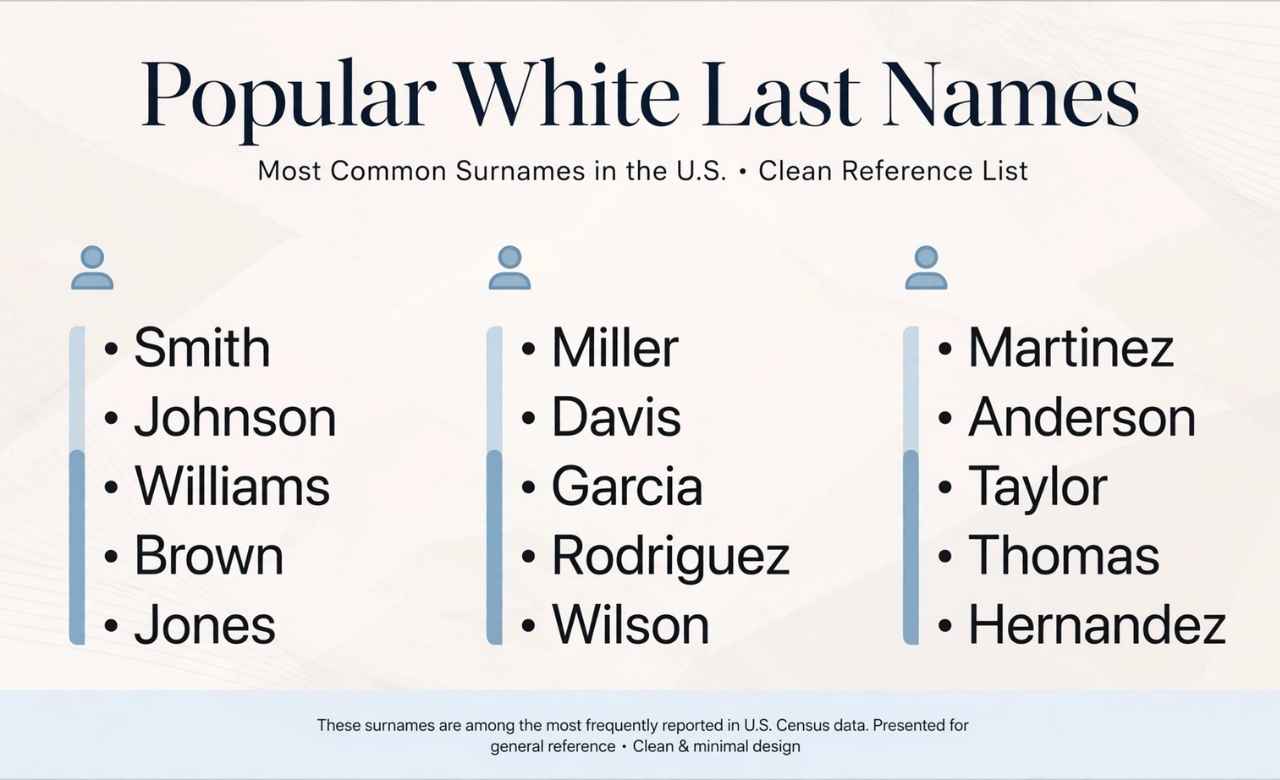
A white last name is more than just a family identifier; it represents history, ancestry, culture, and generations of traditions. Many common white last names originated from European countries such as England, Scotland, Ireland, Germany, France, and Italy, with meanings connected to occupations, locations, personal traits, and family heritage. Whether you are exploring genealogy, creating Popular White Last Names a fictional character, or searching for a meaningful surname, understanding the origins behind these names reveals fascinating stories from the past.
In this guide, you will discover popular, rare, and unique white people last name ideas along with their meanings and origins. From strong white boy last names that sound classic and powerful Popular White Last Names to elegant white girl last names with timeless charm, this collection includes traditional surnames, modern choices, and distinctive family names that reflect cultural roots and historical significance.
What Are White Last Names? Meaning, History and Cultural Background
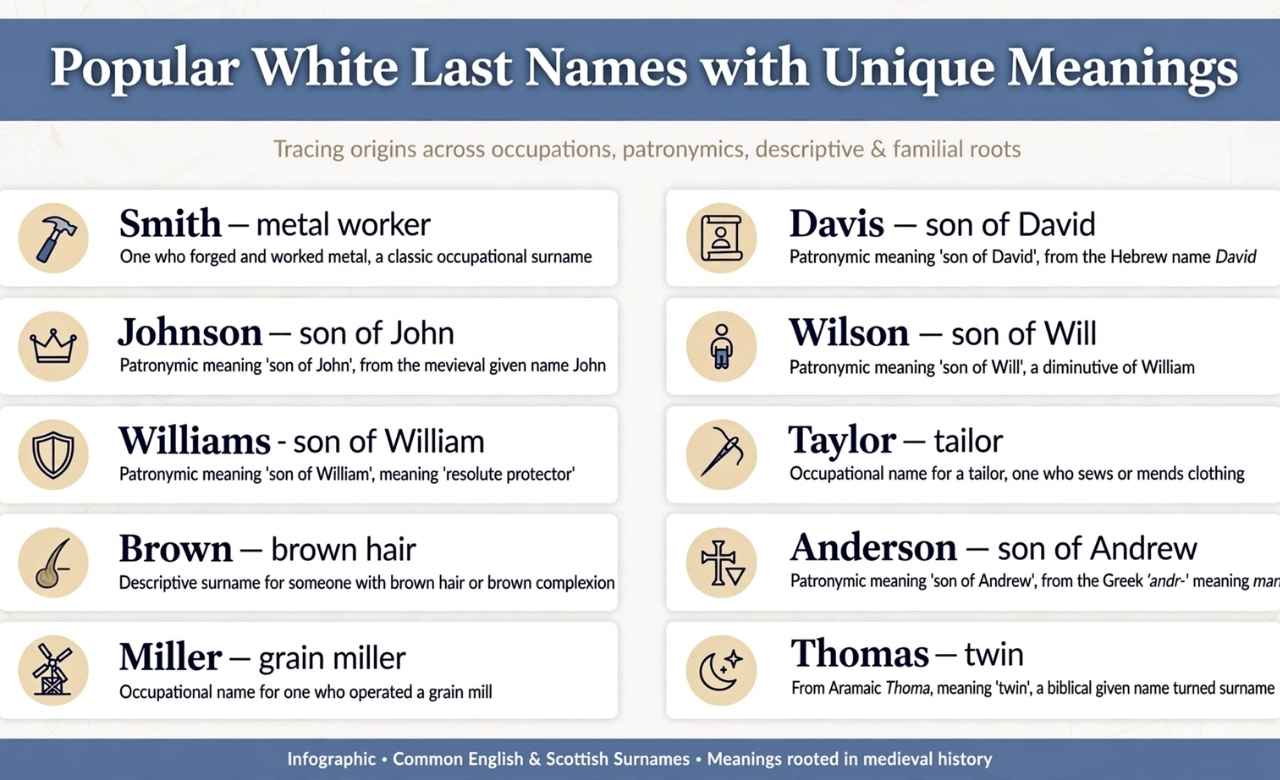
To understand what defines a “white last name,” we must first clarify that surnames themselves carry no biological race. Instead, the term commonly refers to surnames originating from Europe including Anglo-Saxon, Celtic, Germanic, Slavic, and Romance language regions which were carried to North America, Australasia, and other parts of the world through centuries of migration and settlement.
The Evolution of Fixed Surnames
Prior to the 11th century, fixed hereditary last names were almost non-existent in Western Europe. People lived in small, tight-knit agrarian communities where a single Popular White Last Names given name was enough. If two people shared the name John, locals distinguished them by where they lived (John by the hill), what they did (John the baker), who their father was (John, son of William), or a notable physical feature (John the red-headed).
As populations grew, tax collection became standardized, and feudal systems expanded, the need for permanent identification became critical. Between 1000 AD and 1500 AD, hereditary surnames crystallized across Europe into four primary functional categories:
- Occupational Names: Derived from a person’s trade or craft (e.g., Smith, Miller, Baker, Taylor).
- Toponymic & Locational Names: Based on geographical features, towns, or ancestral estates (e.g., Hill, Brooks, Ford, Lancaster).
- Patronymic & Matronymic Names: Identifying a person by their father’s or mother’s given name (e.g., Johnson, O’Brien, Macdonald, Petrov).
- Descriptive (Nickname) Names: Based on physical characteristics, personality traits, or habits (e.g., Brown, Short, Armstrong, Swift).
Most Popular White Last Names in America and Their Meanings
The landscape of American surnames reflects the massive historical waves of immigration from Great Britain, Ireland, Germany, and Western Europe. According to U.S. Census data, the most prevalent surnames in the nation have deep Anglo-Saxon and Germanic roots.
| Surname | Origin | Historical Meaning / Etymology | Primary Category |
| Smith | Anglo-Saxon | “One who works with metal” (from Old English smiþ) | Occupational |
| Johnson | English / Norse | “Son of John” (John means “God is gracious”) | Patronymic |
| Williams | Welsh / English | “Son of William” (William means “Resolute protector”) | Patronymic |
| Brown | Old English / Germanic | “Of dark complexion, hair, or clothing” | Descriptive |
| Jones | Welsh / Hebrew | “Son of John” (Welsh variant of John) | Patronymic |
| Miller | Middle English / German | “One who operates a grain mill” (corresponds to Müller) | Occupational |
| Davis | Welsh / Hebrew | “Son of David” (David means “Beloved”) | Patronymic |
| Wilson | English / Scottish | “Son of Will” or “Son of William” | Patronymic |
| Taylor | Old French / English | “To cut” (from Old French tailleur, a clothing maker) | Occupational |
| Anderson | Scandinavian / Scottish | “Son of Andrew” (Andrew means “Manly or courageous”) | Patronymic |
Popular White Last Names for Males
When selecting or analyzing surnames that carry a strong masculine historic tone, patronymic and occupational names often carry heavy weight. Names like Richardson (“son of the powerful ruler”), Garrison (“son of Garret” or “spear-rule”), and Montgomery (“Gomeric’s mountain”) historically signified patriarchal Popular White Last Names landholding, martial duties, and physical labor.
Popular White Last Names for Females
Surnames that have historically been favored or styled gracefully often trace back to nature, soft geography, or matronymic lineage. Names such as Rose (toponymic/botanical), Claire (from the Latin clarus, meaning “bright” or “clear”), Evelyn (of Norman-French origin), and Grace carry an enduring elegance that seamlessly bridges given names and surnames.
Unique White Last Names with Beautiful Meanings and Origins
If you are looking for surnames that stand out from the most common census lists, Europe’s regional dialects provide a treasure trove of melodious and deeply evocative names.
- Avenel (Anglo-Norman): Meaning “little oat field,” tracing back to Normandy and early English landholders.
- Belrose (French): A poetic locational name translating to “beautiful rose.”
- Calloway (Norman-French): Originally Caullery, referring to a place where pebbles or stones abound, associated with resilience.
- Lindqvist (Swedish): A classic Scandinavian nature-inspired name meaning “linden tree branch.”
- Vandermeer (Dutch): Translating to “of the lake,” evoking serene, picturesque landscapes.
- Fairchild (Old English): A descriptive surname literally meaning “handsome, beautiful, or gentle child.”
Rare White Last Names That Sound Distinctive and Powerful
Rare surnames often survived in isolated regions or belonged to small noble Popular White Last Names houses that did not produce vast branches. These names carry an undeniable authority and phonetic weight.
Distinctive Surnames Architecture:
├── Old Norse Roots ──────> Hallowell ("Holy Spring")
├── Anglo-Norman Roots ──> Pemberton ("Hill of the Barley")
├── Gaelic/Celtic Roots ──> MacQuoid ("Son of the Host")
└── Germanic Roots ──────> Ravenscroft ("Croft of the Raven")
- Ravenscroft (English): Derived from Old English, meaning “the enclosed field of the raven,” blending mystery with strength.
- Hawthorne (English): Locational name referring to someone who lived near a hedge of hawthorn trees; associated with protection and resilience.
- Blackwood (Scottish): Indicating a forest of dark timber; carries an imposing, classic presence.
- Kensington (English): Meaning “the town of Cynesige’s people,” carrying sophisticated aristocratic associations.
- Vance (Old French/Middle English): Meaning “someone who lived near a marsh or fen” (from fenn), sharp and memorable.
Rare White Last Names from Different Countries
Exploring rare surnames across borders reveals fascinating linguistic nuances:
- Italy: Sbarro (derived from local dialects referring to a keeper of barriers/gates).
- Spain/Basque: Echeverria (meaning “the new house”).
- Poland: Zawisza (a legendary chivalric knight’s name meaning “competitive” or “eager for battle”).
- France: D’Aramitz (a noble Gascon family name immortalized in classic literature).
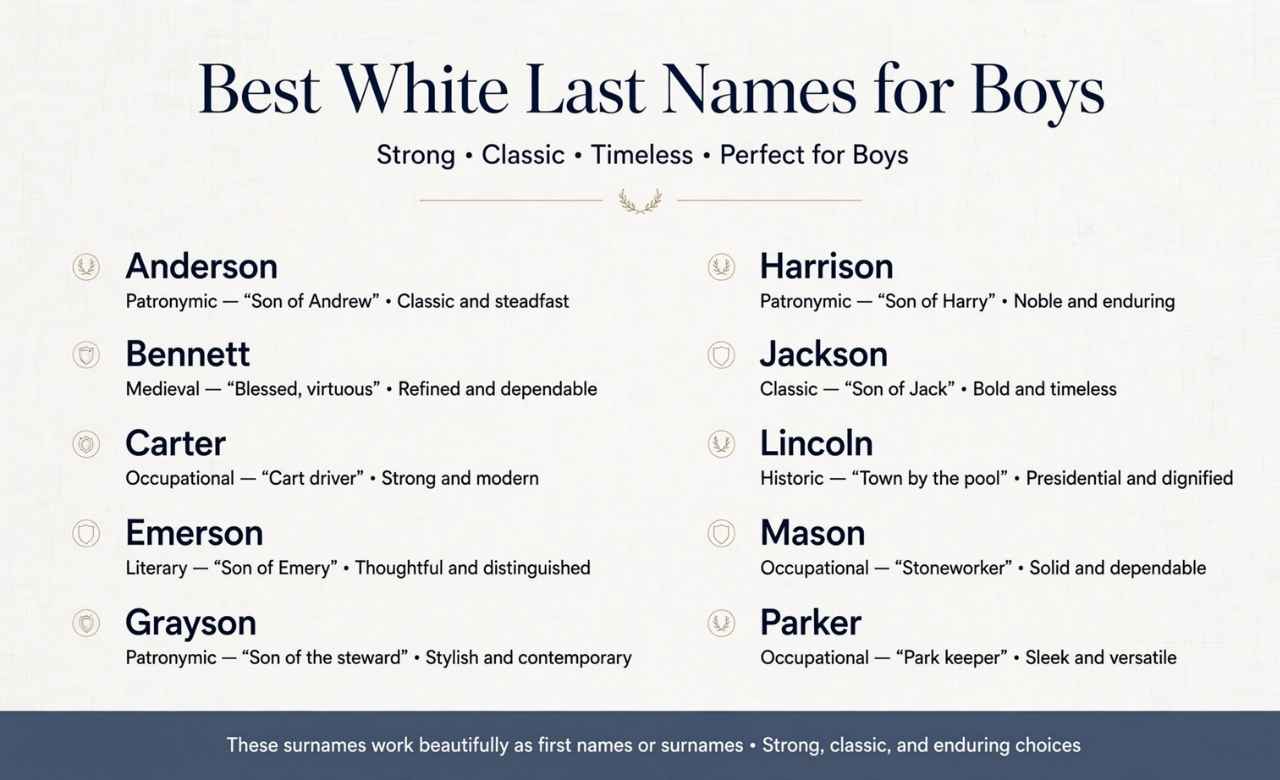
Best White Last Names for Boys with Strong Meanings
When writing fiction or researching family origins, masculine surnames with strong etymological foundations convey leadership, resilience, and fortitude.
- Barrett (Middle English / Old French): Derived from baraud, meaning “mighty bear” or “strife.”
- Callahan (Irish): From Ó Ceallacháin, meaning “bright-headed” or “lover of churches.”
- Griffin (Welsh): Derived from Gruffydd, meaning “strong lord” or “prince.”
- Valiant (French/English): Meaning “brave, strong, and worthy.”
- Stirling (Scottish): Named after the historic castle town, meaning “dwelling of the swallow” or “place of strife.”
Beautiful White Last Names for Girls with Elegant Meanings
Surnames that double as stunning given names or carry soft, lyrical Popular White Last Names cadence are ideal for modern naming trends and literature.
- Adair (Scottish/Irish): Meaning “shallow ford near the oak trees.”
- Delaney (Irish/French): From Ó Dubhshláine, meaning “dark challenger” or from French de la pessière (“from the alder grove”).
- Ellington (English): Meaning “Ellis’s town” or “settlement of the noble ones.”
- Lennox (Scottish): From the Gaelic Leamhnacht, meaning “place of elms.”
- Sinclair (Scottish/Norman): Derived from St. Clair, signifying “clear, bright, and famous.”
Traditional White Surnames from England, Scotland and Ireland
The British Isles have had an outsized impact on global surnames. The interplay between Celtic, Gaelic, Anglo-Saxon, and Norman influences generated distinct naming conventions.
       BRITISH ISLES SURNAME EVOLUTION

  Anglo-Saxon            Gaelic/Celtic             Norman-French
 (Toponymic/Craft)       (Patronymic/Clan)         (Feudal/Baronial)
  ├── Baker               ├── Mac/Mc (Son of)       ├── Fitz (Son of)
  ├── Hill                ├── O' (Grandson of)      ├── Sinclair
  └── Smith               └── Clan Names            └── Warren
English Surnames
English names heavily prioritize geography and trade. Chaucer (shoemaker), Fletcher (arrow-maker), and Underhill (living at the foot of a hill) showcase the practical, grounded nature of early English identity.
Scottish Surnames
Scottish names are inextricably tied to the clan system. Surnames prefixed with Mac or Mc mean “son of” (e.g., MacDonald = Son of Donald). Locational lowland names like Forbes (meaning “field” or “district”) and Campbell (from Gaelic caimbeul, meaning “crooked mouth”) represent rich regional history.
Irish Surnames
Irish names feature some of the oldest patronymic systems in Europe, characterized by the prefixes O’ (“descendant of”) and Mac (“son of”).
- O’Connor (Ó Conchobhair): Meaning “patron of hounds” or “heroic.”
- Gallagher (Ó Gallchobhair): Meaning “foreign helper.”
- Sullivan (Ó Súilleabháin): Meaning “dark-eyed” or “hawk-eyed.”
Old-Fashioned White Last Names That Never Go Out of Style
Certain surnames possess a timeless, vintage charm that feels rooted in late 19th-century history and classic literature.
- Holloway (English): Meaning “the sunken road.”
- Wainwright (English): Occupational name for a builder or repairer of wagons.
- Thackeray (English): Locational name meaning “the corner where reeds grow.”
- Bradford (English): Meaning “broad ford across a river.”
- Sherwood (English): Meaning “bright wood” or “royal forest.”
Famous White Family Names and Their Historical Origins
Historical dynasties and prominent historical families have stamped Popular White Last Names their names into global history.
1. Rockfeller
Derived from the German village of Rockerath, the name Rockefeller traces back to Johann Peter Rockefeller, who emigrated from the Rhineland to the American colonies in the early 18th century.
2. Vanderbilt
A classic Dutch locational surname (Van Der Bilt), meaning “from De Bilt,” a village in Utrecht, Netherlands. It became synonymous with American industrial development and maritime history.
3. Windsor
Originally the German house of Saxe-Coburg and Gotha, the British Royal Family officially adopted the surname Windsor in 1917, named after Windsor Castle (from Old English Windlesora, meaning “riverbank with a winch”).
White European Last Names with Deep Cultural Roots
To understand the broader European landscape, we must look beyond Anglo-Saxon traditions to Central, Southern, and Eastern Europe.
White Last Names with Biblical Connections
Christianity exerted a massive influence on European naming customs during the Middle Ages. Many common surnames are direct adaptations of biblical figures:
- Palmer (English): A pilgrim who carried a palm branch as a token of visiting the Holy Land.
- Christian (English/Danish): Meaning “follower of Christ.”
- Bartholomew (Aramaic origin): Meaning “son of Talmai” (furrow/farmer), popularized throughout medieval Europe.
- Jankowski (Polish): Patronymic derivative of Jan (John), meaning “God is gracious.”
White Last Names Inspired by Nature and Places
Toponymic surnames linked to geography and nature are especially common in Scandinavian and Alpine regions:
- Lindgren (Swedish): “Linden tree branch.”
- Bergman (German/Swedish): “Mountain man” or “dweller on the mountain.”
- Fontaine (French): “Dweller near a spring or fountain.”
- Rivers (English): Referring to someone living near a major waterway.
German White Last Names and Their Powerful Meanings
Germanic surnames are renowned for their descriptive compound structure, often combining physical, occupational, and geographical elements.
GERMAN COMPOUND STRUCTURE:
[Prefix: Nature/Object] + [Suffix: Feature/Man] = Surname
        Stein          +        Berg            = Steinberg ("Stone Mountain")
        Schneider      +        (Craft)         = Schneider ("Tailor")
        Wald           +        Mann            = Waldmann ("Forest Man")
- Schneider: Occupational name meaning “tailor” (literally “one who cuts”).
- Zimmermann: Occupational name meaning “carpenter” or “timber builder.”
- Weber: Meaning “weaver.”
- Hoffman: Originally referring to a farmer who owned his land or managed a manor estate (Hof = yard/manor).
- Richter: Meaning “judge” or “magistrate.”
French and Italian White Last Names with Unique Origins
French Surnames
French last names are celebrated for their melodic phonetic balance, frequently using prefixes like De, Du, or Le.
- Dubois: “Of the wood” or “from the forest.”
- Moreau: Descriptive name for someone with dark hair or a tanned complexion.
- Lefebvre: Occupational name derived from Old French for “craftsman” or “smith.”
- Beaufort: Locational name meaning “beautiful fortress.”
Italian Surnames
Italian surnames are famous for their regional diversity and patronymic plural endings (-i).
- Rossi: The most common Italian surname, meaning “red-haired” or “ruddy complexioned.”
- Ferrari: Occupational name equivalent to the English Smith (working with iron, ferro).
- Esposito: Historically given to foundlings, derived from Latin expositus (“placed outside”).
- Bianchi: Meaning “white” or “fair-haired.”
Royal and Classy White Last Names for Characters and Stories
When crafting fictional worlds, screenplays, or novels, selecting a name with Popular White Last Names aristocratic connotations helps establish immediate narrative tone.
- Cavendish: Associated with the Dukes of Devonshire; implies high status and political history.
- Montgomery: Evokes high-medieval chivalry and nobility.
- Sutherland: Deeply rooted in Highland Scottish nobility and coastal estates.
- Pemberley: A classic literary-style surname evoking rural English estates.
- Kingsley: Meaning “from the king’s meadow.”
White Last Names for Fictional Characters
When building characters, select surnames that mirror their inner traits:
- For a heroic protagonist: Sterling, Vance, Armstrong.
- For a mysterious antagonist: Blackwood, Winter, Vane.
- For an intellectual scholar: Pemberton, Radcliffe, Alistair.
Short, Cute and Modern White Last Names
Modern naming trends lean heavily toward short, punchy, one-to-two-syllable surnames that feel clean and effortless.
- Beck: Meaning “small stream or brook.”
- Cole: Derived from Old English, meaning “coal-black” or “charcoal.”
- Fox: Nature-inspired surname associated with quick intelligence and agility.
- Holt: Meaning “a small grove of trees.”
- Judd: Medieval diminutive of Gideon or Jordan.
Rich-Sounding White Last Names with Elegant Appeal
Names associated with wealth, prestige, and old-money aesthetic often combine compound geographical roots with crisp phonetic endings.
- Harrington: Meaning “estate of Haver’s people,” carrying upscale flair.
- Wellington: Associated with British history, victory, and estate holdings.
- Davenport: Locational name meaning “town on the River Dane.”
- Kensington: Evokes urban elegance and heritage estates.
- Sterling: Derived from starling or “of high quality” (as in sterling silver).
White Last Names That Sound Wealthy and Sophisticated
Surnames like Belmont (“beautiful mountain”), Rothschild (“red shield”), Sinclair, and Livingston carry immediate economic prestige due to centuries of historical association with finance, industry, and land ownership.
How to Choose the Perfect White Last Name
Selecting a surname—whether for a legal name change, a pen name, or a fictional character—requires balancing phonetics, history, and personal resonance.
                  SURNAME SELECTION FRAMEWORK

  [Step 1: Define Intent] ──> Character, Pen Name, or Family History?
            │
  [Step 2: Flow Test]    ──> First Name + Last Name Cadence
            │                (e.g., Avoid repetitive ending sounds)
            │
  [Step 3: Check Origin] ──> Does the etymology fit the identity?
            │
  [Step 4: Syllable Count]─> Pair short first names with long last names
                             (e.g., "Jack Harrington" vs "John Beck")
Key Considerations:
- Rhythm and Cadence: Vary the syllable count between given names and family names. A one-syllable first name (Grant) pairs beautifully with a three-syllable last name (Montgomery).
- Avoid Phonetic Clashing: Ensure the last letter of the first Popular White Last Names name doesn’t slur into the first letter of the last name (e.g., Ross Smith can sound like Ro Smith).
- Etymological Alignment: Verify that the historical meaning aligns with the personality or cultural background you wish to reflect.
Tips for Finding a Unique White Surname with Meaning
If you want a surname that is distinctive without feeling unnatural, use these research strategies:
- Examine Historical Census Records: Search 19th-century county records and passenger manifests for forgotten regional names.
- Study Micro-Toponyms: Look at maps of rural England, Scotland, France, or Germany. Small village names often make striking surnames.
- Combine Nature Terms: Compound Scandinavian and German methods (e.g., combining River + Stone = Livingston or Lind + qvist).
- Explore Archaic Trades: Look beyond Baker and Taylor to obsolete medieval crafts like Fletcher (arrow maker) or Wainwright (wagon maker).
Frequently Asked Questions
What are common white last names?
Common white last names include Smith, Johnson, Williams, Brown, Jones, Miller, Davis, Wilson, Taylor, and Anderson. These surnames mainly come from English, Scottish, German, and other European naming traditions.
What is a good rare last name?
A good rare last name is one that has a unique sound and meaningful history. Names like Sinclair, Beaumont, Sterling, Whitmore, Everly, and Montgomery are elegant examples of uncommon surnames.
What are 1800s’ last names?
Popular last names in the 1800s included Smith, Johnson, Williams, Brown, Miller, Taylor, Anderson, Thompson, Wilson, and Clark. Many of these traditional family names are still widely used today.
What is the top 10 last name?
The top 10 most common last names in the United States include Smith, Johnson, Williams, Brown, Jones, Garcia, Miller, Davis, Rodriguez, and Martinez. These surnames reflect different cultural Popular White Last Names and ancestral backgrounds.
Conclusion
Exploring white last names offers a fascinating journey through history, culture, and family heritage. Every surname carries a story, whether it comes from an ancient occupation, a European village, a noble family line, or a meaningful personal trait. From common white last names like Smith, Johnson, and Williams to rare and elegant surnames like Sinclair, Beaumont, and Sterling, each name reflects the traditions and experiences of generations.
Choosing the right white last name depends on your purpose, whether you are researching Popular White Last Names ancestry, creating a character, selecting a meaningful family name, or simply exploring surname meanings. The best surnames are those that connect with history, sound memorable, and carry a sense of identity. We hope this collection of white boy last names, white girl last names, and unique white people last names helps you discover a name that feels meaningful, timeless, and connected to a rich cultural background.Read Eliana Meaning in the Bible: Biblical Meaning, Spiritual Symbolism & God’s Answer of Grace

Welcome to NameInBible. I am Victoria, a Christian writer passionate about exploring biblical name meanings, Scripture-based insights, and powerful prayers. My goal is to help readers discover the spiritual significance of names and grow closer to God through faith-filled content.