
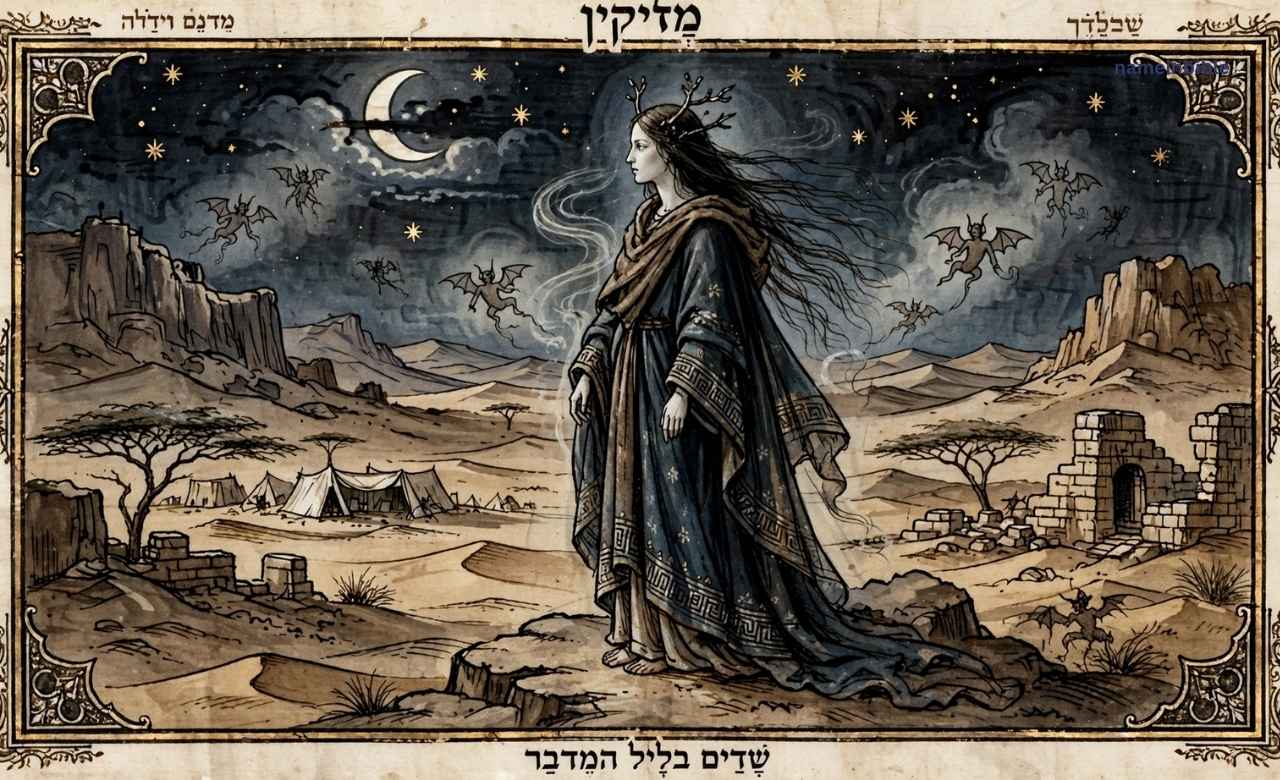
Did you know that millions of people search for Mazikeen in the Bible every single year, expecting to find a terrifying scriptural demon only to discover they’ve been misled by television?
If you’ve watched Lucifer or read The Sandman, you likely know the blade-wielding, half-faced warrior who stands beside the Devil. This leads almost everyone to wonder: who is Mazikeen in the Bible, and what does scripture actually say about her? Here is the absolute truth: there is no record of a Mazikeen demon anywhere in holy texts, and searching for Mazikeen in Bible verses or any canonical Mazikeen Bible reference will leave you empty-handed because her real origins belong to ancient Jewish folklore, not the pages of Scripture.
Is Mazikeen Mentioned in the Bible? What Scripture Actually Says
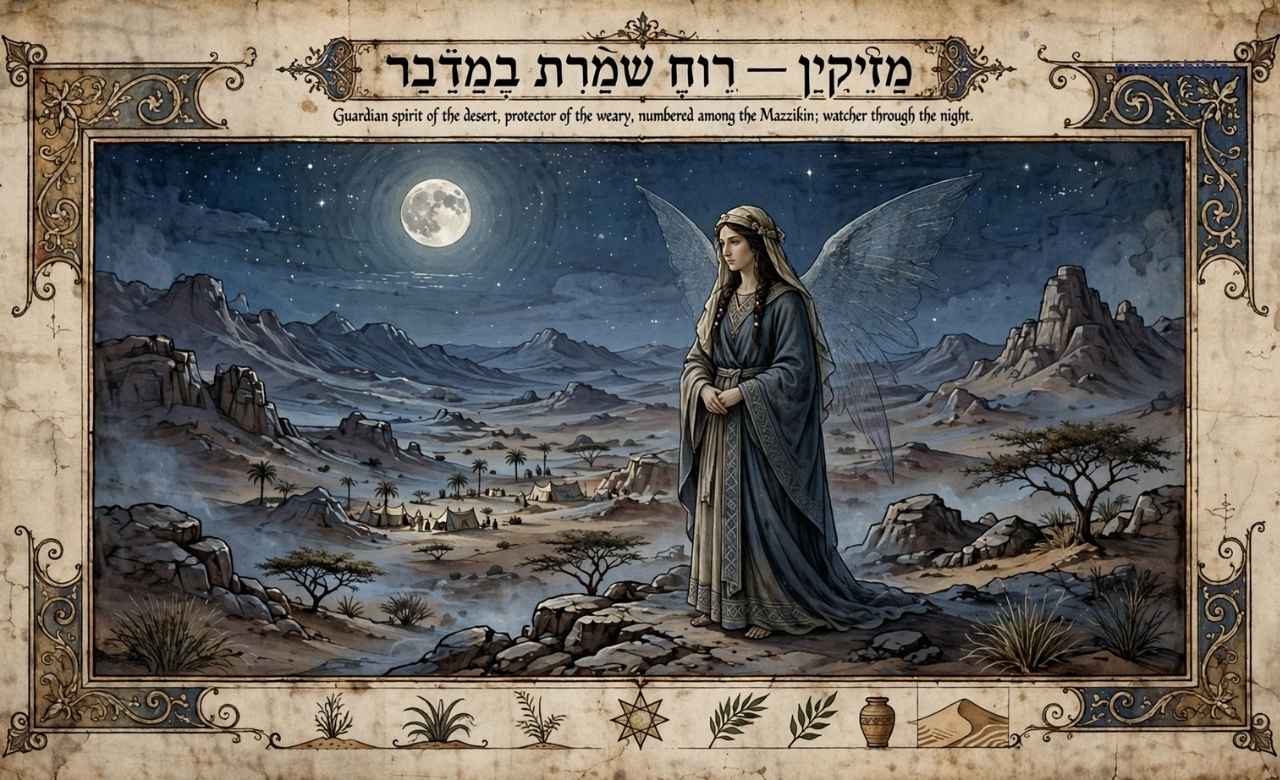
If you have watched the hit television series Lucifer or read Neil Gaiman’s iconic comic book series The Sandman, you likely know Mazikeen (often called “Maze”) as the fiercely loyal, blade-wielding, half-faced demon standing by Lucifer Morningstar. Her character blends martial prowess, complex Mazikeen in the Bible emotional depth, feminine power, and a striking demonic design that has captured the imagination of millions worldwide.
However, her sudden surge in modern pop culture has led to a widespread theological misunderstanding. Thousands of readers and viewers turn to Google every month asking: Is Mazikeen mentioned in the Bible? What is the biblical identity of Mazikeen, and does she have a true scriptural origin?
The short answer is direct: No, Mazikeen is not mentioned anywhere in the canonical Bible. You will not find the name “Mazikeen” in Genesis, the Gospels, the Book of Revelation, or even the King James Version (KJV) translation.
Yet, the history behind her name is far from a complete modern invention. The real story of Mazikeen does not begin in Hollywood or comic book writers’ rooms; it roots itself in centuries of Jewish folklore, ancient Aramaic linguistic roots, Rabbinic Judaism, and the complex Talmudic demonology of late antiquity.
This exhaustive guide uncovers the real history, spiritual significance, and cultural journey of Mazikeen—tracing her evolution from ancient invisible demons in the Babylonian Talmud to her role as a modern pop culture icon.
Mazikeen in the Bible: Meaning, Origins, and the Truth Behind the Name
To understand why people search for a Mazikeen Bible reference, one must look at how popular media weaves real-world mythology into fictional narratives. Writers like Neil Gaiman frequently borrow authentic terminology from ancient religious texts to give their fictional realms an aura of ancient authority.
The Misconception of a Canonical Mazikeen
When fans encounter Mazikeen in The Sandman or Lucifer, her lore feels ancient, heavy, and scriptural. She speaks of primordial battles, ancient hellscapes, and demonic hierarchies. Because viewers associate Lucifer, fallen angels, and hell directly with the Christian Bible, they naturally assume Mazikeen must be an obscure biblical demon alongside entities like Beelzebub, Leviathan, or the Nephilim.
However, canonical scripture—comprising the 66 books of the Protestant Bible or the expanded Catholic and Orthodox canons—never names an individual entity called “Mazikeen.” Canonical biblical theology focuses on a strict framework of fallen angels, Satan (the adversary), and generic unclean spirits, rather than detailing a named hierarchy of folklore entities.
Tracing the Historical Trail
If Mazikeen is absent from canonical scripture, where does the name actually come from?
| Era / Context | Source / Text | Term Used | Meaning / Function |
| Ancient Hebrew / Aramaic | Root m-z-k (מזיק) | Mazik / Maziq | “One who causes damage” or “harmer” |
| Talmudic Era (200–500 CE) | Babylonian Talmud | Mazikin / Mazzikim | Class of invisible, harmful spirits/demons |
| Medieval Kabbalah | Zohar & Mystical Texts | Sitra Achra entities | Malevolent spiritual forces of the “Other Side” |
| 1989–Present | DC / Vertigo / Netflix | Mazikeen (“Maze”) | Proper name for a specific demon character |
The transition from a plural noun describing a class of harmful spirits to a singular proper noun describing a female demon is a classic case of modern myth-making built upon ancient Jewish folklore.
Does Mazikeen Have a Biblical Meaning or Origin?
While the precise name “Mazikeen” does not reside in biblical text, its root language Hebrew is the core language of the Old Testament (the Hebrew Bible). Understanding the linguistic Mazikeen in the Bible mechanics of Hebrew helps clear up the confusion surrounding her name origin and biblical meaning.
    HEBREW ROOT
     מ-ז-ק (m-z-k)  --->  "To Harm" or "To Damage"
           |
   SINGULAR NOUN
     מזיק (Mazik)   --->  "A Damager" / "Harmful One"
           |
    PLURAL NOUN
  מזקין (Mazikin)   --->  "The Harmers" / "Damaging Spirits"
           |
  MODERN ANGLICIZED
    Mazikeen        --->  Proper Name in Fiction & Pop Culture
The Hebrew Root and Linguistic Mechanics
In classical Hebrew and Jewish Babylonian Aramaic, words are constructed from three-letter consonant roots. The name Mazikeen derives directly from the root:
$$\text{Root: } \textit{mem-zayin-qof} \quad (\text{מ-ז-ק})$$
This root carries the explicit definition of injuring, causing damage, or inflicting loss.
- Mazik (מזיק): The singular masculine noun meaning “a damager,” “one who harms,” or “a causer of loss.”
- Mazikin or Mazzikin (מזיקין): The plural noun in Rabbinic Aramaic meaning “the damagers,” “the causers of harm,” or “harmful spirits.”
- Mazzikim (מזיקים): The standard plural form in Classical Hebrew.
The modern spelling Mazikeen is an Anglicized spelling of the Aramaic plural form Mazikin.
Why the Translation Matters
When light or fiction translates Mazikin into English, the trailing “-in” sound sounds like a feminine or proper noun suffix to English speakers (similar to names like Kathleen or Maureen). Consequently, Western authors adapted a plural category of entities “the damagers” and turned it into a proper singular name for an individual female demon.
Therefore, if one asks for the Mazikeen meaning in Hebrew, it translates directly as:
$$\text{Mazikeen} \approx \text{“Those Who Cause Harm”} \quad \text{or} \quad \text{“The Damagers”}$$
The Meaning of Mazikeen in Jewish Tradition and Ancient Folklore
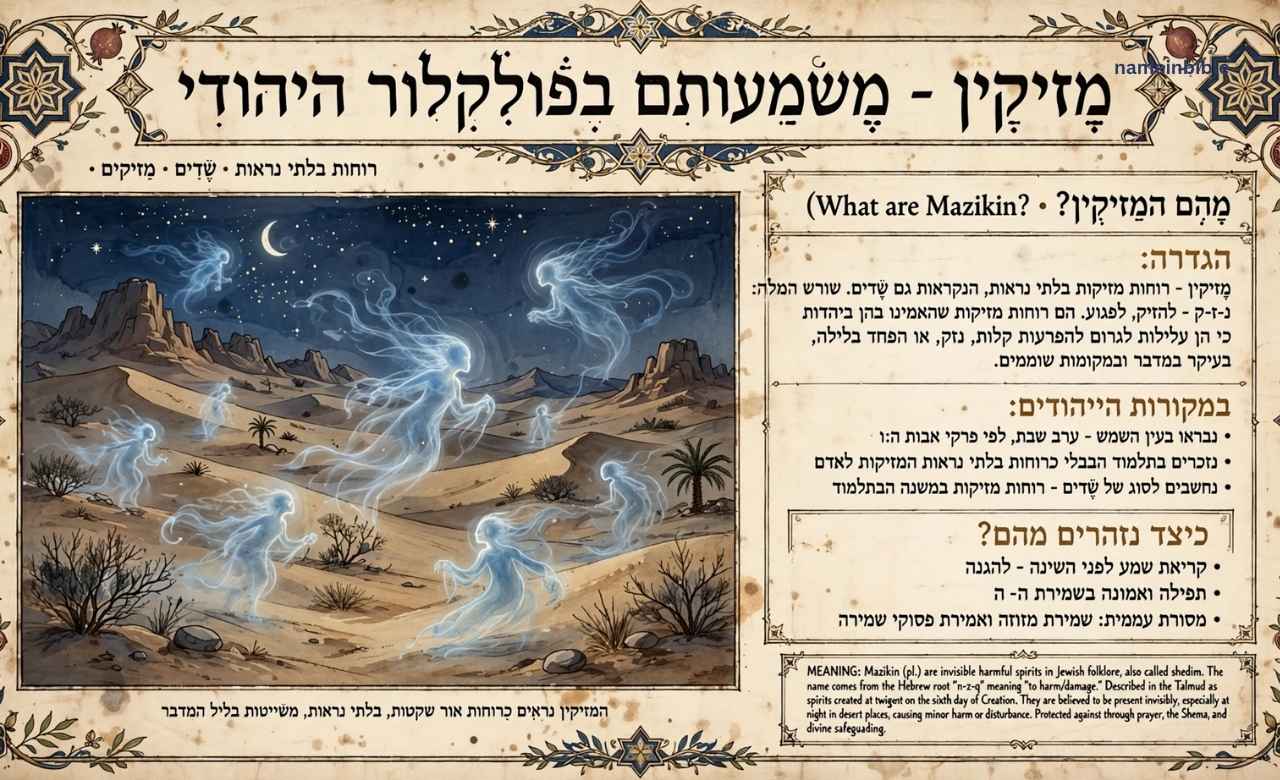
To locate the true historical footprint of the Mazikeen spirit, we must step out of Western Christian theology and enter the world of ancient Jewish tradition and Rabbinic Judaism.
                  =================================
                  ANCIENT JEWISH DEMONIC CATEGORIES
                  =================================
                                  |
         +------------------------+------------------------+
         |                                                 |
  SHEDIM (שדים)                                   MAZIKIN (מזיקין)
  - Referenced in Hebrew Bible                    - Talmudic/Aramaic designation
  - Idolatrous, foreign entities                  - Invisible, chaotic entities
  - Associated with pagan sacrifices              - Responsible for daily harm/mischief
         |                                                 |
         +------------------------+------------------------+
                                  |
                           RUCHOT RA'OT
                        (Evil/Unclean Spirits)
In Jewish lore, the cosmos is not merely divided into pure good (angels) and pure evil (devils). Instead, the spiritual realm contains a vast spectrum of supernatural entities, lingering spirits, and chaotic forces.
The Spectrum of Jewish Demonology
Ancient Jewish texts recognize several distinct categories of spirits that inhabit the world alongside humanity:
- Shedim (שדים): The most common biblical and Rabbinic term for demons. Often understood as dangerous, pagan-associated entities or spirits created on the eve of the first Sabbath.
- Ruchot Ra’ot (רוחות רעות): Literally “evil spirits” or “injurious winds,” often associated with illness, mental affliction, or spiritual impurity.
- Lilin (לילין): Night spirits or nocturnal demons, historically tied to the lore of Lilith.
- Mazikin (מזיקין): The specific class of invisible, chaotic forces whose sole operational role in the world is to cause physical, material, or psychological damage to human beings.
Unlike the medieval Christian view of demons which frames every demon as an active servant Mazikeen in the Bible of Satan dedicated to tempting humans into mortal sin Jewish demonology often views the Mazikin as pests, chaotic ambient entities, or spiritual “hazards” inherent in the structure of the creation.
Who Are the Mazikin? Understanding the Spirits Behind the Name
What did the ancient Israelites and Talmudic sages actually believe about the Mazikin spirits?
In ancient Jewish folklore, the Mazikin were not necessarily towering, horned monsters ruling over a fiery underworld. Instead, they were viewed as invisible demons that coexisted with humans in everyday life, filling the empty spaces of the physical world.
                  =================================
                  THE THREE-PART NATURE OF MAZIKIN
                  (Babylonian Talmud, Chagigah 16a)
                  =================================
                                  |
         +------------------------+------------------------+
         |                        |                        |
    ANGELIC TRAITS          HUMAN TRAITS             ANIMAL TRAITS
  - Have wings             - Eat and drink          - Multiply/reproduce
  - Fly across world       - Die like mortals       - Shift physical form
  - Know future events     - Susceptible to injury   - Cause unseen harm
Attributes of the Mazikin in Ancient Lore
- Invisibility: The Mazikin are normally completely unseen by the human eye. According to Rabbinic tradition, if human beings were granted the vision to see the sheer number of Mazikin surrounding them at any given moment, no person could withstand the horror.
- Omnipresence in Daily Spaces: They were believed to frequent uninhabited places, ruins, dirty areas, and dark corners but also public places like synagogues, wells, and bathhouses during off-hours.
- Hybrid Nature: The Talmud explains that Mazikin share traits with both angels and human beings:
- Like angels, they have wings, can fly from one end of the earth to the other, and can hear predictions of future events from behind the heavenly curtain.
- Like humans, they eat, drink, reproduce, and eventually die.
The Practical Hazards of the Mazikin
In the ancient world, unexplained illnesses, sudden bad luck, stubbed toes, spoiled food, or structural collapses were often attributed to the unseen activity of the Mazik. They were not necessarily seeking the eternal damnation of human souls; rather, they acted as spiritual hazards that caused injury (nezek) whenever humans let down their guard.
Mazikeen and the Talmud: What Jewish Texts Really Say
The primary source for almost everything known about the Mazikin in historical literature is the Talmud specifically the Babylonian Talmud (Talmud Bavli), compiled between the 3rd and 6th centuries CE.
                          ======================
                          THE MAZIKIN IN TALMUDIC
                          LITERATURE & AGGADAH
                          ======================
                                    |
         +--------------------------+--------------------------+
         |                          |                          |
   BERAKHOT 6a                 CHAGIGAH 16a               PESACHIM 110a
  - The Dust/Ash Ritual       - Three traits of angels   - Dangers of even numbers
  - Worn-out knees of Sages   - Three traits of humans   - Nighttime hazards
  - Crowded Synagogues        - Creation at twilight     - Pair-based attacks
Key Talmudic Passages Mentioning the Mazikin
1. Tractate Berakhot 6a: The Unseen Presence
One of the most famous descriptions of the Mazzikin appears in Tractate Berakhot 6a. The Talmud states:
“It was taught: Abba Binyamin says: If the eye were given permission to see, no creature could withstand the mazikin… They are more numerous than we are, and they stand over us like the mounds of earth surrounding a trench.”
To demonstrate their presence, the Talmud even provides a famous ritual:
- Take fine ash and sift it through a sieve.
- Scatter the ash around your bed at night.
- In the morning, you will see footprints resembling those of a rooster in the ash leaving proof of the Mazikin who walked through your room while you slept.
The passage goes on to note that the unexplained fatigue experienced by scholars in synagogues, the sudden fraying of clothes, and the feeling of pressure against one’s legs in crowded rooms are all caused by the unseen crowding of the Mazikin.
2. Tractate Chagigah 16a: The Origins of Demonic Entities
Tractate Chagigah 16a establishes the foundational cosmology of Talmudic demonology. It explains that six things were said regarding demons (Shedim / Mazikin): in three ways they resemble ministering angels, and in three ways they resemble human beings.
This text helps answer a common question: Who created the Mazikin?
In classical Jewish tradition, God created these entities on the sixth day of creation at twilight, right before the first Sabbath. God fashioned their spirits, but before He could construct their physical bodies, the Sabbath arrived and creation ceased. As a result, the Mazikin spirits were left as disembodied, intermediate beings—forever wandering the physical world seeking form or causing disruption.
3. Tractate Pesachim 110a: Hazards of Pairs and Shadows
In Tractate Pesachim, the Talmud warns against doing things in pairs (such as drinking an even number of cups of wine), because the number two invites the attention of the Mazikin. Sages like Rashi (the paramount medieval French commentator) provided extensive glosses on these passages, explaining Mazikeen in the Bible how these entities act as physical “damagers” operating within natural law.
Is Mazikeen a Demon? Biblical and Jewish Perspectives Explained
When evaluating whether Mazikeen is a “demon,” the answer depends heavily on whether you view the question through a Biblical/Christian lens or a Jewish/Talmudic lens.
                         ========================
                         THEOLOGICAL COMPARISON:
                         WHAT IS A "DEMON"?
                         ========================
                                    |
         +--------------------------+--------------------------+
         |                                                     |
  CHRISTIAN THEOLOGY                                   JEWISH FOLKLORE
  (Canonical/Biblical Framework)                       (Talmudic/Aramaic Framework)
  - Fallen Angel (Cast out of Heaven)                  - Distinct Creation (Formed on Day 6)
  - Absolute Evil / Satanic Hierarchy                  - Amoral / Chaotic Forces
  - Objective: Temptation, Sin, Damnation              - Objective: Physical Harm, Nuisance
  - Subject to Exorcism in Jesus' Name                 - Managed via Mitzvot, Prayers, Amulets
1. The Biblical / Christian Perspective
In traditional Christian demonology, a demon is exclusively understood as a fallen angel a spiritual being that rebelled against God alongside Lucifer (as depicted symbolically in verses like Revelation 12:4).
In this strict framework:
- Mazikeen does not exist as a named entity.
- If evaluated as a concept, any “harmful spirit” that opposes divine order is classified simply as an unclean spirit or a minion of Satan.
- There is no concept of neutral or “nuisance” spirits; entities are strictly aligned with the Kingdom of God or the forces of darkness.
2. The Jewish / Folklore Perspective
In ancient Jewish folklore and Kabbalistic literature, the Mazikin occupy a far more nuanced position:
- They are not fallen angels. Angels are entirely separate beings composed of fire and light, possessing no free will of their own.
- The Mazikin were created intentionally by God as part of the ecosystem of the universe.
- They serve a purpose in the cosmic order, often acting as agents of natural consequence, boundary-enforcers, or tests of spiritual discipline.
- While categorized as malevolent or dangerous (ruach ra), they are not viewed as cosmic rivals to God. They, too, are subject to divine authority and can be warded off using sacred texts, the Shema prayer, or specialized protective amulets.
Mazikeen vs. Biblical Demons: Are They the Same?
To further clarify her biblical identity, it is helpful to compare the concept of the Mazik with actual demonic entities and concepts that do appear within canonical scripture.
================================================================================
FEATURE           MAZIKEEN / MAZIKIN             BIBLICAL DEMONS / SHEDIM
================================================================================
Primary Source    Talmud, Aggadah, Folklore      Old & New Testaments
Hebrew Term       מזיקין (Mazikin)                שדים (Shedim), רוחות רעות
Origin Story      Created on Day 6 at twilight   Fallen Angels / Rebellious Spirits
Primary Action    Physical harm, nuisance, loss   Possession, temptation, false worship
Biblical Mention  No (0 occurrences)             Yes (e.g., Deut 32:17, Mark 5:9)
Hierarchical Role Independent chaotic entities   Subordinate to Satan / Evil Realm
================================================================================
Scripture Analysis: Key Biblical Passages
To see how scripture handles evil entities, examine these primary biblical references:
- Deuteronomy 32:17 (The Shedim):“They sacrificed unto devils [Shedim], not to God; to gods whom they knew not…”Here, the Hebrew Bible uses the word Shedim to describe foreign idols and spiritual entities that draw worship away from YHWH.
- Isaiah 34:14 (Desert Spirits & Night Creatures):“The wild beasts of the desert shall also meet with the wild beasts of the island, and the satyr shall cry to his fellow; the screech owl [Lilith] also shall rest there…”This poetic text describes desolate wildernesses inhabited by dangerous spiritual symbols, including Lilith (often translated as night-owl or night-monster).
- Mark 5:9 (New Testament Legion):“And he asked him, What is thy name? And he answered, saying, My name is Legion: for we are many.”New Testament passages depict demons as disembodied personalities seeking human hosts to possess, directly contrasting with the Talmudic Mazikin, who exist independently in physical space without requiring human hosts.
Mazikeen and Lilith: What Is the Connection?
One of the most persistent topics surrounding Mazikeen in lore searches is her connection to Lilith. In modern fiction, media, and late medieval folklore, Mazikeen is frequently depicted as the daughter, child, or chief lieutenant of Lilith.
                  =================================
                  THE LILITH & LILIM GENEALOGY LORE
                  =================================
                                  |
                           PRIMORDIAL LILITH
                    (Legendary First Wife of Adam)
                                  |
                     Fled to the Red Sea Realm
                                  |
         +------------------------+------------------------+
         |                                                 |
    THE LILIM                                        THE MAZIKIN
  (Night Demons / Offspring)                      (Harmful Spirits / Legion)
         |                                                 |
         +------------------------+------------------------+
                                  |
                        MODERN FICTIONAL FUSION
                 (Mazikeen as Daughter of Lilith)
Who Is Lilith in Jewish Folklore?
In post-biblical Jewish mythology most notably developed in the medieval text The Alphabet of Ben Sira (c. 800–1000 CE) and later extended in the Zohar and Kabbalistic literature Lilith is portrayed as the legendary first wife of Adam.
According to the myth:
- Lilith was created from the same earth as Adam, insisting on absolute equality.
- When Adam refused her equality, she uttered the explicit name of God and fled the Garden of Eden.
- She settled in the region of the Red Sea, a realm associated with demonic forces.
- God sent three angels Sanvi, Sansi, and Semanfglof to bring her back. When she refused, she was cursed, and it was decreed that hundreds of her demonic offspring would perish daily.
The Lilim and the Mazikin Connection
The demonic children born to Lilith are historically referred to as the Lilim (or Lilin). They are described as night-spirits that target infants, mothers in childbirth, and men sleeping alone.
In late medieval folklore and early modern demonological compilations, the distinctions between various demonic classes began to blur. The Lilim (children of Lilith) and the Mazikin (harmful spirits) were frequently grouped together under the general umbrella of supernatural entities born from the primordial Mazikeen in the Bible union of Lilith and chaotic forces (or Adam during his 130 years of separation from Eve, as noted in Tractate Eruvin 18b).
Is Mazikeen One of Lilith’s Children? Myth, Legend, and Fiction
Is Mazikeen explicitly recorded as the literal daughter of Lilith in authentic ancient texts?
Historical Folklore vs. Pop Culture
- In Ancient Talmudic Literature: No. The Talmud does not present a named individual demon named “Mazikeen” who is the daughter of Lilith. Mazikin is simply a collective noun for harmful spirits.
- In Medieval Kabbalah: The Zohar speaks extensively of the Sitra Achra (the “Other Side”) and details the demonic hierarchy ruling over impurity. While Lilith is identified as the mother of countless demon spirits (ruchin ve-lilin), the specific named character “Mazikeen” does not appear as her named daughter.
- In Modern Pop Culture (DC/Vertigo & Netflix): Yes. Neil Gaiman and subsequent writers explicitly established that Mazikeen is a child of Lilith.
================================================================================
REALM             RELATIONSHIP TO LILITH
================================================================================
Canonical Bible   Neither entity appears as a personified character.
Talmudic Lore     Mazikin and Lilin are separate categories of spirits.
Medieval Kabbalah Lilith produces legions of unnamed spirits/damagers.
DC / The Sandman  Mazikeen is explicitly the daughter of Lilith, leader of the Lilim.
Netflix Lucifer   Mazikeen ("Maze") is Lilith's daughter who abandoned her children.
================================================================================
In the TV series Lucifer, this relationship becomes a central narrative arc. Lilith (played by Lesley-Ann Brandt in flashback episodes) is depicted as an immortal mother who gave birth to the Lilim a massive demon army to serve Lucifer Morningstar. She extracted her immortality into a ring Mazikeen in the Bible and left her children to develop without maternal love, giving rise to Mazikeen’s deep-seated emotional wounds, fear of abandonment, and fierce independence.
Mazikeen in Islam: Does the Quran Mention Her?
Given that Mazikeen stems from Semitic roots, readers frequently inquire whether there is a Mazikeen Islam connection or if she appears in Islamic theology and the Quran.
                   ================================
                   ABRAHAMIC DEMONOLOGY COMPARISON
                   ================================
                                  |
         +------------------------+------------------------+
         |                                                 |
  JUDAISM (Talmud/Folklore)                         ISLAM (Quran/Hadith)
  - Shedim ( Idolatrous spirits )                  - Jinn ( Made of smokeless fire )
  - Mazikin ( Harmful spirits )                    - Shayatin ( Malevolent Jinn / Devils )
  - Lilin ( Night spirits )                        - Iblis ( Primary Adversary )
         |                                                 |
         +------------------------+------------------------+
                                  |
                           SHARED CONCEPTS
                 - Invisible entities living alongside humans
                 - Free-willed or chaotic physical/spiritual nature
                 - Can cause harm, illness, or mischief
The Quranic Position
No, Mazikeen is not mentioned in the Quran, Hadith literature, or traditional Islamic theology.
However, Islamic spiritual cosmology shares notable structural parallels with the Jewish lore of the Mazikin:
- The World of the Jinn (الجن): In Islam, God created three intelligent species: Angels (from light), Humans (from clay), and Jinn (from smokeless fire). Like the Mazikin in the Talmud, Jinn live alongside humans in an unseen parallel plane, eat, drink, marry, have free will, and eventually die.
- The Shayatin (الشياطين): Malevolent or harmful Jinn Mazikeen in the Bible who follow Iblis (Satan) are referred to as Shayatin (devils). Their operational role—inflicting harm, whispering evil suggestions, and dwelling in unclean or abandoned places—mirrors the function of the Aramaic Mazikin.
- The Concept of the Afrit or Marid: These represent powerful, chaotic classes of Jinn, but none correspond to the specific named figure of Mazikeen.
Mazikeen in the KJV Bible: Is There Any Reference?
The King James Version (KJV), published in 1611, remains one of the most widely read English Bible translations in history. Many users search specifically for Mazikeen in the KJV Bible or search for specific Mazikeen Bible verses.
    SEARCH QUERY: "Mazikeen KJV Bible Verse"
                        |
                        v
    SEARCH RESULTS IN CANONICAL SCRIPTURE:
    - Genesis to Revelation: 0 Hits
    - Old Testament (Hebrew): 0 Hits for proper name
    - New Testament (Greek): 0 Hits
                        |
                        v
    CONCLUSION:
    The name "Mazikeen" does not exist in any KJV verse.
Direct Verse Verification
If you perform a concordance search across the entire King James Bible for the term “Mazikeen,” “Mazik,” or “Mazzikin,” you will find zero occurrences.
Why the Misunderstanding Persists
The confusion often arises because English translations of the Bible (including the KJV) use broad English terms like “devils,” “fiends,” “damsels possessed,” or “unclean spirits” to render various Hebrew and Greek words:
- Hebrew Shedim $\rightarrow$ KJV translates as “devils” (Deut 32:17, Psalm 106:37).
- Hebrew Se’irim (hairy spirits/satyrs) $\rightarrow$ KJV translates as “devils” or “satyrs” (Leviticus 17:7, Isaiah 13:21).
- Greek Daimonion $\rightarrow$ KJV translates as “devil” or “demon” (Mark 5:12).
None of these original terms translate to “Mazikeen.” Any article or online post claiming to pinpoint a specific “Mazikeen Bible verse” is conflating fictional pop-culture lore with actual biblical manuscript data.
Who Is Mazikeen in The Sandman and Other Modern Stories?
The modern transformation of Mazikeen from an obscure Talmudic plural noun into a beloved pop culture character is credited to legendary author Neil Gaiman and artist Kelley Jones.
                  =================================
                  THE MAZIKEEN POP-CULTURE TIMELINE
                  =================================
                                  |
  1989: NEIL GAIMAN'S "THE SANDMAN" (DC/VERTIGO)
  - Introduced in "Season of Mists" storyline (#22)
  - War-leader of the Lilim, loyal consort to Lucifer
  - Half-faced appearance (half beautiful, half rotting/skeletal)
                                  |
  2000–2006: "LUCIFER" COMIC SERIES (MIKE CAREY)
  - Promoted to central protagonist alongside Lucifer
  - Becomes ruler of the Lilim and briefly takes the throne of Hell
  - Deep exploration of demon face, honor, and loyalty
                                  |
  2016–2021: NETFLIX "LUCIFER" TELEVISION SERIES
  - Played by actress Lesley-Ann Brandt ("Maze")
  - Bounty hunter in Los Angeles, manager at Lux nightclub
  - Journey toward gaining a human soul, love, and redemption
                                  |
  2022–PRESENT: NETFLIX "THE SANDMAN" ADAPTATION
  - Portrayed by Cassie Clare
  - Faithful reproduction of Gaiman's original comics design
1. The Sandman Comics (1989)
Mazikeen made her comic book debut in DC/Vertigo’s The Sandman #22 (written by Neil Gaiman) during the famous “Season of Mists” story arc.
In Gaiman’s universe:
- She is a chief member of the Lilim, the children of Lilith.
- She serves as the devoted lover, bodyguard, and companion to Lucifer Morningstar, the ruler of Hell.
- When Lucifer decides to abandon his throne in Hell, abdicate his position, and cut off his angelic wings, Mazikeen leaves Hell alongside him.
- She follows him to Los Angeles, where they open an elite piano bar called Lux.
2. The Lucifer Comic Spin-Off (2000–2006)
In Mike Carey’s acclaimed 75-issue Lucifer series, Mazikeen’s character expands exponentially:
- She is portrayed as a fierce warrior, a master strategist, and a proud leader of her tribe.
- Her allegiance to Lucifer is not based on mind-control or Mazikeen in the Bible demonic servitude, but on mutual respect, deep loyalty, and shared rebellion against divine predestination.
- She eventually becomes the leader of the Lilim army and briefly assumes control of Hell itself.
Mazikeen and Lucifer: How Their Relationship Became Part of Her Story
The relationship between Mazikeen and Lucifer is one of the most compelling dynamics in modern graphic literature and television. Though entirely absent from ancient scripture, this partnership has become an established piece of modern mythology.
                          ======================
                          THE DUAL DYNAMICS OF
                          LUCIFER & MAZIKEEN
                          ======================
                                    |
         +--------------------------+--------------------------+
         |                                                     |
  THE COMIC BOOK LORE                                  THE TELEVISION SERIES
  (Sandman / Vertigo Comics)                           (Netflix's Lucifer)
  - Cosmic, stoic partnership                          - Emotionally volatile friendship
  - Shared desire for absolute autonomy                - Maze acts as Lucifer's enforcer & protector
  - Honor-bound demonic allegiance                     - Navigates human feelings, heartbreak, growth
  - Mazikeen rules the Lilim as queen                  - Maze searches for her own independent soul
The Dynamics of Their Connection
- Absolute Autonomy: Neither Lucifer nor Mazikeen wishes to be ruled by God, Heaven, or Hell’s expectations. Their bond is forged in mutual defiance against external control.
- Loyalty Beyond Redemption: Unlike other demons who seek to overthrow Lucifer or exploit his weaknesses, Mazikeen’s allegiance is unshakeable. She is willing to wage war against Heaven, Hell, or Earth to protect him.
- The Crucible of Humanity: As Lucifer grows closer to humanity (via Detective Chloe Decker in the TV show), Mazikeen faces severe emotional disruption. She feels Mazikeen in the Bible abandoned by her sole anchor, forcing her to embark on a journey to forge her own identity, discover love, and cultivate a human soul.
Why Does Mazikeen Have a Demon Face? The Story Behind Her Appearance
One of the most striking visual hallmarks of Mazikeen is her disfigured face. Viewers and readers consistently ask: Why does Mazikeen have a half-demon face, and what is its symbolic meaning?
                     ===============================
                     THE DUAL FACIAL STRUCTURE OF
                           COMIC MAZIKEEN
                     ===============================
                                    |
         +--------------------------+--------------------------+
         |                                                     |
  RIGHT SIDE (Human / Beautiful)                        LEFT SIDE (Demon / Rotting)
  - Represents her physical presence                   - Exposed bone, muscle, and teeth
  - Connects her to the earthly realm                  - Represents her true demonic heritage
  - Concealed behind mask or human illusion            - Spoke in slurred, dual-toned dialect
1. The Graphic Novel Canon
In the original comic books by Neil Gaiman and Kelley Jones:
- Half of Mazikeen’s face is completely human and strikingly beautiful.
- The other half is entirely decayed, rotting, and skeletal—exposing raw muscle, bone, and teeth.
- Because of her facial structure, her speech in the comics is rendered with slurred, broken dialogue, making her language sound alien and eerie.
- She frequently wears a silver or porcelain half-mask to cover her rotting side when interacting with mortals at the Lux nightclub.
When Lucifer uses his cosmic powers to restore her face to full human perfection, Mazikeen actually becomes furious with him. To her, her disfigured face is not a curse or a defect—it is her heritage, her honor, and her true self. She later demands that her face be returned to its half-skeletal state.
2. The Television Adaptation
In the Netflix Lucifer series:
- Actress Lesley-Ann Brandt plays Mazikeen with a fully human face most of the time, using demonic glamour to blend into Los Angeles society.
- Her true demon face (half-decayed, half-skeletal) is revealed selectively usually to terrify criminals, assert demonic authority, or show vulnerable intimacy to those she trusts (such as Trixie Espinoza or Chloe Decker).
- The VFX design pays homage to Gaiman’s original comics while Mazikeen in the Bible allowing the actress to express a full range of emotion throughout the series.
What Does Mazikeen Symbolize? Power, Pain, Loyalty, and Identity
Beyond the theological history and pop-culture storytelling, the character of Mazikeen resonates deeply with audiences because she functions as a powerful spiritual and psychological archetype.
                      =============================
                      THE ARCHETYPAL SYMBOLISM OF
                               MAZIKEEN
                      =============================
                                    |
         +-------------+------------+------------+-------------+
         |             |                         |             |
      DUALITY       LOYALTY                 INDEPENDENCE   REDEMPTION
   Between worlds  Unshakable devotion     Feminine power  Growth beyond
   (Demon/Human)   to those she loves      & self-sovereignty origin
Core Themes Represented by Mazikeen
- Duality and the Unseen Self: Her half-skeletal face visually embodies the duality inside every human being—the persona presented to the world versus the hidden scars, pain, and monster within.
- Feminine Power and Independence: Mazikeen is never depicted as a damsel in distress. She is an elite warrior possessing enhanced strength, supreme combat skills, and lethal mastery of weaponry. She derives her authority from her own strength rather than male protection.
- The Struggle for Identity: Born as a “soulless” demon from a line of abandoned spirits, Mazikeen’s long-term character arc explores whether a creature defined by violence can transcend its origin. Her struggle proves that identity is not dictated by birth, but forged through personal choice.
- Loyalty vs. Self-Sovereignty: Her arc balances absolute devotion Mazikeen in the Bible to Lucifer with the painful realization that she must exist as her own person moving from being “Lucifer’s servant” to becoming an independent force in the universe.
Mazikeen’s Cultural Impact: From Ancient Folklore to Modern Pop Culture
The journey of the name Mazikeen offers a fascinating case study in how ancient religious concepts evolve over millennia.
 ANCIENT WORLD                    MIDDLE AGES                    MODERN ERA
(200 CE - 500 CE)               (1000 CE - 1600 CE)            (1989 - Present)
       |                                |                              |
   TALMUDIC                         KABBALISTIC                   POP CULTURE
   MAZIKIN                           FOLKLORE                      MAZIKEEN
       |                                |                              |
  Invisible spirits               Class of damagers             Named protagonist,
  causing physical harm           tied to Sitra Achra            pop-culture icon,
  & structural loss               and Lilith's realm             demonic heroine
- Phase 1: Talmudic Utility (200–500 CE): The term Mazikin served a practical, explanatory purpose for ancient people trying to make sense of unseen hazards, sudden illnesses, and natural accidents.
- Phase 2: Mystical Classification (1000–1600 CE): Kabbalistic texts preserved the term within intricate cosmic structures, defining the Mazikin as forces operating on the boundary of holiness and impurity (Sitra Achra).
- Phase 3: Modern Myth-Making (1989–Present): Writers like Neil Gaiman recycled ancient Semitic terminology to enrich modern graphic literature, inadvertently giving birth to an iconic fictional figure who now dominates search engines worldwide.
Frequently Asked Questions
What kind of demon is Mazikeen?
Mazikeen is a lilith, a type of female demon associated with Jewish folklore and later traditions.
She is not described as a specific demon in the Bible itself.
Is Mazikeen actually in the Bible?
No, Mazikeen is not mentioned in the Bible as a named demon or character.
The name comes from later Jewish folklore and is also closely associated with the Hebrew term mazikin.
Who is Mazikeen in history?
Mazikeen is primarily a figure shaped by Jewish folklore rather than biblical history.
The name is connected to supernatural beings believed in some traditions to cause harm or trouble.
Is Maze Lucifer’s sister?
No, Maze is not Lucifer’s sister in biblical or traditional Jewish sources.
In the TV series Lucifer, Mazikeen is portrayed as a close ally and demon who serves Lucifer, not his biological sister.
Conclusion
The truth about Mazikeen in the Bible is simple: Mazikeen herself is not mentioned by name in Scripture. Her origins are connected instead to the Mazikin, harmful spirits found in ancient Jewish and Talmudic traditions. The modern character known as Mazikeen was later developed from these ideas and given a much deeper fictional identity.
Understanding this difference helps separate biblical teaching from Jewish folklore and modern fiction. While Mazikeen is closely associated with Lilith, demons, Lucifer, and The Sandman, these connections belong largely to mythology, comics, and television rather than the biblical text. In the end, Mazikeen is best understood as a fascinating example of how ancient spiritual traditions can inspire powerful modern characters.Read other article White Heart Meaning : What the White Heart Emoji Means in Text, Love & Relationships

Welcome to NameInBible. I am Victoria, a Christian writer passionate about exploring biblical name meanings, Scripture-based insights, and powerful prayers. My goal is to help readers discover the spiritual significance of names and grow closer to God through faith-filled content.