
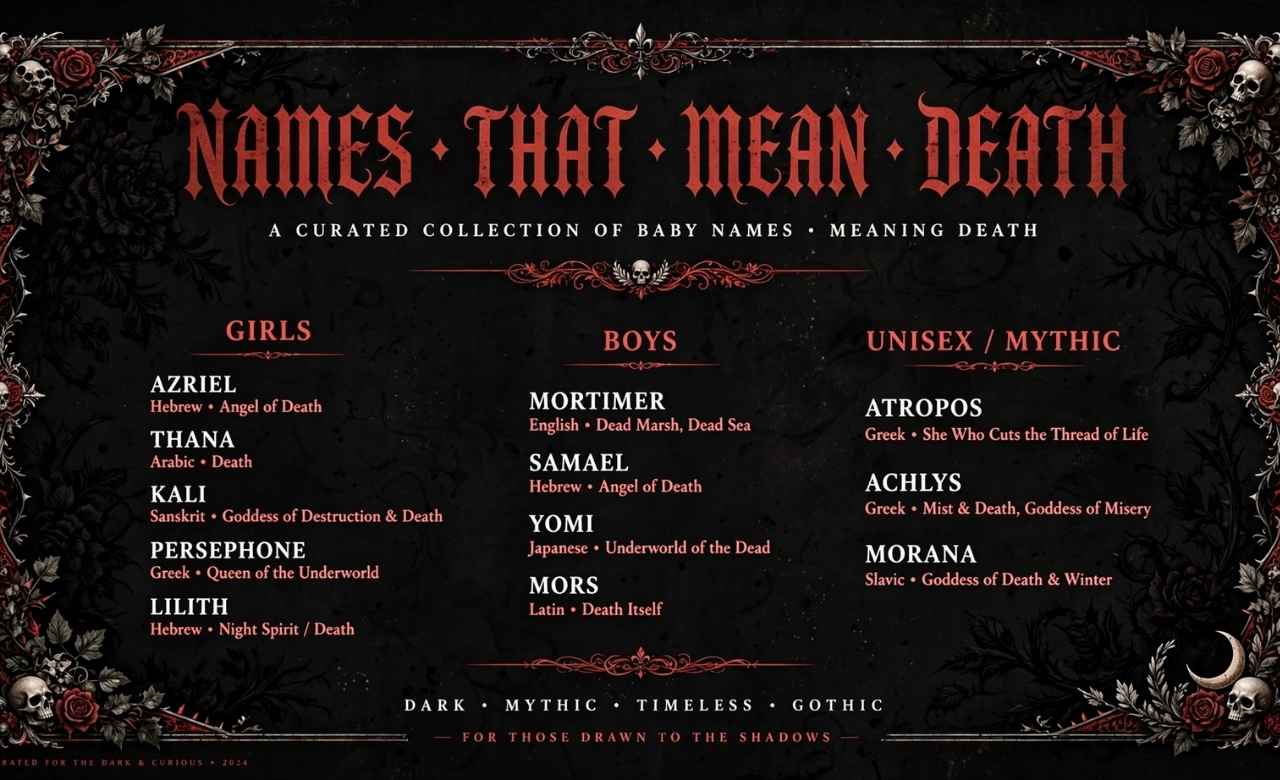
Some names feel ordinary, while others carry an aura of mystery, power, and darkness. If you’re looking for a name with a deeper edge, Japanese naming traditions offer fascinating inspiration through words associated with shadows, night, spirits, mortality, and transformation. From mysterious warrior-style names to poetic names connected with the unknown, these choices can give a character or persona an unforgettable identity.
In this guide, you’ll find Japanese boy names meaning dark, Japanese names with dark meanings, and Japanese boy names with dark meanings, along with unique Japanese names meaning dark. We’ll also look at Japanese names that mean death and names inspired by shadows, spirits, night, rebirth, and Japanese mythology. Whether you need a powerful baby name, an anime character name, a fantasy Names That Mean Death identity, or a memorable gaming name, these Japanese-inspired ideas offer a striking blend of beauty and darkness.
Japanese Names Inspired by Death, Darkness & Rebirth
In the Japanese linguistic and spiritual tradition, mortality, shadows, and renewal are not seen as separate, opposing forces. Instead, they are woven into a continuous cycle. Rooted in the dual foundations of Shinto animism and Buddhist philosophy, Japanese concepts of existence view darkness (yami) not merely as an absence of light, but as the fertile void from which all life emerges. Mortality (mortality) is paired with impermanence (mujo), and death (shi) serves as the essential gateway to spiritual transformation, reincarnation (tensei), and eternal rebirth (saisei or rinne).
When writers, world-builders, gamers, and parents search for Japanese names inspired by death, darkness, and rebirth, they tap into an ancient onomastic system rich with layered nuance. Unlike Western naming conventions where a name often carries a fixed, static definition, Japanese names depend entirely on their underlying kanji (logographic Chinese characters adopted into Japanese). A single spoken name can pivot from luminous to ominous based on the kanji selected. For example, the syllable Rei can mean “beautiful bell” (麗), “spirit/soul” (霊), or “zero/void” (零).
   ┌─────────────────────────────────────────────────────────┐
   │                  THE CONTINUOUS CYCLE                   │
   │                                                         │
   │      (Yami / Kurayami) ───► (Shi / Higan)               │
   │          Darkness                  Death                │
   │             ▲                        │                  │
   │             │                        ▼                  │
   │     (Saisei / Shinsei) ◄─── (Tensei / Rinne)            │
   │          Rebirth                 Reincarnation          │
   └─────────────────────────────────────────────────────────┘
Because of linguistic taboos (imi-kotoba), real-world parents rarely bestow kanji with explicitly ominous definitions like death (死, shi) or destruction (破壊, hakai) onto a child. However, Japanese history, folklore, nature, and poetic traditions are full of evocative, mysterious, and shadowy names. These names carry the quiet beauty of a midnight moon (Tsukiyo), the sacred presence of the spirit realm (Reikon), the ferocity of an ancient warrior (bushi), or the triumph of a new dawn (reimei).
Below is the definitive, exhaustive guide to dark Japanese names, examining their kanji components, direct meanings, cultural context, and creative resonance.
The Linguistics of Dark & Transformative Japanese Names
Understanding the construction of dark, mystical, and regenerative Japanese names requires a grasp of how kanji radicals interact with cultural philosophy.
       [ Radical / Root ]  +  [ Modifying Kanji ]  =  [ Symbolic Meaning ]
        Example: 影 (Kage)  +   羽 (Ha / Feather)   =   Kageha (Shadow Feather)
        Example: 月 (Tsuki) +   夜 (Yo / Night)     =   Tsukiyo (Moonlit Night)
        Example: 転 (Ten)   +   生 (Sei / Life)     =   Tensei (Reincarnation)
Key Linguistic Roots
- Death & Spirit Realm: Rei / Ryo (霊 – spirit, ghost, soul), Shi (死 – death), Ki (鬼 – demon, fierce spirit), Ma (魔 – demon, dark magic), Higan (彼岸 – the far shore / Buddhist afterlife).
- Darkness, Shadow & Night: Kuro / Koku (黒 – black), Yami / An (闇 / 暗 – darkness, dark void), Kage (影 – shadow, reflection), Yoru / Ya (夜 – night), Sumi (墨 – dark ink), Shikkoku (漆黒 – jet black).
- Rebirth, Life & Renewal: Sei / Sho / Inochi (生 – life, birth), Shin / Arata (新 – new, fresh), Reimei (黎明 – dawn / dark before light), Fukkatsu (復活 – resurrection), Rinne (輪廻 – samsara / endless cycle of rebirth), Saki (咲 – to blossom / emerge).
Japanese Boy Names Inspired by Death and Darkness
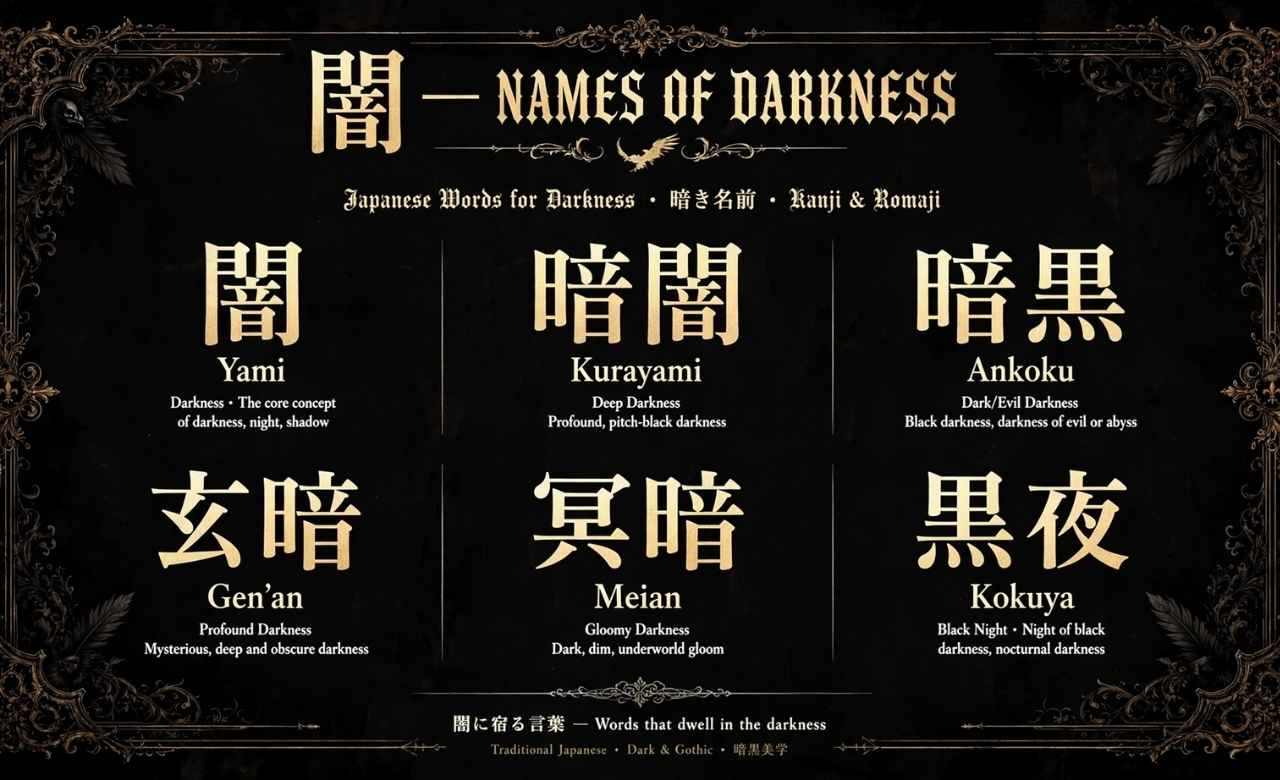
Male names associated with death, deep shadows, and spiritual gravity often evoke images of the obsidian void, the chill of winter, martial finality, and the ancient spirits of the netherworld (Meifu).
| Name (Romaji) | Kanji Options | Literal Breakdown | Symbolic Meaning & Cultural Context |
| Kagehisa | 影久 | 影 (kage – shadow) + 久 (hisa – enduring/long time) | “Eternal Shadow.” Suggests an enduring presence that moves unseen through the world. |
| Kurorou | 黒郎 | 黒 (kuro – black) + 郎 (rou – son/man) | “Son of Darkness/Black.” A traditional masculine construction denoting an affinity for the night. |
| Reisuke | 霊介 | 霊 (rei – spirit/soul) + 介 (suke – shell/herald/assist) | “Protector of Souls” or “Herald of the Spirit Realm.” Carries high spiritual resonance. |
| Yamisuke | 闇助 | 闇 (yami – deep darkness) + 助 (suke – help/aid) | “One who aids from the shadows.” A dark, mysterious name suited for anti-heroes. |
| Gouma | 剛魔 | 剛 (gou – sturdy/iron) + 魔 (ma – demon/dark spirit) | “Unyielding Demon.” Evokes brute strength anchored in supernatural energy. |
| Shiei | 死影 | 死 (shi – death) + 影 (ei/kage – shadow) | “Shadow of Death.” A purely fictional, dramatic name for powerful dark fantasy figures. |
| Setsuna | 刹那 | 刹 (setsu – temple/crush) + 那 (na – what/deep) | “A Split Second / The Ephemeral Moment.” Buddhist term for the fleeting nature of life and mortality. |
| Kokuya | 黒夜 | 黒 (koku/kuro – black) + 夜 (ya/yoru – night) | “Pitch-Black Night.” Signifies deep concealment, quietude, and obsidian skies. |
| Gen’ei | 幻影 | 幻 (gen – illusion/phantom) + 影 (ei – shadow) | “Phantom Silhouette.” Speaks to illusion, ghostly appearances, and unreadable intentions. |
| Danba | 断刃 | 断 (dan – sever/cut off) + 刃 (ba – blade) | “Severing Blade.” Denotes finality, the abrupt end of life, and martial ruthlessness. |
   [ Kurorou: 黒郎 ]  ──►  黒 (Kuro: Jet Black)  +  郎 (Rou: Son/Youth)
   [ Gen'ei:  幻影 ]  ──►  幻 (Gen: Illusion)    +  影 (Ei: Shadow/Echo)
Japanese Girl Names Inspired by Death and Darkness
Female names that channel death, shadowy elegance, and nocturnal power carry a balance of beauty and dread. In Japanese aesthetics, this is known as yugen (profound grace and subtlety).
   [ Kurohana:  黒花 ]  ──►  黒 (Black)   +  花 (Flower)  ──► "The Eclipse Blossom"
   [ Higanbana: 彼岸花 ] ──►  彼岸 (Afterlife) + 花 (Flower) ──► "Red Spider Lily"
| Name (Romaji) | Kanji Options | Literal Breakdown | Symbolic Meaning & Cultural Context |
| Kurohana | 黒花 | 黒 (kuro – black) + 花 (hana – flower) | “Black Flower.” An ominous botanical beauty; reflects resilience that blooms in the dark. |
| Higanbana | 彼岸花 | 彼岸 (higan – other shore/afterlife) + 花 (bana – flower) | The Red Spider Lily. The quintessential Japanese floral symbol of death, farewell, and reincarnation. |
| Reiko | 霊子 | 霊 (rei – spirit/soul/ghost) + 子 (ko – child) | “Child of the Spirits.” (Note: Common versions use 麗子 for “lovely child,” but 霊子 gives an eerie, spectral tone). |
| Yamiko | 闇子 | 闇 (yami – darkness) + 子 (ko – child) | “Daughter of Darkness.” Evokes absolute concealment and the quiet power of the void. |
| Sayoko | 小夜子 | 小 (sa – small) + 夜 (yo – night) + 子 (ko – child) | “Child of the Deep Night.” Elegant, traditional, yet steeped in nocturnal stillness. |
| Kukiko | 幽子 | 幽 (kuki/yuu – faint/ghostly/hidden) + 子 (ko – child) | “Child of the Netherworld Shadows.” Conveys an otherworldly, ethereal presence. |
| Mayoi | 迷宵 | 迷 (mayo – lost/wander) + 宵 (i/yoi – early evening) | “Wandering in the Twilight.” Evokes souls adrift between the mortal world and the afterlife. |
| Shiden | 紫殿 | 紫 (shi – purple/death-adjacent mourning color) + 殿 (den – palace) | “Palace of Violet Shadows.” Reminiscent of twilight court intrigue and phantom royalty. |
| Kageha | 影羽 | 影 (kage – shadow) + 羽 (ha – feather/wing) | “Feather of the Shadow.” Suggests dark-winged familiars, ravens, and fleeting spirits. |
| Tamaki | 魂希 | 魂 (tama – soul/spirit) + 希 (ki – rare/hope) | “Rare Soul of the Ancestors.” A bridge connecting the living to ancestral spirits (reikon). |
Japanese Names That Symbolize Death and Mortality
Mortality in Japanese thought is framed by shogyo mujo—the universal truth that all created things must pass away. These names draw inspiration from the autumn of life, the severing of mortal ties, and the boundaries between earth and the underworld (Meifu / Jigoku).
- Shigure (時雨): “Drizzle in Late Autumn.” Poetically represents the cold rain that strips the trees of leaves, symbolizing the onset of winter and the dying of the year.
- Momiji (紅葉): “Crimson Leaves.” While celebrated for its beauty, in classical poetry it marks the glorious final blaze of life before total winter decay.
- Kasen (霞仙): 霞 (kasen – mist/haze) + 仙 (sen – hermit/immortal). Symbolizes a mortal soul dissolving into the mountain mists upon physical expiration.
- Shouji (終二): 終 (shou – the end/finish) + 二 (ji – two/second). “Mark of the End”; represents closure, final boundaries, and mortality’s curtain call.
- Yuukoku (幽谷): 幽 (yuu – deep/faint/ghostly) + 谷 (koku – valley). “The Shadowed Ravine.” Refers to the hidden pathways souls walk when traveling toward the netherworld.
- Zetsuei (絶影): 絶 (zetsu – sever/extinguish) + 影 (ei – shadow/trace). “Extinguished Shadow.” Conveys the erasure of physical presence upon passing.
- Hakaba (墓場 – fictional surname/moniker): “The Graveyard.” Symbolizes the Names That Mean Death resting place of bones and quiet communion with the departed.
- Kagerou (蜻蛉 / 陽炎): “Mayfly” or “Heat Shimmer.” Represents the absolute transience of life—a creature that lives for a single day, embodying fragile mortality.
Japanese Names With Dark and Mysterious Meanings
These names evoke mist-covered shrines, uncharted ocean depths, veiled intentions, and the liminal spaces where light fails to penetrate.
                    ┌────────────────────────┐
                    │     THE VEILED VOID    │
                    ├────────────────────────┤
                    │  Kuragari  (暗がり)     │
                    │  Yugen     (幽玄)      │
                    │  Shin'en   (深淵)      │
                    │  Kasumi    (幽霞)      │
                    └────────────────────────┘
- Shin’en (深淵): “The Abyss.” Derived from the kanji for profound depth (深) and abyss/chasm (淵). Represents unfathomable psychological or magical depth.
- Kuragari (暗がり): “The Encroaching Dark.” A poetic term for corners where light cannot reach; ideal for stealthy, enigmatic personas.
- Yugen (幽玄): “Subtle Grace / Hidden Profundity.” An aesthetic philosophy referring to the mysterious beauty of that which is sensed rather than seen, like the moon veiled behind clouds.
- Mukyuu (無窮): “The Infinite Void.” Composed of 無 (mu – nothingness/void) and 窮 (kyuu – ultimate/exhaustion). Represents the dark cosmos.
- Oboro (朧): “Hazy Moon / Veiled Light.” Describes a celestial light half-smothered by nocturnal mist; implies secrets and concealed identities.
- Kasumi (幽霞): 幽 (yuu – ghostly/hidden) + 霞 (kasumi – mist). A dark twist on a classic name, meaning “Spirit Mist” that veils sacred grounds.
- Kuroyuri (黒百合): “Black Lily.” In Japanese flower language (hanakotoba), the black lily carries double meanings of love, curses (noroi), and silent vengeance.
Japanese Boy Names That Mean Darkness
These masculine names directly use or imply the kanji for black (kuro), dark (an / kura), void (mu), or shadow (kage), projecting authority and hidden power.
   [ Ankoku:   暗黒 ]  ──►  暗 (Dark)       +  黒 (Black)      ──► "Absolute Void"
   [ Kurogane: 黒鉄 ]  ──►  黒 (Black)      +  鉄 (Iron/Steel) ──► "Black Iron"
   [ Kageyoshi:影義 ]  ──►  影 (Shadow)     +  義 (Justice)    ──► "Shadow Justice"
| Name (Romaji) | Kanji Representation | Semantic Nuance |
| Ankoku | 暗黒 | “Dark Void / Absolute Darkness.” Unrelenting, profound night. |
| Kurogane | 黒鉄 | “Black Steel / Dark Iron.” Indestructible resilience forged in darkness. |
| Kagetsu | 影月 | “Shadow Moon.” The silhouette of the moon cast across dark terrain. |
| Kageyoshi | 影義 | “Justice of the Shadows.” An anti-hero operating outside the light of law. |
| An’ei | 暗影 | “Dark Silhouette.” A quiet, solitary figure walking through shadows. |
| Kurando | 闇人 | “Person of Darkness.” An ancient-sounding title turned into a given name. |
| Kuramitsu | 暗光 | “Dark Light.” An oxymoronic name representing dark energy or black fire. |
| Yashiro | 夜城 | “Castle of the Night.” Evokes nocturnal fortresses and dark sovereignty. |
| Kokuou | 黒皇 | “Black Emperor / Sovereign of Darkness.” Imperial authority over shadow realms. |
| Kageaki | 影明 | “Luminous Shadow.” The sharp, distinct edge where bright light creates pure shadow. |
Japanese Girl Names With Dark Meanings
These feminine names blend beauty, nature, and the elements with the quiet stillness of the dark.
- Yorue (夜江): 夜 (yoru – night) + 江 (e – inlet/bay). “Inlet of the Night Sea.” Evokes calm, pitch-black coastal waters reflecting stars.
- Kuroyabu (黒藪): 黒 (kuro – black) + 藪 (yabu – thicket). “Dark Briar.” Conjures images of thorned, impenetrable forests.
- Amayo (雨夜): 雨 (ama/ame – rain) + 夜 (yo/yoru – night). “Rainy Night.” Suggests melancholic beauty, solitude, and introspective sorrow.
- Kageki (影姫): 影 (kage – shadow) + 姫 (ki/hime – princess). “Princess of Shadows.” A regal name for daughters of dark fantasy dynasties.
- Kurami (闇美): 闇 (kura/yami – darkness) + 美 (mi – beauty). “Dark Beauty.” A celebration of the allure found within the unseen.
- Suminono (墨野): 墨 (sumi – black calligraphic ink) + 野 (no – field). “Field of Black Ink.” Poetically describes a landscape washed in pitch-black midnight.
- Hisame (氷雨 / 緋雨): “Hail / Chill Rain.” Evokes the sudden, piercing freeze of a dark storm that halts living vitality.
- Kuroame (黒雨): 黒 (kuro – black) + 雨 (ame – rain). “Black Rain.” Associated with portentous skies, eclipses, and spiritual cleansing through sorrow.
Japanese Names Connected to Rebirth and Renewal
In the Buddhist worldview of Japan, death is never the end; it is simply the turn of the wheel (Rinne Tensho). Rebirth names reflect sunrise (reimei), spring buds (mebuki), restoration (kaifuku), and the renewal of the soul (shinsei).
   ┌─────────────────────────────────────────────────────────┐
   │                    THE DAWN CYCLE                       │
   │                                                         │
   │      Reimei (黎明)    ──►   Yoake (夜明け)              │
   │     The Darkest Pre-Dawn       The First Light          │
   │              │                        │                 │
   │              ▼                        ▼                 │
   │      Kakusei (覚醒)   ──►   Saisei (再生)               │
   │       The Awakening             True Rebirth            │
   └─────────────────────────────────────────────────────────┘
- Saisei (再生): “Rebirth / Regeneration.” Direct and powerful, symbolizing biological, spiritual, or ideological restoration.
- Arata (新 / 改): “Fresh / Brand New / Renewed.” Represents stepping out from a ruinous past into a new beginning.
- Shinsei (新生): “New Life.” Composed of 新 (shin – new) and 生 (sei – life). Represents the dawn following catastrophe.
- Fukatsu (復活): “Resurrection / Revival.” Brings a fallen warrior or concept back from extinction.
- Rinne (輪廻): “Samsara / The Cycle of Transmigration.” A profoundly philosophical name representing the continuous loop of life, death, and return.
- Kaika (開花): “Blooming / Flourishing.” Describes flowers bursting open after a brutal winter; symbolizes personal rebirth.
- Mezame (目覚め / 覚): “Awakening.” The sudden opening of the eyes to higher spiritual power following symbolic death.
- Reimei (黎明): “The Pre-Dawn Light.” The deep indigo moment when the dark night gives way to dawn’s golden rim.
Japanese Boy Names That Symbolize Rebirth
Masculine names of rebirth often emphasize the warrior rising from defeat, the sovereign rebuilding an empire, or the dawn banishing a long nightmare.
   [ Kazuki:   一希 ]  ──►  一 (One / Beginning)  +  希 (Hope / Horizon)
   [ Tensei:   転生 ]  ──►  転 (Turn / Evolve)    +  生 (Life / Reborn)
   [ Asahi:    旭   ]  ──►  旭 (Rising Sun Breaking the Dark Horizon)
| Name (Romaji) | Kanji Options | Direct Breakdown | Narrative / Thematic Resonance |
| Tensei | 転生 | 転 (ten – turn/transition) + 生 (sei – life) | “Reincarnation.” The soul shifting from one vessel to another across centuries. |
| Kazuki | 一希 / 和生 | 一 (kazu – one/first) + 希 (ki – hope) | “The First Hope.” The initial ray of renewal after devastation. |
| Shinji | 新児 / 新治 | 新 (shin – new/reborn) + 治 (ji – govern/cure) | “New Generation / Healer.” The one who rebuilds what was destroyed. |
| Akatsuki | 暁 | 暁 (akatsuki – daybreak/dawn) | “The Crimson Dawn.” The moment light burns away the midnight shadow. |
| Asahi | 旭 | 旭 (asahi – morning sun) | “The Rising Sun.” Dynamic emergence from the night. |
| Renpei | 蓮平 | 蓮 (ren – lotus) + 平 (pei – peace) | “Peace of the Lotus.” The lotus rises unblemished from filthy swamp muck. |
| Tamotsu | 保 / 完 | 保 (tamotsu – preserve/restore) | “The Restorer.” Reclaims vitality and stability after chaos. |
| Kouki | 幸起 | 幸 (kou – fortune) + 起 (ki – rise/wake) | “Rising Fortune.” A rise from destitution into prosperity. |
Japanese Girl Names That Represent Rebirth
Feminine names symbolizing rebirth focus on budding flora, blossoming through snow, the arrival of morning, and clean slates.
- Chiyo (千代): 千 (chi – thousand) + 代 (yo – generations). “A Thousand Generations.” Signifies the unbroken, eternal lineage of life renewing itself.
- Hatsune (初音): 初 (hatsu – first/new) + 音 (ne – sound). “The First Sound.” Poetically refers to the first songbird of spring breaking winter’s silence.
- Uika (初花): 初 (ui – first/fresh) + 花 (ka – flower). “The Season’s First Flower.” Represents the return of vibrant life to a dead landscape.
- Asuka (明日香): 明日 (asu – tomorrow) + 香 (ka – fragrance). “Fragrance of Tomorrow.” Looks beyond today’s grief toward tomorrow’s renewal.
- Rinka (輪華): 輪 (rin – wheel/cycle) + 華 (ka – splendid flower). “The Flower of the Eternal Cycle.” A life blooming continuously across incarnations.
- Meiko (芽依子): 芽 (mei – sprout/bud) + 依 (i – reliant/grace) + 子 (ko – child). “Child of the Fresh Sprout.” Signifies a green bud breaking through frost.
- Kiyomi (清美): 清 (kiyo – pure/cleansed) + 美 (mi – beauty). “Cleansed Beauty.” Spiritual restoration following a dark baptism.
- Hinata (陽向): 陽 (hi/hyou – sun/light) + 向 (nata/muka – facing). “Facing the Sun.” Turning one’s back on darkness toward the light.
Japanese Names Inspired by Life, Death, and Rebirth
These names balance light and darkness, destruction and renewal, yin and yang (In-You in Japanese Onmyōdō).
          [ IN (Yin) : Darkness / Death ]  ◄──┐
                         │                    │  CYCLICAL HARMONY
                         ▼                    │  (In-You Balance)
          [ YOU (Yang) : Light / Rebirth ] ───┘
| Name (Romaji) | Kanji Options | Concept Represented | Meaning & Profile |
| Enma | 閻魔 | Judge of Life & Death | Name of the Buddhist King of the Underworld who weighs souls and assigns reincarnation. |
| Kouen | 光炎 / 煌円 | Eclipse to Flame | 煌 (kou – spark) + 円 (en – circle). The complete cycle of radiant energy dying and sparking anew. |
| Chitose | 千歳 | Eternal Millennia | Represents endurance through hundreds of cycles of rise and fall. |
| Inyo | 陰陽 | Yin and Yang | 陰 (in – dark/moon/death) + 陽 (you – light/sun/life). The absolute synthesis of cosmic opposites. |
| Kourin | 光輪 | Nimbus / Wheel of Light | 光 (kou – light) + 輪 (rin – cycle/wheel). The wheel of life turning through darkness into radiance. |
| Mugen | 無限 | The Endless Horizon | 無 (mu – void/death) + 限 (gen – limit/boundary). “Without Limit”; life unbounded by physical death. |
| Shiki | 四季 | The Four Seasons | Represents the immutable rhythm of nature: birth (spring), bloom (summer), death (autumn), and quiet rest (winter). |
| Utsusemi | 空蝉 | Cast-off Cicada Shell | A classical literary term for the ephemeral human shell left behind when the soul ascends. |
Japanese Names Meaning Shadow, Night, or Darkness
Names derived from the elements of shade, the twilight horizon, and midnight are among the most popular aesthetic choices.
   Shadow & Night Roots:
   ├─ 影 (Kage)  ──► Shadow / Reflection
   ├─ 夜 (Yoru)  ──► Night
   ├─ 宵 (Yoi)   ──► Early Twilight
   └─ 晦 (Tsugomori / Kai) ──► Dark Moon / Final Night of the Lunar Month
- Kage (影): “Shadow.” Direct, sharp, and iconic. Represents stealth, loyalty in the background, and silent observation.
- Yoru (夜): “Night.” Pure, minimalist, and serene. Embodies the velvet quiet that blankets the earth.
- Kagewaki (影脇): 影 (kage – shadow) + 脇 (waki – flank/side). “Beside the Shadow.” A companion who walks beside darkness.
- Sayoyo (小夜々): “The Deepening Nights.” Evokes layer upon layer of velvet shadow.
- Yoichi (夜一): 夜 (yo – night) + 一 (ichi – first/one). “First Night” or “First Son of the Night.”
- Tsukikage (月影): 月 (tsuki – moon) + 影 (kage – shadow/beam). “Moon Shadow” or “Moonlit Silhouette.” The faint light that sharpens surrounding darkness.
- Yomiya (宵宮): 宵 (yoi – twilight) + 宮 (miya – shrine/palace). “Shrine of Twilight.” Conjures imagery of lantern-lit rituals held at dusk.
- Kuragumo (暗雲): 暗 (kura – dark) + 雲 (gumo – cloud). “Dark Gathering Storm Cloud.” Portends upheaval and dramatic change.
Japanese Names Inspired by Death Gods and Spirits
In Japanese belief, death gods (Shinigami) are psychological and spiritual guides that facilitate the transition from the physical world to the next.
   [ Izanami:    伊邪那美 ] ──► Primordial Death Goddess (Ruler of Yomi)
   [ Tsukuyomi:  月読     ] ──► God of the Moon & Nocturnal Underworld
   [ Shinigami:  死神     ] ──► Psychopomp / Spirit Guide of the Terminal Hour
- Izanami (伊邪那美): The primordial creator goddess who, after consuming the food of the underworld (Yomi-no-kuni), became the Queen of the Dead and Mother of Spirits.
- Tsukuyomi (月読): The Shinto moon god who rules the realm of night and the tides, living in eternal alienation from the sun goddess Amaterasu.
- Enma-O (閻魔王): The Great Judge of Hell (Jigoku). Decides the karmic fate and reincarnation path of departed souls.
- Gozu (牛頭) & Mezu (馬頭): “Ox-Head” and “Horse-Face.” The twin demonic guardians of the Buddhist netherworld who ensure no soul escapes its karmic retribution.
- Kasha (火車): “The Burning Chariot.” A feline spirit that descends from dark clouds to carry away the corpses of unrepentant mortals.
- Sanba (三婆): An allusion to the Datsue-ba (脱衣婆), the terrifying crone who sits beside the Sanzu River (Sanzu-no-Kawa) to strip the clothes from passing spirits.
- Yomotsu (黄泉津): Refers directly to the underworld realm of Yomi. A prefix signifying authority over the damp, shadowed realm of departed souls.
Japanese Names Inspired by Japanese Mythology
Mythology (Kojiki and Nihon Shoki) provides a rich archive of ancient, powerful names steeped in celestial authority, fire, ocean depths, and storm fury.
   [ Kagutsuchi: 迦具土 ] ──► The Fire Deity whose birth burned his mother Izanami
   [ Susanoo:    須佐之男] ──► The Storm God cast out of heaven into the ocean depths
   [ Ryujin:     龍神   ] ──► The Dragon King reigning over the crushing deep
| Mythological Figure | Kanji Used | Element / Domain | Symbolic Application for Characters |
| Kagutsuchi | 迦具土 | Destructive Primordial Fire | Raw fury, self-destructive power, transformative combustion. |
| Susanoo | 須佐之男 | Sea, Storm & Netherworld Exile | Turbulent emotion, fierce swordsmanship, dark defiance. |
| Ryujin | 龍神 | Deep Abyss, Oceanic Serpents | Cold, crushing depths; ancient aquatic authority. |
| Yatagarasu | 八咫烏 | Three-Legged Sun/Shadow Raven | Divine guidance through dark labyrinths; omens of fate. |
| Kitsunebi | 狐火 | Spirit Fire / Ghost Lights | Trickery, illusion, fox spirits dancing across dark moors. |
| Takemikazuchi | 建御雷 | Thunder and Martial Conquest | Blinding lightning that cleaves the sky; martial finality. |
| Amatsu-Mikaboshi | 天津甕星 | Dread Star of Heaven / Primordial Chaos | The ancient god of astral darkness who opposed celestial order. |
Japanese Names Inspired by Yūrei, Yokai, and Dark Spirits
Japan’s folklore is home to thousands of Yokai (supernatural monsters) and Names That Mean Death Yūrei (restless ghosts), representing the eerie, uncanny aspects of existence.
                   ┌───────────────────────────────┐
                   │    FOLKLORIC SPIRIT NAMES     │
                   ├───────────────────────────────┤
                   │  Onryo      (Vengeful Ghost)  │
                   │  Tengu      (Shadow Crow Demon│
                   │  Kiyohime   (Vengeful Serpent)│
                   │  Hannya     (Jealous Demon)   │
                   │  Kamaitachi (Sickle Weasel)   │
                   └───────────────────────────────┘
- Onryo (怨霊): “Vengeful Spirit.” A soul whose burning grievances allow it to break through the veil of death to haunt the living.
- Tengu (天狗): “Heavenly Dog / Crow Demon.” Proud, martial spirits of dark alpine forests, feared for their supernatural swordsmanship.
- Hannya (般若): The iconic horned demon representing human jealousy, sorrow, and obsessive grief transformed into a demonic mask.
- Shuten-doji (酒呑童子): The legendary demon king who ruled Mount Oe, embodying raw demonic strength and nocturnal terror.
- Kiyohime (清姫): A young woman whose unrequited passion transformed her into a fire-breathing serpent demon; represents obsessive, dark devotion.
- Amanojaku (天邪鬼): A perverse yokai that provokes a person’s darkest, most self-destructive impulses; ideal for mischievous anti-heroes.
- Kamaitachi (窮奇 / 鎌鼬): The sickle-clawed wind weasels that cut down travelers in the blink of an eye without leaving a trace of blood.
- Gashadokuro (がしゃどくろ): Giant skeletons assembled from the bones of people who died of starvation or unburied in battlefields.
Japanese Names With Powerful Warrior Meanings
The samurai class (Bushi) lived with death always in mind (memento mori). The classic text Hagakure opens with the line: “The Way of the Samurai is found in death.”
   [ Bushido Philosophy: 葉隠 ] ──► "The Way of the Warrior is Death"
   Names evoke unbreakable resolve, severed cords, and steel tempered in blood.
- Katsuro (勝郎): 勝 (katsu – victory) + 郎 (rou – son). “Victorious Son.” A warrior whose victories are carved from perilous battle.
- Bushi (武士): 武 (bu – martial/war) + 士 (shi – warrior/scholar). The elemental name of the Japanese warrior.
- Masamune (正宗): 正 (masa – correct/true) + 宗 (mune – lineage/master). Historical reference to the legendary swordsmith whose blades radiated cold, dark perfection.
- Muramasa (村正): Legendary bladesmith whose swords were said to be cursed (noroi) and bloodthirsty, demanding human life once unsheathed.
- Kenshin (剣心): 剣 (ken – sword/blade) + 心 (shin – heart/soul). “Heart of the Blade.” Represents a warrior who has aligned his inner self with death.
- Takehiko (武彦): 武 (take – martial spirit) + 彦 (hiko – noble boy). “Champion of the Martial Way.”
- Kageyasu (影保): 影 (kage – shadow) + 保 (yasu – preserve/protect). “Protector in the Shadows.” Denotes a warrior who guards his master from the dark.
Japanese Dark Warrior Names for Boys
These names suit frontline champions, stealth assassins (shinobi), and grim mercenaries who move through battle like living reapers.
| Name (Romaji) | Kanji Combination | Literal Meaning | Archetype & Tone |
| Kagehisa | 影久 | Enduring Shadow | The veteran scout who endures every ambush. |
| Kurokaze | 黒風 | Black Wind | The swift, unseen blade that strikes like a dark gale. |
| Tessai | 鉄斎 | Iron Cleaver / Fortress | An unyielding front-line berserker forged like black iron. |
| Ganto | 巌刀 | Crag Sword | A massive, chipped blade carrying crushing momentum. |
| Zanshiro | 斬四郎 | Fourth Cleaving Son | A swordsman whose strikes end life in a single stroke. |
| Kagefumi | 影踏 | Step of the Shadow | An assassin who matches his targets’ footsteps in silence. |
| Senki | 戦鬼 | War Demon | A soldier who transforms into an unstoppable demon on the battlefield. |
| Kikoku | 鬼哭 | Demon’s Wail | A terrifying name reflecting the sound of whistling blades and weeping spirits. |
Japanese Dark Fantasy Names for Girls
These names evoke shadowy sorceresses, midnight assassins, and gothic priestesses.
- Kurokishi (黒騎士 – fictional moniker): “The Black Knight.” A stern, armor-clad woman bound to a dark sovereign.
- Yoruhime (夜姫): 夜 (yoru – night) + 姫 (hime – princess/noblewoman). “Princess of the Endless Night.”
- Chimori (血守): 血 (chi – blood) + 守 (mori – guardian/protector). “Guardian of the Bloodline.” Evokes vampiric or ancestral blood magic.
- Kurokasumi (黒霞): 黒 (kuro – black) + 霞 (kasumi – mist). “Dark Mist.” A ninja or shadow-mage who dissolves into thin air.
- Rasetsu (羅刹): The female form of Rakshasa—flesh-eating demons of Buddhist folklore known for their terrible ferocity and dark magic.
- Yumekage (夢影): 夢 (yume – dream) + 影 (kage – shadow). “Dream Shadow.” A phantom enchantress who walks through people’s nightmares.
- Kagemi (影美): 影 (kage – shadow) + 美 (mi – beauty). “Shadowed Elegance.” A quiet, lethal beauty who strikes from the dark.
Mysterious Japanese Names With a Gothic Feel
Gothic aesthetics rely on moody atmospheres, melancholic romance, ruin, winter landscapes, and spiritual mystery.
                      ┌────────────────────────────┐
                      │      GOTHIC SENSIBILITY    │
                      ├────────────────────────────┤
                      │  Soranaki   (Sky Weeping)  │
                      │  Shirogane  (White Silver) │
                      │  Kurozome   (Dyed Black)   │
                      │  Sumizome   (Ink-Dyed)     │
                      └────────────────────────────┘
- Sumizome (墨染): “Dyed in Black Ink.” Refers to dark robes worn by mourning Buddhist monks; carries a quiet, contemplative gothic tone.
- Shirogane (白銀): “White Silver / Cold Metal.” Evokes the pale moonlight reflecting off tombstones and silver blades.
- Soranaki (空泣): 空 (sora – empty sky) + 泣 (naki – weeping). “The Weeping Heavens.” A poetic, sorrowful name.
- Kurotaki (黒滝): 黒 (kuro – black) + 滝 (taki – waterfall). “Black Waterfall.” Evokes deep subterranean rivers and dark waters.
- Mizore (霙): “Sleet.” The melancholic freeze where falling snow mixes with freezing rain.
- Kurone (黒音): 黒 (kuro – black) + 音 (ne – melody/sound). “Dark Resonance.” The silent music of the midnight hour.
Cool Japanese Names Inspired by Darkness and Death
These names offer sharp phonetics and bold kanji, making them great choices for gamers, online avatars, manga characters, and modern urban fiction.
   [ Raiden:   雷電 ] ──► Thunder & Lightning Piercing the Void
   [ Kuroudo:  黒人 ] ──► Man of Shadow and Mystery
   [ Reiji:    零児 ] ──► Child of the Absolute Zero Void
- Raiden (雷電): 雷 (rai – thunder) + 電 (den – lightning). The sudden fury that illuminates dark storm skies.
- Kuro (黒): “Black.” Minimalist, memorable, and effortlessly cool.
- Reiji (零児): 零 (rei – zero/void) + 児 (ji – child). “Child of the Absolute Zero.” Signifies a detached, calculating persona.
- Renji (蓮司): 蓮 (ren – lotus) + 司 (ji – govern/rule). The lotus that rules over stagnant waters.
- Kyouya (恭夜 / 凶夜): 凶 (kyou – calamitous/ominous) + 夜 (ya – night). “Night of Calamity.”
- Kuroudo (玄人 / 黒人): 玄 (kuro/gen – mysterious/deep black) + 人 (do – person). An expert who operates from the shadows.
- Souei (蒼影): 蒼 (sou – pale/blue) + 影 (ei – shadow). “Pale Shadow.” A phantom warrior moving in the cold moonlight.
Japanese Names Symbolizing Transformation and New Beginnings
Transformation (henshin or kakusei) requires shedding an old identity. These names represent butterflies emerging from chrysalises, awakenings, and the evolution of the spirit.
   [ Ageha:   揚羽 ] ──► Swallowtail Butterfly (Soul Transformation)
   [ Shinka:  進化 ] ──► Evolution / Transcending Limitations
   [ Arashi:  嵐   ] ──► The Cleansing Storm that Resets the Land
| Name (Romaji) | Kanji Options | Direct Translation | Meaning & Transformation Context |
| Ageha | 揚羽 | Swallowtail Butterfly | In Japanese belief, butterflies carry departed souls to their transformation. |
| Kakusei | 覚醒 | Awakening / Epiphany | The moment a character awakens dormant supernatural power. |
| Shinka | 進化 | Evolution / Transcendence | Stepping beyond mortal human boundaries into a new state of being. |
| Hajime | 初 / 肇 | The Very Beginning | The initial catalyst that starts an entirely new journey. |
| Kaisei | 改成 | Reform / Re-creation | Rebuilding an empire or persona from old ashes. |
| Arashi | 嵐 | Storm / Tempest | The violent tempest that washes away decay to reveal fertile soil. |
| Mebuki | 芽吹き | Sprouting / Fresh Leaves | The return of green life following a wildfire. |
Japanese Names Inspired by the Moon, Night, and Shadows
The moon (Tsuki) is the supreme celestial body of the dark, representing change, illusion, reflection, and quiet light.
                  ┌───────────────────────────────┐
                  │      LUNAR & NIGHT ROOTS      │
                  ├───────────────────────────────┤
                  │  Tsukiko     (Moon Child)     │
                  │  Mikazuki    (Crescent Moon)  │
                  │  Tsukiyo     (Moonlit Night)  │
                  │  Meigetsu    (Full Autumn Moon│
                  │  Kaguya      (Radiant Moon)   │
                  └───────────────────────────────┘
- Tsukiko (月子): 月 (tsuki – moon) + 子 (ko – child). “Child of the Moon.” The classic lunar name.
- Mikazuki (三日月): “The Crescent Moon.” Represents the thin blade of light hanging in the evening sky.
- Tsukiyo (月夜): 月 (tsuki – moon) + 夜 (yo – night). “Moonlit Night.” Evokes crisp shadows cast across quiet gardens.
- Meigetsu (明月): “The Radiant Moon.” The brilliant harvest moon that illuminates dark landscapes.
- Kaguya (かぐや / 輝夜): 輝 (kagu – shine/radiate) + 夜 (ya – night). “Radiance in the Night.” Inspired by the ancient folktale Taketori Monogatari (The Tale of the Bamboo Cutter).
- Yoruhiko (夜彦): 夜 (yoru – night) + 彦 (hiko – noble boy). “Noble Son of the Midnight Sky.”
- Sayo (小夜): 小 (sa – delicate) + 夜 (yo – night). “The Gentle Night.” An understated, elegant name.
Japanese Names That Represent Life After Death
These names draw directly from Buddhist concepts of the Pure Land (Jodo), ancestral realms (Takamagahara), and spirit souls (Reikon).
   [ Tamashii: 魂   ] ──► The Eternal, Indestructible Soul
   [ Eien:     永遠 ] ──► Timeless Eternity Beyond Mortal Death
   [ Reikon:   霊魂 ] ──► The Ancestral Spirit Crossing Dimensions
- Tamashii (魂): “The Spirit / Soul.” The indestructible spark that survives physical destruction.
- Eien (永遠): “Eternity / The Timeless Realm.” Signifies existence unburdened by aging or physical death.
- Reikon (霊魂): “The Departed Soul.” Refers to ancestral spirits honored at the annual Obon festival.
- Joudo (浄土): “The Pure Land.” The paradise where enlightened souls rest after leaving the cycle of mortal suffering.
- Kenzoku (眷属): “Spiritual Household / Familiars.” Spirits that follow a divinity through death and beyond.
- Seirei (聖霊): 聖 (sei – sacred) + 霊 (rei – spirit). “Sacred Spirit.” An ascended soul that watches over descendants.
Rare Japanese Names With Dark and Deep Meanings
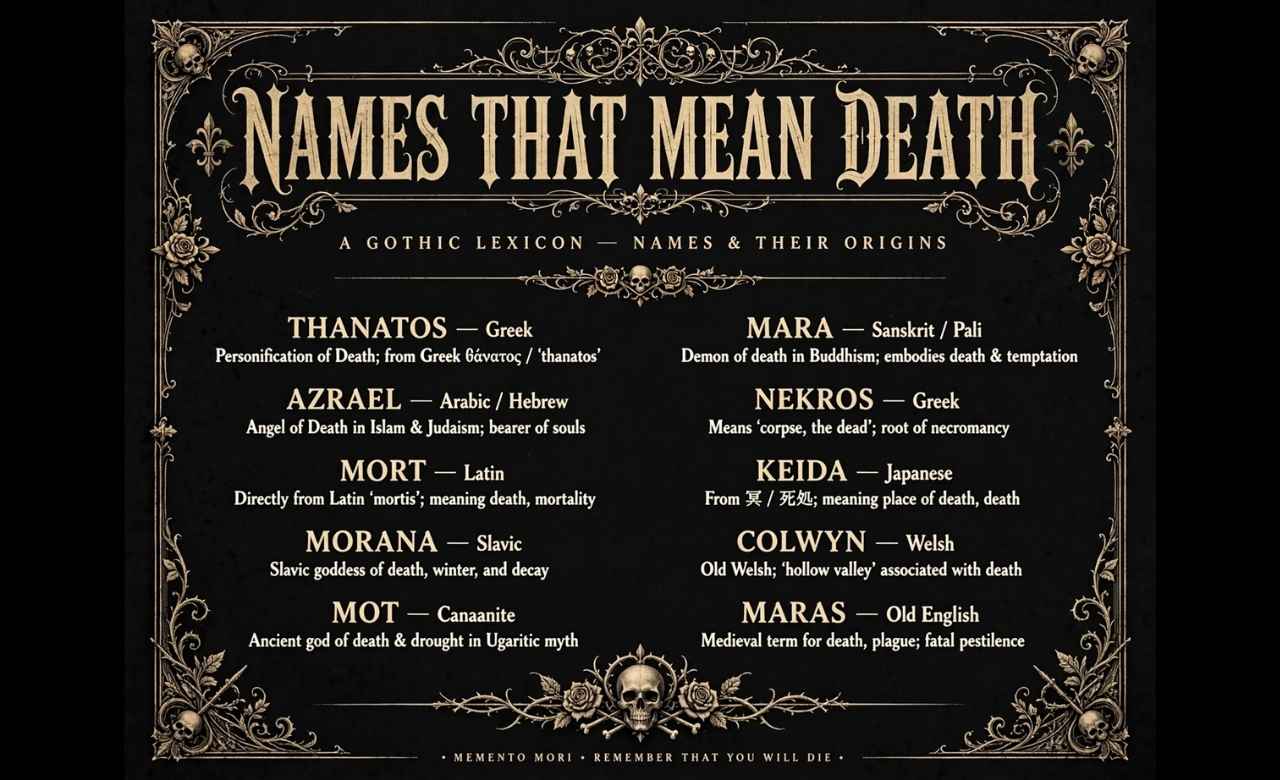
For authors and creators seeking unique, unconventional options that stand out from common anime tropes:
   [ Mumyou:   無明 ] ──► Primordial Spiritual Darkness / The Deep Void
   [ Shikkoku: 漆黒 ] ──► Obsidian / Pure Jet Black
   [ Kurayami: 暗闇 ] ──► Unbroken Midnight / The Chasm
- Mumyou (無明): “Primordial Darkness / Nescience.” A Buddhist term for spiritual blindness and the deep void before enlightenment.
- Shikkoku (漆黒): “Jet Black / Pure Obsidian Lacquer.” Represents impenetrable, lustrous darkness.
- Kageroi (蜻蛉衣): “Robes of the Phantom Mayfly.” Evokes an ethereal, fragile Names That Mean Death presence drifting between worlds.
- Yamiha (闇刃): 闇 (yami – darkness) + 刃 (ha – edge/blade). “Blade of the Dark Void.” A sharp, striking fantasy name.
- Tokoyami (常闇): 常 (toko – eternal/unchanging) + 闇 (yami – darkness). “Everlasting Darkness.” Refers to the sunless primordial world.
- Kurayami (暗闇): “Unbroken Deep Darkness.” Direct, heavy, and resonant.
- Meimei (冥々): 冥 (mei – dark/underworld/obscure). “The Obscure Netherworld.” Speaks to mysteries hidden from human senses.
Beautiful Japanese Names With Unexpected Dark Meanings
These names sound melodious, delicate, and bright on the surface, but carry kanji with dark or somber meanings.
   [ Kohaku: 琥珀 ] ──► Amber: Ancient Resin Preserving Dead Creatures
   [ Hotaru: 蛍   ] ──► Firefly: Fleeting Souls Drifting Toward the Afterlife
   [ Chiyo:  血夜 ] ──► Deceptive: "Blood Night" instead of "Thousand Generations"
| Name (Romaji) | Deceptive Surface Tone | Dark Kanji Combination | Underlying Somber Meaning |
| Hotaru | Delicate, shimmering firefly | 蛍 (Often poetic shorthand for wandering spirits) | Fireflies poetically symbolize the souls of fallen soldiers drifting over marshes. |
| Kohaku | Warm, glowing gemstone | 琥珀 (Fossilized Resin) | Ancient tree blood freezing dead insects in a golden, unyielding tomb. |
| Kanna | Sweet, floral, feminine | 棺奈 (棺 kan – coffin) + 奈 (na) | “Beauty of the Coffin.” A deliberately gothic substitution of a sweet-sounding name. |
| Rei | Cool, lovely, modern | 零 (rei – zero/nothingness) | Represents complete emotional void, nothingness, or isolation. |
| Sora | Expansive, bright sky | 虚 (sora / kyo – void/emptiness) | Uses the kanji for hollow void rather than the bright blue sky (空). |
| Yuka | Gentle, grounded, approachable | 幽香 (幽 yuu – ghostly) + 香 (ka – scent) | “Ghostly Fragrance.” The fleeting scent of incense left behind by a spirit. |
Anime-Inspired Japanese Names With Dark Meanings
Anime and manga have produced iconic characters defined by death, darkness, curses, and resurrection.
   [ Itachi:  鼬   ] ──► Weasel: Bad Omen / Harbinger of Tragic Destiny
   [ Kenpachi:剣八 ] ──► Blade of Eight Desolations / Martial Carnage
   [ Ryuk:    リューク] ──► Shinigami King / Death God Companion
- Itachi (鼬): “Weasel.” In traditional Japanese folklore, weasels are omens of misfortune, bad luck, and fiery disaster—fitting for a tragic, misunderstood anti-hero.
- Kenpachi (剣八): 剣 (ken – sword) + 八 (pachi – eight). A legendary title bestowed on the most bloodthirsty, lethal warrior in the spirit world.
- Ryuk (リューク): The iconic Shinigami from Death Note, representing whimsical, amoral curiosity surrounding human mortality.
- Homura (焔 / ほむら): “Blazing Flame.” Represents obsessive passion and karmic despair burning across repeated timelines.
- Ulquiorra (ウルキオラ): Represents the nihilistic void (Mu) and the despair of empty existence.
- Akaza (猗窩座): Associated with tragic corruption, demonic transformation, and martial obsession.
Japanese Villain and Anti-Hero Names for Characters
Anti-heroes and antagonists require names that convey narrative weight, ruthless ambition, and internal conflict.
                   ┌───────────────────────────────┐
                   │     VILLAIN & ANTI-HERO       │
                   ├───────────────────────────────┤
                   │  Kagekuro   (Black Shadow)    │
                   │  Hakai      (Ruin / Breaker)  │
                   │  Dokuro     (The Skull)       │
                   │  Akuya      (Night of Evil)   │
                   │  Gougetsu   (Ruthless Moon)   │
                   └───────────────────────────────┘
- Kagekuro (影黒): 影 (kage – shadow) + 黒 (kuro – black). “The Obsidian Shadow.” The classic double-darkness construction for unseen masterminds.
- Hakai (破壊): “Destruction / The Breaker.” A title-like name for a force of sheer, unbridled ruin.
- Dokuro (髑髏): “The Human Skull.” A stark memento mori representing a character surrounded by death.
- Akuya (悪夜): 悪 (aku – evil/harsh) + 夜 (ya – night). “Night of Malevolence.” Fits a dark sorcerer or syndicate leader.
- Gougetsu (傲月 / 豪月): 傲 (gou – arrogant) + 月 (getsu – moon). “The Arrogant Moon.” A haughty anti-hero looking down on the world.
- Ryuuzaki (竜崎 / 幽崎): 幽 (ryuu/yuu – faint/ghostly) + 崎 (zaki – cape/crag). A moody, analytical character investigating dark mysteries.
- Kagebane (影刃): 影 (kage – shadow) + 刃 (bane/ha – blade). An executioner who settles scores in the dark.
Japanese Names for Dark Fantasy Characters and Stories
Dark fantasy worlds require atmospheric names tailored to specific classes, archetypes, and power systems:
                      DARK FANTASY CASTING
   ┌──────────────────────┬──────────────────────┐
   │ Necromancers / Mages │ Assassins / Rogues   │
   │ ├─ Reimei (Pre-Dawn) │ ├─ Kurokaze (Blk Wind│
   │ ├─ Yomiko (Yomi Heir)│ ├─ Kageha (Shd Wing) │
   │ └─ Shinen (Abyss)    │ └─ Kageshiro (Phantom│
   ├──────────────────────┼──────────────────────┤
   │ Cursed Royalty       │ Bloodbound Beasts    │
   │ ├─ Kurohime (Princess│ ├─ Karasu (Raven)    │
   │ └─ Gouma (Iron Demon)│ └─ Kiba (Fang)       │
   └──────────────────────┴──────────────────────┘
1. Necromancers, Witches & Dark Priests
- Yomiko (黄泉子): “Child of the Netherworld (Yomi).”
- Reimei (霊冥): 霊 (rei – spirit) + 冥 (mei – underworld). “Soul of the Deep Netherworld.”
- Kigan (鬼願): 鬼 (ki – demon) + 願 (gan – prayer/vow). “Demonic Supplication.”
2. Assassins, Shinobi & Shadow Rogues
- Kageshiro (影白): 影 (kage – shadow) + 白 (shiro – white). “White Shadow.” An assassin who strikes in broad daylight.
- Kurokaze (黒風): “Black Wind.” Unseen momentum and silent takedowns.
- Mumon (無門): 無 (mu – void/none) + 門 (mon – gate). “The Gateless Void.” Infiltrates any stronghold unseen.
3. Cursed Royalty & Dark Knights
- Kurohime (黒姫): “The Obsidian Princess.”
- Kageuji (影氏): 影 (kage – shadow) + 氏 (uji – clan/noble house). “Heir to the Shadow House.”
- Zane (斬影): 斬 (zan – cleave) + 影 (e/kage – shadow). “Shadow Cleaver.”
How to Choose the Right Japanese Name for Your Character
Choosing the right dark, death-adjacent, or regenerative Japanese name requires balancing linguistic accuracy, thematic depth, and cultural awareness.
                  STEP-BY-STEP SELECTION MATRIX
  ┌─────────────────────────────────────────────────────────────┐
  │ 1. Define Core Thematic Arc (Death, Shadow, or Renewal?)    │
  │                             │                               │
  │                             ▼                               │
  │ 2. Select Appropriate Kanji Roots (e.g., Kuro vs. Kage)     │
  │                             │                               │
  │                             ▼                               │
  │ 3. Check Reading Balance (Onyomi vs. Kunyomi harmony)       │
  │                             │                               │
  │                             ▼                               │
  │ 4. Verify Cultural Context (Avoid unintentional real taboos)│
  └─────────────────────────────────────────────────────────────┘
1. Match the Name to the Character’s Thematic Arc
- For characters defined by terminal ends, curses, and vengeance: Prioritize roots like Rei (霊 – spirit), Shi (死 – death, fictional only), Higan (彼岸 – afterlife), or Kuro (黒 – black).
- For characters operating in stealth, secrets, and ambiguous morals: Prioritize Kage (影 – shadow), Yoru (夜 – night), Sumi (墨 – ink), or Oboro (朧 – haze).
- For characters rising from trauma, curses, or defeat: Focus on Arata (新 – new), Shinsei (新生 – new life), Tensei (転生 – rebirth), or Reimei (黎明 – dawn).
2. Pay Attention to Onyomi vs. Kunyomi Readings
Kanji have two types of readings: Kunyomi (native Japanese readings) and Onyomi (Sino-Japanese readings based on Chinese pronunciations).
- Kunyomi readings (e.g., Kuro, Kage, Yoru, Tsuki) tend to sound natural, poetic, and grounded in ancient lore.
- Onyomi readings (e.g., Koku, An, Ei, Mei) sound sharp, formal, and authoritative—ideal for villains, ancient techniques, or noble houses.
3. Respect Real-World Cultural Context vs. Dark Fantasy Tropes
If you are writing realistic contemporary Japanese fiction, avoid names with explicit death kanji like 死 (shi) or 殺 (satsu), as these do not exist as real-world given names due to imi-kotoba (naming taboos). Instead, choose authentic names with dark, subtle aesthetics (such as Sayoko, Kurogane, Hotaru, or Shigure). If writing dark fantasy, supernatural horror, or anime-inspired fiction, you have full creative license to invent striking kanji compounds like Shiei (Shadow of Death) or Yamiko (Daughter of the Void).
Comprehensive Master Reference Table
| Category | Romaji | Kanji | Meaning | Best Suited For |
| Death & Mortality | Higanbana | 彼岸花 | Red Spider Lily (Death Flower) | Cursed anti-heroines, spirits |
| Death & Mortality | Setsuna | 刹那 | Fleeting Moment of Mortality | Tragic swordsmen, philosophers |
| Darkness & Shadow | Kurogane | 黒鉄 | Black Steel / Dark Armor | Heavy tanks, dark warriors |
| Darkness & Shadow | Sayoko | 小夜子 | Child of the Deep Night | Mysterious female leads |
| Darkness & Shadow | Kageaki | 影明 | Shadow and Light | Complex dual-nature protagonists |
| Rebirth & Renewal | Tensei | 転生 | Reincarnation / Transmigration | Reborn heroes, ancient souls |
| Rebirth & Renewal | Reimei | 黎明 | Pre-Dawn Light / Awakening | Leaders rebuilding from ruin |
| Rebirth & Renewal | Arata | 新 | Fresh Beginning / Renewed | Resilient, rising characters |
| Myth & Spirits | Tsukuyomi | 月読 | God of the Moon & Netherworld | Lunar deities, night sovereigns |
| Myth & Spirits | Izanami | 伊邪那美 | Primordial Queen of the Dead | Dark goddesses, final bosses |
| Myth & Spirits | Hannya | 般若 | Demon of Sorrow & Jealousy | Vengeful spirits, cursed fighters |
| Cool & Edgy | Raiden | 雷電 | Thunder and Lightning | Swift, electric anti-heroes |
| Cool & Edgy | Reiji | 零児 | Child of the Zero Void | Cold, calculating tacticians |
| Dark Fantasy | Mumyou | 無明 | Primordial Cosmic Void | Eldritch mages, abyss lords |
The Japanese language treats darkness, mortality, and rebirth not as terrifying ends, but as natural transitions within a great, turning wheel. Whether you choose a name that mirrors the quiet falling of autumn rain (Shigure), the resilience of the black lotus (Renpei), or the dark majesty of the moonlit night (Tsukiyo), each of these names carries an ancient linguistic heritage—bringing authentic depth, spiritual resonance, and evocative power to your characters and worlds.
Frequently Asked Questions
What does Yuki mean in Japanese?
Yuki can have different meanings depending on the kanji, including “snow,” “happiness,” or “courage.” The exact meaning depends on how the name is written.
What name means danger in Japanese?
Japanese does not have one standard personal name that directly means “danger.” Words such as kiken (危険) mean “danger,” but they are not typically used as given names.
What are sad names in Japanese?
Names associated with themes like loss, loneliness, sorrow, darkness, or farewell can create a sad or melancholic feeling. Their meaning often depends on the specific kanji and cultural context.
What is the Japanese word for death?
The most common Japanese word for death is shi (死), while shibō (死亡) means “death” or “deceased” in more formal contexts. Shinu (死ぬ) is the verb meaning “to die.”
Conclusion
Choosing a name inspired by darkness, death, or mystery can give it a powerful meaning and unforgettable character. From Japanese boy names meaning dark to Japanese names with dark meanings, there are plenty of options connected with shadows, night, spirits, mystery, and transformation.
Whether you’re searching for Japanese boy names with dark meanings, Japanese names meaning dark, or Japanese names that mean death, think beyond how a name sounds. Consider its meaning, symbolism, pronunciation, and cultural context. A name inspired by darkness can represent strength, mystery, resilience, or the journey from darkness toward a new beginning.
Take your time exploring these Japanese-inspired names and choose one that truly matches your story, character, or personal style. The right name can turn a simple identity into something memorable, meaningful, and uniquely yours.May you like other article 650+ Names That Mean Flame, Fire & Fiery Spirit: Powerful Name Ideas 2026

Welcome to NameInBible. I am Victoria, a Christian writer passionate about exploring biblical name meanings, Scripture-based insights, and powerful prayers. My goal is to help readers discover the spiritual significance of names and grow closer to God through faith-filled content.