
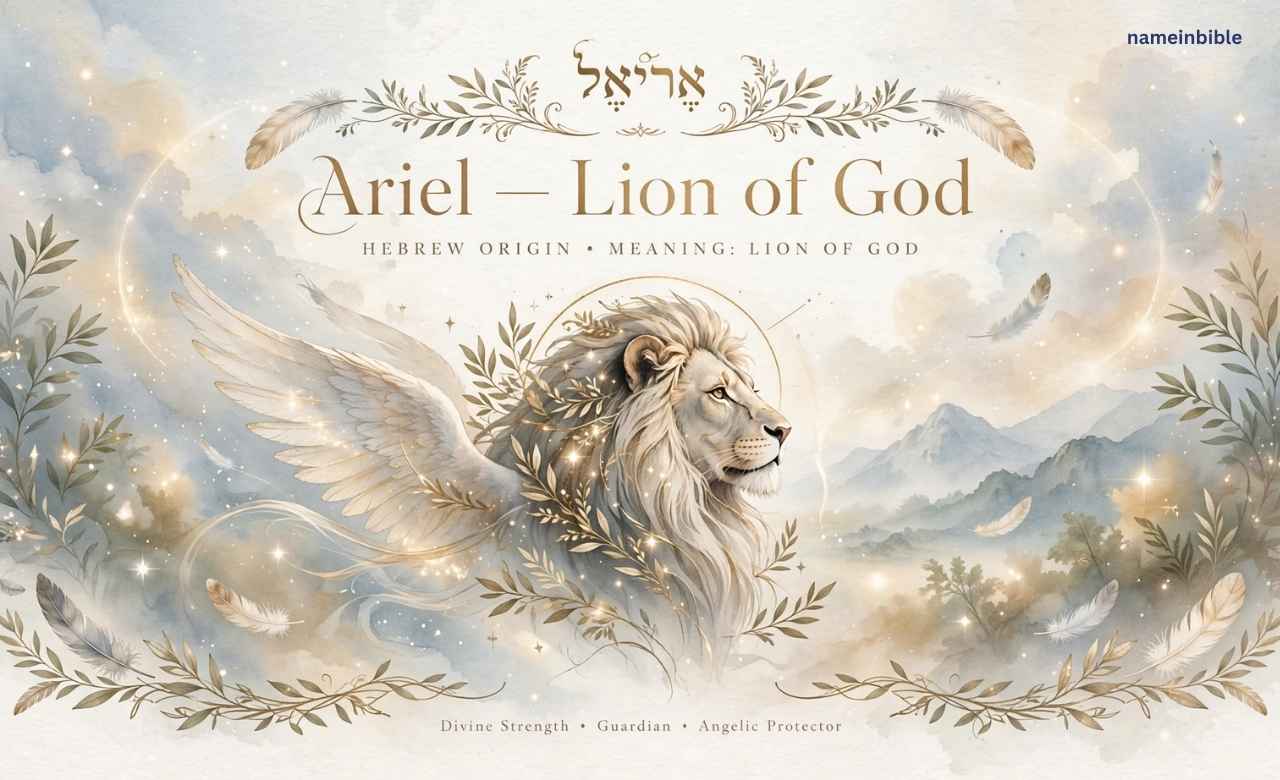
Have you ever come across the name Ariel and felt there was something deeper behind it? Perhaps you heard it during a prayer, saw it in a dream, or noticed it while read Scripture. If you’re wondering about the Ariel Meaning in the Bible, you’re not alone. This powerful Hebrew name carries rich connections to strength, worship, God’s presence, and spiritual purpose.
In Scripture, Ariel has a fascinating story because it can be understood in more than one way. It is associated with the “Lion of God” and also appears as a Ariel Meaning symbolic name connected with Jerusalem in Isaiah 29. These biblical references bring together themes of courage, holiness, correction, worship, and restoration. In this guide, we’ll look at Ariel’s Hebrew origin, biblical references, spiritual symbolism, and what this meaningful name can teach us about faith today.
What Does Ariel Mean in the Bible? Complete Biblical, Hebrew, and Spiritual Guide
The name Ariel carries a multi-layered theological weight in Scripture. Far from being merely a modern given name or a literary figure, Ariel is an ancient Hebrew title loaded with prophetic warning, sacrificial holiness, and royal divine power.
In the biblical text, Ariel serves simultaneously as a personal name, a direct cryptographic title for the holy city of Jerusalem, and an architectural reference to the sacrificial hearth of the temple. Understanding the biblical meaning of Ariel requires examining classical Hebrew linguistics, prophetic imagery in the Old Testament, and the broader theological tapestry of redemption, testing, and restoration.
Ariel Name Meaning in Hebrew and Its Biblical Origin
To understand the Ariel name meaning, one must examine the ancient Semitic language in which the Old Testament was preserved. In the original Masoretic Text of the Hebrew Scriptures, the name is written as אֲרִיאֵל (’Ărî’ēl), or occasionally in alternate spellings such as ’Uriel or ’Ariel.
The name is a classic theophoric construct—a linguistic structure Ariel Meaning pairing a root noun with a shortened name or title for the Almighty. In Semitic onomastics, the suffix -el (אֵל, ’El) points directly to the Creator God, the sovereign Lord of Israel. When parents in ancient Israel assigned an -el name (such as Dani-el, Gabri-el, or Ari-el), they tied the bearer’s earthly identity to the divine presence, character, or deeds of God.
       אֲרִי                 +            אֵל
      ('Ari)                             ('El)
   "Lion" / "Hearth"                    "God"
           \                              /
            \                            /
             אֲרִיאֵל ('Ărî’ēl) = "Lion of God" / "Altar Hearth of God"
The Hebrew origin reflects a dual linguistic root. Classical lexicographers identify two primary etymological branches:
- ’Ari (אֲרִי): Meaning “lion,” denoting predatory majesty, sovereign dominion, untamed strength, and warrior authority.
- ’Arah (אָרָה) / ’Ariel (as found in Ezekiel): Meaning “hearth,” “fireplace,” or the elevated burning platform where sacrificial offerings are consumed by fire before the Lord.
Thus, the Ariel Hebrew origin is rooted in two of the most solemn, potent realities of the ancient covenant: the unstoppable authority of the King of Creation and the purifying fire of the sacred altar.
Is Ariel a Biblical Name?
Yes, Ariel is definitively an authentic biblical name found directly within the canonical Hebrew Scriptures (the Christian Old Testament).
Unlike modern names adapted from secular traditions or popular folklore, Ariel appears in multiple passages across different historical and literary genres within the Bible:
- Prophecy: Isaiah 29:1–7 applies the title directly to Jerusalem.
- History & Genealogies: Ezra 8:16 identifies a specific Jewish leader sent by Ezra on an urgent spiritual mission.
- Military & Clan Contexts: 2 Samuel 23:20 and 1 Chronicles 11:22 reference warrior figures associated with Moab, using the term in a heroic, martial context.
Ariel is not a later liturgical invention or an apocryphal addition; it is an organic, ancient Hebrew biblical name woven through the narrative and prophetic history of ancient Israel.
The Hebrew Meaning Behind the Name Ariel
In ancient Hebrew thought, a name was not merely a convenient social label. A name revealed essence, character, destiny, and the spiritual assignment given by God. When examining what the Ariel meaning in Hebrew conveys, Scripture demands that we sit with two profound, interrelated pictures: majesty and sacrifice.
The root elements merge to establish two dominant definitions accepted across biblical scholarship:
| Hebrew Component | Root Meaning | Combined Form (’Ărî’ēl) | Theological Significance |
| אֲרִי (‘Ari) + אֵל (‘El) | Lion + God | Lion of God | Divine authority, invincible power, courage, spiritual protection, royal dominion. |
| אֲרִאֵיל / הַרְאֵל (‘Ari’el / Har’el) | Hearth / Mountain + God | Altar Hearth of God | Sacrificial devotion, holy presence, spiritual purification, divine judgment, sacred worship. |
These two meanings are not contradictory; they form a cohesive theological paradigm. The God who rules with the fierce, unyielding sovereignty of a Lion is the exact same Holy One who meets His people at the Altar, consuming sin and demanding an undivided heart.
Does Ariel Mean “Lion of God”?
The translation of Ariel as “Lion of God” is the most widely recognized and linguistically sound interpretation of the compound noun.
In Hebrew, the primary term for a mature lion is ’arî (אֲרִי) or ’aryēh (אַרְיֵה). Throughout the Ancient Near East and biblical literature, the lion stood as the undisputed monarch of beasts, representing:
- Invincible Might: The lion fears no adversary and does not turn back before any creature (Proverbs 30:30).
- Judah’s Royal Line: In Genesis 49:9, the patriarch Jacob blesses his son Judah, calling him Gur Aryeh (“a lion’s whelp”) and declaring that the royal scepter shall not depart from his line. This messianic lineage culminates in the New Testament title for Jesus Christ: the “Lion of the Tribe of Judah” (Revelation 5:5).
- Divine Power: When God acts against wickedness or defends His chosen covenant community, Scripture frequently portrays His voice as a roar: “The lion has roared; who will not fear? The Lord God has spoken; who can but prophesy?” (Amos 3:8).
When applied to an individual or a sacred community, calling someone the “Lion of God” signifies that their inner strength does not originate in physical muscle or human willpower. It means their courage, authority, and resilience are fueled directly by God’s strength and the impartation of the Holy Spirit.
Ariel and the Meaning “Altar of God”
While “Lion of God” captures the imagination, serious biblical scholarship recognizes an equally profound translation: “Altar Hearth of God.”
This meaning emerges prominently in prophetic literature dealing with temple worship, the sanctuary, and sacred architecture. In Ezekiel 43:15–16, the prophet describes the visionary future temple and specifically designates the upper surface of the altar of burnt offering—the very hearth upon which the sacred sacrificial fire burned continuously:
“And the altar hearth (Hebrew: Harel / Ariel) shall be four cubits; and from the altar hearth upward there shall be four horns. The altar hearth shall be square, twelve cubits long by twelve cubits broad.”
Here, the linguistic connection points toward the consuming fire of God’s holy presence:
[ SACRED ALTAR HEARTH ]
          ▲
          │ (Fire descending from God)
          │  Consuming sin, accepting the blood atonement
          ▼
[ THE HEARTH OF ARIEL ] ──> A place of death to self, continuous worship,
                            and absolute surrender before the Holy One
The altar hearth was the place where:
- Sin was atoned for through the blood of innocent substitutes.
- The holy fire fell from heaven (Leviticus 9:24), never to be put out.
- Sweet-smelling incense and animal sacrifices rose as sweet savors of total devotion to the Almighty.
Thus, Ariel conveys the profound solemnity of an altar—a place of death, surrender, burning purification, and covenant communion with God.
Where Is Ariel Mentioned in the Bible?
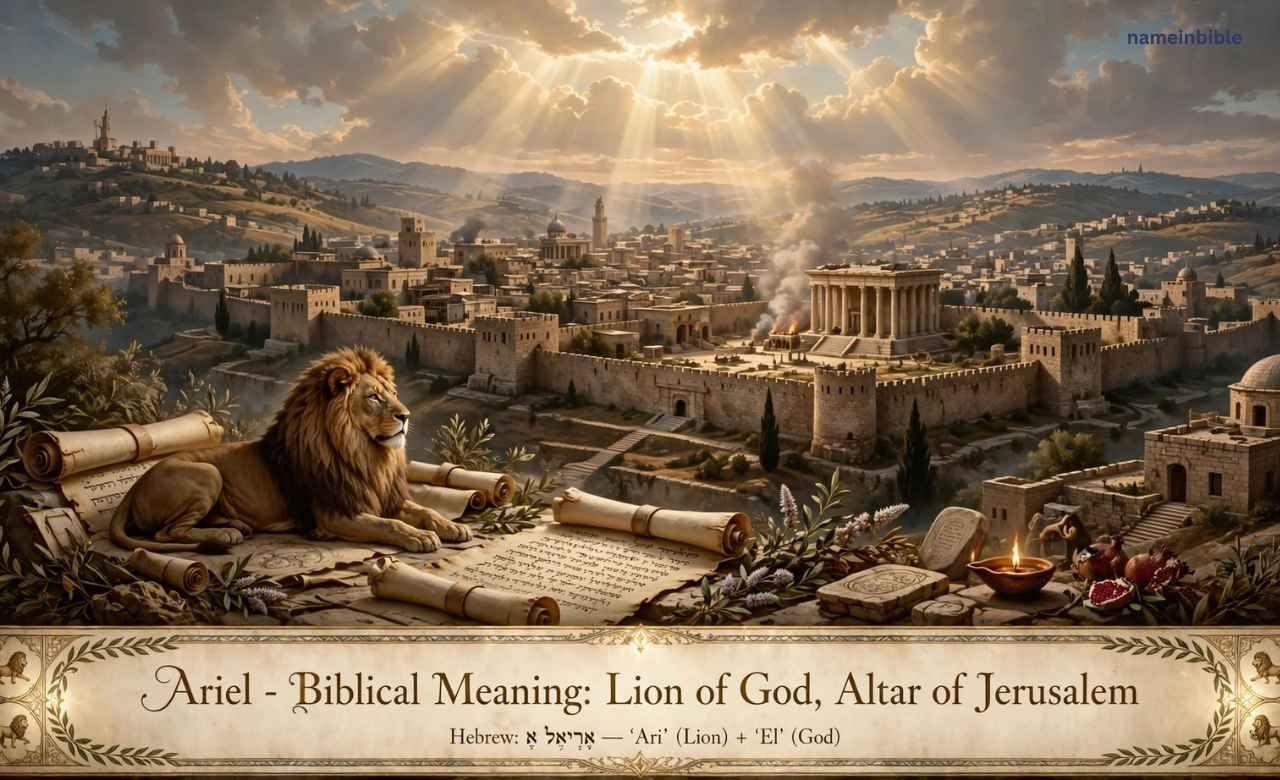
To grasp the full biblical meaning of Ariel, we must examine the specific biblical texts where the word appears. Ariel appears across three distinct books of the Bible, occupying unique literary spaces:
1. The Prophetic Judgment and Deliverance of Jerusalem: Isaiah 29:1–7
The prophet Isaiah uses “Ariel” four distinct times in the span of two verses to refer directly to the historic capital of Judah:
“Ah, Ariel, Ariel, the city where David encamped! Add year to year; let the feasts run their round. Yet I will distress Ariel, and there shall be moaning and lamentation, and she shall be to me like an Ariel.” (Isaiah 29:1–2, ESV)
2. The Restitution and Purity of the Temple Ministry: Ezra 8:16
In the post-exilic historical book of Ezra, when the Jewish exiles were returning from Babylonian captivity to rebuild Jerusalem and restore temple worship, a man named Ariel is introduced as a prominent community leader:
“Then I sent for Eliezer, Ariel, Shemaiah, Elnathan, Jarib, Elnathan, Nathan, Zechariah, and Meshullam, leading men; also for Joiarib and Elnathan, who were men of insight.” (Ezra 8:16, ESV)
3. The Heroic Deeds of Benaiah: 2 Samuel 23:20 & 1 Chronicles 11:22
In the historical records of King David’s mighty men, David’s royal bodyguard commander, Benaiah the son of Jehoiada, is commended for his valor:
“Benaiah the son of Jehoiada was a valiant man of Kabzeel, a doer of great deeds. He struck down two ‘ariels’ of Moab [often translated as ‘two lion-like men’ or ‘champions of Moab’].” (2 Samuel 23:20)
Ariel in the Book of Isaiah Explained
The 29th chapter of Isaiah represents the most extensive, theologically rich, and contextually critical usage of the term Ariel in the entirety of the Bible.
Isaiah lived during the eighth century BC, a tumultuous era when the ruthless Assyrian Empire, led by King Sennacherib, swept across the Levant, conquering the northern kingdom of Israel and reducing Judah’s fortified cities to rubble. In Isaiah 29, the prophet delivers a chilling, poetic oracle concerning the impending siege of Jerusalem.
       HISTORICAL & PROPHETIC FRAMEWORK: ISAIAH 29
─────────────────────────────────────────────────────────────
• Historical City:  Jerusalem (The Mount Zion of David)
• Symbolic Title:   Ariel ("Lion of God" / "Altar Hearth")
• The Crisis:       Empty, ritualistic religion without heart surrender
• The Consequence:  Divine distress; foreign armies encamp like an altar fire
• The Culmination:  Sudden supernatural deliverance of the faithful remnant
Isaiah opens his prophetic lament with the mournful Hebrew particle Hôy (הוֹי), translated as “Ah,” “Woe,” or “Alas.” This is a funeral dirge. God is not speaking to a foreign pagan city like Nineveh, Babylon, or Damascus; He is addressing the city where David dwelt—the very epicenter of His covenant promises.
The repetition in the prophetic cry, “Ariel, Ariel,” carries extreme urgency in biblical Hebrew. Doubling a name (as in “Abraham, Abraham” or “Samuel, Samuel”) marks a moment of solemn divine intervention, deep passion, and cosmic importance.
What Does Ariel Represent in Isaiah 29?
In Isaiah 29, Ariel represents Jerusalem standing under the scrutiny of divine holiness. The passage pivots masterfully on a terrifying play on words regarding both definitions of Ariel:
- The City That Thought It Was a “Lion of God”: Jerusalem boasted in its invincibility. It was the royal city of King David, protected by God’s promise. The inhabitants assumed their heritage, walls, and royal Davidic lineage made them untouchable. They roared in pride like a young lion.
- The City Turned Into an “Altar Hearth”: Because the people practiced superficial religion—going through the motions of the sacred calendar while their hearts were far from God (Isaiah 29:13)—God warned that He would turn the entire city into an Ariel: an altar hearth of slaughter and burning.
Isaiah 29:2 delivers this stark prophetic irony:
“Yet I will distress Ariel, and there shall be moaning and lamentation, and she shall be to me like an Ariel.”
God proclaims: You call yourself the Lion of God, secure within your palaces. But because of your unrepentant idolatry and mechanical worship, I will bring the siege engines against you. The entire city will become an altar, surrounded by fire, where human lives and architectural pride will be consumed like sacrificial fat on the temple hearth.
Yet, the chapter does not terminate in despair. In Isaiah 29:5–8, God shifts from judge to protector. When the foreign hordes surround Jerusalem, the Almighty descends in thunder, earthquake, flame, and tempest. The enemies of Ariel are crushed and vanish like chaff before the wind.
Thus, Ariel represents both the chastening discipline of God and His unshakable covenant commitment to redeem and defend His people.
Ariel as a Symbol of Jerusalem in Scripture
Why did the Holy Spirit inspire Isaiah to substitute the beloved name Yerushalayim (Jerusalem) with the enigmatic title Ariel?
Jerusalem was known across the ancient world as:
- The City of David: The seat of the earthly king and the throne of Judah.
- The Location of Mount Moriah: The place where Abraham offered Isaac (Genesis 22) and where Solomon erected the magnificent temple.
- The City of the Great King: The earthly dwelling place of Yahweh’s presence, positioned between the wings of the cherubim over the Ark of the Covenant.
By renaming Jerusalem Ariel, Scripture emphasizes that Jerusalem’s true significance was never its stone masonry, high defensive ramparts, or military garrisons.
Jerusalem’s only true glory was the Altar of God at its center. Without holy worship, genuine obedience, and total reliance upon divine power, Jerusalem was no better than any pagan capital.
Ariel symbolizes Jerusalem stripped of superficial pretense: a place where God demands truth in the inward parts, where His refining fire burns, and where He establishes His eternal peace through holiness.
Ariel in Ezra: The Biblical Context of the Name
Moving from the poetic laments of the prophets to the historical narrative of the restoration, we encounter Ariel as a personal name in Ezra 8:16.
Following seventy years of Babylonian exile, the Persian king Artaxerxes permitted the priest-scribe Ezra to lead a secondary wave of Jewish exiles back to Jerusalem. Their mission was crucial: to re-establish the Torah, purify the priesthood, and restore legitimate sacrificial worship at the rebuilt temple.
       EZRA'S RECRUITMENT CRISIS (Ezra 8:15–20)

  Gathering at River Ahava  ──>  Discovered NO Levites among the people
                                      │
                                      ▼
             Ezra sends elite leaders (Including ARIEL)
                                      │
                                      ▼
               Successful Mission to Casiphia
                                      │
                                      ▼
       Brought 38 Levites & 220 Temple Servants back to serve God's House
Upon assembling the exiles at the river of Ahava, Ezra made a distressing discovery: there were no sons of Levi among the volunteers. Without Levites, no animal sacrifices could be offered, the altar could not function, and the temple would stand spiritually hollow.
Ezra immediately commissioned a delegation of nine prominent, trustworthy men to embark on a sensitive recruitment mission to the Jewish settlement at Casiphia. Among these key men was Ariel.
In this historical account, Ariel is designated as one of the ro’shim—a “chief man,” a person of insight, leadership, social standing, and unquestioned integrity.
Ariel’s biblical assignment was clear: to step out in faith, go behind enemy lines of spiritual apathy, and bring back consecrated servants dedicated to holy worship. The expedition was an overwhelming success, securing nearly three hundred Levites and temple servants to re-ignite the holy fires upon the altar in Jerusalem.
Is Ariel a Person, Place, or Symbol in the Bible?
Given the diverse passages examined, biblical readers frequently ask whether Ariel should be classified as a personal name, a geographical location, or an abstract spiritual metaphor.
The accurate theological answer is: Ariel is all three.
                           THE TRIFOLD BIBLICAL IDENTITY OF ARIEL
                                             │
      ┌──────────────────────────────────────┼──────────────────────────────────────┐
      │                                      │                                      │
      ▼                                      ▼                                      ▼
1. AS A PERSON                         2. AS A PLACE                          3. AS A SYMBOL
• Leader under Ezra (Ezra 8:16)        • Prophetic name for Jerusalem        • "Lion of God" (Sovereignty)
• Champion/warrior in David's era        (Isaiah 29:1–7)                      • "Altar Hearth" (Purification)
  (2 Samuel 23:20)                     • The hearth of the sanctuary          • Spiritual transformation through
                                         altar (Ezekiel 43:15–16)               trials and fire
- Ariel as a Historical Person: In Ezra 8:16, Ariel is an authentic human being—a post-exilic leader with administrative authority, practical wisdom, and devotion to God’s house. In 2 Samuel 23:20, the plural or construct form describes elite, lion-like warriors.
- Ariel as a Geographical Place: In Isaiah 29, Ariel is a prophetic proper noun directly designating the historic, walled city of Jerusalem, where David pitched his royal tent and established his dynasty.
- Ariel as an Enduring Spiritual Symbol: Throughout biblical theology, Ariel functions as a living emblem of the dual nature of God’s dealings with humanity: combining the invincible authority of the Lion with the refining fire of the Altar.
Ariel as a Name Connected to God’s Strength
Throughout the Old and New Testaments, the fundamental human dilemma is self-sufficiency: relying on the “arm of the flesh” rather than leaning entirely upon the Almighty.
The name Ariel serves as a permanent linguistic antidote to human arrogance. By joining ’Ari (lion) to ’El (God), the name reminds us that true spiritual authority does not stem from human charisma, intellectual prowess, or physical might:
- The Source of Courage: A lion is naturally bold, but a “Lion of God” derives its boldness from knowing that the Lord of Hosts surrounds and sustains it. As Proverbs 28:1 declares, “The wicked flee when no one pursues, but the righteous are bold as a lion.”
- The Subordination of Power: The name reminds every believer that all dominion belongs unconditionally to God. The lion is not autonomous; it belongs to ’El. Any strength granted to humanity is held in sacred stewardship for God’s divine purposes.
- Victory in Spiritual Warfare: In Christian theology, the believer does not war against flesh and blood, but against spiritual principalities (Ephesians 6:12). The name Ariel calls the follower of Christ to put on divine armor, standing firm in the omnipotent strength of the Lion of Judah.
The Spiritual Meaning of Ariel
When transitioning from purely historical exegesis to the wider spiritual meaning of the name Ariel, one discovers a profound portrait of the Christian life.
The spiritual meaning of Ariel centers on the collision between divine holiness and human brokenness. It illustrates what occurs when a sovereign, holy God draws near to an imperfect, fragile human being.
To be linked to the spiritual frequency of Ariel is to be marked for a life that refuses superficiality. It means understanding that God will not tolerate empty religious rituals or shallow, external piety.
The spiritual essence of Ariel is consecration: allowing the Holy Spirit to burn away carnal pride upon the altar of worship until nothing remains except pure faith, genuine love, and the untamed power of the Living God.
What Does the Name Ariel Symbolize?
In biblical typology and Christian devotional thought, the name Ariel symbolizes four core spiritual realities:
                          FOUR PILLARS OF ARIEL SYMBOLISM
                                         │
      ┌──────────────────┬───────────────┴───────────────┬──────────────────┐
      ▼                  ▼                               ▼                  ▼
1. SACRIFICIAL     2. UNYIELDING                   3. PURIFYING       4. UNCONDITIONAL
   SURRENDER          BOLDNESS                        DISCIPLINE         DELIVERANCE
   Living life as     Standing firm in truth          Allowing God to    Trusting God to save
   a living sacrifice against the currents            burn away sin      His remnant through
   on God's altar.    of cultural darkness.           in life's trials.  every dark storm.
- Sacrificial Surrender: Ariel symbolizes a heart laid bare before God. Romans 12:1 commands believers to present their bodies as “a living sacrifice, holy and acceptable to God, which is your spiritual worship.” Ariel is the physical and spiritual place where human self-will dies so that divine life can resurrect.
- Unyielding Boldness and Moral Courage: Just as the lion walks through the wilderness without fear of intimidation, Ariel symbolizes the believer who walks uprightly in a fallen, hostile world, refusing to compromise biblical truth for social convenience.
- Purifying Discipline: Ariel symbolizes the furnace of affliction. When God permits trials in the life of His people, He is not seeking to destroy them; He is using the altar of adversity to melt away dross and produce refined gold (1 Peter 1:7).
- Unconditional Deliverance: Even when Jerusalem was surrounded by overwhelming imperial armies, God defended Ariel for His own name’s sake. The name symbolizes that God’s covenant mercy will always have the final word over those who truly place their trust in Him.
Biblical Symbolism Associated With Ariel
Scripture is rich with interconnected metaphors, and the components that form Ariel appear in several key biblical symbols:
The Golden Altar and the Bronze Altar
Under the Mosaic Covenant, the Tabernacle featured two distinct altars: the Bronze Altar of Burnt Offering (representing blood atonement, forgiveness of sin, and complete dedication) and the Golden Altar of Incense (representing uninterrupted intercessory prayer and adoration). Ariel connects directly to this sacrificial economy, reminding the reader that approaching the King of Kings requires atonement, reverence, and cleansing.
The Cherubim Faces
In the prophetic throne-room visions of Ezekiel (Ezekiel 1:10) and John the Revelator (Revelation 4:7), the four living creatures surrounding the celestial throne possess four distinct faces: a human, an eagle, an ox, and a lion. The face of the lion symbolizes royalty, majesty, executive authority, and sovereign power—attributes directly embedded within the name Ariel.
Fire from Heaven
In the Old Testament, whenever God accepted an offering with supreme pleasure, He did not wait for men to light the wood; holy fire fell directly from heaven to consume the sacrifice (Leviticus 9:24; 1 Kings 18:38; 2 Chronicles 7:1). As the “Altar of God,” Ariel symbolizes the descending, supernatural presence of the Holy Spirit, consuming our worldly nature and setting our spirits ablaze with holy passion.
Ariel and the Themes of Strength, Worship, and God’s Presence
Ariel sits at the cross-section of three dominant themes that run across the entire biblical storyline:
                                [ THE PRESENCE OF GOD ]
                                           ▲
                                          / \
                                         /   \
                                        /     \
                                       ▼       ▼
                             [ ROYAL STRENGTH ] ─── [ TRUE WORSHIP ]
                                  ("Lion")              ("Altar")
1. Royal Strength Without Arrogance
Human strength easily degenerates into tyranny, pride, and self-glorification. Ariel re-aligns human power with its divine origin. True spiritual strength is not demonstrated through aggressive domination, but through quiet, unshakable confidence in the promises of God. It is strength rooted in righteousness.
2. Authentic, Costly Worship
David famously declared, “I will not offer burnt offerings to the Lord my God that cost me nothing” (2 Samuel 24:24). The altar hearth of Ariel rejects cheap grace and superficial religion. Worship that pleases God requires the sacrifice of our time, our pride, our ambitions, and our carnal preferences.
3. The Transforming Presence of God
Where the Altar is raised and the Lion roars, God’s manifest presence (Shekinah) dwells. In His presence, mountains melt like wax, demonic powers tremble, and broken human hearts find total healing and eternal security.
The Positive Spiritual Meaning of Ariel
When parents, believers, and students of the Bible consider Ariel as a name or personal identity, its positive spiritual dimensions offer immense encouragement:
- A Heritage of Divine Protection: To be marked by the name Ariel is to rest in the comforting reality that the Lord is an impenetrable fortress. The Lion of God watches over His flock; He neither slumbers nor sleeps (Psalm 121:4).
- Inner Spiritual Resilience: Life in a fallen world brings seasons of intense grief, sudden tragedy, and unexpected conflict. The spiritual blessing of Ariel imparts an internal, supernatural stamina—a God-given resolve that enables a person to weather every storm without breaking.
- A Heart Consumed with Holy Fire: In an age characterized by spiritual apathy, cynicism, and lukewarm devotion, the positive spiritual meaning of Ariel is a life ablaze with divine love. It mirrors the disciples on the Emmaus road whose hearts burned within them as Christ opened the Scriptures (Luke 24:32).
- Leadership and Moral Clarity: Like the historical Ariel in Ezra 8, who rallied others to serve God’s house when enthusiasm was low, the name carries a call to leadership, integrity, and proactive kingdom impact.
The Warning or Deeper Meaning of Ariel in Scripture
It is a dangerous spiritual mistake to treat biblical names as harmless, sentimental trinkets. The Bible never uses the word Ariel as a flattering compliment; in Isaiah 29, it is a grave warning.
The sober, deeper meaning of Ariel carries several critical admonitions for every community of faith:
“Because this people draw near with their mouth and honor me with their lips, while their hearts are far from me, and their fear of me is a commandment taught by men…” (Isaiah 29:13)
The Danger of Empty Ritualism
Jerusalem possessed the glorious temple, the Aaronic priesthood, the Levitical choirs, and the annual feasts. Yet God declared He would bring distress upon Ariel. Why? Because external religion without internal repentance is an offense to God. Going to church, singing hymns, and quoting scripture mean nothing if the heart is harboring bitterness, secret sin, and pride.
The Inevitability of Divine Sifting
If we will not voluntarily lay our lives upon the altar of worship as an Ariel, God in His loving discipline may permit life circumstances to become an altar hearth that forces us to our knees. God loves His children too deeply to leave them in their self-deception. His refining fire will consume our wood, hay, and stubble (1 Corinthians 3:12–15) so that eternal spiritual gold can emerge.
What Does Ariel Mean Spiritually in Your Life?
When reflecting on the name Ariel on a personal, devotional level, several profound questions emerge for your spiritual walk:
                            PERSONAL SPIRITUAL INVENTORY: ARIEL
──────────────────────────────────────────────────────────────────────────────────────────
  QUESTION 1:  Am I relying on my own human intellect, or am I moving in the strength
               of the "Lion of God"?

  QUESTION 2:  Is my heart a functioning "Altar of God," where my personal ambitions
               are freely surrendered to His will?

  QUESTION 3:  Has my spiritual life devolved into mechanical routine, or is it alive
               with the genuine fire of the Holy Spirit?
──────────────────────────────────────────────────────────────────────────────────────────
If you are navigating a season of intense pressure, difficulty, or spiritual warfare, the name Ariel speaks directly to your circumstances:
- It declares that the battle you face is not yours, but the Lord’s. The Lion of Judah fights on behalf of those whose hearts are fully devoted to Him.
- It reframes your suffering. Your trials are not arbitrary accidents; they are the refining hearth of God, burning away fear, self-reliance, and worldliness, preparing you for higher spiritual authority.
Ariel Name Meaning in Dreams: A Biblical Perspective
Throughout Scripture, God frequently utilized dreams and visions of the night to communicate warnings, instructions, and prophetic destiny to His people (Genesis 28:10–19; 1 Kings 3:5; Matthew 1:20; Acts 2:17).
When contemplating the biblical dream meaning of the name or imagery of Ariel, one must always filter nocturnal experiences through the authoritative lens of written Scripture, seeking the discernment of the Holy Spirit rather than secular dream dictionaries.
Dreaming of the word, name, or explicit biblical symbols of Ariel—such as a majestic lion resting beside a burning sacred altar—carries significant spiritual symbolism. Generally, such dreams revolve around two primary themes: an encounter with God’s sovereign power or a summons to deeper personal consecration.
Seeing Ariel in a Peaceful Dream: Possible Meaning
If you experience a dream featuring the name Ariel, a lion, or an altar bathed in light, serenity, and peace, several biblical interpretations emerge:
- A Reassurance of Divine Protection: In biblical imagery, when a lion appears peaceful and protective (as opposed to predatory), it frequently symbolizes the watchful eye of the Lord. The dream may be an encouragement from the Holy Spirit that the Lion of the Tribe of Judah is actively guarding you, your family, or your calling against spiritual adversaries.
- Confirmation of Divine Favor and Calling: Hearing or seeing the name Ariel in a tranquil context may signal a divine commissioning. Much like Ezra calling upon Ariel to recruit temple servants, God may be calling you to step forward into spiritual leadership, spiritual discernment, or renewed kingdom service.
- Restoration of Broken Altar Worship: If the dream centers on the altar hearth aspect of Ariel in an atmosphere of reverence, it may indicate that your season of seeking, prayer, and repentance has been heard by God. The Lord is accepting your life as a sweet-smelling aroma, ushering you into a season of renewed spiritual peace and spiritual awakening.
Seeing Ariel in a Frightening or Intense Dream
Not all spiritual dreams are comfortable. At times, the Holy Spirit allows shaking visions to awaken our consciences, mirroring the intense prophetic warnings of Isaiah 29.
If the dream involves a menacing lion, a consuming, uncontrolled fire, or distress surrounding the name Ariel, consider the following scriptural warnings:
- A Call to Urgent Repentance: Just as Isaiah warned Jerusalem that her mechanical religion would turn her into an altar of distress, a terrifying dream may be an urgent warning against complacency. It serves as a holy wake-up call to examine your heart, abandon hidden sins, and return to sincere fellowship with Jesus Christ.
- Confronting Spiritual Warfare: Scripture notes that the enemy, Satan, prowls around like a roaring lion seeking someone to devour (1 Peter 5:8). An intense dream may expose an impending spiritual attack or an atmosphere of fear that must be confronted using the Word of God, the name of Jesus, and the power of the blood of the Lamb.
- Entering the Refining Furnace: If the dream portrays an intense, burning altar, it may signify that you are entering a period of spiritual testing. The fire will be hot, but its purpose is not your destruction; it is the holy fire of God sent to purge away every encumbrance that hinders your race of faith.
Does the Name Ariel Have a Prophetic Meaning?
Yes, the name Ariel holds significant prophetic weight within the grand narrative of end-times biblical prophecy and messianic redemption.
                  THE PROPHETIC TRAJECTORY OF ARIEL (JERUSALEM)
                                        │
     ┌──────────────────────────────────┴──────────────────────────────────┐
     ▼                                                                     ▼
PAST / HISTORICAL FULFILLMENT                               FUTURE / ESCHATOLOGICAL FULFILLMENT
• Siege of Jerusalem by Sennacherib (701 BC)                • Final gathering of nations against Jerusalem
• Sudden judgment on the Assyrian army                       (Zechariah 12 & 14; Revelation 19)
• Physical altar fire in Solomon's and Zerubbabel's temple  • Consummation of God's Kingdom; Messiah's reign
In prophetic literature, Jerusalem (Ariel) is the geographic center of God’s redemptive history. In the ultimate eschatological showdown described in Zechariah 12–14 and Revelation 19–20:
- The nations of the earth gather in rebellion against the holy city of Jerusalem.
- The city appears completely vulnerable, surrounded by overwhelming military might—just as Isaiah described in Isaiah 29:1–4.
- Suddenly, the heavens tear open. The Messiah descends in royal majesty as the Lion of Judah, crushing the armies of darkness with the breath of His mouth, and establishing His millennial reign of righteousness.
Thus, Ariel prophetically testifies that no matter how dark human history becomes, the purpose of God will stand. The holy fire will purify, the true Lion will reign, and God’s chosen city and covenant people will experience everlasting redemption.
Ariel Meaning in Christianity and Christian Baby Names
Over the past century, Ariel has become an immensely popular name across Christian families globally, used for both boys and girls (though frequently viewed as masculine in Israel and predominantly feminine or unisex in Western cultures).
When Christian parents select Ariel as a Christian baby name, they are choosing far more than a melodic, lyrical sound. They are bestowing an ancient covenant prayer over the life of their child:
                            BLESSINGS EMBEDDED IN THE NAME ARIEL
                                             │
      ┌──────────────────────────────────────┼──────────────────────────────────────┐
      │                                      │                                      │
      ▼                                      ▼                                      ▼
BOLDNESS & COURAGE                     SACRIFICIAL PURITY                     KINGDOM PURPOSE
"May this child stand as a             "May this child live as an             "May this child possess
Lion of God, refusing to bow           uncompromised Altar of God,            insight, leadership, and
to peer pressure, secular apathy,      consecrated and filled with the        wisdom to call others into
or spiritual compromise."              fire of the Holy Spirit."              the worship of God."
In Christian naming theology, giving a child a biblical name creates a continuous spiritual anchor. Every time the child hears their name called, they are subtly reminded of their identity in Christ: they are not orphans in a chaotic world, but warriors and worshipers belonging to the King of Kings.
Ariel Meaning in Islam: What Does It Mean?
Because Hebrew and Arabic share deep Semitic roots, many individuals ask about the Ariel meaning in Islam and whether the name exists in Islamic theology and the Quran.
- Absence in the Quran: The specific compound Hebrew name Ariel does not appear in the Quran, nor is it listed among standard traditional Islamic religious names.
- Arabic Linguistic Cognates: In Arabic, the word for lion is typically Asad (أَسَد) or Haydar (حَيْدَر). The Arabic equivalent to the Hebrew name for God (’El) is Ilah or Allah. The Islamic equivalent concept to “Lion of God” is the Arabic title Asadullah (أَسَدُ الله).
- Historical Usage of the Concept in Islam: The title Asadullah (“Lion of God”) was famously bestowed by the Prophet Muhammad upon his uncle, Hamza ibn Abd al-Muttalib, and later heavily associated with Ali ibn Abi Talib (the fourth Caliph and first Shia Imam) due to their legendary battlefield courage.
- General Islamic Perspective on the Name: Arabic speakers recognize Ariel (Ari’el / أريئيل) primarily as a distinct, historically Jewish and Hebrew biblical name. While Arabic and Islamic culture respects biblical prophets, the name Ariel is generally understood within the Islamic world through the lens of its Hebrew biblical roots rather than Islamic scripture.
Ariel vs. Arielle: Meaning, Origin, and Biblical Connection
In contemporary naming trends, the spellings Ariel and Arielle are often used interchangeably. However, exploring their etymological nuances clarifies their historical and biblical connection:
| Linguistic Category | Ariel (אֲרִיאֵל) | Arielle (French Variation) |
| Linguistic Origin | Classical Biblical Hebrew | French feminine adaptation of the Hebrew root |
| Gender Use (Global) | Unisex (predominantly masculine in Hebrew) | Predominantly feminine |
| Literal Meaning | “Lion of God” / “Altar Hearth of God” | “Lioness of God” / “Altar of God” |
| Biblical Presence | Appears directly in the canonical Hebrew text | Does not appear in Scripture (derivative form) |
| Phonetic Cadence | Three syllables: Ah-ree-el or Air-ee-uhl | Three syllables: Ah-ree-EL (emphasis on last syllable) |
Both names draw entirely from the exact same Hebrew root (’Ari + ’El). Choosing Arielle retains the entire rich biblical tapestry of the “Lion of God” while incorporating a soft, elegant French cadence.
What Can Christians Learn From the Biblical Meaning of Ariel?
The study of Ariel is far more than an academic exercise in Hebrew lexicography; it provides a comprehensive manual for authentic Christian discipleship.
1. Merge Strength With Sacrifice
Modern culture often celebrates aggressive, self-assertive strength. Conversely, some religious circles paint humility as passive, weak, and voiceless. The name Ariel shatters this false dichotomy:
- The Lion without the Altar results in ruthless tyranny, pride, and spiritual destruction.
- The Altar without the Lion results in cowardice, compromise, and defeat in the face of evil.
- The Christian is called to embody both: fearless courage against the forces of darkness, accompanied by total, brokenhearted surrender upon the altar of God.
2. Guard Against the Leaven of Empty Religion
Isaiah’s warning to Ariel remains burning truth for the modern church. It is entirely possible to construct magnificent buildings, host emotionally charged worship gatherings, and memorize Christian terminology while the Lord Himself stands grieved outside the door. God desires truth in the inner being. He calls us to throw open the doors of our hearts, invite His refining fire to consume our hidden hypocrisies, and walk in authentic holiness.
3. Step Forward as Spiritual Leaders in Times of Spiritual Lack
Like the faithful leader Ariel in Ezra 8, Christians are living in a culture experiencing a devastating spiritual famine—a desperate shortage of individuals willing to serve the house of God with pure motives. God is seeking modern Ariels: men and women of insight, wisdom, and steadfast dedication who will leave their comfort zones, rally the weary, and restore the beauty of holy worship to the world.
Frequently Asked Questions
Why is Jerusalem called Ariel?
Jerusalem is called Ariel in Isaiah 29 as a symbolic name connected with the city of David. The term can suggest both “Lion of God” and an altar-like place, highlighting Jerusalem’s strength, worship, judgment, and restoration.
What does Ariel symbolize?
Biblically, Ariel symbolizes strength, holiness, worship, divine presence, and spiritual refinement. Its meaning also reflects the balance between God’s correction and His promise of restoration.
Is Ariel an angel or an archangel?
The Bible does not identify Ariel as an angel or archangel. Ariel appears in Scripture mainly as a name and symbolic term, while later religious traditions sometimes associate Ariel with angelic figures.
What does Ariel mean in Isaiah?
In Isaiah 29, Ariel is used as a symbolic name for Jerusalem, the city where David lived. The passage combines themes of warning, judgment, worship, and eventual divine restoration.
Who is God’s strongest angel?
The Bible does not clearly rank angels by physical strength. Michael the archangel is portrayed as a powerful heavenly warrior, especially in Daniel, Jude, and Revelation.
What does Ariel mean biblically?
The biblical meaning of Ariel is commonly connected with “Lion of God” and, in some contexts, an altar or hearth of God. In Scripture, the name is especially associated with Jerusalem and themes of divine strength, worship, correction, and restoration.
Conclusion
The Ariel Meaning in the Bible carries a powerful blend of strength, worship, holiness, and God’s presence. Its connection with the Hebrew ideas of the “Lion of God” and “Altar of God,” along with its symbolic use for Jerusalem in Isaiah 29, gives the name a deeper biblical significance than its simple definition suggests.
Ultimately, Ariel reminds us that faith can involve both strength and surrender. God may call us to stand courageously, but He also invites us to lay down fear, pride, and control before Him. Whether you’re researching the name Ariel, considering it for a child, or reflecting on its spiritual symbolism, its biblical themes point toward faith, repentance, restoration, and trust in God.
The most important lesson is not simply the meaning of a name, but the truth it points toward: God’s strength can sustain us, His presence can guide us, and His correction can lead us toward restoration. Read other article 650+ Funny & Creative Names That Mean Infinite: Unique Ideas for Every Style

Welcome to NameInBible. I am Victoria, a Christian writer passionate about exploring biblical name meanings, Scripture-based insights, and powerful prayers. My goal is to help readers discover the spiritual significance of names and grow closer to God through faith-filled content.