
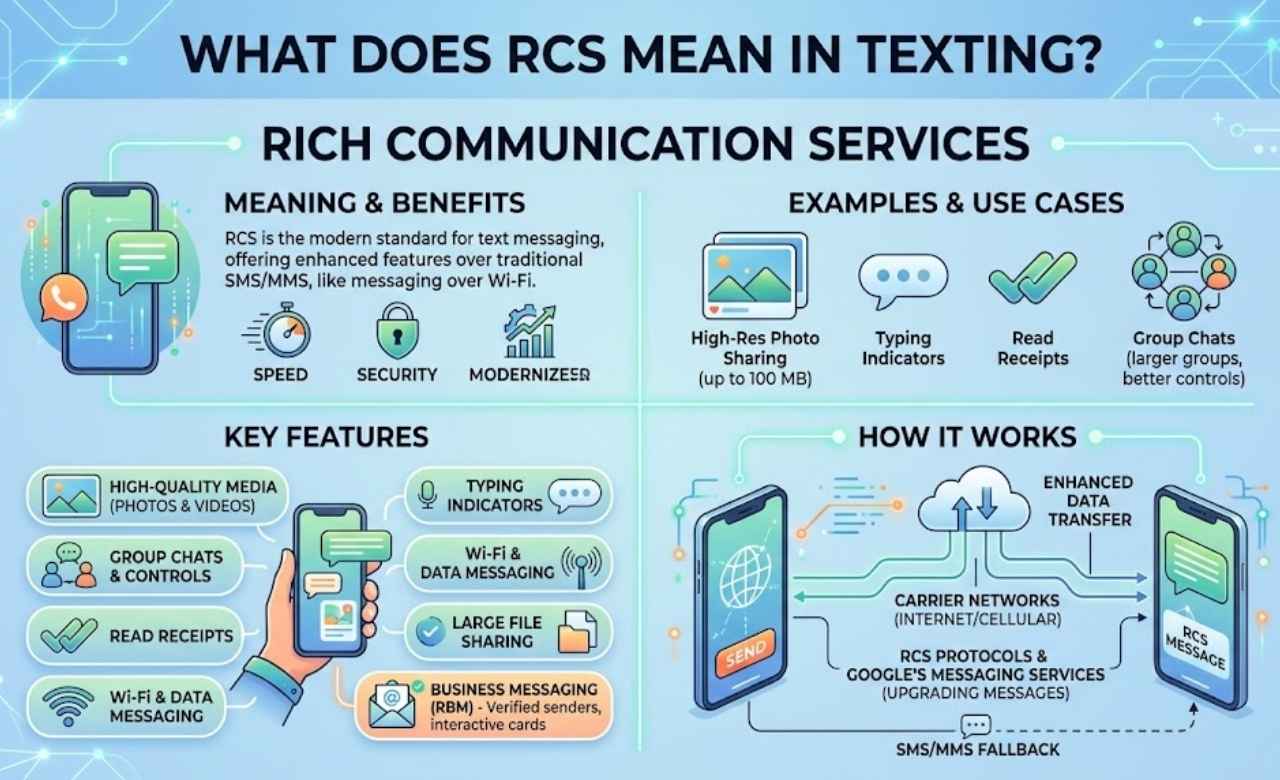
Have you ever opened your Messages app and noticed RCS next to a conversation and wondered, “what does text message RCS mean?” You’re not alone. RCS can be confusing, especially when your messages suddenly look different or you see features like read receipts, typing indicators, and better-quality photos.
If you’re using an iPhone, you may have an even more specific question: what does text message RCS mean on iPhone? In simple terms, RCS meaning is Rich Communication Services. It’s a modern messaging standard that adds advanced chat features to regular texting, making messages work more like an internet-based chat.
In this guide, you’ll learn what RCS means, how it works on iPhone and Android, how it differs from SMS and iMessage, and what those RCS labels and features actually mean when you’re texting someone.
What Does RCS Mean in a Text Message?
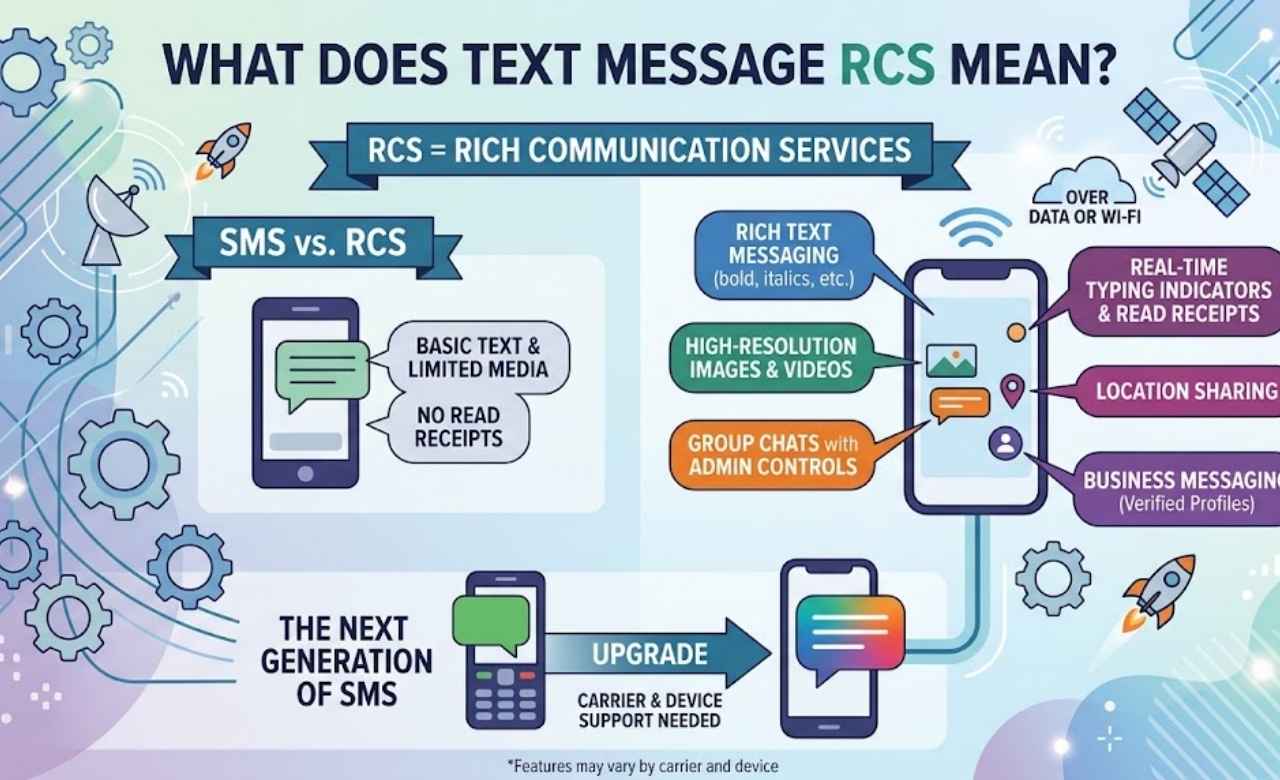
When you look down at the text composer in your phone messaging app and notice the prompt reads “RCS message” instead of the familiar “Text message” or “SMS”, your device has switched to modern internet-based messaging.
RCS stands for Rich Communication Services. In a text message, RCS means your conversation is being routed over an internet connection (Wi-Fi or cellular mobile data) using an advanced RCS Mean telecommunications protocol, rather than travelling across legacy cellular voice and signaling channels.
Historically, native smartphone texting was tethered to 1990s technology:
- SMS (Short Message Service): Capped at 160 characters of plain text.
- MMS (Multimedia Messaging Service): Limited to tiny, highly compressed images, audio snippets, or slideshows, frequently capped around 1 MB to 3.5 MB by carriers.
When a message indicates RCS, those constraints disappear. Native texting transforms into a full-featured modern chat application directly inside your default messaging app—providing live typing indicators, delivery receipts, real-time read receipts, high-resolution media sharing, inline emoji reactions, and seamless group messaging, all tied straight to your standard phone number without forcing you to sign up for third-party platforms like WhatsApp or Signal.
What Does RCS Stand For?
RCS stands for Rich Communication Services.
Created under the technical stewardship of the GSMA (GSM Association)—the global industry trade organization that represents mobile network operators worldwide—the standard was developed as a unified blueprint to replace basic cellular messaging.
To ensure cross-carrier and cross-device interoperability, the industry standardized on the GSMA RCS Universal Profile. This specification outlines the technical rules for how telecommunications carriers, operating systems, and device manufacturers exchange modern chat features so an Android device on T-Mobile, a Samsung phone on Verizon, and an iPhone running iOS on AT&T can communicate without missing media, dropped attachments, or broken group chats.
RCS Meaning in Simple Words
To understand RCS in simple terms: RCS gives your regular phone texting the modern powers of WhatsApp, iMessage, or Messenger, right inside your phone’s default text app.
Think of traditional SMS as a postcard mailed through the post office: it has a tight word limit, moves through older channels, offers no way to see if the recipient glanced at it, and can’t carry anything heavy.
RCS is like an instant courier over the internet: it handles high-resolution photo albums, confirms delivery the millisecond it lands on the screen, shows you when the other person is actively typing a reply, and keeps group conversations synced. You do not need to download a separate chat app, make a username, or remember a password; your existing cellular phone number is your identity.
How Does RCS Messaging Work?
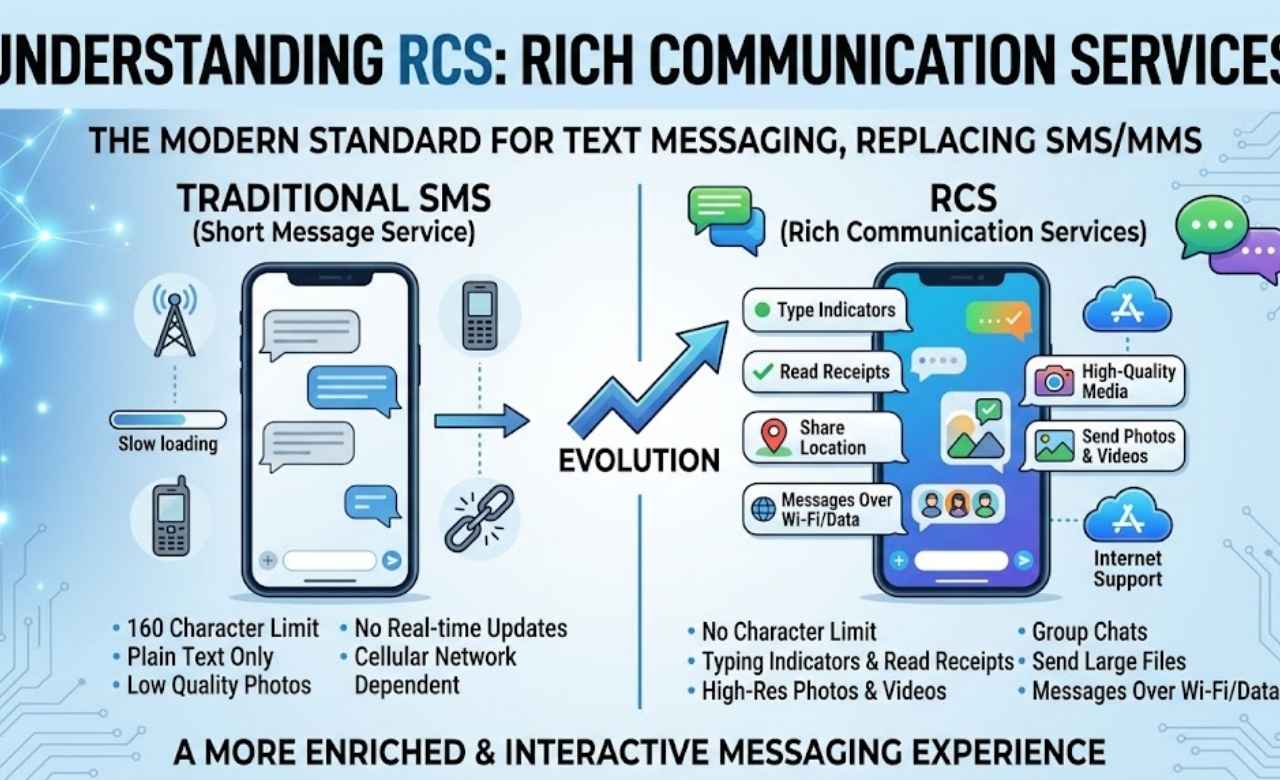
Traditional SMS messages travel across the cellular signaling channel—the SS7 (Signaling System No. 7) network control channel that mobile towers use to coordinate voice calls. Because SMS was designed to piggyback on leftover bandwidth in these signaling paths, it is inherently bound to strict character limits and low throughput.
RCS works completely differently:
- IP-Based Architecture: RCS operates on IP (Internet Protocol) networks. Whenever your device dispatches an RCS text, it packages the payload (text, media, reactions) into IP data packets and transmits them using your active Wi-Fi or cellular mobile data connection.
- Session Initiation Protocol (SIP) and IMS: RCS utilizes the IMS (IP Multimedia Subsystem) framework running on telecommunications networks. It negotiates sessions using SIP (Session Initiation Protocol), which tells the network whether the sender and recipient both have active RCS capability.
- Capability Discovery: When you open a conversation, your messaging app sends an invisible, background query to verify if the contact’s phone and carrier support the RCS Universal Profile. If the answer is yes, the chat switches into rich mode, unlocking typing bubbles, read status, and full-resolution media pipelines. If either phone is offline, unprovisioned, or lacks carrier support, the app gracefully falls back RCS Mean to traditional SMS or MMS.
- Cloud Infrastructure: Depending on your carrier and ecosystem, your RCS traffic is routed either through carrier-managed IMS cores or hosted networks such as the Google Jibe Cloud, which powers reliable worldwide routing across millions of Android devices.
+-----------------------------------------------------------------------------------+
|                            HOW RCS TEXT ROUTING WORKS                             |
+-----------------------------------------------------------------------------------+
|  Sender opens conversation -> Phone runs invisible Capability Discovery (IMS/SIP) |
|                                                                                   |
|  [ Both devices support RCS + Active Data? ]                                      |
|         |                                  |                                      |
|        YES                                 NO                                     |
|         v                                  v                                      |
|  Transmitted via IP Data             Transmitted via Legacy Carrier Lines          |
|  (Wi-Fi / Mobile Data)               (Cellular Signaling / SS7 Channels)          |
|         v                                  v                                      |
|  RCS Chat Active:                    SMS / MMS Fallback:                          |
|  - Full HD photo/video               - Compressed, blurry media                   |
|  - Real-time read receipts           - No typing indicators                       |
|  - Live typing bubbles               - 160-character limits                       |
|  - Inline tapback reactions          - Broken cross-platform groups               |
+-----------------------------------------------------------------------------------+
RCS vs SMS: What’s the Difference?
| Feature | Legacy SMS (Short Message Service) | Modern RCS (Rich Communication Services) |
| Transmission Network | Cellular signaling channels (voice control paths) | IP Data networks (Wi-Fi or Mobile Data) |
| Character Limit | Strict 160 characters (longer texts get split) | Virtually unlimited (supports lengthy paragraphs) |
| Typing Indicators | No | Yes (live animated typing dots) |
| Read Receipts | No (only basic network carrier delivery confirmations) | Yes (shows exact read/viewed timestamps) |
| Media Attachments | Not supported (requires MMS) | Supported natively at high bandwidth |
| Reaction Tapbacks | Broken (renders as “Liked [quoted text]”) | Dynamic interactive emoji reactions |
| Offline Operation | Requires basic cellular signal bars | Operates over any local Wi-Fi without cell reception |
SMS was finalized in the mid-1980s and first deployed commercially in 1992. It lacks any awareness of whether the receiver’s screen is active, whether they have opened the message, or if they are currently composing a thought. RCS brings native cellular texting up to parity with modern web applications.
RCS vs MMS: What Changes?
MMS was introduced to allow the transmission of multimedia content over mobile networks, but it has severe limitations:
- Aggressive Compression: MMS carriers impose brutal file-size ceilings, typically between 600 KB and 3.5 MB. If you record a 4K video or snap a 50-megapixel photo, your phone’s MMS engine drastically downsamples the image into a pixelated, unreadable file.
- Audio Degradation: Voice notes sent over MMS sound scratchy and muffled due to outdated compression codecs.
- Network Latency: MMS relies on a cumbersome WAP (Wireless Application Protocol) push-and-fetch architecture that can take minutes to process or fail entirely on congested networks.
RCS, by contrast, supports file payloads up to 100 MB or more (depending on carrier/client implementations). High-resolution photos retain crisp detail, video files preserve their smooth framerate and clarity, and high-fidelity audio notes transmit clearly.
RCS vs iMessage: Are They the Same?
While RCS and iMessage offer nearly identical user experiences—such as high-res images, read receipts, and typing bubbles—they are built on completely distinct structural foundations:
- Proprietary vs. Open Standard: iMessage is an Apple-exclusive proprietary platform running entirely on Apple’s private push-notification infrastructure (APNs). It only functions natively between Apple hardware (iPhone, iPad, Mac, Apple Watch). RCS is a global telecommunications standard governed by the GSMA and supported across hardware manufacturers, mobile operating systems, and network carriers.
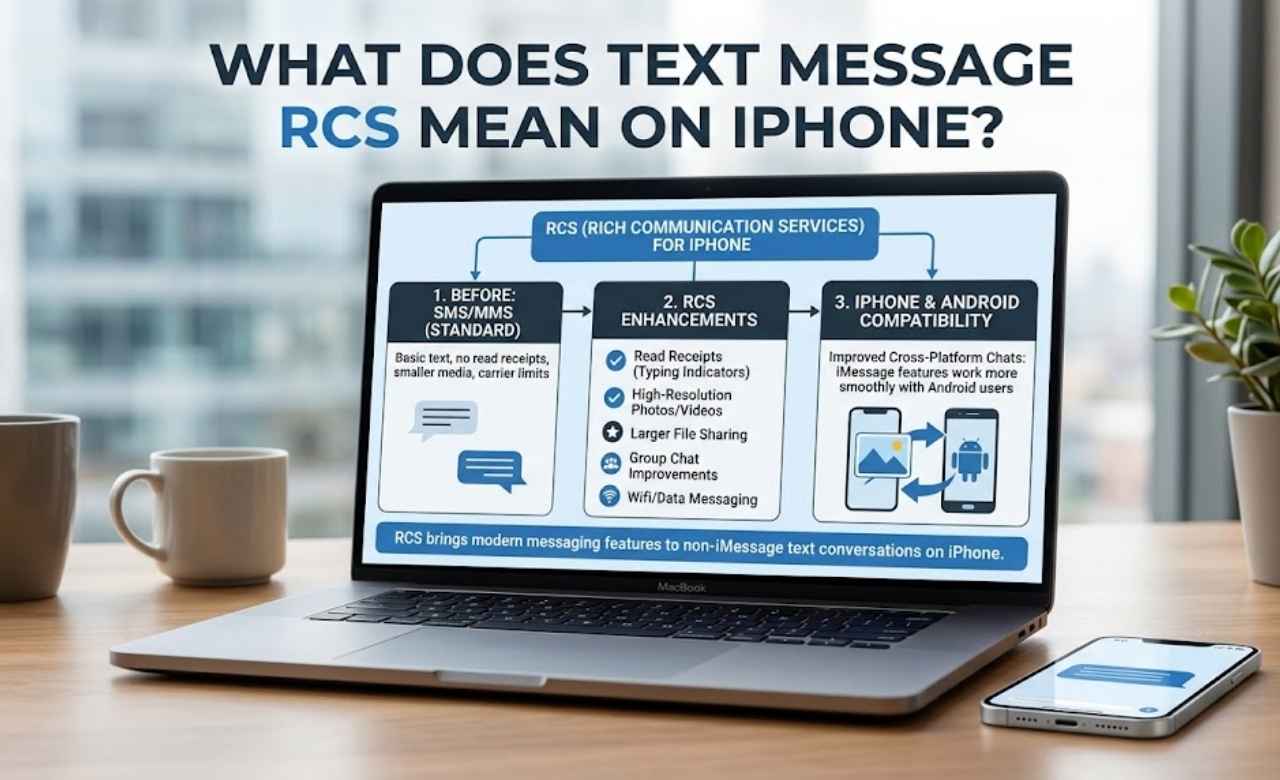
- Cross-Platform Bridge: Apple integrated the GSMA RCS Universal Profile into iOS. This means iMessage remains the default when iPhone users chat with other iPhone users, but whenever an iPhone messages an Android phone, the system upgrades the connection from legacy SMS/MMS to RCS.
What Does RCS Mean in Texting on Android?
On Android, RCS represents the baseline modern messaging standard. For years, the Android ecosystem suffered from fragmentation: different mobile carriers rolled out mutually RCS Mean incompatible versions of advanced messaging, leaving users stuck with SMS.
Google solved this issue by adopting the GSMA Universal Profile, building native RCS chat features directly into the operating system, and routing traffic through its scalable Jibe infrastructure. On modern Android devices:
- RCS replaces SMS automatically whenever you message someone who also has RCS active.
- Group messaging between Android users gains member management, high-res media, and smooth emoji reactions.
- Seamless switching ensures that if your data connection drops, Android can automatically fall back to standard SMS to deliver urgent text.
What Does RCS Mean in Texting on Samsung?
If you use a Samsung Galaxy device (such as an S-series, Z Fold/Flip, or A-series device), RCS functionality operates through one of two interfaces:
- Samsung Messages: Historically, Samsung devices shipped with Samsung’s proprietary messaging app. Within Samsung Messages, RCS is often designated as “Advanced Messaging” or “Chat Services.” It relies on your carrier’s direct network integration or an underlying Google backend.
- Google Messages on Galaxy: In recent hardware cycles, Samsung partnered closely with Google, establishing Google Messages as the default, out-of-the-box SMS/RCS client on new Galaxy hardware.
On a Samsung device, an active RCS chat transforms the conversation bubble into a deeper, richer color, replaces the classic paper airplane icon with a lock or chat icon, and exposes features like live typing bubbles and read indicators in single chats and groups.
What Does RCS Mean in Texting on Google Messages?
Google Messages is the flagship application for the RCS ecosystem. When you use Google Messages:
- The text field displays “RCS message” alongside a small padlock icon when communicating with another Google Messages user.
- You get full support for rich reactions, animated emoji, custom voice effects, and high-speed transfer of documents, uncompressed photos, and 1080p/4K video clips.
- Google integrates End-to-End Encryption (E2EE) by default for one-on-one and group RCS conversations between Google Messages users, using the robust Signal protocol to ensure nobody—not even Google or your carrier—can read your text payloads.
What Does RCS Mean on iPhone?
Apple officially integrated the GSMA RCS Universal Profile into the native iOS Messages app.
On an iPhone, RCS means that when you text a friend or family member who uses an Android phone, your conversation is no longer forced onto legacy SMS/MMS. While conversations between two iPhone users remain handled by Apple’s native iMessage engine, cross-platform conversations between iOS and Android automatically route over RCS.
This upgrade gives iPhone users texting Android users:
- High-resolution photo and video sharing.
- Live typing indicators and read receipts.
- Smooth, fully functional group chats where people can be added or removed without breaking the thread.
- Inline tapback reactions that attach directly to the message bubble rather than creating duplicate text responses.
Why Are RCS Messages Green on iPhone?
One of the most frequent points of user confusion is the RCS Mean bubble color in iOS Messages: Why are RCS messages still green on an iPhone?
Apple reserves Blue bubbles exclusively for iMessage (Apple-device to Apple-device communication). Any message sent to an external, non-Apple operating system is color-coded Green.
However, there is an essential technical difference between the two types of green bubbles on iOS:
- Light Green / SMS: Sent over cellular telephone signaling paths; character-limited, lacks read receipts, and delivers pixelated multimedia.
- Rich Green / RCS: The text composer says “Text Message • RCS”, confirming high-definition photo sharing, real-time typing indicators, and reliable data-driven message routing.
The green color simply designates that the message is leaving Apple’s private iMessage ecosystem; it does not mean your media will be compressed or that modern chat features are disabled.
What Features Does RCS Messaging Have?
+------------------------------------------------------------------------------------+
|                             CORE SUITE OF RCS CAPABILITIES                         |
+------------------------------------------------------------------------------------+
|  [Typing Indicators]  <--->  Displays real-time typing bubbles                     |
|  [Read Receipts]      <--->  Shows exact delivery and read/viewed timestamps       |
|  [High-Res Media]     <--->  Sends uncompressed 4K photos and crystal-clear videos |
|  [Group Controls]     <--->  Name groups, add/remove members, clean thread sync    |
|  [File Transfers]     <--->  Transfers PDFs, docs, and archives up to 100MB+       |
|  [Emoji Reactions]    <--->  Interactive tapbacks render inline across platforms   |
+------------------------------------------------------------------------------------+
Read Receipts and Typing Indicators
In standard SMS, messaging is a “blind send”: you tap transmit, your carrier acknowledges that the cellular tower received the packet, and you have no idea whether the recipient’s phone rang, died, or was looked at.
With RCS:
- Live Typing Indicators: As soon as the person on the other end starts typing on their keyboard, three animated dancing dots appear in real time.
- Read Status: The moment the recipient taps into your conversation thread and views your message, the status marker shifts from “Delivered” to “Read” (along with the exact time of viewing). Both parties have the option to toggle this setting off in their privacy preferences.
High-Quality Photos and Videos
MMS compression routinely shrinks high-resolution images down to low-resolution thumbnails with unreadable text and severe pixelation.
RCS transfers multimedia over high-speed IP data streams. When you send a 48-megapixel image or a 1080p/4K video through an RCS thread, the file retains its original resolution, vivid color depth, dynamic range, and metadata. Family photos, scanned documents, and landscape clips arrive cleanly across Android and iOS.
Group Chats and Reactions
Group texting over MMS has long been problematic: Android and iPhone users in the same MMS group thread frequently experienced dropped messages, duplicated threads, or desynchronized replies.
RCS resolves these issues with proper group chat management:
- Custom group naming and participant avatars.
- The ability to add or remove members dynamically without rebuilding the thread.
- Leaving a group cleanly without continuing to receive pings.
- Inline Tapback Reactions: If someone “Hearts”, “Thumbs Up”, or laughs at a comment, the emoji renders directly on the bubble corner on both Android and iPhone, eliminating the annoying legacy SMS habit of texting back
"Liked 'See you at 8!'".
Larger File Sharing
Because RCS treats messages as rich data packets rather than tiny signaling pulses, it supports direct transfer of non-media files:
- Work documents, spread sheets, and PDF forms.
- Uncompressed ZIP and audio files.
- Payloads commonly scaling up to 100 MB, allowing you to bypass RCS Mean external cloud-storage links or email attachments when sharing documents directly from your smartphone file explorer.
Delivery and Read Status
RCS replaces guesswork with clear, sequential status stages:
[Sending] ---> [Sent (One check)] ---> [Delivered (Two checks)] ---> [Read (Filled checks / "Read")]
- Sending: The message is uploading from your local device buffer to the data network.
- Sent: The payload has cleared your device and arrived safely on the RCS routing server.
- Delivered: The message has been successfully pushed to the recipient’s phone screen or notification tray.
- Read / Viewed: The recipient has actively unlocked their phone, opened the messaging app, and viewed the thread.
Does RCS Mean Someone Has Read Your Message?
Not necessarily. Seeing the tag “RCS” in your text composer only indicates that the conversation is connected via the RCS protocol—it is not proof that the recipient has read what you sent.
To determine if someone has read your text, look at the message status marker on the individual bubble:
| Marker | What It Means |
| “Sent” (Single Checkmark) | The message left your phone and reached the network, but hasn’t reached their device yet. |
| “Delivered” (Double Checkmarks) | The text arrived at the recipient’s phone, but they haven’t opened the chat thread. |
| “Read” or “Seen” (Double Filled Checkmarks) | The user opened your conversation and viewed your message. |
Privacy Note: Read receipts are user-configurable. If your contact navigates to their messaging privacy settings and disables “Send Read Receipts,” their status will remain marked as “Delivered” indefinitely, even after they have read your message.
Does RCS Use Wi-Fi or Mobile Data?
Yes. RCS is entirely dependent on an active internet connection.
Unlike traditional SMS, which transmits over basic cellular frequency bands even when mobile data is toggled off, RCS relies on IP (Internet Protocol) networking.
- Wi-Fi Connectivity: If you are connected to a home, office, or public Wi-Fi network, RCS routes all communications through that local connection. You can send and receive texts, photos, and group chats even in areas with zero cellular reception (such as in an underground basement or on airplane Wi-Fi).
- Mobile Data (4G LTE / 5G): When disconnected from Wi-Fi, your smartphone automatically routes RCS messages across your cellular mobile data bucket.
- Data Consumption: For standard text-only messages, RCS uses tiny amounts of data (fractions of a kilobyte). However, if you frequently exchange high-definition videos, audio memos, or large raw photo batches, those transfers draw from your plan’s mobile data allotment.
- What Happens Without Internet? If you have neither Wi-Fi nor mobile data, your phone will hold the RCS message in a queue, or automatically ask if you want to fall back to standard cellular SMS/MMS.
Is RCS Messaging Encrypted?
Security is one of the most critical aspects of the RCS Mean modern messaging landscape. The encryption status of an RCS message depends directly on the platform and client applications involved.
1. Android-to-Android (Google Messages)
When two Android users communicate using Google Messages with RCS chats enabled, conversations feature End-to-End Encryption (E2EE) by default. Google uses the battle-tested Signal Protocol to encrypt messages before they leave your hardware. A small padlock icon appears next to the timestamp, verifying that neither Google, your cellular carrier, nor any third party can intercept or decrypt the contents of your messages, photos, or group discussions.
2. Cross-Platform (iPhone to Android)
Historically, the base GSMA RCS Universal Profile (specifically versions up to Profile 2.4) only mandated encryption in transit (TLS/client-to-server encryption). While protected against eavesdropping on public Wi-Fi networks, messages technically passed through carrier or server relays in decrypted form.
To solve this gap, the GSMA published the Universal Profile 3.0 specification, integrating cross-platform End-to-End Encryption based on the open MLS (Messaging Layer Security) standard. As major operating systems like iOS and Android implement this specification, cross-platform conversations between iPhones and Androids gain the same robust end-to-end encryption enjoyed within single-platform ecosystems.
+-----------------------------------------------------------------------------------+
|                           RCS ENCRYPTION LANDSCAPE                                |
+-----------------------------------------------------------------------------------+
|  Connection Type           |  Security Protocol    |  Status                      |
|----------------------------|-----------------------|------------------------------|
|  Android <--> Android      |  Signal Protocol      |  Full End-to-End Encrypted   |
|  (Google Messages)         |                       |  (Padlock Icon Visible)      |
|----------------------------|-----------------------|------------------------------|
|  iPhone <--> Android       |  MLS via GSMA UP 3.0  |  Interoperable E2EE rollout  |
|  (Cross-Platform)          |  / In-Transit (TLS)   |  (Phased Carrier Deployment) |
|----------------------------|-----------------------|------------------------------|
|  Legacy SMS / MMS Fallback |  None                 |  Unencrypted plain text      |
+-----------------------------------------------------------------------------------+
Why Does RCS Sometimes Stop Working?
Because RCS operates as an authenticated cloud service tied to a physical phone number, network misconfigurations, SIM switches, or cache corruption can disrupt your connection.
RCS Not Connecting or Verifying
When setting up or updating your phone, your messaging app must verify your phone number with your carrier’s RCS backend. If this fails, the app may display errors like “Setting up…”, “Connecting…”, or “Registration failed.”
Common causes include:
- Carrier Gateway Timeout: The verification SMS sent in the background by Google or your carrier failed to return correctly.
- VPN Interference: Active VPNs can block the SIP handshake required to authenticate your IMS profile with carrier servers.
- Dual-SIM Confusion: If your phone runs a dual physical SIM or eSIM setup, the messaging app may attempt to route RCS tokens through the secondary data line while listening for confirmation on the primary voice line.
RCS Messages Sending as SMS
If a thread suddenly reverts to a gray or basic SMS text bubble, the system has triggered an automatic SMS fallback:
- Poor Data Connectivity: If either the sender or receiver loses cellular data or drops off Wi-Fi, the RCS routing engine times out and switches to standard SMS to avoid delivery delays.
- Recipient Disabled RCS: If the person you are texting turns off chat features, transitions to an unsupported device, or switches to an area without carrier RCS routing, your app downgrades the conversation to SMS.
- App Cache Glitches: A corrupted local carrier database can temporarily break the invisible capability check.
RCS Not Working on iPhone
If you are running an iPhone and cannot access RCS features when texting Android contacts:
- iOS Version: RCS support requires modern iOS firmware (iOS 18 or later). Check Settings > General > Software Update to ensure your device is current.
- Carrier Bundle Provisioning: Your carrier must deploy an updated carrier profile to your iPhone. Smaller MVNOs (Mobile Virtual Network Operators) sometimes take longer to roll out carrier bundles supporting RCS than major tier-one networks. Check Settings > General > About to verify if a carrier update prompt appears.
- Toggle Disabled: The setting may simply be turned off. Navigate to Settings > Apps > Messages and confirm RCS Messaging is toggled On.
RCS Not Working on Samsung or Android
If your Android or Samsung device suddenly loses RCS chat functionality:
- Carrier Services Outdated: The background subsystem that manages IMS handshakes (often listed as Carrier Services in the Google Play Store) may be out of date. Update it via the store.
- Stuck Number Registration: If you recently moved your SIM card from an older phone to a new one without turning off RCS on the old device, the RCS registration servers may still point your phone number to your old device’s cryptographic identity. You can resolve this using Google’s public RCS deregistration portal.
- Battery Optimization Throttling: Aggressive battery-saving utilities may put the messaging app or Google Play Services to sleep, killing background push notifications.
How to Turn RCS Messaging On or Off
Managing your RCS settings is straightforward across both major mobile operating systems.
How to Enable RCS on Android
- Open the Google Messages app on your device.
- Tap your Profile picture or account icon located in the upper right-hand corner of the search bar.
- Select Messages settings.
- Tap RCS chats (on older builds, this may be labeled Chat features).
- Toggle the switch next to Turn on RCS chats to the On position.
- Wait a few moments while your phone verifies your number. When successful, the status indicator will shift to a green “Connected.”
How to Turn Off RCS on Android
If you are switching back to a non-RCS basic phone, troubleshooting connection errors, or preparing to transfer your SIM to an iPhone without porting data:
- Launch Google Messages.
- Tap your Profile icon > Messages settings > RCS chats.
- Toggle the Turn on RCS chats switch to Off.
- A pop-up dialog will ask for confirmation, warning that you will lose rich chat features. Tap Turn off.
(Tip: If you already discarded your old Android phone without turning off RCS, search online for the official Google Messages deregistration web tool, enter your phone number, and type the six-digit verification code to detach your line from the server).
How to Enable RCS on iPhone
To enable RCS on an Apple iPhone:
- Ensure your iPhone is updated to iOS 18 or later.
- Open the Settings app on your iPhone.
- Scroll down the settings list and tap Apps (or locate Messages directly).
- Select Messages.
- Scroll down to the Text Messaging section.
- Locate the toggle labeled RCS Messaging and flip it to On (Green).
(Note: If you do not see the RCS toggle, your mobile carrier has not yet pushed the required carrier bundle enabling the feature on your plan. Contact your network provider to confirm when RCS provisioning is scheduled for your account).
What Does RCS Mean When Texting Someone?
When you open a one-on-one conversation with a contact and the input bar indicates RCS, the messaging experience changes in several key ways:
- Real-Time Presence: The conversation is active and live. When they start typing, you see the animated typing indicator immediately; when they open your note, you receive an immediate timestamped confirmation.
- High-Definition Media Exchange: You can snap and share photos or videos knowing your contact will receive the exact file without severe MMS compression artifacts.
- No Character Anxieties: You can send long messages without worrying about carrier systems splitting your text into multiple scrambled pieces or converting it into an MMS.
- Cost Savings: For international communication, RCS transmits over your standard internet connection. If both parties are on Wi-Fi, you can chat without racking up expensive per-message international SMS fees (provided you avoid falling back to SMS).
Examples of RCS in Text Conversations
Here is what everyday texting looks like with and without RCS:
Scenario 1: Sharing a Family Vacation Video
- Without RCS (SMS/MMS): An Android user records a 20-second clip of their child running on the beach and sends it to an iPhone. The carrier compresses the file down to 1.2 MB. The iPhone user receives a grainy, pixelated video where faces are barely recognizable.
- With RCS Active: The Android user sends the exact same clip. It transmits over IP data at full 1080p resolution. The iPhone user receives the video with clear audio and sharp visuals.
Scenario 2: Planning an Event in a Mixed Group Chat
- Without RCS (SMS/MMS): Five friends (three on iPhone, two on Android) try to plan dinner. An iPhone user taps “Love” on a suggestion. The Android users receive an awkward separate text:
Loved “Let’s do Mexican at 7pm”. Another person leaves the chat, but everyone’s phones continue pinging because MMS cannot manage group membership. - With RCS Active: The group conversation stays organized. When someone hearts a message, an emoji reaction attaches directly to the bubble. New members can be added seamlessly, and users can exit the thread without disrupting it for everyone else.
Scenario 3: Coordinating Arrival at an Airport
- Without RCS (SMS/MMS): You text: “I’m outside terminal 2.” You wait by the curb, unsure whether the driver received the message or is stuck in traffic.
- With RCS Active: You text: “I’m outside terminal 2.” Within seconds, two small checkmarks appear indicating delivery. A moment later, they change to “Read,” followed by a live typing bubble. You know your message was seen and a reply is coming.
FAQS
Why do my text messages say RCS?
Your messages say RCS because your phone and messaging app support Rich Communication Services. It means the conversation can use advanced features such as read receipts, typing indicators, and high-quality media sharing.
Is RCS chat safe?
RCS can be safe to use, but its security and encryption depend on the messaging app, device, carrier, and conversation. Some RCS chats support end-to-end encryption, while others may not.
Is RCS message free?
RCS messages typically don’t have a per-message SMS charge, but they use mobile data or Wi-Fi. Your carrier’s data plan and messaging terms may still apply.
Is RCS the same as SMS?
No, RCS and SMS are different messaging standards. RCS offers modern chat features, while SMS is a basic text messaging system with fewer capabilities.
Conclusion
Now that you know what does text message RCS mean, it should be much easier to understand when you see RCS in your messaging app. RCS meaning is Rich Communication Services, a modern messaging standard that can offer features such as read receipts, typing indicators, better-quality media, and improved group chats.
If you’re wondering what does text message RCS mean on iPhone, it simply means your iPhone is using RCS messaging when supported for that conversation. RCS is different from SMS and iMessage, although it can make texting between supported devices feel more like a modern chat app.
So, seeing RCS doesn’t usually have a hidden or romantic meaning. It mainly tells you about the technology being used to send your messages.Read other article 300+ Cholo Names with Meanings: Cool, Unique & Tough Ideas

Welcome to NameInBible. I am Victoria, a Christian writer passionate about exploring biblical name meanings, Scripture-based insights, and powerful prayers. My goal is to help readers discover the spiritual significance of names and grow closer to God through faith-filled content.