
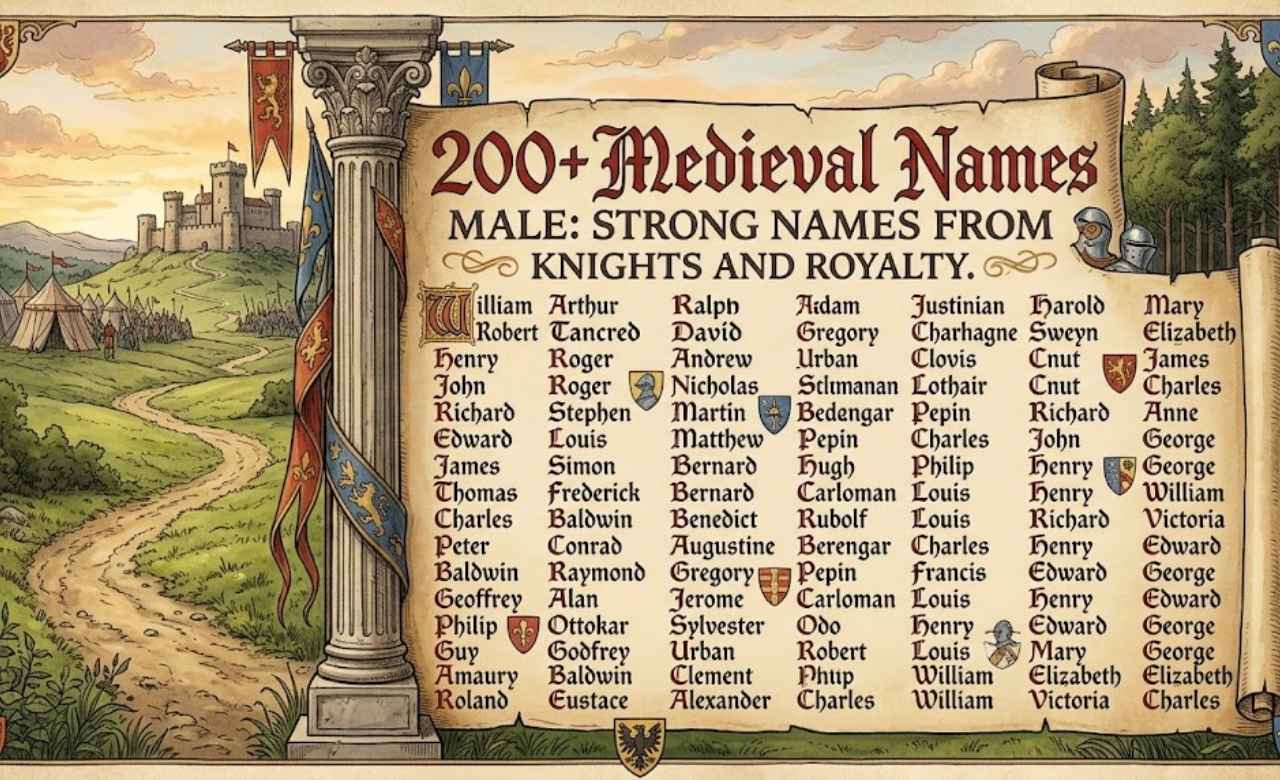
From the bloodied ramparts of Hastings to the candlelit scriptoriums of Lindisfarne, the names carried by European men during the Middle Ages were never casual tags they were carved into shields as oaths, spoken as royal decrees, and recorded in stone to outlast dynasties.
Choosing the right medieval male names is a direct plunge into a millennium of raw ambition, chivalric romance, and brutal feudal survival. Whether you are seeking a commanding moniker for a newborn, breathing historical steel into a fantasy protagonist, or tracing the etymological roots of names that survived Medieval Names Male the collapse of empires, uncovering the stories behind these ancient appellations reveals how language itself was forged by fire, faith, and conquest.
Historical Origins: Where Do Medieval Male Names Come From?
The inventory of names utilized across medieval Europe was shaped by distinct linguistic layers deposited across successive historical eras. Following the retreat of Roman administrative Medieval Names Male authority in the 5th century, the classical naming convention—the Roman tria nomina (praenomen, nomen, and cognomen)—disintegrated across Western Europe, giving way to single-element and dithematic naming traditions.
       [Collapse of the Western Roman Empire (c. 476 AD)]
                              │
         ┌────────────────────┴────────────────────┐
         ▼                                         ▼
 Germanic / Anglo-Saxon                     Christian / Biblical
  Dithematic Inventions                     Conversion Traditions
(e.g., Æthel + ræd = Æthelred)              (e.g., John, Peter, Paul)
         │                                         │
         └────────────────────┬────────────────────┘
                              ▼
           [The Norman Conquest of England (1066)]
                              │
          ┌───────────────────┴───────────────────┐
          ▼                                       ▼
Continental Germanic Names                Diminutive Inventions
 via Anglo-Norman French               & Universal Surnames System
(William, Robert, Richard)              (Robin, Jack, Wilkin, Hodge)
The Dithematic System of Germanic Naming
The foundational naming engine across Northern, Western, and Central Europe was dithematic (two-element) compounding. Common to Old English (Anglo-Saxon), Old Norse, Old High German, and Gothic dialects, dithematic names joined two distinct semantic roots to form an aspirational invocation:
- Prefix elements: Stems conveying high social or metaphysical concepts, such as Æthel- (noble), Ead- (wealth, prosperity), Beorht- (bright, illustrious), Wulf- (wolf), and Os- (divine, god).
- Suffix elements: Stems denoting agency, authority, or battle function, such as -ric (ruler, king), -ward (guardian, watchman), -stan (stone, fortress), -win or -wine (friend, companion), -wig (battle, warrior), and -red or -ræd (counsel, wisdom).
When an Anglo-Saxon lord was named Æthelred, his name literally translated as “Noble Counsel” (Æthel + ræd). When a Continental Saxon named his son Godfrey (Gud-frid), he invoked “God’s Peace.” These names were not arbitrary labels; they served as legal signatures, lineage markers, and protective talismans.
The Christian Layer: Baptismal Traditions and Patristic Influence
Alongside the Germanic substrate ran the ecclesiastical tradition. Following the conversion of the Anglo-Saxon heptarchy, the Frankish kingdoms under the Merovingians and Carolingians, and the Scandinavian realms, the Latin Christian Church revolutionized naming practices.
Biblical names of Hebrew, Aramaic, and Greek origin—such as Yohanan (John / “Yahweh is gracious”), Petros (Peter / “Rock”), Stephanos (Stephen / “Crown”), and Mikha’el (Michael / “Who is like God?”)—entered the insular and continental registers. By the 12th and 13th centuries, ecclesiastical edicts and the canonization of popular saints encouraged local parish priests to assign biblical or martyr names at infant baptism, creating a pan-European corpus of Christian forenames.
The Norman Rupture (1066)
In 1066, William, Duke of Normandy, conquered Anglo-Saxon England. This political conquest resulted in the fastest onomastic revolution in British history. Within three generations, native insular names like Godric, Wulfric, Leofwine, and Eadward were pushed down the social hierarchy or displaced entirely.
The Normans—themselves descendants of Norsemen who had assimilated into northern France and adopted a Latinized, Continental Germanic dialect—introduced a streamlined, highly concentrated stock of aristocratic names: William (Wilhelm), Robert, Richard, Henry, and Geoffrey. By the turn of the 13th century, an estimated 80% of English men shared fewer than fifteen personal names, necessitating the rapid development of hereditary surnames and diminutive nicknames (Will, Wat, Hob, Dick, Rob, Jack).
Timeless Classics: Medieval Boy Names Still Popular Today
Many male names universally considered classic today are direct continuations of High Middle Ages nomenclature. These names stabilized during the 11th through 14th centuries and have retained popularity across centuries of linguistic shifts.
| Name | Linguistic Origin | Medieval Root / Components | Historical Meaning | Modern Everyday Nicknames |
| William | Norman French / Old Germanic | Willa (will/desire) + helm (helmet/protection) | “Resolute Protector” or “Vehement Guardian” | Will, Liam, Bill, Billy |
| Robert | Continental Germanic | Hrod (fame/renown) + berht (bright/shining) | “Bright with Renown” or “Fame-Bright” | Rob, Bob, Robbie, Bobby, Robin |
| Richard | Proto-Germanic via Old French | Ric (ruler/power) + hard (hardy/brave/stern) | “Powerful Ruler” or “Brave Leader” | Rick, Rich, Dick, Ritchie |
| Henry | Old High German (Heimirich) | Heim (home/estate) + ric (ruler) | “Ruler of the Household / Estate” | Hank, Harry, Hal |
| Geoffrey | Old French / Germanic | Gau (territory) or Gis (pledge) + frid (peace) | “Divinely Peaceful” or “Pledge of Peace” | Geoff, Jeff, Geo |
| Thomas | Aramaic via Ecclesiastical Latin | Ta’oma (twin) | “Twin”; popularized by Thomas Becket | Tom, Tommy |
| Alexander | Greek via Latin & Anglo-Norman | Alexo (to defend) + aner/andros (man) | “Defender of Men” | Alex, Alec, Xander, Sandy |
| Edward | Old English (Eadweard) | Ead (fortune/wealth) + weard (guardian) | “Guardian of Prosperity / Wealth” | Ed, Eddie, Ned, Ted |
| Nicholas | Greek via Latin | Nike (victory) + laos (people) | “Victory of the People” | Nick, Colin, Nicol, Claus |
| Hugh | Germanic via Old French | Hug (heart/mind/spirit) | “Bright in Mind and Spirit” | Hugo, Huey |
These names thrived because they bridged multiple socio-cultural priorities: they carried aristocratic clout, enjoyed Church validation through venerated saints, and adapted smoothly into colloquial speech through punchy monosyllabic and disyllabic hypocorisms (pet forms).
How to Choose the Right Medieval Name for Your Baby or Character
Selecting a medieval male name requires balancing historical authenticity, phonetic resonance, and modern utility. Whether naming a newborn or developing a protagonist for an epic fantasy novel or tabletop campaign, use these structural criteria:
1. Etymological Weight and Root Meaning
Examine the underlying word stems. Medieval names convey explicit, literal meanings:
- If seeking themes of protection, evaluate stems with -ward (e.g., Hereward, Edward), -mær (fame), or -helm (e.g., Anselm, Wilhelm).
- For themes of leadership, target roots containing -ric (e.g., Alaric, Theodoric), Wald (rule/power, as in Reginald or Waltheof), or Cyne- (royal/kin, as in Cynegils).
2. Temporal and Historical Precision
Context matters. Naming an Anglo-Saxon character in 870 AD “William” is historically inaccurate, as that name arrived with the Norman invasion in 1066.
- Early Middle Ages (c. 500–1000 AD): Characterized by Old English, Old Norse, Frankish, and Celtic names (Cuthbert, Ragnar, Clovis, Cadwallon).
- High Middle Ages (c. 1000–1300 AD): The peak of chivalry, the Crusades, and feudal codification; dominated by Anglo-Norman, Capetian French, and Holy Roman imperial names (Baldwin, Godfrey, Tancred, Raymond, Giles).
- Late Middle Ages (c. 1300–1500 AD): Widespread adoption of biblical names, diminutive forms, and patronymics (Jack, Wat, Robin, Laurence, Bartram).
   EARLY (500–1000 AD)          HIGH (1000–1300 AD)           LATE (1300–1500 AD)
 ┌──────────────────────┐     ┌──────────────────────┐     ┌──────────────────────┐
 │ • Cuthbert           │     │ • Baldwin            │     │ • Jack / Wat / Robin │
 │ • Ragnar             │ ──> │ • Godfrey            │ ──> │ • Laurence           │
 │ • Clovis             │     │ • Tancred            │     │ • Bartram            │
 │ • Cadwallon          │     │ • Raymond            │     │ • Miles              │
 └──────────────────────┘     └──────────────────────┘     └──────────────────────┘
   Dialects: Old English,       Dialects: Anglo-Norman,       Dialects: Middle English,
   Old Norse, Celtic, Frankish  Old French, Middle German     Diminutives, Church Saints
3. Phonetic Balance and Modern Wearability
Consider the rhythm and cadence of the name when paired with a surname:
- Highly archaic spellings featuring diphthongs like Æ or Œ (Æthelstan, Leofric) look visually striking in literature, but often encounter administrative and pronunciation difficulties on modern birth certificates.
- Modern-compatible adaptations soften archaic orthography without losing root integrity: Athelstan, Leofric, Alden, Garrick, or Everard.
Royal & Imperial Medieval Names for Men (Kings, Emperors & Rulers)
Royal names across the Middle Ages were intentionally repetitive. Dynastic stability relied on projecting continuity with revered ancestors, leading to clusters of identical names across monarchies.
                   [IMPERIAL & ROYAL LINEAGES]
                                │
         ┌──────────────────────┴──────────────────────┐
         ▼                                             ▼
   HOLY ROMAN EMPIRE                           BRITISH MONARCHIES
(Charlemagne / Ottonian / Hohenstaufen)       (Wessex / Plantagenet / Norman)
  • Otto (Prosperity / Sovereign)               • Athelstan (First King of England)
  • Frederick (Peaceful Ruler)                  • Henry (Courtly Power & Law)
  • Conrad (Bold / Audacious Counsel)           • Richard (Martial Prowess / Lionheart)
Regal Medieval Names Inspired by the Holy Roman & British Dynasties
Holy Roman Imperial Lineages
- Charlemagne / Charles: Derived from the Germanic Karl (“free man”). As the foundational Holy Roman Emperor crowned in 800 AD, his name defined European rulership; in Slavic tongues, the name itself became the word for king (król, korol).
- Otto: Derived from Audo or Odo, meaning “wealth, fortune, prosperity.” Borne by Otto I (Otto the Great) and his successors, this name established the Ottonian Dynasty, unifying the German and Italian realms in the 10th century.
- Frederick: Rooted in frid (peace) and ric (ruler). Borne by the Hohenstaufen emperor Frederick I “Barbarossa” and his grandson Frederick II (Stupor Mundi), the name represented central imperial authority over the papacy and Italian city-states.
- Conrad: From kuon (daring, bold) and rad (counsel). A cornerstone name of the Salian Dynasty, signifying a ruler capable of decisive, audacious strategic planning.
- Lothair: Rooted in the Frankish Hlothair, from hlud (loud, famous) and hari (army/warrior). Borne by the grandson of Charlemagne whose kingdom, Lotharingia, formed the historical middle realm between France and Germany.
British Royal Dynasties
- Athelstan (Æthelstan): Compound of æthel (noble) and stan (stone). As the grandson of Alfred the Great, Athelstan became the first recognized King of all England in 927 AD after vanquishing Viking and Celtic coalitions at the Battle of Brunanburh.
- Alfred (Ælfred): Composed of ælf (elf, supernatural being) and ræd (counsel). Signifies “wise counsel aided by the divine.” Alfred the Great of Wessex defended his realm against the Great Heathen Army and instituted broad legal and educational reforms.
- Stephen: Derived from the Greek Stephanos (“laurel wreath” or “crown”). Borne by King Stephen of Blois (reigned 1135–1154), whose contested succession triggered “The Anarchy,” a protracted civil war against Empress Matilda.
Noble Baron and Duke Names from the High Middle Ages
Beyond sovereign monarchs, the high feudal aristocracy—dukes, counts, and barons—cultivated exclusive naming conventions that spread across their territories through patronage and intermarriage.
- Guy (Guido): Derived from the Germanic Wido, meaning “wood” or “wide.” A favored name across the nobility of France, Flanders, and Outremer, borne prominently by Guy de Lusignan, King of Jerusalem.
- Fulk (Foulques): From the Germanic folk (“the people” or “chieftain of the armed host”). A signature name of the powerful Counts of Anjou, known for their territorial expansion and battlefield cunning.
- Theobald: Composed of theod (people/nation) and bald (bold/brave). Common among the Counts of Blois and Champagne, translating directly to “Bold for the People.”
- Humphrey (Humfrey): Formed from hun (warrior cub / bear cub / giant) and frid (peace). A traditional Norman-baronial name, later borne by Duke Humphrey of Gloucester.
- Bertram: Compounding berht (bright) and hramn (raven). Symbolizes “Bright Raven,” echoing the ancient association between aristocratic leaders and battlefield omens.
Badass Knight Names: Legendary Crusaders & Chivalric Heroes
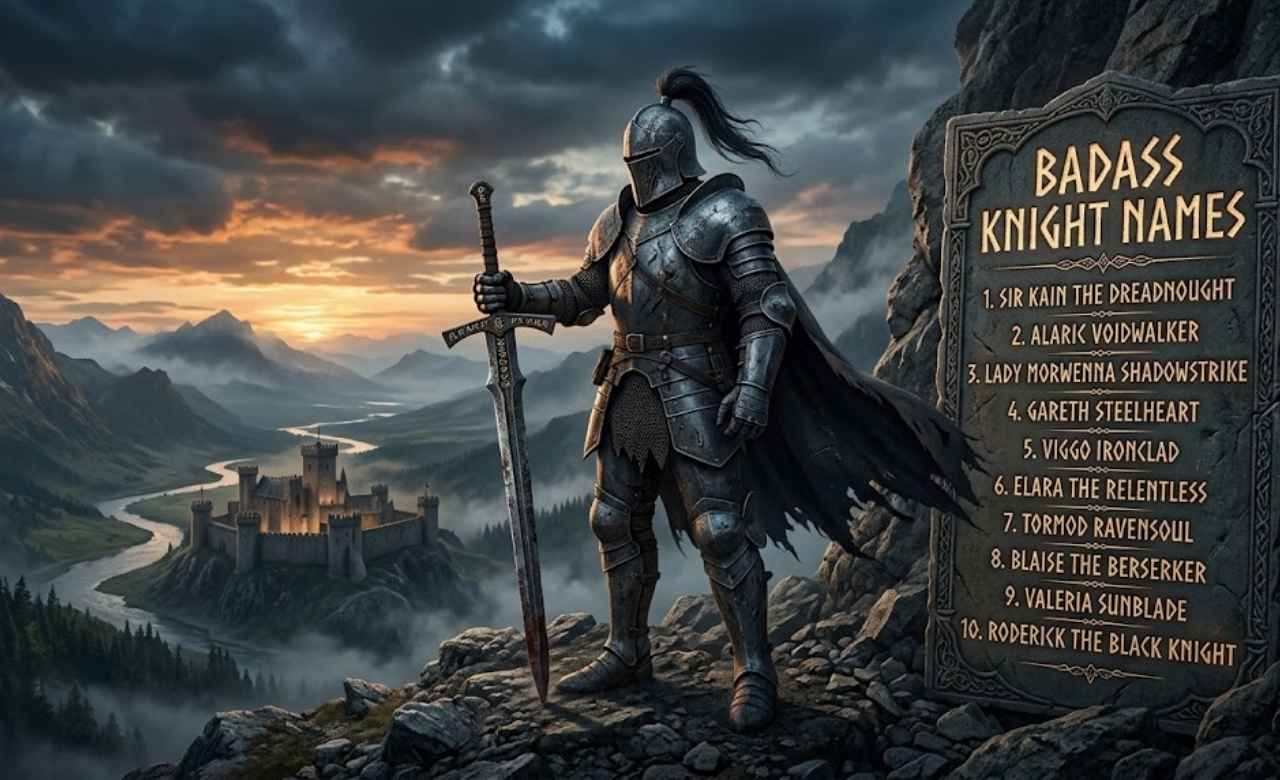
The emergence of knightly culture between the Council of Clermont in 1095 and the mid-14th century created a distinct category of martial names. These names were borne by military commanders, founders of chivalric orders, and crusading barons in the Levant.
                     [CHIVALRIC TRADITION]
                               │
         ┌─────────────────────┴─────────────────────┐
         ▼                                           ▼
   CRUSADER FRONTIERS                         CHIVALRIC ORDERS
(Levant / Outremer Campaigns)               (Templars / Hospitallers)
  • Godfrey de Bouillon (Advocate)            • Tancred (Thoughtful Counsel)
  • Baldwin (Brave, Steadfast Friend)         • Raymond (Protective Judgment)
  • Bohemond (Gigantic / Indomitable)         • Arnaut (Eagle-Power Warrior)
- Godfrey (Godefroy de Bouillon): From Gud-frid (“God’s Peace”). Godfrey was a principal leader of the First Crusade who captured Jerusalem in 1099, famously declining the title of king in favor of Advocatus Sancti Sepulchri (“Advocate of the Holy Sepulchre”).
- Baldwin (Baudouin): Compounding bald (bold, daring) and win (friend). Borne by five kings of the Crusader Kingdom of Jerusalem, most notably Baldwin IV, who maintained military parity against Saladin despite suffering from lepromatous leprosy.
- Tancred: Derived from the Old Norse/Norman Thanc-rad, meaning “thoughtful counsel” or “mindful deliberation.” Borne by Tancred of Hauteville, an Italo-Norman prince who distinguished himself as one of the most formidable commanders of the First Crusade.
- Bohemond: Originally a nickname referencing a legendary giant (Buamundus), applied by Robert Guiscard to his son. Bohemond I of Antioch was an imposing Norman strategist who outmaneuvered the Byzantine Empire and established the Principality of Antioch.
- Raymond: Derived from the Germanic Raginmund, combining ragin (advice, divine judgment) and mund (hand, protection). Borne by Raymond IV, Count of Toulouse, commander of the Provençal crusader armies.
- Arnaut: A southern Occitan and Catalan evolution of Arnold, joining arn (eagle) and wald (rule, power) to denote “Eagle Ruler.” Associated with troubadour-knights whose battle verses defined courtly martial ethics.
Strong Warrior Names for Men with Meanings of Power and Conquest
Across the Early and High Middle Ages, a man’s name often operated as a psychological declaration of combat prowess and territorial ambition.
Fierce Anglo-Saxon & Old English Male Names (400–1066 AD)
The Old English linguistic substrate was rich with martial imagery, drawing heavily on weapons, ancestral spirits, and totemic predators.
       [OLD ENGLISH WARRIOR ONOMASTICS]
                      │
   ┌──────────────────┼──────────────────┐
   ▼                  ▼                  ▼
Predatory Totems    Weaponry & Arms     Sovereignty & Lineage
• Wulfric          • Garret / Garhelm   • Cynegils
• Beowulf          • Osgar              • Ceawlin
• Cynewulf         • Hereward           • Aethelweard
- Wulfric: Compounds wulf (wolf) and ric (ruler/mighty). It translates as “Wolf-Ruler” or “Ruler with Lupine Ferocity.”
- Hereward: From here (army/host) and weard (guardian/warden). Means “Guardian of the Host.” Borne by the Anglo-Saxon folk hero Hereward the Wake, who led sustained guerilla resistance against William the Conqueror in the Fens of Ely.
- Cuthbert: Compounded from cuth (famous, renowned, known) and berht (bright). Translates as “Famously Bright”; Cuthbert of Lindisfarne was the patron saint of the martial kingdom of Northumbria.
- Garret / Garhelm: Rooted in the Old English gar (spear, javelin). Garhelm denotes “The Spear-Helmet,” symbolizing a warrior who defends his shield-wall with forward-pointing spears.
- Beowulf: The quintessential Old English epic name. Etymologically interpreted as Beo (bee) + wulf (wolf)—a kenning for “the Bear” (the wolf of the bees who plunders their hives).
- Cynegils: Compounding cyne (royal/kin) and gils (pledge/arrow). An early king of the West Saxons who secured territory against native Romano-British enclaves.
Norse & Viking Medieval Names for Rugged and Strong Boys
Scandinavian naming practices preserved in runic inscriptions and Icelandic sagas emphasized raw physical power, the elements, and Old Norse pagan cosmology.
             [OLD NORSE WARRIOR COMPOUNDS]
                           │
       ┌───────────────────┴───────────────────┐
       ▼                                       ▼
  Lupine & Ursine Roots                 Thunder & Wrath Stems
 • Ulf / Torstein                      • Thorir / Torvald
 • Björn / Ketil                       • Ivar / Svein
- Ivar (Ívarr): Derived from yr (yew tree / bow of yew) and arr (warrior). Translates as “Bow Warrior.” Borne by Ivar the Boneless, the formidable tactician of the Great Heathen Army that landed in East Anglia in 865 AD.
- Björn: A direct noun-name meaning “Bear.” A cornerstone Scandinavian appellation popularized by Björn Ironside, a legendary Viking chieftain who conducted naval expeditions across France, Spain, and the Mediterranean.
- Torstein (Þórsteinn): Compound of the theophoric root Þórr (Thor, the god of thunder) and steinn (stone, rock). Signifies “Thor’s Unyielding Stone Fortress.”
- Gunnar: Derived from Old Norse Gunnr (battle/strife) and arr (warrior). Translates as “Fierce Battle-Warrior”; a legendary hero in the Völsunga saga.
- Svein (Sven / Sveinn): Originally meant “boy,” “youth,” or “free-born squire,” evolving into a title for young sea-raiders and kings, such as Sweyn Forkbeard, King of Denmark and England.
- Ragnar: Compounding regin (counsel/gods) and arr (warrior/army). Translates as “Warrior of the Gods’ Counsel.” Made famous by the legendary saga hero Ragnar Lodbrok.
Celtic, Gaelic & Welsh Medieval Names with Ancient Strength
Celtic onomastics across early Ireland, the Scottish Highlands, and medieval Wales prioritized poetic valor, physical traits, and tribal sovereignty.
- Brian: Derived from the Proto-Celtic root *brixs (height, hill, elevation) or *brig- (power, strength). Elevated by Brian Boru, the High King of Ireland who broke the military dominance of the Dublin Norse at the Battle of Clontarf in 1014.
- Callum (Colm): From the Latin columba (“dove”). While visually gentle, it was adopted by fierce Scottish Gaels in honor of Saint Columba, who established the island abbey of Iona and converted the martial Pictish confederacies.
- Cadwallon (Cadwallader): From Welsh cad (battle) and gwaladr (lord, sovereign, ruler). Translates directly as “Battle-Lord.” Borne by Cadwallon ap Cadfan, the 7th-century King of Gwynedd who sacked Northumbria.
- Duncan (Donnchadh): Compounding donn (brown-haired or chieftain) and chadh (warrior). Translates as “Dark Warrior” or “Brown-Haired Chieftain.” Borne by early Scottish kings during the era of Gaelic-Pictish unification.
- Owain (Owen): The Welsh cognate of Eugene (Greek Eugenes, “well-born”) or derived from oun (lamb) or Celtic ywen (yew tree). Celebrated in the Welsh Arthurian cycle through Owain mab Urien, a legendary champion of the Old North.
Regional & Linguistic Heritage
Norman-French Medieval Names Introduced After 1066
The Norman settlement of England transformed the phonetic landscape of insular Europe. The newcomers favored Continental Germanic stems filtered through Old French phonology:
- Geoffrey / Godfrey: While Godfrey remained closer to its Germanic religious roots, Geoffrey developed into the courtly standard of Anglo-Norman governance and chronicle-writing (such as Geoffrey of Monmouth).
- Payne (Pagan / Paien): Derived from the Latin paganus, originally denoting a “country dweller” or “rustic,” but later used by the Normans to designate a child born before parental baptism or simply as an assertive personal name (Paganus).
- Almeric (Amaury): From the Germanic Amalric, joining amal (vigor, work, endurance) and ric (ruler). Signifies “The Ruler of Industry and Endurance.”
- Odo: The Norman monosyllabic variant of Otto, meaning “wealth” or “possessions.” Borne by Bishop Odo of Bayeux, the half-brother of William the Conqueror who commissioned the Bayeux Tapestry.
- Waleran: Compounded from walh (stranger/foreigner) and hramn (raven). A high-status aristocratic name in the Anglo-Norman Marcher lordships.
Germanic Medieval Male Names with Rich Etymology
Continental Germany and the Low Countries served as the primary source of European dithematic naming.
┌──────────────────┐     ┌──────────────────┐     ┌──────────────────┐
│   PREFIX STEM    │  +  │   SUFFIX STEM    │  =  │  COMPOUND NAME   │
├──────────────────┤     ├──────────────────┤     ├──────────────────┤
│ Adel- (Noble)    │     │ -hard (Stern)    │     │ Adelhard         │
│ Ever- (Boar)     │     │ -hard (Brave)    │     │ Everard          │
│ Volk- (People)   │     │ -mar (Famous)    │     │ Folkmar          │
│ Wig- (Battle)    │     │ -berht (Bright)  │     │ Wigbert          │
│ Hart- (Stern)    │     │ -mann (Man)      │     │ Hartmann         │
└──────────────────┘     └──────────────────┘     └──────────────────┘
- Adelhard (Adalhard): Formed from adal (noble) and hard (hardy/brave). Signifies “Noble in Strength.”
- Everard (Eberhard): Compounding eber (wild boar) and hard (brave/stern). Translates as “Brave as the Wild Boar,” invoking an animal revered in early Germanic hunting for its relentless aggression.
- Hartmann: From hart (hardy/strong) and mann (man). Denotes a resilient, steadfast warrior or protector.
- Folkmar (Volkmar): Compounding folk (people/army) and mar (famous/celebrated). Translates as “Famous Among the People.”
- Wigbert: From wig (war/combat) and berht (bright). Translates as “Illustrious in Combat.”
Early Slavic & Eastern European Medieval Names for Boys
In Eastern Europe and the Kievan Rus, medieval naming drew upon Old Church Slavonic, pagan Slavic deities, and warrior alliances. These names often incorporated the stem -slav (glory, fame) or -mir (peace, order, world).
- Yaroslav: Compounded from yaru (fierce, bright, spring-like) and slava (glory). Translates as “Fierce in Glory.” Borne by Yaroslav the Wise, Grand Prince of Kiev, who codified Russian law and expanded Kievan Rus power.
- Boleslav (Boleslaus): Compounded from bole (greater, more) and slava (glory). Translates as “Greater Glory.” A dynastic name of the Polish Piast dynasty, starting with Bolesław I the Brave.
- Vladimir (Volodimer): Derived from vlasti (to rule, power) and meri (great) or miru (peace, world). Signifies “Ruler of the Realm” or “Great in Sovereign Power.” Vladimir the Great Christianized the Kievan Rus in 988 AD.
- Casimir (Kazimierz): Formed from kaziti (to destroy, challenge) and miru (peace). Translates as “Peacemaker” or “He Who Commands Peace.” A recurring name among the monarchs of high-medieval Poland.
- Svyatoslav: Compounded from svyatu (sacred, holy) and slava (glory). Signifies “Holy Glory”; borne by Svyatoslav I, the expansionist pagan warrior-prince of Kiev.
Medieval Names Recorded in the 1086 Domesday Book
Commissioned by William the Conqueror to survey landholdings across England, the 1086 Domesday Book provides a verified historical snapshot of transitional English onomastics, capturing native Anglo-Saxon, Scandinavian, and Anglo-Norman landowners side by side:
- Alnod (Ælfnoth): Compound of ælf (elf) and noth (daring, bold). Recorded as a major pre-Conquest landholder across several southern shires.
- Godric: Compounding god (good or God) and ric (power/ruler). Meaning “Good Ruler.” One of the most prevalent Anglo-Saxon male names recorded in the 1086 inquest.
- Siward (Sigeward): Derived from sige (victory) and weard (guardian). Borne by Earl Siward of Northumbria, an Anglo-Danish magnate who fought against Macbeth of Scotland.
- Wulfric: A recurring entry among tenant farmers and dispossessed Saxon thegns across the Midlands.
- Ilbert: A continental Norman name recorded in the Domesday survey, compounded from hild (battle) and berht (bright). Borne by Ilbert de Lacy, builder of Pontefract Castle.
- Drogo: An Old Saxon and Breton name meaning “to carry” or “to serve as an emissary.” Drogo de la Beuvrière held extensive estates in Yorkshire following the Conquest.
Arthurian Legend Names: Knights of the Round Table & Mythic Heroes
The publication of Geoffrey of Monmouth’s Historia Regum Britanniae (c. 1136) and the French romances of Chrétien de Troyes introduced Arthurian chivalry into Western aristocratic culture. Names from this cycle were frequently adopted by nobility looking to connect their families to ancient mythic lineage.
                  [THE ARTHURIAN ROUND TABLE]
                               │
       ┌───────────────────────┼───────────────────────┐
       ▼                       ▼                       ▼
  Courtly Champions      Spiritual Seekers       Fringe & Tragic
• Lancelot du Lac       • Galahad (Purity)      • Tristan (Sorrow)
• Gawain (May-Hawk)     • Percival (The Veil)   • Bedivere (Spear-Lord)
- Arthur: Likely derived from the Celtic *Artos (bear) combined with *viros (man), meaning “Bear-Man,” or from the Roman clan name Artorius. The legendary High King of Camelot who unified Britain against Anglo-Saxon invaders.
- Lancelot: An Anglo-Norman diminutive, likely a hypocorism of Lanzo (Germanic for “land” or “lance/spear”). Immortalized in French romance as Lancelot du Lac, Arthur’s principal champion.
- Gawain (Gwalchmei): Derived from the Welsh Gwalchmei, compounding gwalch (hawk) and mei (the month of May) to mean “Hawk of May.” Gawain represented the chivalric balance of courtly courtesy and warrior skill.
- Galahad: Rooted in the biblical place-name Gilead or the Welsh Gwalchavad (“Hawk of Summer”). Designed by 13th-century Cistercian romance writers as the spiritually pure knight who achieves the Holy Grail.
- Percival (Perceval): Invented or adapted by Chrétien de Troyes, traditionally interpreted as perce-val (“pierce the valley”). Associated with the Grail quest, innocence, and spiritual maturation.
- Tristan (Tristram): Derived from the Pictish name Drustan (diminutive of Drest, meaning “riot” or “tumult”), later influenced by the French triste (“sad, sorrowful”). Hero of the tragic courtly romance of Tristan and Iseult.
- Bedivere (Bedwyr): From the Welsh Bedwyr, possibly deriving from *bito-viros (“man of the world”) or connected to the spear (pedry-). In Arthurian lore, the loyal marshal who returned the sword Excalibur to the Lady of the Lake.
Mythological & Dark Medieval Male Names for D&D and Fantasy Characters
Tabletop role-playing games (such as Dungeons & Dragons), grimdark fantasy, and speculative fiction often require medieval names with a shadowy, imposing, or gothic tone.
- Alaric: Compounding ala (all) and ric (ruler). Meaning “Ruler of All.” Borne by Alaric I, the Visigothic king who shocked the ancient world by leading the sack of Rome in 410 AD.
- Morcar: An Old English and Brittonic compound meaning “Great Protector” or “Dark Sea Sentinel.” Borne by the historical Morcar, Earl of Northumbria, who resisted Norman rule.
- Balian: An Old French evolution, popularized by Balian of Ibelin, who defended Jerusalem against Saladin in 1187. The name evokes fortification, siege defense, and grim resilience.
- Gaston: Derived from the Gascon/Germanic gast (“guest” or “stranger”). A common aristocratic name in southwest France, carrying an austere, commanding cadence.
- Ulric (Ulrich): Compounding odal (ancestral heritage, nobility) and ric (ruler). Conveys dark, austere lineage.
- Viggo: Derived from the Old Norse vig (war, battle, conflict). Short, direct, and aggressive.
- Grimbald: Compounded from grim (fierce, resolute, mask) and bald (bold). Signifies “Bold Behind the Visor” or “Fierce and Daring.”
Medieval Boy Names Inspired by Historical Folklore & Ballads
- Robin: A Norman French diminutive of Robert (Hrod-berht, “bright fame”). Forever linked to the outlaw folk hero of Sherwood Forest, Robin Hood, who fought against corrupt feudal authorities.
- Weyland (Wayland / Völundr): Rooted in the Germanic *Wēlandaz, from *wel- (art, craft, cunning). The mythic master blacksmith of Germanic and Anglo-Saxon folklore, capable of forging blades that sliced through stone.
- Tam Lin: A traditional Scottish ballad figure associated with the fairy court and rescue through personal courage. Tam is the medieval Scots diminutive of Thomas.
- Guy of Warwick: The legendary hero of an English romance cycle who performed trials of monster-slaying across Europe and the Holy Land before retiring into a hermit’s cell.
Rare and Forgotten Medieval Names for Boys (Obscure & Unique)
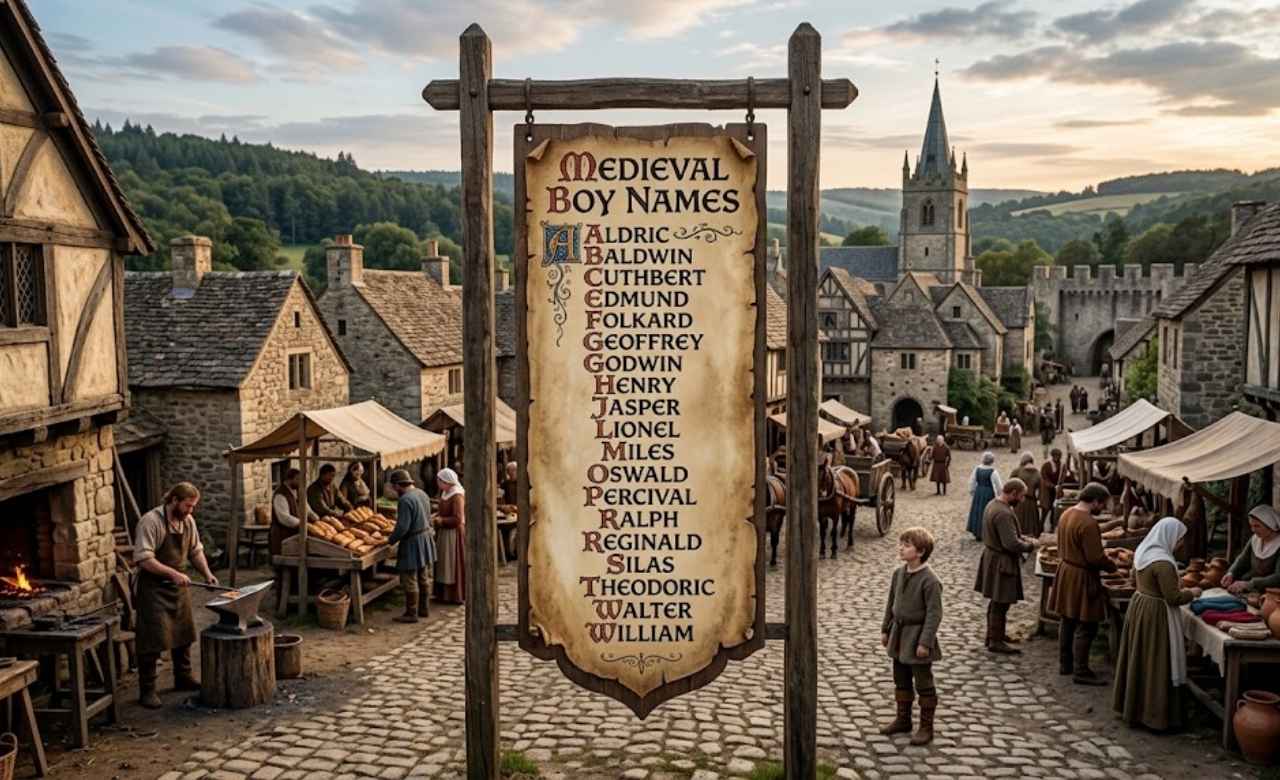
Generations of administrative standardisation winnowed medieval naming registers down to a handful of popular options. The following historically documented options were lost to broader usage, offering distinct choices for naming projects:
                  [ARCHIVAL REDISCOVERIES]
                             │
     ┌───────────────────────┼───────────────────────┐
     ▼                       ▼                       ▼
Anglo-Saxon Heritage    Continental Norman       Monastic Records
• Wystan                • Drogo                 • Cynric
• Leofric               • Warin                 • Aldous
• Kenelm                • Fulbert               • Jocelyn
- Wystan (Wīgstān): Compounded from Old English wig (battle/war) and stan (stone). Translates as “Battle Stone.” Saint Wystan was an 8th-century Mercian prince-martyr.
- Leofric: Formed from leof (beloved, dear) and ric (ruler). Translates as “Beloved Ruler.” Historically famous as the powerful Earl of Mercia and husband of Lady Godiva.
- Kenelm (Cynelm): Compounded from cyne (royal/kin) and helm (helmet/protection). Translates as “Royal Protector.” Borne by an Anglo-Saxon child saint venerated in the West Midlands.
- Aldous (Aldus): A Norman-English evolution of ald (old, wise, experienced). Famous in the early print era through the Venetian humanist Aldus Manutius.
- Cynric (Kinric): Compounding cyn (family, tribe, king) and ric (ruler). Translates as “Ruler of the Clan.”
- Fulk (Foulque): The quintessential high-medieval Anglo-Norman baronial name that fell out of favor post-1500, preserving a distinct historical rhythm.
- Warin (Guarin): An Old French name from Germanic war (guard, watchman). Signifies “The Attentive Watchman.”
Short & Punchy One-Syllable Medieval Boy Names
Medieval commoners and working classes used short, punchy monosyllables derived from occupations, nature, or clipped aristocratic names:
- Piers: The Old French nominative form of Peter (Greek Petros, “rock”). Central to Middle English literature through William Langland’s allegorical poem Piers Plowman.
- Giles: Derived via Old French from the Latin Aegidius, which in turn came from the Greek aigidion (“kid,” “young goat”) or aigis (“shield of Zeus”). Patron saint of cripples and forests.
- Rolf (Rollo): A contracted Scandinavian and Frankish form of Hrolf (Hrod-wulf, “famous wolf”). Borne by the Viking chieftain Rollo who founded the Duchy of Normandy in 911 AD.
- Guy: Derived from Germanic Wido (“wood”). Simple, direct, and widely used across the High Middle Ages.
- Cole: A medieval diminutive of Nicholas, or derived from the Old English col (charcoal, dark-featured).
- Bram: A clipped Dutch and Middle English form of Abraham (“Father of Nations”).
- Miles: The Norman-French adaptation of the Latin miles (“soldier”), or a derivative of the Germanic Milo (possibly meaning “merciful” or “peaceful”).
Gentle, Soft & Melodic Medieval Names for Boys
Not all medieval names were centered on conquest, predators, and combat. Monastic scholarship, courtly love, and religious devotion produced soft, melodic options with gentle meanings:
- Peregrine: Derived from the Latin peregrinus, meaning “traveler from abroad,” “sojourner,” or “pilgrim.” Highly valued by medieval families whose sons embarked on religious journeys to Rome or Santiago de Compostela.
- Anselm: Composed of ans (god, divine) and helm (helmet, protection). Translates as “With Divine Protection.” Borne by Saint Anselm of Canterbury, a celebrated medieval philosopher who pioneered the ontological argument.
- Crispin: From the Latin crispus, meaning “curly-haired.” Saint Crispin was the patron saint of shoemakers, his feast day immortalized by Shakespeare in the Battle of Agincourt speech in Henry V.
- Emilian: Derived from the Roman family name Aemilius, meaning “rival” or “industrious.” Preserved through monastic lineages in southern Europe.
- Sylvester: Derived from the Latin silva (“forest”), meaning “Of the Forest” or “Dweller in the Woods.” Borne by three popes, including Sylvester II, a brilliant 10th-century scholar and mathematician.
- Blaise (Blasius): From the Latin meaning “lisping” or “stammering.” Saint Blaise was venerated in the High Middle Ages as one of the Fourteen Holy Helpers.
Sacred & Biblical Medieval Male Names Used in the Middle Ages
The cult of the saints governed everyday life in the Middle Ages. The liturgical calendar determined harvest times, fairs, and legal terms, so parents routinely named sons after saints on whose feast day they were born.
                  [ECCLESIASTICAL FOUNDATION]
                               │
       ┌───────────────────────┼───────────────────────┐
       ▼                       ▼                       ▼
  Apostolic Pillars       Desert Fathers          Archangels
• John (Grace)          • Jerome (Sacred Name)  • Michael (Defeats Chaos)
• Peter (Foundation)    • Anthony (Priceless)   • Gabriel (Strength)
• Bartholomew (Furrow)  • Simon (Hearing God)   • Raphael (Healing)
- Bartholomew: Aramaic name meaning “Son of Talmai” (bar-Talmay, “son of the one who plows furrows”). A major saint whose feast day anchored late-summer trade fairs across medieval Europe.
- Laurence (Lawrence): From the Latin Laurentius, meaning “Of Laurentum” or “Crowned with Laurel.” Laurence was a popular early Roman martyr whose cult spread across medieval England and France.
- Michael: Hebrew for “Who is like God?” (Mikha’el). In medieval angelology, the Archangel Michael was depicted as the captain of the heavenly host, making his name popular among Christian knights.
- Simon: From the Hebrew Shim’on, meaning “God has heard.” A foundational apostolic name that yielded common medieval diminutives like Sim, Simkin, and the surname Simpson.
- Gervase (Gervais): Derived from Germanic ger (spear) combined with a Celtic or Latin element. Borne by several chroniclers and church figures across the 12th century.
- Clement: From the Latin clemens, meaning “merciful,” “mild,” or “forbearing.” Favored by popes and monasteries emphasizing peace.
Cool Medieval Names That Sound Perfectly Modern Today
Many medieval male names fit modern naming trends. They offer recognizable phonetic structures, clear nicknames, and rich backstories without sounding dated:Read more:How to Change Your Xbox Username (Gamertag) – Easy Step-by-Step Guide
- Alden: From Old English Healfdene (“Half-Dane”) or Ealdwine (“Old Friend”). Soft, contemporary, and easily paired with modern surnames.
- Conrad: Clean, punchy Germanic imperial heritage with the direct nickname Rad or Kurt.
- Garrick: An Anglo-Norman occupational or topographic name linked to gar (spear), carrying the energetic rhythm of modern favorites like Maverick and Gerrick.
- Bennett: The medieval English vernacular form of Benedict (Latin Benedictus, “blessed”). An organic alternative to Benjamin.
- Lucian (Lucien): Derived from the Latin lux (“light”). A popular late-medieval choice that retains a fresh, contemporary sound.
- Almeric: An uncommon alternative to Alexander or Eric, with the accessible nickname Albie or Rick.
- Everett: An English surname-evolution of the medieval Everard (“boar-brave”), balancing historical depth with modern style.
A to Z Directory of Medieval Male Names and Origins
This directory collects verified, historically sourced medieval male names, tracking their etymological origins, primary linguistic roots, and meanings.
       [HISTORICAL NOMENCLATURE: ETYMOLOGICAL MAP]
┌─────┬──────────────┬──────────────────┬─────────────────────────────┐
│ Let │ Name         │ Origin           │ Root Elements & Meaning     │
├─────┼──────────────┼──────────────────┼─────────────────────────────┤
│  A  │ Alaric       │ Gothic           │ Ala- (all) + ric (ruler)    │
│  B  │ Baldwin      │ Germanic         │ Bald (bold) + win (friend)  │
│  C  │ Conrad       │ Old High German  │ Kuon (bold) + rad (counsel) │
│  D  │ Drogo        │ Saxon / Breton   │ Drog (to carry/bear)        │
│  E  │ Everard      │ Germanic         │ Eber (boar) + hard (brave)  │
│  F  │ Fulk         │ Frankish         │ Folk (people/host)          │
│  G  │ Godfrey      │ Germanic         │ God (divine) + frid (peace) │
│  H  │ Hereward     │ Old English      │ Here (army) + weard (guard) │
│  I  │ Ivar         │ Old Norse        │ Yr (yew bow) + arr (warrior)│
│  J  │ Jocelyn      │ Norman French    │ Gaut (Geatish tribal root)  │
│  K  │ Kenelm       │ Old English      │ Cyne (royal) + helm (guard) │
│  L  │ Leofric      │ Old English      │ Leof (dear) + ric (ruler)   │
│  M  │ Morcar       │ Celtic / Saxon   │ Great protector / warden    │
│  N  │ Nigel        │ Anglo-Norman     │ Nigellus (dark/black)       │
│  O  │ Osric        │ Old English      │ Os (god) + ric (ruler)      │
│  P  │ Piers        │ Old French       │ Petros (rock/stone)         │
│  Q  │ Quentin      │ Latin / French   │ Quintus (the fifth-born)    │
│  R  │ Raymond      │ Germanic         │ Ragin (counsel) + mund (hand│
│  S  │ Siward       │ Anglo-Danish     │ Sige (victory) + weard (ward│
│  T  │ Tancred      │ Norman / Norse   │ Thanc (mind) + rad (counsel)│
│  U  │ Ulric        │ Germanic         │ Odal (heritage) + ric (rule)│
│  V  │ Valdemar     │ Scandinavian     │ Vald (rule) + mar (fame)    │
│  W  │ Wystan       │ Old English      │ Wig (battle) + stan (stone) │
│  X  │ Xanthus      │ Medieval Latin   │ Xanthos (golden/yellow)     │
│  Y  │ Yaroslav     │ Slavic           │ Yaru (fierce) + slava (fame)│
│  Z  │ Zachary      │ Biblical Hebrew  │ Zakharyah (Yahweh remembers)│
└─────┴──────────────┴──────────────────┴─────────────────────────────┘
A
- Alaric: Gothic. Stems: ala (all) + ric (ruler). “Ruler of All.”
- Alden: Old English. From eald (old) + wine (friend). “Wise, Long-Standing Friend.”
- Almeric: Continental Germanic. Stems: amal (work/vigor) + ric (ruler). “Ruler of Industry.”
- Anselm: Germanic. Stems: ans (deity) + helm (helmet/protection). “Under Divine Protection.”
- Athelstan: Old English. Stems: æthel (noble) + stan (stone). “Noble as Stone.”
B
- Baldwin: Germanic via Norman French. Stems: bald (bold) + win (friend). “Steadfast Friend.”
- Bartholomew: Aramaic. From bar-Talmay. “Son of the Furrows.”
- Bedivere: Welsh/Arthurian. From Bedwyr. “Spear Warrior” or “Man of the World.”
- Bennett: Middle English. Vernacular of Benedictus. “Blessed.”
- Bertram: Germanic. Stems: berht (bright) + hramn (raven). “Illustrious Raven.”
C
- Cadwallon: Welsh. Stems: cad (battle) + gwaladr (sovereign). “Battle-Lord.”
- Casimir: Slavic. Stems: kaziti (command/destroy) + mir (peace). “He Who Enforces Peace.”
- Clement: Latin. From clemens. “Merciful and Forbearing.”
- Conrad: Old High German. Stems: kuon (bold) + rad (counsel). “Audacious Counsel.”
- Cuthbert: Old English. Stems: cuth (famous) + berht (bright). “Famously Bright.”
D
- Drogo: Old Saxon/Breton. Stem: drog (to carry/bear). “The Carrier or Emissary.”
- Duncan: Scottish Gaelic. Stems: donn (brown/chieftain) + chadh (warrior). “Dark Warrior.”
- Dunstan: Old English. Stems: dun (dark/hill) + stan (stone). “Fortress on the Hill.”
- Denis: Greek via Old French. From Dionysios. “Follower of the Mountain God.”
E
- Eadmund (Edmund): Old English. Stems: ead (prosperity) + mund (protection). “Protector of the Realm’s Fortune.”
- Edward: Old English. Stems: ead (wealth) + weard (guardian). “Prosperous Guardian.”
- Emilian: Latin. From aemulus. “Rival” or “Industrious.”
- Everard: Germanic. Stems: eber (wild boar) + hard (stern/brave). “Brave as the Wild Boar.”
- Eustace: Greek via Old French. From Eustachios. “Fruitful and Steadfast.”
F
- Ferdinand: Visigothic. Stems: fardi (journey) + nand (daring/brave). “Daring Voyager.”
- Florian: Latin. From flos (flower). “Flourishing; Prosperous.”
- Folkmar: Germanic. Stems: folk (the army/people) + mar (fame). “Famous Among the Host.”
- Fulk: Frankish. Stem: folk (people/chieftain). “Chieftain of the Armed Host.”
- Frederick: Germanic. Stems: frid (peace) + ric (ruler). “Peaceful Sovereign.”
G
- Galahad: Welsh/Arthurian. From Gwalchavad. “Hawk of Summer.”
- Gawain: Welsh. From Gwalchmei. “Hawk of May.”
- Giles: Greek via French. From aigis. “Bearer of the Protective Shield.”
- Godfrey: Germanic. Stems: god (divine) + frid (peace). “God’s Peace.”
- Gunnar: Old Norse. Stems: gunnr (battle) + arr (warrior). “Fierce Battle-Warrior.”
H
- Hartmann: Germanic. Stems: hart (hardy/resolute) + mann (man). “Resolute Warrior.”
- Henry: Germanic. Stems: heim (home/estate) + ric (ruler). “Ruler of the Estate.”
- Hereward: Old English. Stems: here (army) + weard (guardian). “Army Guardian.”
- Hubert: Germanic. Stems: hug (mind/spirit) + berht (bright). “Bright in Spirit.”
- Hugh: Old French from Germanic. Stem: hug (intellect/spirit). “Bright in Mind.”
I
- Ilbert: Norman French. Stems: hild (battle) + berht (bright). “Illustrious in Battle.”
- Ingelram (Ingram): Germanic. Stems: Ing (ancestral god) + hramn (raven). “Raven of the Divine Ing.”
- Ivar: Old Norse. Stems: yr (yew bow) + arr (warrior). “Bow Warrior.”
- Ivo (Yves): Old French from Germanic. Stem: iv (yew wood/bow). “The Archer.”
J
- Jocelyn: Continental Norman. Derived from the Germanic tribal name Gaut (the Geats).
- John: Hebrew via Church Latin. From Yohanan. “Yahweh is Gracious.”
- Jasper: Persian via Medieval Christian tradition. Meaning “Treasurer.”
K
- Kenelm: Old English. Stems: cyne (royal) + helm (helmet/protection). “Royal Protector.”
- Kilian: Irish. Meaning “Little Church” or “Fierce Strife.” A major missionary saint across medieval Franconia.
L
- Lambert: Continental Germanic. Stems: land (territory) + berht (bright). “Illustrious Across the Land.”
- Lancelot: Anglo-Norman. Diminutive of Lanzo (land/lance). “Bearer of the Lance.”
- Laurence: Latin. From laurus (laurel). “Crowned with the Victorious Laurel.”
- Leofric: Old English. Stems: leof (beloved) + ric (ruler). “Beloved Ruler.”
- Lothair: Germanic. Stems: hlud (fame/glory) + hari (warrior). “Famous Battle-Warrior.”
M
- Marmaduke: Old Irish/Anglo-Scandinavian. Likely Mael Maedoc (“Follower of Madoc”).
- Miles: Latin/Norman. From miles. “Soldier.”
- Morcar: Brittonic/Old English. “Dark Sea Guardian.”
- Michael: Hebrew. From Mikha’el. “Who is Like God?”
N
- Nicholas: Greek. Stems: nike (victory) + laos (people). “Victory of the People.”
- Nigel: Anglo-Norman Latinization of Neil (Gaelic: “champion” or “cloud”), influenced by niger (“dark/black”).
O
- Odo: Norman French. Stem: audo (wealth/fortune). “The Fortunate.”
- Osric: Old English. Stems: os (divinity) + ric (ruler). “Divine Ruler.”
- Otto: Old High German. Stem: ot (prosperity/power). “Sovereign Prosperity.”
- Owain: Welsh. Celtic adaptation of “Well-Born” or “Yew-Tree Warrior.”
P
- Payne: Anglo-Norman. From Latin paganus. “Rustic Countryman.”
- Peregrine: Latin. From peregrinus. “Sojourner/Devout Pilgrim.”
- Percival: Old French romance origin. “He Who Pierces the Valley.”
- Piers: Old French. Vernacular form of Peter. “The Unyielding Rock.”
Q
- Quentin: Latin via Old French. From quintus. “The Fifth-Born Child.”
R
- Ragnar: Old Norse. Stems: regin (counsel/gods) + arr (warrior). “Warrior of Divine Counsel.”
- Raymond: Germanic. Stems: ragin (counsel) + mund (hand/protection). “Protective Counsel.”
- Richard: Germanic. Stems: ric (ruler) + hard (stern/brave). “Powerful Ruler.”
- Robert: Germanic. Stems: hrod (fame) + berht (bright). “Bright with Renown.”
- Rolf: Old Norse. Stems: hrod (fame) + wulf (wolf). “Renowned Wolf.”
S
- Sampson: Hebrew via Old French. From Shimshon (“Sun-Child”). A popular Old Testament name among Norman families.
- Siward: Anglo-Danish. Stems: sige (victory) + weard (guardian). “Guardian of Victory.”
- Stephen: Greek via Latin. From stephanos. “The Crown of Victory.”
- Svyatoslav: Slavic. Stems: svyatu (holy) + slava (glory). “Sacred Glory.”
T
- Tancred: Norman/Old Norse. Stems: thanc (thought/mind) + rad (counsel). “Thoughtful Counsel.”
- Theobald: Germanic. Stems: theod (the people) + bald (bold). “Bold for the People.”
- Theodoric: Germanic. Stems: theod (people) + ric (ruler). “Ruler of the People.”
- Thomas: Aramaic. From Ta’oma. “The Twin.”
- Tristan: Celtic. From drustan (riot/tumult). “The Bold Champion.”
U
- Ulric (Ulrich): Old High German. Stems: odal (ancestral land) + ric (ruler). “Noble Hereditary Ruler.”
- Urian: Welsh/Brittonic. Stem: orv (privileged/high-born). “Of Royal Standing.”
V
- Valdemar: Old Norse/Scandinavian. Stems: valdr (rule/power) + marr (famous). “Illustrious in Rule.”
- Viggo: Old Norse. Stem: vig (war/combat). “The Battle-Fighter.”
- Vladimir: Slavic. Stems: vlasti (to rule) + mir (peace/world). “Sovereign of the World.”
W
- Waleran: Anglo-Norman. Stems: walh (stranger) + hramn (raven). “Foreign Raven.”
- Warin: Germanic via Old French. Stem: war (to guard/protect). “The Sentinel.”
- William: Germanic via Norman French. Stems: wil (will/resolution) + helm (helmet/protection). “Resolute Protector.”
- Wulfric: Old English. Stems: wulf (wolf) + ric (ruler). “Wolf-Ruler.”
- Wystan: Old English. Stems: wig (battle) + stan (stone). “Fortress Stone of War.”
X
- Xanthus: Medieval Latin borrowing. From Greek xanthos. “Golden-Haired.”
Y
- Yaroslav: Slavic. Stems: yaru (fierce/bright) + slava (glory). “Fierce in Glory.”
- Yvon: Breton/Old French. Stem: iv (yew/bow). “Young Archer.”
Z
- Zachary: Hebrew via Christian Latin. From Zakharyah. “The Lord Remembers.”
Linguistic Insights: Medieval Pronunciation & Dialects
To authentically capture medieval male names in literature, historical writing, or character development, it helps to understand how these names were spoken in their contemporary settings. The Great Vowel Shift (c. 1400–1700) fundamentally transformed English vowel sounds, creating a distinct auditory gap between medieval and modern speech:
- Old English (Anglo-Saxon) Phonology: Names beginning with Æ were pronounced with a short, open front vowel, like the a in modern “cat” (e.g., Æthelstan sounded closer to “ATH-el-stahn”). The digraph ea in names like Eadward was a true diphthong, pronounced with both vowel sounds running together (“EH-ahd-ward”). The suffix -ric was pronounced with a hard palatal sound similar to the modern “ch” in German ich or the English “ch” (“Wulf-rich”).
- Anglo-Norman French Transitions: After 1066, Norman French softened hard Germanic consonants. The gutteral W- sounds of Continental Germanic were often preserved in northern Norman dialects (retaining William and Waleran), while Central Parisian French softened them into Gu- (yielding Guillaume and Guerin).
- The Evolution of Diminutives: By the 13th century, common speech relied heavily on rhyming diminutives. A man baptized as Robert was colloquially known as Rob, which was rhymed into Hob or Dob. Similarly, Richard yielded Rick, Dick, and Hick; William yielded Will, Bill, and Wilkin. Understanding these conversational contractions brings historical fiction characters and naming worldbuilding to life.
FAQs
What’s a cool medieval name?
A cool medieval name could be Alaric, Cedric, Roland, Godfrey, or Tristan. These names have an old-world, heroic feel that works well for characters or baby names.
What are royal names for boys?
Popular royal boy names include Arthur, Henry, William, Edward, Charles, and Richard. They have a classic, noble sound and are linked to kings and historical rulers.
What is a gothic name for a guy?
Gothic names for guys include Draven, Lucian, Damien, Dorian, Alistair, and Raven. They often have a dark, mysterious, elegant, or supernatural vibe.
What are the 20 rarest names for boys?
Rare boy names include Aurelius, Evander, Leander, Osric, Zephyr, Caspian, Oberon, and Thane. Other uncommon choices include Balthazar, Caelan, Emeric, Isidore, Lorcan, Peregrine, Quillon, Ragnar, Soren, Valerian, Xavian, and Zephyrus
Conclusion
Far from obsolete relics preserved only in monastic rolls or parish registers, medieval male names remain dynamic linguistic vessels carrying the courage, faith, and political revolutions of a thousand years. Whether rooted in the raw, nature-bound compounds of the Anglo-Saxon shield-wall, the aristocratic polish of the Anglo-Norman court, or the hagiographical traditions of the Christian church, these appellations possess an innate gravitas that modern naming conventions rarely match.
Choosing one connects a modern child, an epic protagonist, or an imagined kingdom directly to the foundational sagas and historic crossroads of Western heritage reminding us that behind every syllable lies a legacy forged in iron, ink, and ancestral ambition.

Welcome to NameInBible. I am Victoria, a Christian writer passionate about exploring biblical name meanings, Scripture-based insights, and powerful prayers. My goal is to help readers discover the spiritual significance of names and grow closer to God through faith-filled content.