
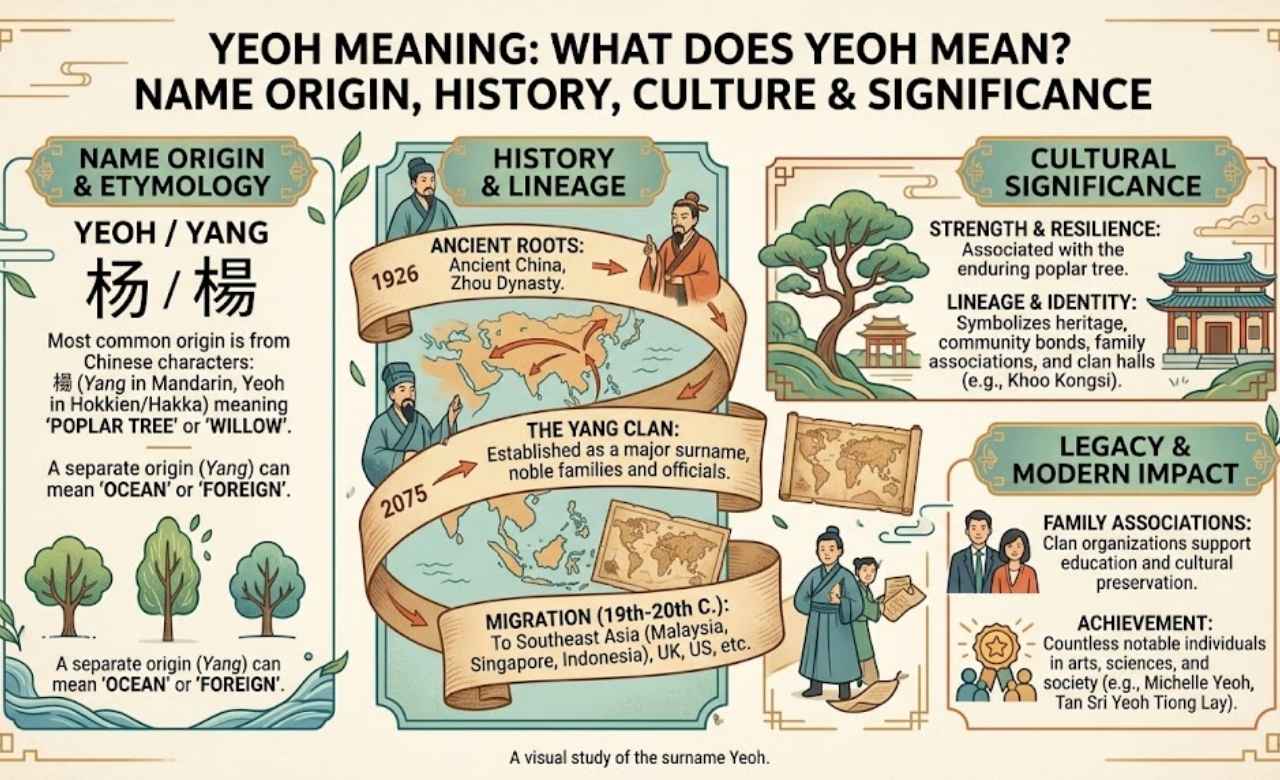
The surname Yeoh carries thousands of years of imperial history, linguistic evolution, and migration across yeoh meaning maritime Asia. While globally recognized today through international icons like Academy Award-winning actress Michelle Yeoh, the lineage represents an ancestral branch of Chinese civilization.
Whether you are tracing your yeoh meaning ancestral roots, building a family tree, or exploring Chinese onomastics, this comprehensive guide unpacks the origin, cultural significance, linguistic mechanics, and geographic distribution of the Yeoh family name.
Quick Answer
Yeoh is a Chinese surname with roots in Chinese language and culture. It is a Romanized form of the Chinese family name Yang (杨/楊) in certain dialects, including Hokkien and Teochew. The surname is particularly common among Chinese communities in Malaysia, Singapore, and other parts of Southeast Asia.
Yeoh Name Meaning at a Glance
| Attribute | Specification |
| English Spelling | Yeoh |
| Alternate Spellings | Yeo, Yang, Yong, Eow, Yew, Iu |
| Traditional Chinese Character | 楊 |
| Simplified Chinese Character | 杨 |
| Pinyin (Mandarin Romanization) | Yáng |
| Dialect of Origin | Southern Min (Hokkien / Teochew) |
| Literal Botanical Meaning | Poplar tree, willow, aspen (Salicaceae family) |
| Core Character Components | 木 (Wood / Tree) + 昜 (Sunlight / Bright openness) |
| Ancestral Geographic Origin | Ancient Hongnong (modern-day Henan & Shaanxi provinces, China) |
| Primary Modern Strongholds | Malaysia, Singapore, Taiwan, Southern China, Global Diaspora |
| Chinese Surname Ranking | Tied with 楊/杨 (Ranked 6th most common surname in China) |
What Is the Origin of the Name Yeoh?
To understand the origin of the surname Yeoh, one must look past its Western alphabetic spelling and examine the classical Chinese clan systems of antiquity. The surname Yeoh is an Yeoh Meaning authentic, dialect-specific romanization of the ancient Chinese patronymic Yang (楊).
       Ancient Zhou Dynasty Royal Lineage (Ji 姬 Clan)
                             │
            Duke Wu of Jin enfeoffs Prince Boqiao
                             │
               Fiefdom of Yang (楊国 / 邑)
                             │
            Descendants Adopt Fief as Patronymic:
                         楊 (Yang)
                             │
     ┌───────────────────────┴───────────────────────┐
     ▼                                               ▼
Central Plains Expansion                 Southern Migration (Fujian/Chaoshan)
(Mandarin: Yáng)                         (Hokkien / Teochew: Iôⁿ / Yeoh)
                                                     │
                                            Nanyang Migration (19th-20th C.)
                                                     │
                                        Malaya & Singapore (Yeoh / Yeo)
The Princely Enfeoffment in the Zhou Dynasty
The origin of the Yeoh lineage traces back nearly 3,000 years to the Zhou Dynasty (c. 1046–256 BCE). Historical records, including Sima Qian’s Records of the Grand Historian (Shiji) and the yeoh meaning classical genealogical register Yuanhe Xingzuan, trace the clan’s roots to the royal house of Ji (姬), the ancestral family of King Wen and King Wu of Zhou.
During the Spring and Autumn Period (770–476 BCE), Duke Wu of the State of Jin granted an estate to his son, Prince Boqiao (伯僑). This feudal territory was known as the Fief of Yang (楊邑), located in what is today Hongtong County, Shanxi Province. In accordance with ancient Chinese naming traditions (Xing Shi system), the noble descendants of Prince Boqiao adopted the name of their assigned territory as their Yeoh Meaning hereditary surname to honor their ancestral authority. Consequently, Prince Boqiao is revered by genealogists as the founding progenitor of the Yeoh (Yang) clan.
The Historic Cradle of Hongnong
As centuries passed, the epicenter of the Yeoh family shifted southward to Hongnong (弘農郡), an ancient commandery situated along the borders of modern Henan and Shaanxi provinces.
During the Han Dynasty (202 BCE – 220 CE), the Hongnong Yang clan emerged as an intellectual and political powerhouse:
- The “Confucius of the West”: Scholar-statesman Yang Zhen (楊震) established the family’s moral ethos, serving as Grand Commandant and earning renown for incorruptibility.
- The Four Generations of Three Excellencies: For four consecutive generations, members of the Hongnong Yang lineage attained the three highest ministerial positions in the imperial court (San Gong), cementing Hongnong as the premier ancestral hall mark (tanghao) of the clan.
Is Yeoh a Chinese Name or Surname?
Yeoh is strictly a Chinese family name (surname). It is not historically used as an individual given name Yeoh Meaning (ming).
In Chinese naming architecture, naming conventions follow a Surname + Given Name hierarchy:
[Family Name / Patronymic]  +  [Generational Name]  +  [Personal Name]
          Yeoh                         Choo                   Kheng
       (Ancestry)                  (Generation)            (Individual)
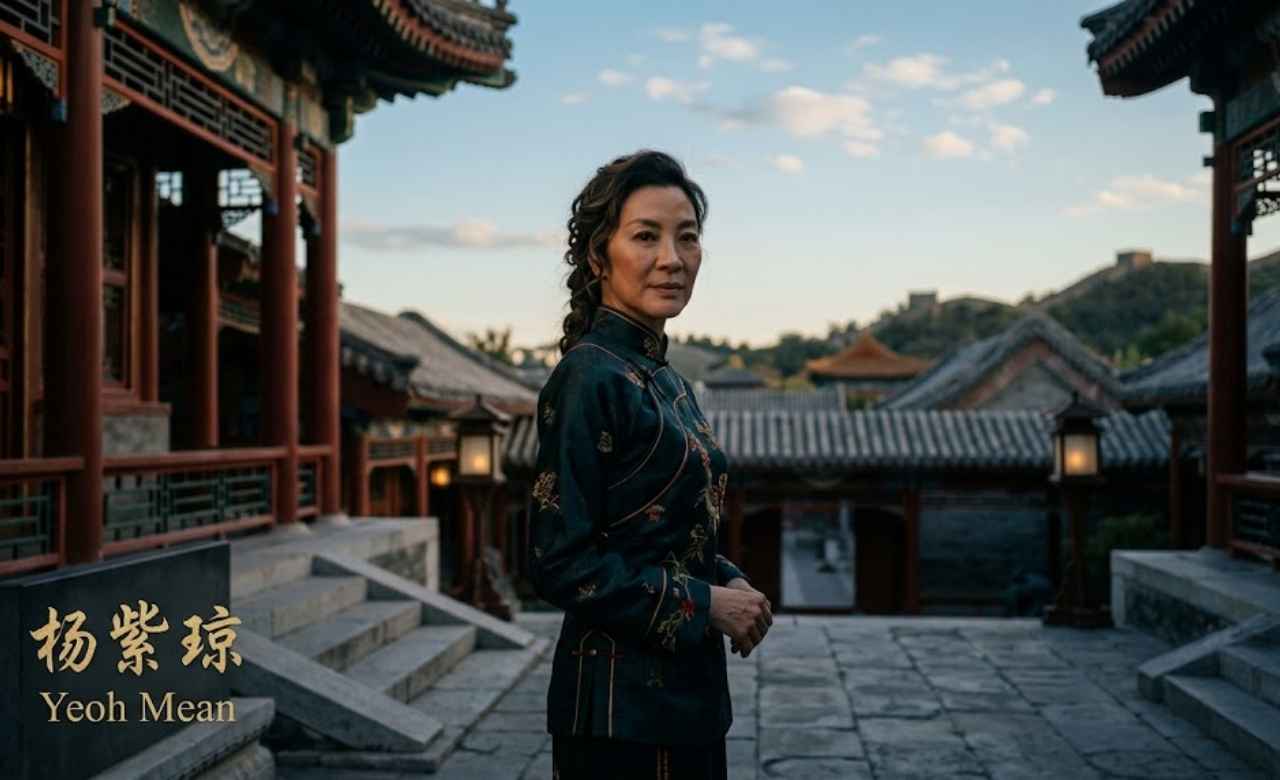
In Western societies and official Anglophone records (such as passports, legal deeds, and school registries), Chinese individuals often invert their names or register their surname at the end. For instance, Michelle Yeoh’s legal Chinese name is Yeoh Choo Kheng (楊紫瓊), where Yeoh is her family lineage, Choo is her generational identifier, and Kheng represents her personal name.
What Does Yeoh Mean in Chinese?
Etymologically, the Chinese surname Yeoh refers to the poplar tree (Populus) and carries classical associations with the willow (Salix).
            楊 (Traditional Chinese Character)
           ┌─────────────────┴─────────────────┐
           ▼                                   ▼
       木 (Mù)                             昜 (Yáng)
     Semantic Radical                    Phonetic Radical
  Meaning: Tree, Wood, Vitality       Meaning: Sunlight, Radiance, Expanding
           │                                   │
           └─────────────────┬─────────────────┘
                             ▼
     Literal: "The tree that flourishes under expanding sunlight"
In ancient agricultural China, names derived from nature held practical and metaphysical significance:
- Botanical Resilience: Poplars and willows were admired for their rapid growth, flexibility, deep-root systems, and ability to thrive alongside rivers.
- Vitality and Renewal: Because willow cuttings easily sprout anew when replanted, the character came to symbolize fertility, continuity, and endurance through adversity.
Yeoh in Chinese Characters
Depending on geographic region and historical period, the surname Yeoh is written in two distinct orthographic forms.
Traditional Chinese: 楊
The traditional glyph 楊 has been utilized for millennia in imperial stone inscriptions, classical literature, and genealogical records (zupu):
- It features the semantic classifier 木 (wood/tree) on the left side, indicating botanical nature.
- On the right side, it contains 昜 (yáng), an archaic ideogram depicting the sun rising over the horizon, spreading light and expansive positive energy.
- This form remains the legal standard in Hong Kong, Macau, Taiwan, and among traditional overseas Chinese communities in Malaysia, Singapore, and North America.
Simplified Chinese: 杨
In the 1950s and 1960s, the People’s Republic of China introduced standardized writing reforms to promote literacy:
- The complex right-hand component 昜 was simplified to the cursive-derived stroke structure 𠃓.
- The resulting character 杨 is the official standard in mainland China and is widely used in Singapore’s Chinese-language media and instructional curricula. Both characters refer to the exact same ancestral lineage.
Yeoh and Its Chinese Romanization
A frequent source of cross-cultural confusion is the variance between Yeoh and Yang. They are the exact same name written through two different linguistic filters.May you like other article What Does SYBAU Mean in Text? SYBAU Meaning, Slang & Examples (2026)
                  Chinese Character: 楊 / 杨
                              │
     ┌────────────────────────┴────────────────────────┐
     ▼                                                 ▼
Official Standard (Mandarin)              Regional Dialect (Southern Min)
Hanyu Pinyin: Yáng                        Hokkien / Teochew: Iôⁿ / Yeoh
Used in: Mainland China, Taiwan           Used in: British Malaya, Singapore
Why Chinese Surnames Are Spelled Differently
Before the standardization of Hanyu Pinyin by mainland China in 1958, there was no single universal system for converting Chinese spoken sounds into the Roman alphabet. Surnames were romanized based on how they sounded in the immigrant’s regional spoken dialect.
When British colonial administrators in the Straits Settlements (Penang, Malacca, Singapore) recorded incoming immigrants at harbor immigration offices, clerks transcribed what they heard phonetically using English spelling rules:
- A northern or standard Mandarin speaker pronounced 楊 as Yáng.
- A Southern Min (Hokkien or Teochew) speaker pronounced 楊 with an open, nasalized vowel: Iôⁿ or Yeoh.
- A Cantonese speaker pronounced it as Yeung or Yeong.
- A Hakka speaker pronounced it as Yong.
The British clerks in Malaya wrote down Yeoh or Yeo to capture the distinctive coastal Fujian pronunciation, creating a permanent legal surname that persists across generations today.
What Is the History of the Yeoh Surname?
The history of the Yeoh (Yang) family reflects the political and dynastic transitions of imperial China. Over two and a half millennia, the clan produced emperors, prime ministers, military strategists, and renowned poets.
Dynasty / Period               Historic Milestone for the Yeoh (Yang) Lineage
──────────────────────────────────────────────────────────────────────────────
Zhou Dynasty (c. 1046 BCE)     Prince Boqiao is granted the Fief of Yang; clan begins.
Han Dynasty (202 BCE–220 CE)   Hongnong Yang clan achieves ministerial prominence.
Sui Dynasty (581–618 CE)       Yang Jian unifies China as Emperor Wen, founding the Sui.
Tang Dynasty (618–907 CE)      Clan supplies imperial consorts, scholars, and ministers.
Song Dynasty (960–1279 CE)     The "Yang Family Generals" defend the northern frontier.
19th–20th Century              Nanyang diaspora settles in British Malaya and Singapore.
The Imperial Zenith: The Sui Dynasty (581–618 CE)
The zenith of political influence for the Yeoh clan arrived in 581 CE, when Yang Jian (楊堅), posthumously honored as Emperor Wen of Sui, brought an end to centuries of division following the collapse of the Han Dynasty:
- Yang Jian unified China’s northern and southern territories.
- He established the Imperial Examination System (Keju), a meritocratic civil service structure that endured until 1905.
- He initiated the construction of the Grand Canal, linking the Yellow and Yangtze river basins to facilitate commerce and cultural integration.
The Martial Valor of the Yang Family Generals
During the Northern Song Dynasty (960–1127 CE), the lineage became synonymous with military loyalty through the legends of the Generals of the Yang Family (Yang Jia Jiang).
Led by patriarch Yang Ye (楊業) and matriarch She Saihua, three successive generations of the clan defended Song borders against Khitan invaders from the Liao Dynasty. Their historic sacrifices became a cornerstone of Chinese opera, folklore, and martial literature, symbolizing filial piety and duty to the homeland.
Where Did the Yeoh Family Name Come From?
Tracing the physical migration of the Yeoh surname reveals a southward movement across the Chinese subcontinent, followed by a maritime transition into Southeast Asia.
1. Shanxi & Shaanxi (Yellow River Cradle: Central Plains)
   │
   ▼ [Disruptions of Jin & Tang Dynasties]
2. Henan & Jiangxi (Inland Waypoints)
   │
   ▼ [Song Dynasty Southern Shift]
3. Fujian & Eastern Guangdong (Hokkien & Teochew Coastal Bases)
   │
   ▼ [19th-Century Maritime Diaspora via South China Sea]
4. Southeast Asia (Penang, Malacca, Singapore - "Nanyang")
- The Northern Heartland: The clan emerged in the Central Plains (Zhongyuan) along the Yellow River basin, concentrating around modern Shanxi, Shaanxi, and Henan provinces.
- The Southern Flight: During the Western Jin Dynasty’s collapse (Disaster of Yongjia, 311 CE) and the later Tang Dynasty rebellions, entire aristocratic clans migrated south of the Yangtze River to escape northern conflicts.
- The Maritime Gateway (Fujian Province): The ancestors of those bearing the specific spelling Yeoh settled in Fujian Province, primarily in Quanzhou, Zhangzhou, and Xiamen, as well as the adjacent Chaoshan region of Guangdong. In these coastal enclaves, the localized Southern Min phonetics transformed the pronunciation of the surname into Iôⁿ.
- The Southeast Asian Migration (Nanyang): In the 19th and early 20th centuries, economic hardship, famine, and political upheaval prompted thousands of Southern Min speakers to set sail across the South China Sea. Settling in British Malaya, the Dutch East Indies, and Singapore, these emigrants registered their family name under colonial transliterations, establishing the modern Yeoh diaspora.
Is Yeoh a Malaysian or Chinese Surname?
This question reflects a common misunderstanding of cultural ancestry versus legal nationality.
Yeoh is an ethnically Chinese surname, held predominantly by citizens of Malaysia and Singapore.
Ethnicity: Chinese (Hokkien / Teochew ancestry)
Origin: Fujian Province, Southern China
Orthography: 楊 / 杨
Nationality: Malaysian, Singaporean, British, Australian, American, etc.
- Cultural Roots: The surname has no indigenous roots in the Austronesian Malay language or traditional Malaysian naming structures (which often use patronymic systems like bin or binti).
- Sociopolitical Reality: The specific spelling Yeoh developed within British Malaya. Consequently, someone bearing the spelling Yeoh is almost universally an ethnic Chinese individual whose family lived in, or migrated through, Malaysia or Singapore.
Where Is the Yeoh Surname Most Common?
While the broader Yang clan encompasses over 45 million people worldwide, the Romanized spelling Yeoh is geographically concentrated in Southeast Asia and Commonwealth nations.
Geographic Density of the Romanized Surname "Yeoh":
────────────────────────────────────────────────────────
Malaysia          ██████████████████████████ (Highest Concentration)
Singapore         █████████████
United Kingdom    ████
Australia         ████
United States     ███
Rest of World     ██
Yeoh in Malaysia
Malaysia is home to the highest concentration of individuals named Yeoh worldwide. The surname is especially prevalent in states historically shaped by Hokkien immigration:
- Penang: The island of Penang represents the epicenter of Malaysian Hokkien culture. The Yeoh clan was among the leading immigrant families who established clan jetties, ancestral kongsis, and merchant trading houses in George Town.
- Perak and Selangor: Towns like Ipoh (the birthplace of Michelle Yeoh) and Klang saw influxes of Hokkien settlers drawn to 19th-century tin mining and trade networks.
- Malaysian Clan Associations: Clan cohesion remains active through organizations like the Yeoh Kongsi (楊氏公會), which provide academic scholarships, maintain ancestral halls, and organize annual ancestor worship ceremonies during the Qingming Festival.
Yeoh in Singapore
In Singapore, the spelling Yeoh exists alongside its close phonetic twin, Yeo. Early Hokkien and Teochew pioneers settled along the Singapore River, contributing to early civic and commercial infrastructure. Today, Singaporean Yeohs are well-represented across government, medicine, banking, and the arts.
Yeoh in China and Other Regions
- Mainland China: You will rarely find the spelling Yeoh on domestic Chinese passports or identity cards. Instead, every individual of this ancestral bloodline is registered under the pinyin form Yang or the simplified character 杨.
- Taiwan: While the Hokkien dialect (Taiwanese Hokkien) is spoken natively by millions in Taiwan, the Republic of China’s romanization historically relied on the Wade-Giles system (Yang) or modern Pinyin. Thus, the spelling Yeoh remains rare there.
- Western Diaspora: Substantial communities of Yeohs live across Australia, the United Kingdom, Canada, and the United States, representing generations of professional emigration from Malaysia and Singapore.
How Do You Pronounce Yeoh?
Pronouncing the surname correctly depends on whether you are using yeoh meaning conversational English, standard Mandarin, or ancestral Hokkien.
Dialect / Language      Phonetic Spelling         Sound Breakdown
──────────────────────────────────────────────────────────────────────────────
Anglophone English      /joʊ/ or "YOH"            Rhymes with "go", "so", "low"
Mandarin Chinese        Yáng [jǎŋ]                Rising tone, sounds like "YAH-ng"
Southern Min (Hokkien)  Iôⁿ [iõ˨˩]                 Gliding "ee-yoh" with a nasal finish
The Westernized English Pronunciation
In English-speaking environments, Yeoh is pronounced as a single syllable:
- “YOH” (rhyming with go, show, slow, and toe).
- The final letters “-eh” or “-h” are silent modifiers added by colonial-era British scribes to signal a prolonged, open vowel sound.
The Mandarin Chinese Pronunciation: Yang
If you address a bearer of this surname in Mandarin:
- It is pronounced Yáng in the second (rising) tone.
- It begins with an open “YAH” sound and finishes with an elongated, resonant “-ng” consonant.
The Ancestral Hokkien Pronunciation: Iôⁿ
In authentic Hokkien, the name carries a nasal tone:
- Phonetically, it begins with an “ee” glide that moves into an open “oh” vowel, held in a low-falling pitch.
- The speaker keeps the soft palate relaxed, allowing air to pass through both the mouth and nose simultaneously (Iôⁿ).
What Does the Yeoh Surname Represent?
Across centuries of dynastic rule and diaspora, the Yeoh family name has stood for three enduring cultural virtues.
                          Core Values of the Yeoh Clan
                                       │
     ┌─────────────────────────────────┼─────────────────────────────────┐
     ▼                                 ▼                                 ▼
Intellectual Integrity             Martial Loyalty                  Communal Duty
(Legacy of Yang Zhen:          (The Yang Family Generals:       (Nanyang Kongsis: Mutual
 "Heaven knows, Earth knows")   Sacrifice for Sovereign)          aid & Clan solidarity)
- Moral Incorruptibility: Rooted in the story of Han Dynasty statesman Yang Zhen, who famously rejected a late-night bribe with the words: “Heaven knows, Earth knows, you know, and I know; how can you say no one knows?” (天知,地知,你知,我知).
- Defensive Loyalty: Commemorated in the sacrifices of the Northern Song military figures who protected frontier civilian populations.
- Pioneering Tenacity: Exhibited by 19th-century Nanyang migrants who established schools, hospitals, and civil networks throughout Malaya and Singapore.
Does Yeoh Have a Spiritual or Symbolic Meaning?
In addition to its literal botanical definition, the surname Yeoh holds symbolic meaning within traditional Chinese worldviews.
Yin and Yang Connections
The character 楊 contains the structural radical 昜 (yáng), which represents:
- Solar energy, light, warmth, and the masculine, generative principle of the cosmos (Yang in the Yin-Yang duality).
- Combined with the wood radical (木), it signifies trees growing vigorously toward the light.
       Five Phases (Wu Xing) Classification:
       ──────────────────────────────────────
       Element:     Wood (木, Mù)
       Season:      Spring (Renewal, Youth, Growth)
       Direction:   East (Sunrise, Dawning of Light)
       Attributes:  Flexibility, Upward Striving, Expansion
Feng Shui and Folk Beliefs
In traditional Chinese folklore, wood from the willow (yangliu) was believed to possess protective spiritual properties. Taoist ritual masters occasionally utilized willow branches to dispel malevolent energies during cleansing rites, associating the botanical root of the Yeoh name with renewal, resilience, and protection.
Does Yeoh Have a Cultural Meaning?
Within Chinese artistic and literary traditions, the poplar and willow trees referenced by the surname Yeoh appear consistently as symbols of connection and farewell.
Classical Motif: Breaking the Willow Branch (折柳, Zhé Liǔ)
──────────────────────────────────────────────────────────────────────────
In Tang Dynasty poetry, parting travelers were gifted a willow sprig.
The word for willow (柳, liǔ) sounds identical to "stay" (留, liú).
It carried the message: "Do not depart; or if you must, root yourself wherever you land."
For the diaspora who carried the surname Yeoh across the South China Sea, this cultural motif resonated deeply. It reminded emigrants to take root, adapt to new soils, and build communities while honoring their ancestral origins.
Is Yeoh a Rare Surname?
Whether the surname is considered rare depends on the linguistic lens used to assess it.
Global Scope: Character 楊 (Yang)
──────────────────────────────────────────────────────────────────
Ranking: 6th most common surname in China
Population: ~45+ million people worldwide
Rarity: EXTREMELY COMMON (Among the world's most populous names)

Regional Scope: Romanization "Yeoh"
──────────────────────────────────────────────────────────────────
Ranking: Highly prevalent in Malaysia & Singapore
Rarity in the West: UNCOMMON / MODERATE
Distribution: Found primarily in diaspora networks outside Asia
- By Chinese Character (楊): It is one of the most common family names on the planet. According to demographic surveys from China’s Ministry of Public Security, it consistently ranks as the 6th most common surname in mainland China, accounting for over 3% of the total Han Chinese population.
- By Romanized Spelling (Yeoh): It is a regionally distinct spelling found primarily in Malaysia, Singapore, and among members of the Southeast Asian diaspora. In Europe, North America, and mainland China, the spelling Yeoh is far less common than its pinyin counterpart, Yang.
Yeoh Surname Variations and Alternate Spellings
Because Chinese surnames were transcribed using different regional dialects and European languages, the character 楊 produced dozens of spelling variants worldwide.
| Spelling | Primary Dialect / Linguistic Origin | Main Regions Found |
| Yeoh | Southern Min (Hokkien) | Malaysia, Singapore, UK, Australia |
| Yeo | Southern Min (Hokkien / Teochew) | Singapore, Malaysia, Philippines |
| Yang | Mandarin (Hanyu Pinyin / Wade-Giles) | Mainland China, Taiwan, Global |
| Yong | Hakka | Malaysia, Singapore, Indonesia |
| Yeung | Cantonese (Hong Kong Government Romanization) | Hong Kong, Canada, US, UK |
| Yeong | Cantonese / Korean Romanization | Hong Kong, South Korea, Malaysia |
| Eow / Yew | Southern Min Regional Dialects | Northern Malaysia (Penang, Perak) |
| Iu / Io | Hokkien (Portuguese Macanese Transcription) | Macau, Portugal |
| Dương | Sino-Vietnamese Pronunciation | Vietnam |
| Yo | Japanese Sino-Reading | Japan |
Yeoh vs. Yeo: What Is the Difference?
A common question among those researching Southeast Asian family histories is the distinction between Yeoh and Yeo.
                Ancestral Character: 楊 (Southern Min Origin)
                                      │
           ┌──────────────────────────┴──────────────────────────┐
           ▼                                                     ▼
      "Yeoh" Spelling                                       "Yeo" Spelling
  • Scribe preference in Northern Malaya               • Scribe preference in Singapore &
    (Penang, Perak, Kedah)                               Southern Malaya (Johor, Malacca)
  • Strong Hokkien alignment                           • Common among both Hokkien & Teochew
  • Retains silent terminal "-h"                       • Minimalist English spelling
- Identical Lineage: Both spellings represent the exact same Chinese character (楊) and belong to the same ancestral clan.
- Dialectal Nuance: While both reflect Southern Min roots, Yeoh is predominantly associated with Hokkien speakers from northern Malaysia (such as Penang). Yeo is commonly adopted by both Hokkien and Teochew individuals from Singapore and southern Peninsular Malaysia.
- Administrative Idiosyncrasy: The inclusion of the terminal letter “h” was largely determined by the personal preference of the colonial British clerk or church official who registered an immigrant’s initial arrival paperwork.
Yeoh vs. Yue and Other Similar Chinese Surnames
Because several Chinese characters share similar English transcriptions, it is easy to confuse Yeoh with other surnames that look or sound alike.
English Spelling     Chinese Character    Mandarin Pinyin      Meaning / Origin
──────────────────────────────────────────────────────────────────────────────
Yeoh / Yeo           楊                   Yáng                 Poplar / Willow tree
Yue / Yueh           岳                   Yuè                  High mountain peak
Yue / Yu             越                   Yuè                  State of Yue; to surpass
Yu                   余                   Yú                   Abundance; surplus
You / Yew            尤                   Yóu                  Outstanding; unique
None of these alternate surnames share genealogical roots with the Yeoh (楊) family:
- Yue (岳): Made famous by Song Dynasty general Yue Fei, this lineage represents an entirely separate clan.
- Yue (越): Associated with the ancient Yue kingdoms of southern coastal China.
- Yu (余): An ancestral family name concentrated in southern provinces, etymologically unrelated to the poplar tree clan.
Is Yeoh a Family Name or Given Name?
Yeoh functions exclusively as a family name (surname).
In classical Chinese naming traditions:
- Family names (Xing) are passed down patrilineally from father to child.
- Given names (Ming) are selected by parents based on generational poems (zibei), aesthetic beauty, or birth-chart astrological balances.
Example: Michelle Yeoh's Name Structure
────────────────────────────────────────
Full Name:             Yeoh Choo Kheng (楊紫瓊)
Surname (Family):      Yeoh (楊)
Generational Name:     Choo (紫)
Personal Given Name:   Kheng (瓊)
In casual Western dialogue, an individual named Yeoh might be called by their complete personal name or their surname preceded by a title (such as Mr. Yeoh or Ambassador Yeoh). Addressing someone simply by their surname without a title or personal name is grammatically incorrect in traditional Chinese culture.
Famous People With the Surname Yeoh
Bearers of the surname Yeoh have achieved international prominence across cinema, business, politics, and the sciences.
       Field / Industry             Prominent Bearer of the Yeoh Name
       ──────────────────────────────────────────────────────────────────────
       Cinema & Arts                Michelle Yeoh (Academy Award-winning actress)
       Corporate & Enterprise       Tan Sri Dato' Seri Yeoh Tiong Lay (YTL Founder)
       Business Leadership          Francis Yeoh (Executive Chairman, YTL Corp)
       Medicine & Research          Yeoh Ghim Seng (Cardiothoracic Surgeon & Politician)
- Tan Sri Michelle Yeoh (楊紫瓊): The Malaysian-born cinematic icon made history in 2023 by becoming the first Asian woman to win the Academy Award for Best Actress for her performance in Everything Everywhere All at Once.
- Tan Sri Dato’ Seri Yeoh Tiong Lay (楊忠禮): Renowned Malaysian industrialist and philanthropist who founded the YTL Corporation, one of Malaysia’s largest integrated infrastructure conglomerates.
- Tan Sri Francis Yeoh (楊肅斌): Eldest son of Yeoh Tiong Lay, who expanded YTL Corporation into an international utilities, rail transit, luxury hospitality, and power generation brand.
- Yeoh Ghim Seng (楊錦成): A distinguished Singaporean surgeon who served as Speaker of the Parliament of Singapore for two decades (1970–1989) and briefly acted as the nation’s President.
Michelle Yeoh and the Yeoh Surname
Academy Award winner Michelle Yeoh has played a central role in introducing this regional Hokkien surname to international audiences.
                              Michelle Yeoh
                                   │
     ┌─────────────────────────────┼─────────────────────────────┐
     ▼                             ▼                             ▼
Ancestral Roots             Birth & Upbringing            Global Stardom
Fujian Province, China       Ipoh, Perak, Malaysia         Hollywood & World Cinema
Lineage: 楊 (Hokkien)        Bilingual / Multicultural     Academy Award Winner (2023)
- Family Roots: Michelle Yeoh was born in Ipoh, Perak, Malaysia, into an ethnic Chinese family of Hokkien descent.
- Linguistic Lineage: Her legal name, Yeoh Choo Kheng, directly reflects the British Malayan Hokkien romanization system.
- Cultural Representation: Her public embrace of her family name in Hollywood without anglicizing her surname (as was common in earlier eras of cinema) has made Yeoh one of the most recognizable Chinese surnames in the global arts landscape.
How to Research Your Yeoh Family History
Researching a Yeoh family tree requires bridging Western romanized documentation with classical Chinese genealogical sources.
                    Steps to Researching Yeoh Genealogy
                                     │
     ┌───────────────────────────────┼───────────────────────────────┐
     ▼                               ▼                               ▼
1. Uncover Ancestral Glyphs      2. Identify the Tanghao         3. Locate the Zupu
Obtain Chinese characters        Find the ancestral hall         Consult Clan Registers
from gravestones or deeds        name (e.g., Hongnong 弘農)       for generational tracking
1. Document the Original Chinese Characters
Because Western records capture only the English spelling Yeoh, your first step is identifying the exact Chinese characters used by your ancestors:
- Examine tombstones (shibei) in traditional Chinese cemeteries, which almost always engrave the ancestral surname, given name, and ancestral village.
- Review ancestral tablets (shenzhupai), legal deeds, marriage certificates, and old family letters.
2. Identify the Ancestral Hall Name (Tanghao)
Traditional Chinese families identify with an ancestral commandery known as a Tanghao (堂號):
- For the Yeoh clan, the most prestigious ancestral hall name is Hongnong Tang (弘農堂).
- Locating this title on home doorways, altar carvings, or gravestones confirms your branch’s historical connection to the ancient Hongnong commandery.
3. Trace the Generational Poem (Zibei)
Many Chinese clans used a rhyming generation poem (zibei) to name children across generations:
- Each generation takes one character from the poem as their middle name.
- Comparing your family’s middle names against ancestral poems helps match your lineage to recorded clan branches in China.
4. Consult the Genealogy Book (Zupu)
The definitive genealogical record is the Zupu (族譜) or Jiapu (家譜):
- These comprehensive lineage books track male descendants back dozens of generations, documenting dates of birth, marriage alliances, burial locations, and civic honors.
- Many overseas Chinese associations, such as the Malaysian Yeoh Clan Association or genealogical libraries in Fujian Province, preserve copies of these records.
Common Questions About the Yeoh Name
Is Yeoh a Chinese surname?
Yes. Yeoh is an authentic Chinese surname representing the character 楊 (simplified: 杨). It is the Southern Min (Hokkien/Teochew) phonetic romanization of the name widely known in Mandarin pinyin as Yang.
What nationality is the surname Yeoh?
The surname Yeoh is culturally and ethnically Chinese. However, by nationality, the vast majority of people who use the spelling Yeoh are citizens of Malaysia or Singapore, along with their diaspora communities in the United Kingdom, Australia, Canada, and the United States.
What does Yeoh mean in Chinese?
Etymologically, Yeoh means the poplar tree or willow (Populus / Salix). The character combines the wood element (木) with the sun/radiance element (昜), carrying connotations of vitality, endurance, and upward growth.
Is Yeoh the same as Yang?
Yes. Yeoh and Yang are the exact same surname written in two different linguistic forms. Yang is the official Mandarin Pinyin transcription, whereas Yeoh is the Southern Min (Hokkien) transcription historically used in Malaysia and Singapore.
Why is Yang spelled Yeoh in Malaysia?
During the 19th and early 20th centuries, British immigration officials in Malaya transcribed Chinese surnames based on spoken regional dialects rather than standard Mandarin. Because the majority of early Chinese settlers in Malaya came from the Hokkien-speaking region of Fujian, the local pronunciation (Iôⁿ) was officially registered as Yeoh or Yeo.
How do you pronounce Yeoh?
In everyday English, it is pronounced as a single syllable: “YOH” (rhyming with so, go, and show). In standard Mandarin Chinese, it is pronounced Yáng with a rising tone. In ancestral Hokkien, it is pronounced with a distinct nasal vowel glide (Iôⁿ).
The surname Yeoh links modern diaspora communities across Malaysia, Singapore, and the West to the ancient royal courts of the Zhou Dynasty, the statecraft of the Hongnong scholars, and the cultural traditions of maritime Fujian. It stands as an enduring emblem of resilience, intellectual integrity, and deep ancestral heritage.
Conclusion
The Yeoh meaning is closely connected to Chinese family heritage, language, and regional dialects. Yeoh is primarily a Chinese surname and is a Romanized form of the family name Yang (杨/楊) in certain dialects, including Hokkien and Teochew.
While Yeoh is not an English word, slang term, or romantic expression, it carries cultural significance for families with Chinese roots, particularly in Malaysia, Singapore, and other parts of Southeast Asia. Its spelling and pronunciation can vary depending on the family’s dialect and region.
So, when you see the name Yeoh, it generally refers to a Chinese family name with a long linguistic and cultural history.

Welcome to NameInBible. I am Victoria, a Christian writer passionate about exploring biblical name meanings, Scripture-based insights, and powerful prayers. My goal is to help readers discover the spiritual significance of names and grow closer to God through faith-filled content.