
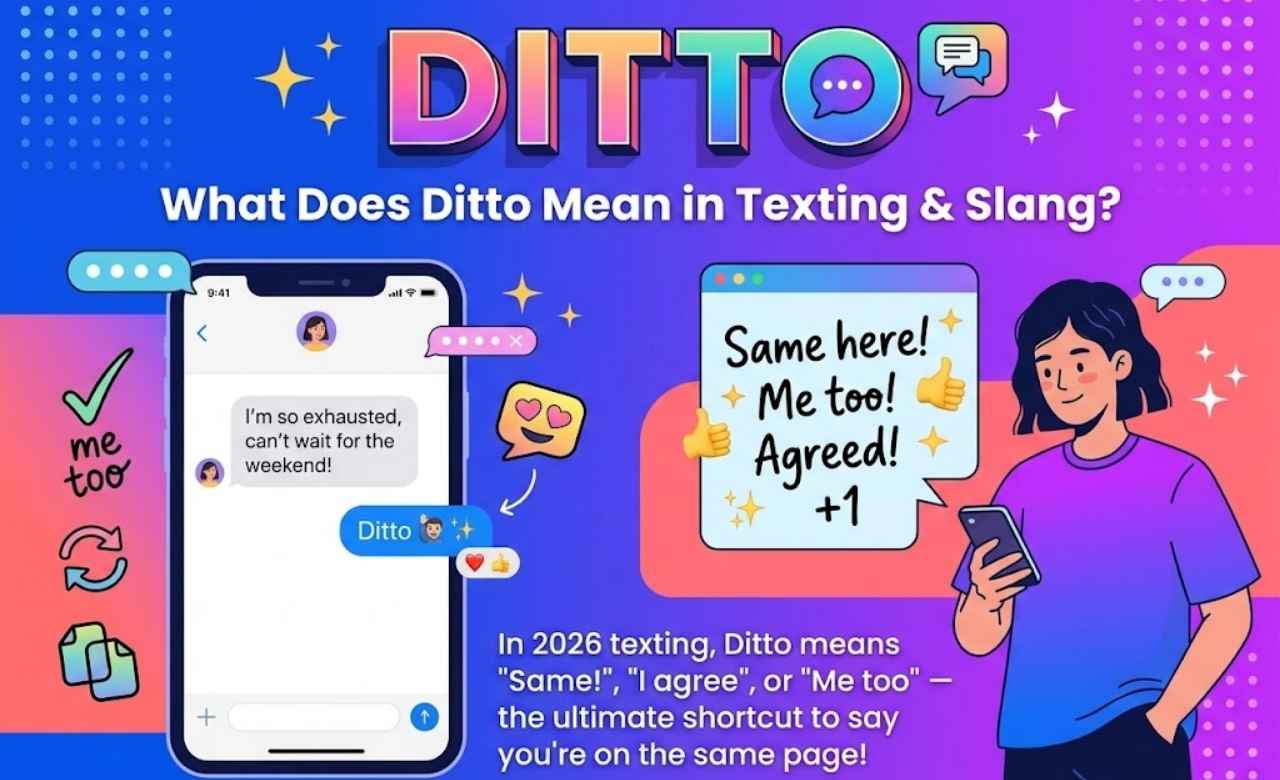
Have you ever sent a heartfelt text, a funny observation, or a quick comment, only to receive a single-word reply: “Ditto”? In modern online messaging, casual conversation moves fast. Whether you are chatting on WhatsApp, scrolling through TikTok comments, snapping a friend on Snapchat, or navigating the subtle waters of dating apps, short replies dominate daily communication. Understanding exact slang meanings and conversational nuances is essential so nothing gets lost in translation.
If you have found yourself wondering what does ditto mean, where the expression originates, or whether someone is agreeing with you, flirting, or brushing you off, this comprehensive guide breaks down the full ditto meaning in text, its historical origins, emotional weight in relationships, professional boundaries, and modern pop culture references.
What Does Ditto Mean in Texting?
At its core, the ditto meaning in texting functions as a conversational shortcut representing mutual agreement, duplicate thoughts, or shared experiences. When someone types “ditto” in a text message, they are communicating: “Same here,” “Me too,” “I agree,” or “The same goes for me.”
Text messaging favors speed and efficiency. Instead of typing out a complete sentence repeating what the other person just stated, a texter sends “ditto” to endorse the previous statement entirely. It affirms that the sender holds the identical view, is undergoing the exact same situation, or feels the duplicate emotion without needing to formulate their own wording.
Person A: "I am completely exhausted after that workout today."
Person B: "Ditto. My legs feel like lead."
In this context, Person B uses the term to immediately validate Person A’s experience, confirming that their physical state matches Person A’s fatigue.
Ditto Meaning in Text in English
In formal and informal English alike, the word ditto functions as a noun, an adverb, and an informal interjection. When analyzing the ditto meaning in text in English, it operates primarily as an anaphoric pro-form—a grammatical element that borrows its entire meaning from the sentence or clause that came right before it.
If someone writes, “I think the new project deadline is completely unrealistic,” and you reply “Ditto,” the word technically substitutes for: “I also think the new project deadline is completely unrealistic.” It eliminates redundancy in language, creating an effortless bridge between two people participating in digital dialogue.
Does Ditto Mean Same or Me Too?
A common question among texters is: does ditto mean same or does it mean me too? The answer is that it easily means both, shifting depending on the grammatical structure of the sentence it answers:
- When used as “Me Too”: It applies to subjective states, feelings, actions, or physical conditions.
- Example: “I need a large coffee right now.” → Reply: “Ditto” (Meaning: Me too).
- When used as “Same”: It applies to objective observations, external situations, evaluations, or shared opinions.
- Example: “Traffic on the highway is a total nightmare.” → Reply: “Ditto” (Meaning: Same / Same here).
Because of this dual flexibility, ditto seamlessly fits almost any conversational exchange where one party wants to mirror the sentiment of another without reinventing the wheel.
Ditto Meaning in Slang: Simple Definition and Examples
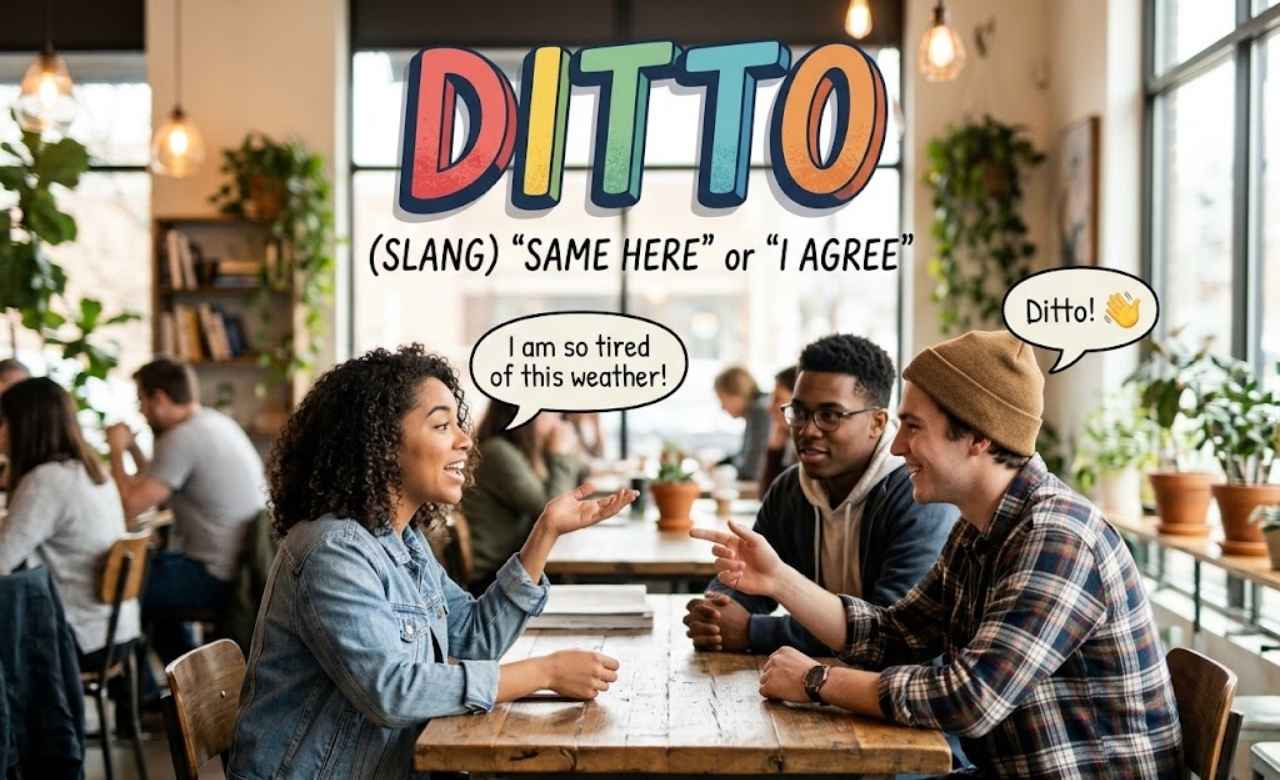
When applied to conversational internet slang, the ditto meaning in slang represents an ultra-casual, laid-back confirmation of solidarity. It is an effortless way to say “I second that,” “Facts,” or “You took the words right out of my mouth.”
In casual social media circles and informal texting, slang often prizes brevity and emotional shorthand. While some slang terms emerge overnight and vanish just as quickly, ditto has remained a permanent fixture of conversational English for decades, bridging generational divides between Gen X, Millennials, and Gen Z.
Here are everyday slang examples showing how it functions across different scenarios:
- Shared craving:
- User 1: “Honestly, I could eat a massive pepperoni pizza right now.”
- User 2: “Ditto! Let’s order one.”
- Mutual frustration:
- User 1: “This meeting could have easily been an email.”
- User 2: “Big ditto. Complete waste of time.”
- Sympathy over bad luck:
- User 1: “My flight got delayed by three hours.”
- User 2: “Ditto, stuck at terminal B waiting forever.”
In street slang and youth vernacular, it carries no pretense; it is honest, direct, and universally decoded as total alignment.
What Does Ditto Mean in a Relationship?
Understanding what does ditto mean in a relationship requires emotional sensitivity, as romantic partnerships rely heavily on explicit emotional validation. In romantic contexts, ditto can be a playful sign of effortless harmony—or, conversely, a source of emotional frustration if used in place of vulnerable, heartfelt expressions.
When couples spend extensive time together, their mental wavelengths frequently synchronize. In low-stakes daily moments, sending a quick “ditto” indicates comfort and shared wavelength:
- Partner A: “I just want to stay in tonight, order takeout, and watch movies.”
- Partner B: “Ditto, babe. Putting on sweatpants now.”
Here, the reply demonstrates shared preferences and low-maintenance intimacy. However, when the stakes are emotional, the dynamics change drastically.
What Does Ditto Mean When Someone Says I Love You?
Few messaging scenarios cause as much anxiety as answering romantic vulnerability with single-word replies. So, what does ditto mean when someone says I love you, and does ditto mean I love you too?
Technically, yes—semantically it translates to “I feel the same way” or “I love you too.” However, emotionally, replying “ditto” to an explicit declaration of love rarely delivers the depth the other partner hopes to receive.
Partner A: "I just wanted to let you know that I love you so much."
Partner B: "Ditto ❤️"
While Partner B may genuinely feel love, “ditto” can read as defensive, non-committal, rushed, or emotionally guarded.
Cinematic Cultural Note: The most famous romantic use of this word appears in the classic 1990 film Ghost, starring Patrick Swayze (Sam) and Demi Moore (Molly). Throughout the film, whenever Molly says “I love you,” Sam defensively and playfully replies “Ditto,” struggling to say the actual words out loud. It is only at the climactic conclusion of the story that Sam finally vocalizes “I love you,” to which Molly tearfully responds, “Ditto.”
If your romantic partner texts you “ditto” after you express love, assess their personality: are they naturally shy, in a hurry at work, or quoting classic cinema, or are they subtly deflecting emotional intimacy?
Is Saying Ditto Romantic or Rude?
Whether saying ditto is romantic, cute, or outright rude depends entirely on tone, timing, and connection:
- When it is Romantic & Playful:
- When paired with romantic emojis (e.g., “Ditto 🥰✨”).
- Inside established relationships where it serves as an inside joke.
- When agreeing on shared relationship goals: “I can’t wait to see you tonight.” → “Ditto, counting down the minutes!”
- When it Feels Rude or Cold:
- As a stand-alone reply to deep vulnerability, emotional confessions, or serious relationship talks.
- When sent without punctuation or emojis after someone offers a thoughtful, multi-paragraph compliment.
- During an argument where one person expresses frustration or distress, and the other curtly retorts “Ditto” to shut down dialogue.
Context dictates courtesy. If an emotional moment calls for warmth, take the extra three seconds to spell out your feelings rather than leaning on shorthand.
Ditto Meaning in Text From a Girl or Guy
Gender dynamics in texting often come down to texting habits, comfort levels, and social cues. Let us examine how the interpretation changes depending on who hits send.
Ditto Meaning From a Girl
When a girl texts “ditto,” context reveals whether she is being flirty, casual, or intentionally maintaining boundaries:
- The Casual Mirror: If you are talking about everyday things (music, weather, tiring schedules) and she texts “Ditto lol,” she is being friendly, relatable, and matching your energy.
- The Flirty Echo: If you text, “I had an amazing time tonight, you looked stunning,” and she replies, “Ditto! Had the best time with you 😊,” she is enthusiastically reciprocating the attraction while keeping the tone light and breezy.
- The Polite Buffer: If you send a long, expressive compliment or ask how she feels about you, and she responds with an isolated “Ditto.” with no follow-up question, it often functions as a soft boundary. It acknowledges the message without opening the door to deeper intimacy.
Ditto Meaning From a Guy
Guys frequently favor pragmatic, concise messaging over wordy prose. When a guy texts you “ditto”:
- Total Agreement: Most men use ditto literally. If he says “Ditto,” he genuinely shares your exact opinion or sentiment. He rarely overthinks the subtext.
- Low-Effort Convenience: If he is busy playing games, working, or out with friends, “ditto” is his fast way of staying connected without pausing his activity.
- Emotional Hesitation: If you send a vulnerable emotional text and he writes back “Ditto man” or “Ditto,” it may indicate he feels the sentiment but feels awkward, vulnerable, or unpracticed in verbalizing emotional depth.
What Does Ditto Mean on Snapchat, TikTok and Instagram?
Modern social platforms have turned texting slang into dynamic cultural shorthand. The ditto meaning on social media thrives across comments, DMs, and video reposts.
┌─────────────────┬────────────────────────────────────────────────────────┐
│ Platform        │ Typical Usage Context                                  │
├─────────────────┼────────────────────────────────────────────────────────┤
│ Snapchat        │ Quick snap captions, streak updates, shared states     │
│ TikTok          │ Comment section agreements, stitch replies, memes      │
│ Instagram & WA  │ Story reaction DMs, group chats, message endorsements  │
└─────────────────┴────────────────────────────────────────────────────────┘
Ditto Meaning on Snapchat
On Snapchat, where interactions are instantaneous and driven by disappearing images, the ditto meaning on Snapchat centers on shared activities and parallel moods:
- Snap Captions: A user posts a photo of an iced matcha latte with the caption “Need this to survive today.” A recipient snaps back a picture of their own coffee cup with the single caption “Ditto.”
- Story Replies: If someone posts a photo looking exhausted at a desk studying for finals, friends reply “Ditto” in direct chats to signify solidarity in academic misery.
Ditto Meaning on TikTok
On TikTok, algorithms curate niche communities where collective relatability drives viral success. The ditto meaning on TikTok manifests primarily in the comment section:
- Top Comments: When a creator posts a relatable POV video (e.g., “That feeling when you cancel Friday plans to stay in bed”), thousands of users simply comment “Ditto” or “Heavy on the ditto.”
- Stitch & Duet Endorsements: Creators use the word in overlay text when duetting another creator’s rant, signaling that their thoughts mirror the original creator’s perspective 100%.
Ditto Meaning on Instagram and WhatsApp
- Instagram Direct Messages (DMs): When reacting to a shared meme or aesthetic travel reel, typing “ditto” indicates you want to visit that exact place or find the clip just as hilarious.
- WhatsApp Group Chats: In fast-moving family or team chats, ditto serves as an efficient tool to vote or agree without spamming the thread:
- Family member: “I think 7:00 PM is the best time for dinner.”
- Multiple replies: “Ditto,” “Ditto from us,” “Ditto here.”
Ditto Meaning in Chat: How People Use It in Conversations
In live digital environments—from Discord gaming servers and Twitch streams to personal group chats—the ditto meaning in chat acts as an instant consensus generator.
Chat rooms move rapidly. Reading dozens of messages per minute makes prolonged responses cumbersome. Saying “ditto” in chat serves three main communicative functions:
- Consensus Building: A team member suggests a tactical play in Discord; three others type “ditto” to confirm the plan without cluttering audio channels.
- Amplifying Complaints: When one community member notes server lag or software glitches, a flood of “ditto” replies alerts moderators to widespread issues.
- Echoing Excitement: When an event is announced, users echo the sentiment to show collective anticipation.
Funny Ditto Meaning in Text Messages
Beyond literal agreement, the word has substantial comedic utility. Texters frequently use ditto meaning in text funny contexts through dramatic hyperbole, sarcastic mirroring, or ironic self-deprecation.
Consider these comedic situations:
- Sarcastic Self-Pity:
- Friend A: “I have accomplished absolutely nothing today except eating cereal and watching reality TV for six consecutive hours.”
- Friend B: “Ditto. Truly peak human productivity.”
- Deflecting Clichés:
- Friend A: “I solemnly swear to never drink cheap tequila ever again in my life.”
- Friend B: “Ditto. See you next Friday at the bar.”
- Meme Accompaniment: Texters often send a GIF of a character frantically nodding alongside the caption “Ditto,” turning a plain confirmation into an expressive, laughing moment.
Ditto Meaning Me Too: Are They Exactly the Same?
While ditto meaning me too is accepted in modern vernacular, they are not exact linguistic clones. Subtle semantic differences dictate when one sounds natural and the other sounds slightly off.
┌─────────────────────┬──────────────────────────┬──────────────────────────┐
│ Feature             │ "Ditto"                  │ "Me Too"                 │
├─────────────────────┼──────────────────────────┼──────────────────────────┤
│ Scope of Reference  │ Applies to people, facts,│ Strictly applies to the  │
│                     │ objects, and third parties│ first-person pronoun (I) │
│ Grammatical Role    │ Interjection / Adverb    │ Pronoun phrase           │
│ Tone                │ Quirky, breezy, retro    │ Direct, personal         │
│ Professional Usage  │ Informal only            │ Acceptable in standard   │
│                     │                          │ spoken English           │
└─────────────────────┴──────────────────────────┴──────────────────────────┘
- Grammatical Versatility: “Me too” can only refer to yourself. If someone says, “Sarah loves hiking,” replying “Me too” means I love hiking. But if someone points out, “Sarah loves hiking, and Mark loves hiking,” you can say, “Ditto for Alex,” meaning the same condition applies to someone else.
- Emotional Warmth: “Me too” inherently feels slightly more personal because it directly invokes the self (“me”). “Ditto” is slightly detached, viewing the shared statement as an objective fact rather than a deep personal revelation.
How to Use Ditto in a Sentence With Real Examples
To grasp its natural placement, review these practical examples spanning various real-world situations:
- “My brother loves strawberry cheesecake, and ditto for my sister.”
- “I haven’t slept more than five hours all week, and ditto for half the people on our team.”
- “If you think you’re getting out of cleaning the garage, think again—and ditto goes for your brother.”
- “She found the movie utterly brilliant, and I have to say ditto to that.”
- “I’m voting in favor of the proposal, and my business partner says ditto.”
- “The hotel room was immaculate; the service, ditto.”
- “I feel awful today.” → “Ditto, must be that bug going around.”
- “I need a three-week vacation on a remote island immediately.” → “Ditto!”
What Does Ditto Mean When Someone Replies to Your Message?
When someone sends you a message that consists entirely of “ditto,” how should you decode their intent? Reading between the lines requires checking three parameters:
- The Nature of Your Original Message:
- If you made an observational statement (“It’s way too humid today”), their “ditto” is simply routine, friendly agreement.
- If you asked an open question (“What do you want to eat tonight?”), a reply of “ditto” is nonsensical or lazy, meaning they didn’t read your message carefully.
- The Speed of the Reply:
- A reply sent within 10 seconds indicates they saw your message instantly and shot back an enthusiastic agreement.
- A reply sent three days later reading merely “ditto” suggests low engagement or an attempt to acknowledge an unread thread without spending real energy.
- Accompanying Punctuation and Emojis:
- “Ditto 😂🙌” = Enthusiastic, warm, engaged.
- “ditto” (all lowercase, no emoji) = Neutral, passive, or potentially preoccupied.
Read more:Skibidi Meaning in 2026: What Does It Mean in Slang?
How to Respond When Someone Says Ditto?
Knowing how to respond to ditto prevents the conversation from hitting an awkward dead end. Because ditto simply agrees with your previous point, it does not introduce new information. The conversational ball remains firmly in your court.
How to Reply to Ditto From Your Crush
If your crush hits you with a “ditto,” don’t let the interaction flatline. Pivot the momentum forward with wit, charm, or a gentle tease:
- If they said ditto to you missing them:
- “Ditto? That’s all I get? You have to say it with feeling 😉”
- “Prove it. What time are you free this week?”
- If they said ditto to how great your date was:
- “Glad we’re on the same page. When are we planning round two?”
- “I knew you had immaculate taste in dates 😌”
- Playful callout for brevity:
- “One whole word? Don’t wear yourself out typing over there!”
How to Reply to Ditto From a Friend
With friends, conversations can easily stay casual or veer off into planning concrete action:
- Take immediate action on the shared desire:
- Friend: “Ditto, I’m starving.” → You: “Cool, tacos or burgers? Pick one.”
- Acknowledge the mutual vibe:
- Friend: “Ditto, this class is killing me.” → You: “Seriously. Let’s grab iced coffee the second this lecture ends.”
- Let it naturally rest:
- If the exchange was just a quick check-in, simply drop a reaction emoji (like a thumbs-up or heart) on their “ditto” and carry on with your day.
Ditto Meaning in Dating Apps and Online Relationships
Dating apps like Tinder, Bumble, Hinge, and Feeld operate under unique conversational pressures. First impressions matter immensely, and conversational effort is scrutinized.
When evaluating what does ditto mean in dating, keep these dynamics in mind:
- The Energy Gauge: If you send an interesting, engaging opening message and their entire response is “Ditto,” take it as a yellow flag. Dating app etiquette generally expects each person to contribute new hooks, banter, or questions to keep the spark alive.
- Agreement on Intentions: When profiles state: “Looking for someone who loves spontaneous weekend road trips,” a match opening with “Ditto to the road trips! Where was your last one?” successfully leverages the term to establish immediate common ground while still advancing the conversation.
Origin of Ditto: Where Did the Word Come From?
Tracing the ditto slang origin takes us on a fascinating historical journey through linguistic evolution. Contrary to popular belief, ditto is not a modern internet acronym or Gen Z slang invention; it dates back hundreds of years.
[Latin: Dictus]
   └── Meaning: "Said" or "Spoken"
          │
          ▼
[Tuscan Italian: Detto / Ditto]
   └── Meaning: "The aforementioned" or "The said matter"
          │
          ▼
[17th-Century English Commerce]
   └── Adopted by British merchants to prevent repetitive ledger entries
          │
          ▼
[Modern English Slang & Texting]
   └── Casual shorthand for "Same here," "Me too," and "I agree"
- Etymological Roots: The word stems from the Tuscan Italian dialect word detto (historically variant ditto), which is the past participle of the verb dire (“to say”). This traces back directly to the Latin word dictus, meaning “having been said” or “the aforementioned.”
- Adoption into English (17th–18th Century): English merchants, bookkeepers, and scribes borrowed the term in the early 1600s. In commercial ledgers, writing out long, repetitive product descriptions day after day was tedious. Scribes began writing “ditto” to represent “the aforementioned item.”
- Transition to Everyday Speech: By the mid-to-late 18th century, English speakers began using it colloquially outside of financial ledgers to mean “the same thing again.” It survived centuries of cultural transitions, seamlessly entering telegraphs, typewritten documents, early internet forums, and now smartphones.
What Does Ditto Mean in Everyday English?
Outside of digital screens, ditto holds an established place in standard conversational English. When spoken out loud during face-to-face interactions, it carries a punchy, warm, and concise tone.
In spoken conversation, people frequently say:
- “I’ll have the grilled salmon.” → Dining companion: “Ditto for me, please.”
- “Have a fantastic weekend!” → Departing coworker: “Ditto! Enjoy your time off.”
In everyday dialogue, the word avoids stiff formalities while sounding natural, friendly, and accessible. It is fully understood by people across all age demographics, making it one of the most reliable pieces of conversational shorthand in the English lexicon.
Ditto Synonyms: Other Ways to Say the Same Thing
If you find yourself using ditto too often and want to expand your vocabulary, there are countless alternatives suited for every register—from hyper-casual texting to polished professional discussions.
Casual & Slang Synonyms
- Same here: The most natural direct equivalent in everyday text messaging.
- Me too: Perfect for personal experiences and matching emotions.
- I feel you / Mood: Modern slang alternatives indicating deep empathy and shared frustration or joy.
- Big facts / Real: Slang terms confirming that you endorse the truth of the previous statement.
- Seconded: Slightly humorous, pseudo-formal agreement among friends.
Professional & Polite Synonyms
- Likewise: Sophisticated, polite, and universally appropriate in both business and social environments.
- I share your sentiment: Excellent for workplace memos and collaborative feedback.
- Agreed: Clean, decisive, and professional.
- I echo that thought: Ideal for business meetings and strategic discussions.
Ditto vs Same vs Likewise vs Me Too: Key Differences
Choosing the ideal response depends on understanding the subtle tonal and structural differences among these four closely related terms:
| Word / Phrase | Formality Level | Best Used For | Example Context |
| Ditto | Highly Informal | Casual texts, funny chats, fast verbal replies | “I’m wiped out.” → “Ditto.” |
| Same | Informal | Quick internet comments, slang banter | “Craving tacos.” → “Same.” |
| Likewise | Semi-Formal / Formal | Polite returns of well wishes, professional emails | “Great meeting you.” → “Likewise.” |
| Me Too | Neutral / Universal | Direct personal emotional alignment | “I loved that film.” → “Me too.” |
Use ditto when you want casual levity; use same when you want modern internet brevity; use me too when sharing personal identity or feelings; and reserve likewise when responding gracefully to polite well wishes.
What Does Ditto Mean in Professional Emails and Work Chats?
Workplace communication rules differ substantially from private texting. While platforms like Slack, Microsoft Teams, and Google Chat have blurred the line between office speech and casual banter, caution is warranted.
- In Formal Client/Executive Emails: Do not use ditto. Replying to an executive’s project vision or a client’s requirements with “ditto” can appear lazy, flippant, or unprofessional. Instead, use: “I completely agree,” “We share this objective,” or “Likewise.”
- In Casual Internal Team Chats (Slack/Teams): In low-hierarchy internal channels, saying “Ditto to what Sarah mentioned regarding the bug report” is generally accepted and saves reading time. However, using the built-in thumbs-up (👍) or clapping reaction emoji is often even cleaner.
What Is the Meaning of Ditto Marks in Writing?
Before ditto was an informal slang word, it was an indispensable physical notation system in typography, handwriting, and bookkeeping known as ditto marks.
Item Ordered          Quantity
------------------------------
Leather Notebook         10
  ”      ”               25
  ”      ”               50
- The Symbol: A ditto mark consists of a pair of small quotation marks (
”) or double apostrophes placed underneath a line of text. - The Purpose: It instructs the reader to repeat the exact word or figure written directly above it in that column.
- Modern Rule: In academic and formal research writing (such as APA, MLA, or Chicago styles), ditto marks are strictly prohibited in tables. Every data point or recurring label must be typed out completely to avoid misinterpretation in automated data extraction.
What Does Ditto Mean in Business and Accounting?
In financial reporting, physical inventory tallying, and traditional ledger accounting, the historical meaning of ditto remains rooted in accuracy and time-saving efficiency.
When clerks managed physical paper ledgers, writing out lengthy descriptions like “Grade A Imported Timber” dozens of times per page invited clerical fatigue and human error. Scribes used the word “ditto” or ditto marks to indicate that the exact same item category, tax code, or account entry applied to the line below.
In modern computerized accounting software (like QuickBooks, SAP, or Excel), this practice has been replaced by the “fill down” command (Ctrl+D), automated macro replications, and relational database keys.
What Is the Meaning of Ditto by NewJeans?
In contemporary global pop culture, the term reached massive international prominence with the release of the hit song “Ditto” by the popular South Korean girl group NewJeans (released in late 2022).
- The Song’s Core Theme: The track explores the bittersweet, vulnerable ache of adolescent infatuation, nostalgia, and the craving for emotional reciprocation.
- Lyrical Meaning: In the chorus, the lyrics state: “Say it back, oh, say it ditto.” Here, the singer yearns for their crush to mirror their feelings. The narrator has laid their heart on the line, begging the other person not to stay silent, but to utter that single word—ditto—to validate that the attraction is mutual.
- Visual Symbolism: The accompanying music videos tap into 1990s camcorder aesthetics, evoking deep themes of memory, platonic bonds, and the transient nature of youth. The song successfully reintroduced the vintage term to millions of Gen Z and Gen Alpha listeners worldwide.
Is Ditto a Positive or Negative Response?
Because ditto holds zero inherent emotional charge of its own, it functions like an echo. Its positive or negative tone is dictated entirely by the sentiment it mirrors:
- Inherently Positive Usage:
- “I am so proud of our team’s accomplishment!” → “Ditto!” (Echoes joy and shared triumph).
- Inherently Negative Usage:
- “I absolutely despised that boring presentation.” → “Ditto.” (Echoes distaste and cynicism).
- Passive-Aggressive Hazard: If someone pours their heart out explaining why they felt hurt, and the reply is a blunt “Ditto,” the term becomes weaponized as emotional dismissal.
Common Mistakes People Make When Using Ditto
To avoid conversational awkwardness, watch out for these frequent mistakes when dropping ditto into conversations:
- Replying to Questions Instead of Statements:
- Incorrect: “What time are you coming over?” → “Ditto.” (Makes no sense).
- Correct: “I’m planning to leave at six.” → “Ditto, see you then.”
- Overusing It in Deep Relationship Moments: Using it repeatedly when your partner shares meaningful, heartfelt emotions can make you seem emotionally detached.
- Using It in High-Stakes Professional Correspondence: Sending “ditto” to an external client or corporate executive undermines your professional presence.
- Ignoring Syntactic Alignment: If someone says, “I haven’t eaten all day,” replying “Ditto” correctly means “I haven’t eaten either.” Make sure you genuinely agree with the exact premise of the statement before echoing it.
Why Do People Say Ditto Instead of I Agree?
Given how many ways there are to say “I agree,” why does ditto retain such enduring popularity?
- Conversational Speed: It takes under half a second to type or speak.
- Playful Energy: It feels lighter, cooler, and less formal than “I agree” or “I concur.”
- Complete Linguistic Inclusivity: It captures agreement with both facts (“It’s hot outside”) and emotions (“I miss home”) without needing grammatical adjustments.
- Generational Staying Power: It has survived across decades of evolving slang, making it universally recognizable across diverse age groups.
Can You Say Ditto to a Compliment?
Using ditto to answer a compliment requires finesse, as it can easily backfire if misapplied.
- When It Works (Reciprocal Compliments):
- If a friend says, “It was so great seeing you today, you look fantastic!”
- You can say: “Ditto! You looked amazing too!”
- When It Fails (Self-Compliment Traps):
- If someone says, “You did an extraordinary job presenting today!”
- Replying “Ditto” implies you think you did a great job too, coming across as arrogant or self-absorbed. The correct response is simply: “Thank you so much!”
Only use ditto on a compliment if you are reflecting that compliment back onto the other person.
Is Ditto Formal or Informal English?
Ditto is firmly informal English.
While it has historic roots in formal merchant ledgers and typography, contemporary dictionaries classify it as an informal colloquialism when spoken or typed. It belongs in personal texts, social media banter, casual face-to-face discussions, and friendly workplace chat channels. It should never be used in academic research papers, legal briefs, executive summaries, or formal job applications.
Frequently Asked Questions About Ditto Meaning
Is Ditto Another Word for Same?
Yes. In virtually every casual context, ditto functions as an exact synonym for “same” or “same here,” signaling that you hold the identical opinion, condition, or experience.
Does Ditto Mean I Love You Too?
Technically, it communicates agreement with the phrase “I love you.” However, because it lacks personal vulnerability, relying on it instead of speaking the actual words can come across as guarded or unromantic.
Is Ditto a Flirty Response?
It can be flirty if paired with playful teasing, winking emojis, or an energetic follow-up. By itself, however, it is merely neutral agreement.
Can Ditto Mean I Agree?
Yes. Expressing agreement with an opinion, statement, or observation is one of the most common applications of the word in modern English.
What Is the Opposite of Ditto?
Because ditto means “the same,” its conceptual opposites include phrases like “on the contrary,” “not me,” “I disagree,” or “quite the opposite.”
Understanding Ditto Meaning in Modern Conversations
Whether you encounter it as a rapid-fire comment on TikTok, a breezy confirmation text from a friend, an inside joke with a partner, or the title of a chart-topping pop anthem, the word ditto remains one of the most versatile, enduring expressions in the English language.
Originating from the Latin dictus and Italian detto, it evolved from physical ledger bookkeeping into a universal digital shorthand for shared feelings, mutual alignment, and conversational efficiency. Knowing when to use it—and when to opt for deeper, more explicit words—ensures your digital and real-world communication remains clear, authentic, and engaging.

Welcome to NameInBible. I am Victoria, a Christian writer passionate about exploring biblical name meanings, Scripture-based insights, and powerful prayers. My goal is to help readers discover the spiritual significance of names and grow closer to God through faith-filled content.