

Have you ever spoken to someone who sounded polite but somehow made you feel stupid, small, or unimportant? Maybe they explained something you already knew, gave you a fake compliment, or used a demeaning tone that left you questioning their intentions. That uncomfortable feeling often comes from condescending behavior, and recognizing it isn’t always easy.
So, what does the word condescending mean, and why can even a simple comment feel insulting? Understanding the condescending tone meaning helps you recognize when someone is talking down to you or acting as though they’re smarter or more important. A common example of being condescending is hearing, “Oh, you finally figured that out!” instead of receiving genuine encouragement.
In this guide, we’ll explore the true meaning of condescending, real-life examples of someone being condescending, subtle warning signs, and the difference between confidence and superiority. You’ll also discover how to recognize disrespectful communication and respond calmly without losing your confidence.
What Does Condescending Mean? Simple Definition and Explanation
The word condescending describes an attitude, tone, or style of communication where someone treats others as if they are less intelligent, capable, knowledgeable, or important than themselves. At its core, the condescending meaning centers on an assumed air of superiority. When someone displays condescending behavior, they are deliberately or unconsciously talking down to someone, acting as if they are operating from a higher intellectual, social, or moral plane.
In modern English, the term carries an inherently negative connotation. It is categorized as an adjective derived from the verb condescend. Historically, in Middle English and Old French (originating from the Latin condescendere, meaning “to descend together” or “to stoop”), the word originally described a noble, monarch, or person of high status graciously setting aside their rank to interact with people beneath them without asserting their privilege. Over centuries, however, social hierarchies shifted. The gracious act of “stooping” evolved into an insult: today, implying that you must stoop or lower yourself to interact with another person implies that the other person is fundamentally inferior.
Therefore, a precise condescending definition today reflects behavior that showcases a patronizing, haughty, or dismissive air, leaving the recipient feeling belittled by someone or marked as intellectually inadequate.
Condescending Meaning in Simple English
To break down the condescending meaning in simple words: being condescending means acting like you are smarter, better, or more important than someone else, especially when explaining or saying something to them.
When someone uses a condescending approach, their primary posture is:
- “I know everything about this topic, and you know very little.”
- “Let me simplify this basic concept so your simple mind can grasp it.”
- “You are fortunate that I am taking my valuable time to educate you.”
In everyday dialogue, it is commonly described as “talking down” to people, treating full-grown adults like small children, or packaging an insult inside a veneer of polite instruction.
What Does Condescending Mean in Everyday Life?
In practical day-to-day encounters, condescension rarely presents itself as an outright scream or an explicit curse word. Instead, it weaves through ordinary conversations, family dinners, collaborative tasks, and retail exchanges as a subtler form of disrespectful communication.
Everyday condescension manifests when:
- An IT specialist explains a basic software update using deliberate baby talk, dragging out syllables while rolling their eyes.
- A peer interrupts an ongoing conversation to give an unnecessary correction regarding a minor grammatical slip or trivial pronunciation mistake, solely to demonstrate superior knowledge.
- A sales associate glances at your casual attire, offers a tight, dismissive smirk, and asks if you are “sure you can afford to browse this aisle.”
These daily interactions disrupt healthy human relationships because they establish an artificial power imbalance. Rather than two equal individuals sharing perspectives, one party forces the other into an assumed position of inferiority, poisoning the interaction through subtle invalidation.
Condescending Meaning With Examples You Can Easily Understand
To grasp how this behavior operates in context, examining concrete scenarios is essential. The line separating genuine assistance from a condescending attitude often lies in intent, humility, and conversational delivery.
Simple Examples of Condescending Behavior
- The Basic Task Breakdown: You have managed spreadsheets for five years. A new team lead leans over your desk, physically points at your screen, and announces: “Now, make sure you click that big blue button marked ‘Save,’ sweetie. That way your work actually stays on the computer.” The tone assumes you cannot comprehend fundamental computer literacy.
- The “Pat on the Head” Compliment: You present a meticulously researched proposal during a group session. A colleague smirks and remarks: “Oh, look at you! You actually managed to assemble some coherent thoughts today. Isn’t that darling?” This is fake praise engineered to diminish your credibility under the guise of an encouraging compliment.
- The Trivial Invalidation: You share excitement about finishing an introductory 5K running program. An experienced runner scoffs softly and says: “A 5K is essentially a brisk walk with running shoes on. Call me when you run a half-marathon; then we can talk about real athletic endurance.” The comment actively erases your achievement to uphold their personal sense of superiority.
Condescending vs. Respectful Communication Examples
Understanding the distinction between supportive instruction and condescension becomes clear when contrasting the exact same communicative objective across different delivery styles:
| Scenario / Objective | Condescending Communication | Respectful Communication |
| Explaining a complex work process | “Try to follow along this time; I don’t want to explain this three times like I usually have to with beginners.” | “This process has several intricate moving parts, so feel free to stop me at any point if you want to clarify a step.” |
| Addressing an error made by a peer | “Obviously, if you had actually read the documentation like anyone else would, you wouldn’t have made this mistake.” | “It looks like step four didn’t sync properly here. The documentation can be tricky; let’s troubleshoot the discrepancy together.” |
| Giving unsolicited guidance | “You clearly have no clue how to negotiate with clients. Sit back, stay quiet, and observe an expert at work.” | “Client negotiation can be tough. I’ve handled similar accounts in the past—would you be open to a few strategies that worked for me?” |
| Responding to an alternative opinion | “That is adorably naive, but in the real world, things work quite differently.” | “I see where you’re coming from, though my experience on the ground led to a slightly different conclusion. Here is what I observed.” |
How to Pronounce Condescending Correctly
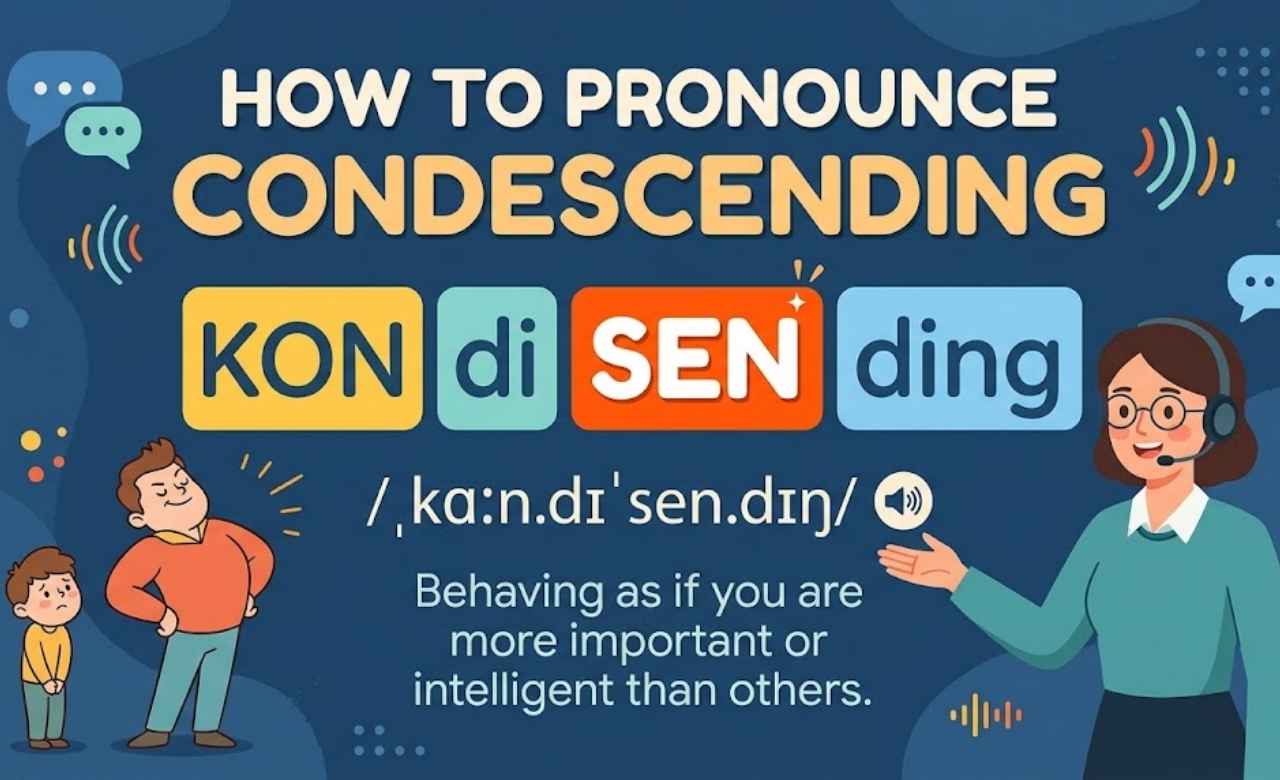
Clear articulation ensures you can use the word accurately during academic, professional, and personal discussions without hesitation.
Condescending Pronunciation and Phonetic Spelling
The word condescending consists of four distinct syllables: con-de-scend-ing.
- IPA (International Phonetic Alphabet):
/ˌkɒndɪˈsɛndɪŋ/(British English) or/ˌkɑːndɪˈsɛndɪŋ/(American English). - Phonetic Guide: kon-di-SEN-ding.
- Syllable Breakdown:
- Con- (pronounced like con in “concept” or khan).
- de- (pronounced like dih or a soft duh).
- scend- (pronounced exactly like the word send; the letters “sc” create a clean, singular /s/ sound).
- -ing (standard gerund ending, as in “sing”).
The primary stress rests on the third syllable: kon-dih-SEND-ing.
Common Pronunciation Mistakes
- Hard “C” or “SK” Sound: A frequent misstep involves trying to voice the “c” after the “s”, resulting in con-de-SKEND-ing. In modern English, the consonant cluster “sc” before “e” is pronounced strictly as a soft /s/ sound.
- Emphasis on the Wrong Syllable: Placing the primary stress on the first syllable (CON-de-send-ing) or second syllable (con-DE-send-ing) distorts the word’s cadence. Keep the weight firmly on the root syllable: SEND.
- Slurring the Middle Vowel: Flattening the second syllable entirely into con-SEND-ing causes the speaker to skip the middle structural syllable de-, turning the term into an incorrect amalgam.
What Is a Condescending Person? Meaning and Personality Traits
A condescending person is an individual who consistently adopts a posture of patronizing superiority toward others. Rather than treating social interactions as exchanges between peers of equal inherent worth, they organize their interpersonal universe along a vertical hierarchy where they occupy the summit.
Understanding a condescending person meaning requires looking beyond isolated conversational slip-ups. While anyone can occasionally make an insensitive slip due to stress or exhaustion, a genuinely condescending person displays an enduring, patterned behavioral blueprint centered on social, professional, or intellectual superiority.
Characteristics of a Condescending Person
- Compulsive Need to Instruct: They cannot bear being an equal participant in an exchange. They routinely morph ordinary casual conversations into impromptu lectures where they cast themselves as the mentor and you as the novice.
- Hyper-Correction: They seize upon minor semantic slips, slips of the tongue, or peripheral inaccuracies, interrupting narratives to correct a date by twenty minutes or a spelling by one letter.
- Invalidation of Others’ Accomplishments: When someone else shares an achievement, the condescending individual diminishes it by sharing a grander personal story, highlighting flaws in the achievement, or labeling the feat as “beginner’s luck.”
- Superficial Politeness: They frequently dress their dismissals in an overly sweet, faux-gentle vocabulary, masking passive-aggression beneath layers of manufactured courtesy.
- Defensiveness Against Critique: If challenged, they immediately shift the blame, accusing the other party of being “overly sensitive,” “insecure,” or “incapable of taking helpful advice.”
How to Recognize a Superior Attitude
Recognizing a superior attitude requires observing how someone responds to situations where they are not the primary authority in the room:
- They struggle to celebrate others: When a colleague or peer receives praise, their immediate reaction is skepticism, dismissive silence, or a backhanded critique.
- They monopolize discussions: They operate under an exaggerated sense of importance, believing that a meeting, dinner party, or group chat cannot reach valid conclusions without their definitive stamp of approval.
- They maintain an asymmetrical conversational standard: They demand your complete attention when they speak, yet freely look at their phone, interrupt, or gaze away while you are talking.
10 Common Signs Someone Is Being Condescending
Recognizing signs of a condescending person involves assessing verbal syntax alongside physiological cues. Condescension thrives within the synthesis of linguistic framing and physical demeanor.
                  SIGNS OF CONDESCENSION
    ┌─────────────────────────┴─────────────────────────┐
    ▼                                                   ▼
Verbal Cues                                     Nonverbal Cues
├── "Obviously / Clearly..."                     ├── The Asymmetrical Smirk
├── Weaponized Pet Names ("honey", "bud")        ├── Exaggerated Eye-Rolling
├── Interrupting with Minor Corrections          ├── Mock Patience / Nodding
└── Explaining Basic, Obvious Concepts           └── Dismissive Hand Waves
Verbal Signs of Condescending Behavior
- Preface Invalidation: Beginning sentences with qualifiers like “Obviously,” “Clearly,” or “As any sensible person knows…” These phrases subtly signal that if you did not already know what follows, you lack common sense.
- Weaponized Diminutives and Pet Names: Using familiar endearments like “sweetheart,” “buddy,” “champ,” “honey,” or “little lady” in professional or contentious settings. This strategy infantilizes the recipient.
- The Interrogative Trap: Asking leading questions designed not to gather information, but to expose supposed ignorance: “Are you honestly telling me you’ve never read that foundational paper?”
- Simplification Tropes: Using phrases such as “Let me break this down into bite-sized pieces for you,” implying the listener cannot process standard, professional-level concepts.
- Dismissive Summaries: Concluding a discussion by waving off the other person’s perspective: “Well, you’ll understand when you have a bit more experience in the real world.”
Nonverbal Signs and Body Language
- The Asymmetrical Smirk: Rather than a genuine, warm smile involving both eyes and mouth, a condescending smile is frequently lopsided, tight-lipped, and amused, communicating: “Your words are amusingly foolish.”
- Exaggerated Eye-Rolling and Ceiling Glances: Shifting their eyes upward or around the room while you speak, telegraphing impatience and disdain to everyone present.
- Mocking Displays of Patience: Sighing loudly, tapping a foot, checking a watch, or drumming fingers against the table while you are explaining your point, framing listening to you as a burdensome chore.
- The Tilt and Pat: Tilting the head to one side with an expression of performative sympathy, occasionally paired with an unwelcome pat on the arm or shoulder, treating the speaker like a distressed child.
- The Dismissive Hand Wave: Flicking their fingers outward toward you as if shooing an insect, physically cutting off your sentence before you have reached your point.
What Does a Condescending Tone Sound Like?
Words on a printed page convey only raw text; the tone breathes intent into those words. You can utter a perfectly benign, neutral phrase—such as “Thank you for your thoughts”—and transform it into a cutting insult purely through tonal inflection. A condescending tone is an auditory signature of superiority.
Condescending Tone Examples in Conversations
- The “Kindergarten Teacher” Cadence: Slowing down your speech rhythm drastically, over-enunciating vowels, and raising the pitch of your voice when speaking to a competent adult: “Now… we… do… not… touch… that… setting… do… we?”
- The Bored Monotone: Speaking with a flat, dry, deadpan delivery that signals the conversation is completely unworthy of mental energy or focus: “Yes, yes, fascinating point. Are you quite done yet?”
- Singsong Performative Pity: Using an exaggerated upward inflection at the end of sentences to convey mock sympathy: “Oh, sweetie, did you really think that would work out for you?”
How Tone Changes the Meaning of Words
Human language depends heavily on prosody, pitch, pace, and vocal inflection. When communication occurs, context and delivery carry far more psychological weight than literal definitions:
- Literal phrase:“Good job.”
- Warm tone: Indicates genuine appreciation, camaraderie, and encouragement.
- Condescending tone (drawn-out, dropping cadence: “Gooood jooob” accompanied by a flat stare): Communicates that the person barely reached the floor of basic competence, functioning as an insult.
- Literal phrase:“I hear what you are saying.”
- Empathetic tone: Demonstrates that the listener is engaged and taking the speaker’s emotional reality seriously.
- Condescending tone (clipped, accompanied by a heavy sigh): Translates to: “Your words are entering my ears, but they are devoid of value, and I am waiting for you to stop making noise.”
20 Condescending Phrases People Use Without Realizing It
Many people pepper their daily dialogue with condescending idioms without recognizing how offensive those phrases sound to the listener. These phrases often masquerade as polite commentary or helpful guidance, yet systematically degrade the person on the receiving end.
               THE ANATOMY OF A PATRONIZING PHRASE
┌─────────────────────────────────┐   ┌─────────────────────────────────┐
│     The Innocent Surface        │   │      The Unspoken Subtext       │
│  "Actually, as a matter of fact"│ = │ "You are wrong; let an expert   │
│                                 │   │  correct your naive error."     │
├─────────────────────────────────┼───┼─────────────────────────────────┤
│  "You look great for your age!" │ = │ "The standard expectation for   │
│                                 │   │  someone your age is decay."    │
├─────────────────────────────────┼───┼─────────────────────────────────┤
│  "Don't worry your head about   │ = │ "This matter exceeds your basic │
│   these technical details."     │   │  intellectual capabilities."    │
└─────────────────────────────────┘   └─────────────────────────────────┘
Common Condescending Words and Expressions
- “Actually…”The Subtext: Dropped at the beginning of a reply, it acts as a conversational red light, signaling that everything you just uttered is incorrect and that proper wisdom is about to arrive.
- “Does that make sense?” (when overused or clipped)The Subtext: While sometimes intended to check for clarity, when spoken with an exasperated drop in tone, it suggests: “Are your basic cognitive faculties capable of grasping what I just laid out?”
- “As I already stated previously…”The Subtext: “You failed to pay attention the first time, so now you are forcing me to waste my valuable breath repeating myself.”
- “Calm down; you’re being emotional.”The Subtext: A textbook gaslighting tactic that invalidates your logical points by framing valid passion as irrational instability.
- “It’s not rocket science.”The Subtext: “This concept is exceedingly simple, so your failure to understand it immediately points to an embarrassing lack of intelligence.”
- “You’ll understand when you’re older / have more experience.”The Subtext: Erases the validity of someone’s current perspective based purely on age or tenure rather than engaging with the merit of the idea.
- “I’m surprised you managed to figure that out!”The Subtext: Communicates that the baseline expectation for your performance was absolute failure.
- “Let me speak to your manager.”The Subtext: Communicates that you are a worker devoid of agency, authority, or problem-solving capability.
- “No offense, but…”The Subtext: A preemptive disclaimer granting the speaker imagined permission to launch a derogatory attack while demanding that you stay placid.
- “Clearly, you’ve never had to deal with this before.”The Subtext: Positions the speaker as a seasoned veteran while dismissing the other person as an uninitiated novice.
Polite-Sounding Phrases That Feel Insulting
- “With all due respect…”The Reality: Almost universally followed by a statement that demonstrates zero respect whatsoever.
- “Bless your heart.”The Reality: In many regional dialects (notably the American South), this functions as a soft-spoken linguistic dagger signaling pity toward someone viewed as hopelessly inept.
- “Oh, you’re so brave for wearing that!”The Reality: A backhanded compliment that implies the outfit is unconventional or unflattering, and that you lack fashion awareness.
- “You’re actually remarkably articulate!”The Reality: Often directed across racial, cultural, or age lines, carrying the offensive assumption that people of your background are typically incoherent.
- “I appreciate your passion, but let the adults handle this.”The Reality: Relegates the speaker to the standing of an unruly child, stripping them of professional standing.
- “Don’t worry your pretty little head about it.”The Reality: An overtly sexist, infantilizing phrase designed to push someone out of strategic decisions.
- “Thanks for trying anyway!”The Reality: Delivered with a tight smirk, it reduces earnest, high-level effort to the participation trophy of a toddler.
- “I’m sure you did the absolute best you could.”The Reality: Suggests that even when you push your abilities to their absolute limit, your output remains mediocre.
- “Just out of curiosity, did you even review the materials?”The Reality: A passive-aggressive assertion that you arrived at the table lazy, unprepared, and careless.
- “Per my last email…”The Reality: The modern corporate equivalent of yelling: “Can you not read? The answer was provided to you in black and white, you incompetent reader.”
Condescending vs. Patronizing: Meaning and Key Differences
People frequently use the words condescending and patronizing interchangeably. While they share considerable semantic territory—both involve an attitude of superiority—their underlying emotional mechanisms and linguistic roots differ.
What Does Patronizing Mean?
To understand patronizing meaning, look to its root word: patron (from the Latin pater, meaning “father”). Historically, a patron was a protector, benefactor, or guardian who provided financial or structural backing to artists, dependents, or clients of lower status.
Consequently, patronizing behavior involves treating someone with an apparent air of kindness, benevolence, or fatherly protection that secretly conceals a superior attitude. The patronizing individual does not merely talk down to you; they pose as your generous guide, treating you like a child who requires careful stewardship, shielding, and simplified instruction. It is condescension wrapped in pseudo-helpful care.
Patronizing vs. Condescending Examples
- Pure Condescension (Cold Superiority):A senior engineer scoffs at a junior developer’s code: “This architecture is laughable. Did you build this in an afternoon without consulting a single industry manual?”Dynamic: Direct, cutting, contemptuous, and openly superior.
- Patronizing Behavior (Benevolent Superiority):The same senior engineer pats the junior developer gently on the back with a tender smile: “Oh, don’t worry yourself over these complex algorithms, buddy. Leave the heavy lifting to the senior staff, and we’ll keep you safe on the basic color palettes for now, alright?”Dynamic: Affectionate, protective, infantilizing, and invalidating.
┌─────────────────────────────────┐   ┌─────────────────────────────────┐
│          CONDESCENDING          │   │           PATRONIZING           │
├─────────────────────────────────┼───┼─────────────────────────────────┤
│ • Overt disdain or superiority  │   │ • Masked as care or protection  │
│ • Distance, coldness, haughty   │   │ • Pseudo-parental, infantilizing│
│ • Treating you as incompetent   │   │ • Treating you like a helpless  │
│   and unworthy                  │   │   child who needs guidance      │
└─────────────────────────────────┘   └─────────────────────────────────┘
In short: all patronizing acts are condescending, but not all condescending acts are patronizing. Condescension can be cold and dismissive, while patronizing communication often hides behind an uncomfortable smile of parental indulgence.
Condescending vs. Arrogant: Are They the Same?
Another frequent communication point is comparing condescending vs arrogant. While both emerge from an unchecked ego, their behavioral targets differ.
Difference Between Arrogance and Condescension
- Arrogance (Self-Absorption): Arrogance is an internal self-assessment characterized by an exaggerated sense of importance, entitlement, and pride. An arrogant person is obsessed with their own brilliance, pedigree, wealth, or power. They do not necessarily need an audience to degrade; they simply bask in their perceived greatness.
- Condescension (Relational Downward Projection): Condescension requires an interpersonal target. It is not just believing you are magnificent; it is the active process of broadcasting that superiority onto someone else by talking down to someone. Condescension is arrogance translated into an active interaction.
| Dimension | Arrogance | Condescension |
| Primary Focus | The Self (“Look at how incredible I am.”) | The Other (“Look at how hopelessly inferior you are compared to me.”) |
| Social Presence | Can exist in total solitude or self-praise. | Requires another person to actively patronize or talk down to. |
| Behavioral Style | Boastful, loud, self-aggrandizing, dominant. | Instructive, mocking, dismissive, patronizing. |
Examples of Arrogant and Condescending Attitudes
- The Arrogant Person: Strides into a dining establishment loudly boasting to his companion: “I make more money in an afternoon than everyone in this dining room makes all year combined. My resume is unmatched in this city.” (Self-aggrandizing display).
- The Condescending Person: Looks at the server handing them the menu and smirks: “Oh, sweetheart, let me explain how to pronounce these French entrees properly so you don’t embarrass yourself with other guests tonight.” (Interpersonal downward projection).
Condescending vs. Rude: How to Tell the Difference
Distinguishing between condescending vs rude behavior helps us understand why condescension often leaves a deeper, more confusing sting than simple bad manners.
Can Someone Be Condescending Without Being Rude?
Yes, absolutely. A person can follow every rule of conventional etiquette—maintaining a low volume, saying “please,” smiling pleasantly, and holding the door—while remaining completely condescending.
Condescension routinely operates inside polite vocabulary. When someone insults your capacity using polite grammar, they maintain plausible deniability. If you object, they can easily reply: “I was only being polite and trying to assist you; why are you getting so defensive?” This unique dynamic is why polite condescension frequently feels more manipulative than direct hostility.
Rude vs. Condescending Behavior in Daily Life
- Rude Behavior: Unvarnished, direct, and indifferent to social etiquette:
- Cutting in front of you in the grocery line without acknowledging you.
- Shouting: “Get out of my way!” on a crowded sidewalk.
- Slamming a folder onto your desk and snapping: “Fix this garbage right now.”
- Condescending Behavior: Structured around an explicit or implicit hierarchy:
- Letting you pass in line while announcing: “Go on ahead, dear; you look like you have trouble balancing your schedule.”
- Smiling gently and saying: “Excuse me, but you might want to watch your steps; people from your area aren’t usually accustomed to high-end venues like this.”
- Handing the folder back while cooing: “Nice attempt, champ. Let’s sit down so I can show you how the big kids handle formatting.”
Rude behavior is blunt force; condescending behavior is a polished, downward strike wrapped in a veneer of superiority.
Condescending vs. Belittling: Meaning and Examples
The interaction between condescending vs belittling marks the line where an annoying conversational quirk shifts into destructive emotional invalidation.
What Does Belittling Someone Mean?
Belittling (from make little) means intentionally diminishing, minimizing, or disparaging another person’s achievements, skills, dignity, or emotions. When someone belittles you, their objective is to make you feel tiny, inconsequential, and worthless. It is an aggressive, destructive communication dynamic that attacks your self-esteem and undermines your agency.
When Condescending Behavior Becomes Belittling
Condescension describes the posture of assumed superiority, whereas belittling describes the active tearing down of another individual. Condescension often serves as the delivery method for belittling behavior.
- Scenario: You proudly tell your partner or supervisor that you were selected to give a keynote address at a local industry conference.
- A Condescending Reaction: “Oh, that’s adorable. They must have been trying to make the speaker lineup more accessible to entry-level professionals this year.” (Dismissing your merit through patronizing minimization).
- The Belittling Result: By framing your significant professional honor as an act of pity or tokenism, the speaker erodes your confidence, minimizes your labor, and leaves you feeling belittled by someone who refuses to see your worth.
When condescension shifts from mild intellectual vanity into continuous, targeted invalidation, it becomes chronic psychological belittlement.
Read more:270+ Boy Names That Mean Angel Heavenly 2026
Condescending Meaning and Synonyms: Words With Similar Meanings
The English language offers a rich palette of descriptive vocabulary to capture the subtle shades of superior, dismissive behavior.
                     SPECTRUM OF SUPERIORITY
    Softer / Mild                           Overt / Severe
┌──────────────────────┬──────────────────────┬──────────────────────┐
│     Patronizing      │     Condescending    │     Contemptuous     │
│   Supercilious       │       Disdainful     │       Arrogant       │
│     Snobbish         │        Haughty       │       Pompous        │
└──────────────────────┴──────────────────────┴──────────────────────┘
Common Synonyms for Condescending
- Patronizing: Adopting an air of condescending benevolence or parental indulgence.
- Supercilious: Behaving or looking as though one thinks one is superior to others; characterized by an arched eyebrow and cold disdain.
- Haughty: Blatantly and disdainfully proud; showing an arrogant superiority to those considered inferior.
- Disdainful: Showing contempt or a lack of respect; viewing others as unworthy of serious consideration.
- Snobbish: Tending to look down on others deemed lower in social class, intellect, taste, or wealth.
- Smug: Having or showing an excessive, irritating pride in oneself or one’s achievements.
- Pompous: Affectedly grand, solemn, or self-important.
Stronger and Softer Alternatives to Condescending
- Softer, More Nuanced Alternatives:
- Dismissive: Showing that you do not think someone or something is worth considering.
- Unintentionally patronizing: Giving unsolicited guidance without realizing it insults the recipient’s capability.
- Breezy / Detached: Minimizing a serious situation through casual, low-effort engagement.
- Stronger, More Severe Alternatives:
- Contemptuous: Manifesting deep hatred and complete lack of respect; treating someone as utterly worthless.
- Scornful: Feeling or expressing absolute derision and mockery toward another person.
- Imperious: Assuming power or authority without justification; acting like an arrogant tyrant barking orders.
What Is the Opposite of Condescending? Antonyms Explained
Exploring the opposite of condescending illuminates healthy, constructive, and emotionally mature alternatives for everyday communication.
Common Antonyms of Condescending
- Respectful: Showing high regard, courtesy, honor, and recognition for another’s dignity.
- Humble: Having a modest estimation of one’s own importance; free from vanity and arrogance.
- Deferential: Showing polite respect and yielding consideration to another’s views or wishes.
- Egalitarian: Believing in and acting on the principle that all people are equal and deserve equal rights and respect.
- Modest: Unassuming in the estimation of one’s abilities or achievements.
- Approachable: Friendly, welcoming, and easy to speak to without barriers of rank or ego.
Examples of Respectful and Humble Communication
- Acknowledging Shared Ground: Instead of presuming an intellectual void, a humble expert says: “I know you have extensive experience with logistical workflows; let’s combine that with what our dev team built and see where they fit together.”
- Inviting Collaboration Without Hierarchy: Instead of delivering a sermon, an egalitarian leader notes: “Here is the approach that has worked well for my clients, but I’m eager to hear your perspective—what challenges do you anticipate based on your experience?”
- Offering Guidance with Permission: Rather than dumping unwanted advice, a respectful mentor asks: “I encountered a very similar snag last quarter. Would it be helpful if I shared the two pitfalls we ran into, or would you prefer to test your approach first?”
Condescending Meaning in a Sentence: 15 Useful Examples
Using words in clear contexts solidifies comprehension. Below are 15 carefully constructed sentences demonstrating the term’s syntactic application across varied settings.
Simple Sentences Using Condescending
- “Her condescending comment about his grammar deeply embarrassed him in front of the group.”
- “I cannot tolerate his condescending smile whenever I ask for clarification.”
- “Stop taking that condescending approach with me; I understand this software just as well as you do.”
- “The clerk gave us a condescending look the moment we asked to see items on sale.”
- “His condescending response ruined what had started as a productive team discussion.”
Professional and Everyday Sentence Examples
- “The project director’s condescending communication style alienated the junior staff and spiked the department’s turnover rate.”
- “Rather than offering helpful mentorship, she responded with a string of condescending remarks that made new hires dread asking questions.”
- “He read the report with a cold, condescending smirk, tossing it on the conference desk as if it were junk mail.”
- “Her apology sounded entirely condescending, packed with defensive non-apologies like ‘I’m sorry you felt that way.'”
- “Using an overtly condescending tone in client-facing correspondence will rapidly erode trust with your partners.”
- “I avoided sitting near Marcus at dinner because his compulsive need to dispense condescending explanations is exhausting.”
- “The senator faced backlash after issuing a condescending statement that dismissed the voters’ financial concerns as frivolous.”
- “Even though his words were formally polite, his condescending attitude made it clear he considered the assembly a waste of time.”
- “She shut down his condescending behavior cleanly by pointing out her ten years of expertise in the matter.”
- “Writing clear technical copy requires simplifying complex frameworks without slipping into a condescending cadence that alienates the reader.”
Condescending Meaning in Farsi (Persian) With Examples
Understanding cross-cultural linguistic equivalents helps non-native speakers translate and interpret interpersonal behaviors across diverse linguistic environments.
Persian Translation of Condescending
In Farsi (Persian), the concept of being condescending is captured by several precise terms, depending on whether one is describing the internal attitude or the outward communication style:
- متکبرانه (Motakabberaneh): Arrogantly, haughtily, or in a manner displaying excessive pride and superiority.
- تحقیرآمیز (Tahghir-amiz): Humiliating, belittling, or dismissive; describing words that degrade another person’s dignity.
- از بالا به پایین نگاه کردن (Az bala be paeen negah kardan): A widely used Persian idiom meaning literally “to look at someone from top to bottom” (looking down on someone from above).
How Condescending Is Used in Persian Conversations
In practical Persian interactions, the idiomatic expression is commonly deployed when an individual acts with an inflated sense of rank or status:
- Sentence: «او همیشه با لحنی تحقیرآمیز و از بالا به پایین با کارمندانش صحبت میکند.»
- Transliteration: “Oo hamisheh ba lahne tahghir-amiz va az bala be paeen ba karmandanash sohbat mikonad.”
- English Translation: “He always speaks to his employees with a condescending (belittling) tone, looking down on them from above.”
This directly captures the English sense of condescension: projecting an assumption that the listener occupies an inferior rank or intellect.
Condescending Meaning in Arabic With Translation and Examples
The Arabic language, renowned for its semantic depth, features distinct terms that capture the core dynamics of talking down to others.
Arabic Translation of Condescending
- مُتَعَالٍ (Muta’ali) / التَّعَالِي (Al-Ta’ali): Acting high and mighty; raising oneself above others in rank, intellect, or posture. This represents the closest direct translation of the English word condescending.
- مُتَكَبِّر (Mutakabbir): Arrogant, haughty, or full of pride.
- ازدِرَائِيّ (Izdira’i): Contemptuous, disdainful, or expressing scorn.
- النظرة بدونية (Al-nathra bi-dooniyyah): Looking down upon others as lesser or inferior.
Condescending Behavior Explained in Arabic
In Arabic social contexts, Al-Ta’ali reflects an attitude that violates cultural and spiritual codes of humility:
- Sentence: «تَكَلَّمَ مَعِي بِأُسْلُوبٍ مُتَعَالٍ وَكَأَنَّنِي لَا أَفْهَمُ شَيْئًا.»
- Transliteration: “Takallama ma’ee bi-usloobin muta’alin wa-ka’annee la afhamu shay’an.”
- English Translation: “He spoke to me in a condescending (superior) manner, as if I understood nothing at all.”
Here, muta’ali highlights not just personal pride, but the active process of hoisting oneself onto a pedestal while treating the conversational partner as an inferior.
Condescending Meaning for Kids: Easy Definition and Examples
Explaining complex psychological behaviors to children requires simple vocabulary and relatable settings, like classrooms and playgrounds.
How to Explain Condescending to Children
Being condescending means acting like a “know-it-all” who treats others like little babies who know nothing.
When someone acts condescending to you, they use a voice or words that say: “I am way smarter and bigger than you, and you are too silly to understand anything on your own.” It is the opposite of being a helpful, friendly teammate.
Simple School and Classroom Examples
- The Playground Game: You are learning how to skip rope for the first time. Another kid rolls their eyes, snatches the rope out of your hands, and says: “Oh brother, just sit down on the bench. You’re holding it like a toddler; let a real athlete show you how it’s done.” That kid is being condescending.
- The Math Class: You raise your hand to ask the teacher to explain a subtraction problem one more time. The student sitting next to you giggles and whispers: “Are you serious? My four-year-old sister can do that in her sleep.” That whisper is a condescending comment.
- What a Good Friend Does Instead: A supportive friend says: “Subtraction was tricky for me at first too! Want to practice with these counting blocks together at recess?”
Why Do People Act Condescending? 7 Common Reasons
Condescension rarely surfaces in a vacuum. It is an outward defense mechanism driven by internal psychological friction.
                  PSYCHOLOGICAL DRIVERS
    ┌───────────────────────┴───────────────────────┐
    ▼                                               ▼
Internal Vulnerability                          Learned / Structural
├── Masking Deep Insecurity                     ├── Mimicking Toxic Mentors
├── Defending Fragile Ego                       ├── Lack of Empathy & Self-Awareness
└── Hoarding Control & Power                    └── Cultivated Superiority Complex
Insecurity, Ego, and Superiority Complex
- Compensating for Deep Insecurity: Psychologists recognize that the loudest assertions of superiority often mask acute fears of inadequacy. When individuals secretly fear they are incompetent or irrelevant, belittling others creates an artificial, temporary shield for their self-esteem.
- The Fragile Ego Under Threat: When someone’s status, knowledge, or authority is challenged, an unchecked ego reflexively strikes back. Adopting a condescending tone allows them to neutralize the perceived threat without engaging the actual argument.
- A Cultivated Superiority Complex: As Alfred Adler identified in individual psychology, a superiority complex develops as a compensatory mechanism for an underlying inferiority complex. The individual convinces themselves of their transcendent value to avoid facing personal limitations.
- The Need to Control and Dominate: Condescension functions as an effective tool for social dominance. By placing others on the defensive, the condescending individual unilaterally controls the conversation’s direction, terms, and boundaries.
Poor Communication and Learned Behavior
- Toxic Socialization and Learned Behavior: Many people grew up in homes, schools, or workplace cultures where love, praise, and status were conditional and competitive. If an individual spent years under a patronizing parent or supervisor, they often replicate that exact communication style, assuming it is the standard marker of expertise.
- Deficits in Social and Emotional Intelligence: Some individuals genuinely suffer from low emotional empathy and poor self-awareness. They may believe they are simply being direct, analytical, or helpful, completely oblivious to how their nonverbal cues and word choices alienate those around them.
- Intellectual Impatience: Highly technical or fast-thinking people can grow frustrated when others need time to absorb unfamiliar ideas. That impatience often vents as patronizing sighs, eye-rolls, and unnecessary corrections.
Is Being Condescending a Form of Disrespect?
Yes. Condescension is not just an idiosyncratic personality quirk; it is an active, insidious form of disrespectful communication that fundamentally degrades personal autonomy.
Why Condescending Comments Feel Insulting
Condescension stings deeply because it attacks an individual’s baseline agency and equality. Healthy human discourse rests on mutual respect: the mutual acknowledgment that both participants are conscious, capable adults whose viewpoints carry inherent worth.
When someone addresses you with condescension, they unilaterally revoke that equality. They establish an uninvited hierarchy:
- They position themselves as the master, you as the student.
- They position themselves as the judge, you as the claimant.
- They position themselves as the adult, you as the child.
Because this dynamic is often delivered with calm phrasing or fake praise, the victim often experiences an unsettling double-bind: they feel insulted, yet feel social pressure not to react lest they be branded “irrational,” “angry,” or “oversensitive.”
The Difference Between Disrespect and Honest Feedback
It is vital to distinguish between constructive critique and patronizing disrespect:
- Honest Feedback (Respectful): Focuses on the objective work, behavior, or outcome, with the goal of supporting your growth.Example: “The data visualization in section three obscures the core trend line. Let’s revise the axis formatting so the board can interpret the results clearly.”
- Condescending Disrespect (Personal): Centers on your cognitive competence, using the error to place you below the speaker.Example: “Clearly you don’t look at numbers very often. Let me step in and fix this before the executives realize who put this together.”
Honest feedback lifts the work up; condescending communication pushes the individual down.
How to Respond to a Condescending Person Without Being Rude
Confronting condescension requires balancing composure with clear boundaries. Lashing out in anger validates the patronizing person’s belief that you are out of control; remaining silent invites further disrespect.
             THE 3-STEP DE-ESCALATION FRAMEWORK
   [Step 1: Pause & Regulate]
   Take a breath; refuse the bait of immediate anger.
                │
                ▼
   [Step 2: Shine a Spotlight]
   Name the behavior or tone directly using neutral language.
   ("Was that meant to sound dismissive?")
                │
                ▼
   [Step 3: Re-anchor the Boundary]
   Enforce equal footing and return to the substantive facts.
   ("Let's focus on the data as colleagues.")
Polite but Firm Responses to Condescending Comments
- Call Out the Delivery Directly:“I appreciate the update on this project, but your tone sounds quite dismissive. Let’s communicate as professional equals.”
- Ask the Mirroring Question:When someone drops a patronizing phrase or backhanded insult, pause, maintain steady eye contact, and calmly ask: “Did you intend for that to sound as condescending as it came across?” This forces them to either double down or backtrack.
- Refuse the Infantilization:If someone calls you a pet name or uses baby talk: “My name is David, not ‘buddy.’ Please address me by my name.”
- Re-Anchor the Conversation on Facts:“Let’s bypass the commentary on my experience level and keep our focus purely on the validity of these quarterly figures.”
How to Set Healthy Communication Boundaries
- Stay Calm and Slow Your Speech: Condescending people often aim to provoke an emotional outburst to confirm their perceived superiority. Neutralize this by dropping your vocal pitch, lowering your volume, and maintaining an even pulse.
- Refuse Unsolicited Lectures: When someone tries to explain your own specialty to you, step in calmly: “Thank you, but I am well-versed in this system. Let’s move directly to our action items.”
- Exit Chronic Cycles: If a relative, acquaintance, or peer routinely demeans your input despite direct boundaries, limit your engagement: “I’m glad to discuss this when we can speak with mutual respect. Until then, I am stepping away from this conversation.”
Condescending Behavior at Work: Examples and How to Handle It
The workplace is a common breeding ground for subtle condescension. Rigid corporate hierarchies, performance evaluations, and competitive environments can easily amplify patronizing habits.
Signs of a Condescending Boss or Coworker
- The Explanatory Takeover: You present a fresh strategy, and a peer interrupts: “What Sarah is trying to say, if I can translate her thoughts into business strategy, is…”
- Weaponized Public Correction: A supervisor highlights a simple clerical oversight in front of the entire team, using exaggerated sighs and theatrical questions: “Do we need to take an afternoon course on how to fill out a time sheet, team?”
- Exclusion from High-Level Strategy: Shunting qualified professionals away from important initiatives with dismissive brush-offs: “Don’t worry your head about the budget numbers; we’ll let leadership manage the stressful tasks.”
Professional Ways to Address Condescending Remarks
- Use the One-on-One Channel: Never enter a public power struggle in front of executive leadership. Schedule a brief, private meeting. Use objective observation: “During this morning’s pipeline review, you cut off my summary to explain that the metrics were ‘too advanced’ for me. That felt dismissive of my role. In the future, I expect the opportunity to present my data directly.”
- Document Patterned Conduct: If the condescending boss behavior borders on workplace harassment or discrimination, compile dates, witnesses, exact quotes, and projects impacted.
- Elevate to Human Resources with Clear Impact Metrics: Frame the grievance around productivity, culture, and team efficacy: “This continued pattern of patronizing communication is chilling collaboration, causing talent turnover, and obstructing project delivery.”
Condescending Communication in Text Messages and Emails
The absence of facial expressions, vocal prosody, and physical posture in digital communication makes written correspondence particularly vulnerable to patronizing tones—both deliberate and accidental.
Examples of Condescending Text Messages
- “Did you actually read my previous message, or did you just guess? Lol.”
- “K.” (Sent after you spent twenty minutes laying out an intricate logistical proposal).
- “Aww, that’s cute, but let the adults handle dinner tonight, okay? 😉”
- “I mean… obviously? Thought that went without saying.”
The use of emojis like wink faces 😉, upside-down faces 🙃, or laughter abbreviations (lol, lmao) paired with dismissive messages often functions as a passive-aggressive shield to soften a blunt insult.
How to Recognize a Patronizing Email Tone
- The Repetitive Paper Trail Jab: “Re-attaching the workflow document that was already sent on Monday, Tuesday, and yesterday morning for your review.”
- The Sarcastic Salutation / Sign-off: Ending an argument with “Hope this clears up your confusion!” or “Best of luck figuring this out.”
- Excessive Quotation Marks: Referring to your role, work, or ideas with dismissive scare quotes: “We reviewed your ‘findings’ and determined they are unsuitable.”
Professional Response Template for Email Condescension:
“Thank you for recirculating the attachment. I reviewed the original document; my question specifically addressed the variance between line item four and the Q3 budget cap. Let’s align on that specific delta during our call tomorrow.”
What Does Condescending Mean in Relationships and Friendships
Condescension inside romantic relationships and close friendships is exceptionally destructive. Famed relationship researcher Dr. John Gottman identified contempt—which includes condescension, mocking, and eye-rolling—as the single greatest predictor of relationship dissolution and divorce.
           THE PROGRESSION OF RELATIONAL CONTEMPT
┌────────────────────────────────────────────────────────┐
│ 1. Subtle Condescension                                │
│    Patronizing corrections, playful eye-rolling.       │
└──────────────────────────┬─────────────────────────────┘
                           │
                           ▼
┌────────────────────────────────────────────────────────┐
│ 2. Chronic Invalidation                                │
│    Partner's thoughts dismissed as "cute" or "naive."   │
└──────────────────────────┬─────────────────────────────┘
                           │
                           ▼
┌────────────────────────────────────────────────────────┐
│ 3. Deep-Seated Contempt                                │
│    Open mockery, loss of mutual respect, breakup.      │
└────────────────────────────────────────────────────────┘
Signs of Condescending Behavior Between Friends
- The Competency Monopolizer: Whenever you take up a new hobby, sport, or interest, your friend steps in not as a cheering supporter, but as an authority: “Oh, you’re learning chess? Don’t play online yet; you’ll get crushed. Let me teach you how pieces actually work.”
- Public Embarrassment: Using social gatherings to playfully mock your opinions, culinary tastes, or reading habits: “Everyone, listen to what Mark thought was true today—it’s hilarious.”
- The Asymmetrical Dynamic: They expect you to listen to their problems with deep empathy, but respond to yours with brief, dismissive hand-waves: “You think your week was tough? That’s adorable. Let me explain what real pressure looks like.”
How to Address Dismissive Communication Respectfully
- Address the Pattern in Quiet Moments: Do not bring it up in the heat of a social party or during an argument. Pick a calm, neutral window: “Yesterday, when you told Sarah that my opinion was naive, it hurt. When you talk down to me, it makes me feel like you don’t value our friendship as equals.”
- Observe the Reaction: A genuine friend will reflect, apologize, and adjust their behavior. A toxic, condescending individual will invalidate you again: “You take everything so seriously; can’t you take a harmless joke?”
- Decide on Proximity: If the individual consistently refuses to interact on an equal, respectful playing field, stepping back from the friendship is often necessary for your emotional well-being.
Condescending Meaning According to Reddit: Common Experiences
Social forums like Reddit offer an unvarnished look at how modern culture experiences, decodes, and discusses condescending communication daily.
How Reddit Users Describe Condescending Behavior
Across popular communities like r/socialskills, r/mildlyinfuriating, r/relationships, and r/AmItheAsshole, users consistently describe condescension not merely as an insult, but as a subtle form of emotional exhaustion:
- “Weaponized Incompetence Assumptions”: Redditors frequently complain about colleagues or in-laws who act as though the user cannot perform basic life tasks (cooking, parenting, taxes, simple car repairs) without an unsolicited lecture.
- The “I Know Better” Smile: Many user stories describe a specific facial look: the “smug customer service grin” or the “smirking in-law nod,” where the offender refuses to argue openly, choosing instead to smile pityingly at the poster.
- The “Weaponized Therapy-Speak”: A growing complaint on forums centers on modern condescension masking itself behind psychological terms: “I hear that you’re projecting your unhealed trauma right now, sweetie, and that’s okay, but let’s be realistic.”
Common Communication Problems Discussed Online
Discussions across online forums showcase several recurring points of friction:
- Generational Condescension: Older demographics dismissing younger individuals with “Just wait until you join the real world,” contrasted with younger demographics dismissing older generations through dismissive internet tropes.
- Tech-Elitism: Digital spaces where tech-savvy individuals ridicule beginners who ask basic questions, frequently replying with condescending remarks like “Ever heard of Google?” or “RTFM (Read the Manual).”
- The Trap of “Explaining Things to Death”: Common viral threads recount instances where someone explained a woman’s own published book, academic research, or career field back to her without realizing she was the expert—a dynamic often discussed under the cultural umbrella of “mansplaining.”
Can Someone Be Condescending Without Realizing It?
Yes. While intentional condescension is malicious, unintentional condescension happens all the time among well-meaning individuals who suffer from communication blind spots.
Unintentional Condescension vs. Deliberate Disrespect
| Trait | Unintentional Condescension | Deliberate Disrespect |
| Underlying Intent | Eager to assist, over-enthusiastic, or socially awkward. | Seeks dominance, status reinforcement, and belittlement. |
| Response to Feedback | Shocked, apologetic, embarrassed, and eager to adjust. | Highly defensive, dismissive, or gaslighting (“You’re too sensitive”). |
| Consistency | Occurs intermittently during specific technical topics. | A chronic, baseline attitude applied across various settings. |
Many people genuinely believe they are being helpful. A seasoned expert explaining an entry-level concept may simplify their words so much that they accidentally sound like they are teaching a preschooler. Their intent is clarity; the impact, however, is condescension.
How to Recognize Your Own Condescending Habits
To audit your own communication style, ask yourself these honest questions:
- Do I tend to answer questions that were not directed at me?
- Do I frequently start responses with “Actually” or “No, look…”?
- Do I assume that if someone disagrees with me, they simply failed to grasp the complexity of the topic?
- Do I explain basic concepts to peers without asking if they are already familiar with the subject?
- Do I find myself mentally chuckling at other people’s confusion rather than offering empathetic support?
If you answered yes to two or more of these questions, you may be slipping into condescending habits without realizing it.
What Is the Difference Between Condescending and Condescension?
From a grammatical and linguistic standpoint, both words stem from the identical semantic root, yet they perform distinct functions in a sentence.
       ETYMOLOGY & GRAMMAR: ROOT "CONDESCEND"
                  ┌───────────────────┐
                  │   condescendere   │
                  │ (Latin: to stoop) │
                  └─────────┬─────────┘
          ┌─────────────────┴─────────────────┐
          ▼                                   ▼
   Condescending                       Condescension
   [Adjective / Participle]            [Noun]
   Describes the trait or tone.        Describes the abstract act/state.
   "A condescending remark."           "Treated with condescension."
Condescending as an Adjective
Condescending functions primarily as an adjective (and occasionally as the present participle of the verb condescend). It modifies nouns by describing a person, tone, smile, posture, or statement that carries an air of superiority.
- As an adjective modifying a noun:“She gave him a condescending nod before leaving the podium.”(Here, condescending describes the quality of the nod).
- As a predicate adjective:“His explanatory tone was deeply condescending.”(Here, it describes the subject tone).
Condescension as a Noun
Condescension is a noun. It represents the abstract concept, behavior, quality, or act of treating someone as inferior. It is the tangible entity or behavioral condition itself.
- As the object of a preposition:“The artist looked upon the rookie’s sketches with undisguised condescension.”(Here, condescension is the noun naming the emotion/posture displayed).
- As the subject of a sentence:“Such blatant condescension has no place within a collaborative work environment.”(Here, condescension functions as the primary subject of the clause).
How to Stop Sounding Condescending When Speaking to Others
Refining your communication style requires transforming your internal mindset and polishing your outward delivery. The goal is to share knowledge clearly while preserving the dignity and equality of your conversation partner.
Replace Patronizing Phrases With Respectful Words
Small, intentional shifts in everyday vocabulary can transform your conversational impact:
- Instead of: “Obviously, you should know that…”Say: “As a quick baseline for this discussion…” or “As you might already know…”
- Instead of: “Let me make this simple enough for you to get.”Say: “Let’s focus on the two main takeaways here.”
- Instead of: “Does that make sense?” (snapped impatiently)Say: “How does that sit with you?” or “Did I explain that clearly, or should I walk through any of it again?”
- Instead of: “Actually, you are wrong about that.”Say: “My understanding of that data is slightly different. Here is what I found…”
- Instead of: “You’ll understand once you’ve been here as long as I have.”Say: “From what I’ve seen in past quarters, this approach ran into some friction, which is why we adapted it.”
Improve Your Tone and Active Listening Skills
- Ask Permission Before Mentoring: Before launching into advice, ask: “Would you like to brainstorm some solutions together, or did you just want to vent? I’m happy to do either.”
- Eliminate Unnecessary Semantic Corrections: If someone’s meaning is completely clear, resist the impulse to interject with minor corrections about phrasing, names, or trivia. Let the conversation flow.
- Check Your Pitch and Pacing: Avoid slowing down your speech as if addressing a toddler when explaining intricate systems. Speak at a natural, engaging tempo. If clarification is needed, let your partner invite it.
- Practice Active Listening: Focus entirely on understanding what the speaker is saying, rather than quietly formulating your next intellectual rebuttal. True humility starts with listening without an agenda.
Condescending vs. Sarcastic: Meaning, Tone, and Examples
Sarcasm and condescension frequently intersect, but they are driven by distinct rhetorical dynamics.
┌─────────────────────────────────┐   ┌─────────────────────────────────┐
│            SARCASM              │   │          CONDESCENSION          │
├─────────────────────────────────┼───┼─────────────────────────────────┤
│ • Irony: Saying the opposite    │   │ • Superiority: Talking down     │
│   of what is literally meant    │   │   to someone                    │
│ • Often aimed at absurdities,   │   │ • Aimed downward at another     │
│   situations, or dark humor     │   │   person's capability           │
│ • Can be friendly and playful   │   │ • Inherently dismissive         │
└─────────────────────────────────┘   └─────────────────────────────────┘
When Sarcasm Sounds Condescending
Sarcasm relies on irony: stating the opposite of the literal truth to highlight absurdity, playfully mock, or vent frustration (e.g., looking at torrential rain and remarking, “What glorious beach weather we’re having”).
Sarcasm turns into condescension when it targets another person’s competence, intellect, or standing. Rather than highlighting a silly situation, the irony is aimed directly at the individual to make them look foolish.
- Sarcastic Condescension Example: A team member asks where the company printer paper is stored. A coworker replies with a wide grin: “Oh, I don’t know, maybe in the giant closet labeled ‘PRINTER PAPER’ right behind you? Brilliant deductive reasoning there, Sherlock.”This blends sarcastic irony with condescending belittlement.
How to Identify the Difference in Conversations
- Playful Sarcasm (Mutual, Horizontal): Both parties share equal social footing, understand the joke, and find it amusing. The irony usually targets a shared nuisance (bad traffic, terrible weather, corporate software bugs): “Oh, wonderful, another software update. My favorite part of the morning.”
- Condescending Communication (Vertical): The comment establishes a hierarchy. The speaker places themselves above the listener, mocking their intelligence: “Oh, wow, you figured out how to use the copy machine. Give the genius a medal.”
If the humor relies on making someone feel small, foolish, or intellectually inferior, it is not harmless wit—it is condescension.
Key Takeaways: Understanding Condescending Meaning and Behavior
Quick Summary of the Meaning and Warning Signs
- Core Definition: The condescending meaning describes treating others as if you are fundamentally superior, more intelligent, or more important, often manifested by talking down to someone.
- Linguistic Lineage: Derived from the Latin condescendere, moving from historic royal graciousness to modern interpersonal disrespect.
- Key Verbal Warnings: Watch for dismissive phrases like “Obviously,” “Actually,” “Bless your heart,” weaponized pet names (“honey,” “champ”), and patronizing simplifications.
- Nonverbal Markers: Smirks, eye-rolling, theatrical sighs, head tilts, and dismissive hand gestures speak volumes before a word is spoken.
- Psychological Drivers: Condescension typically masks deep insecurities, fragile egos, an Adlerian superiority complex, or learned habits from toxic environments.
- Everyday Boundaries: When confronted by condescending behavior, keep your composure, shine an objective spotlight on their delivery, refuse pet names, and keep the conversation anchored on mutual respect.
Respectful Alternatives to Condescending Communication
True expertise never requires putting others down. When an expert communicates with confidence and humility, they uplift everyone in the room:
- Trade Lectures for Inquiries: Instead of asserting absolute authority, ask thoughtful questions that bring out others’ insights.
- Offer Mentorship with Consent: Always ask if advice is welcome before stepping into teacher mode.
- Practice Intellectual Humility: Recognize that every person you speak with possesses knowledge, life experiences, and skills that you do not.
- Value Mutual Dignity: Measure communicative success not by whether you proved yourself the smartest person in the room, but by whether the exchange was productive, respectful, and clear.
Frequently Asked Questions (FAQs)
What does a condescending person mean?
A condescending person acts as if they are smarter, more capable, or more important than others. They often talk down to people, use a superior tone, or make others feel inferior.
Is condescending an insult?
Yes, calling someone condescending can be insulting because it criticizes their attitude or behavior. The word describes someone who treats others with disrespect or a sense of superiority.
Is condescending the same as rude?
Not exactly. Rude behavior shows a lack of manners or respect, while condescending behavior specifically suggests superiority. Someone can be condescending without using openly rude words.
What is the synonym of condescending?
Common synonyms for condescending include patronizing, arrogant, snobbish, superior, and belittling. The best synonym depends on the situation and how the person behaves toward others.
Conclusion
Understanding what does the word condescending mean is about more than learning a definition. It’s about recognizing when someone’s words, attitude, or demeaning tone make others feel less intelligent, capable, or valued. Sometimes, even a polite sentence can carry an uncomfortable sense of superiority.
Knowing the condescending tone meaning helps you identify subtle disrespect in everyday conversations. Whether it’s an unnecessary explanation, a sarcastic compliment, or an example of being condescending at work, the key is to pay attention to context, tone, and repeated behavior.
By understanding real-life examples of someone being condescending, you can communicate more confidently, set respectful boundaries, and avoid treating others the same way.
Remember, true intelligence doesn’t require making someone else feel small. Respectful communication is not about proving who knows more; it’s about making sure everyone feels heard, understood, and valued.

Welcome to NameInBible. I am Victoria, a Christian writer passionate about exploring biblical name meanings, Scripture-based insights, and powerful prayers. My goal is to help readers discover the spiritual significance of names and grow closer to God through faith-filled content.