
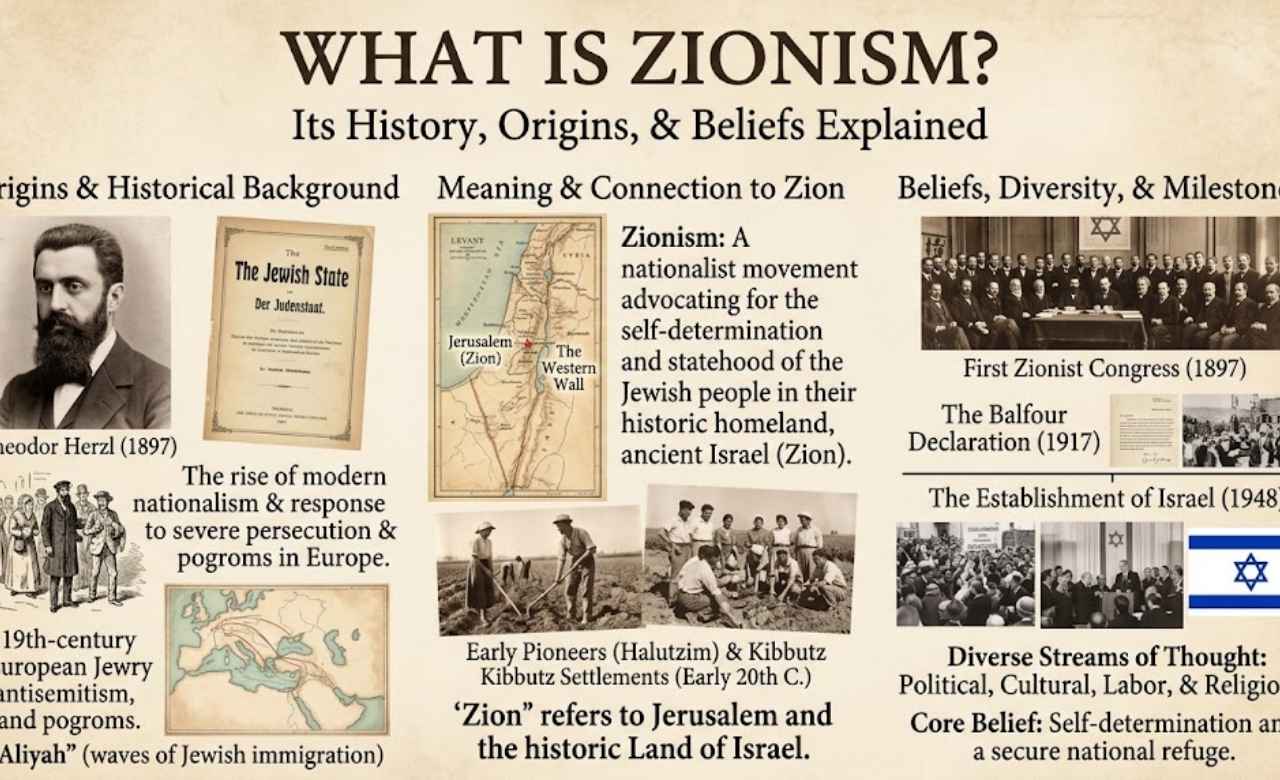
The word Zionist appears everywhere from breaking news headlines and political debates to social media discussions about Israel and Palestine. But what is a Zionist, and why does this single word spark so much controversy? Is it connected to Judaism, support for Israel, or a particular political belief?
Understanding the Zionist meaning requires looking beyond today’s heated arguments. Zionism began as a modern Jewish national movement in the late 19th century, shaped by Jewish historical ties Zionist Meaning to the Land of Israel, European nationalism, and rising antisemitism. Over time, its meaning and political significance evolved, particularly following Israel’s establishment in 1948.
So, what is a Zionist in simple terms? A Zionist is someone who supports Zionism, generally associated with Jewish national self-determination in the historic Land of Israel. However, not every Jewish person identifies as a Zionist, and Zionists themselves hold different political views.
This guide explores what Zionism means, its history, core beliefs, connection to Israel and Palestine, and why the term remains controversial in 2026.
What Does Zionist Mean? A Simple and Clear Definition
A straightforward Zionist definition describes an adherent or supporter of the political ideology known as Zionism. The term functions as both an adjective (e.g., Zionist philosophy, Zionist Congress) and a noun referring to any person—regardless of their ethnicity, nationality, or personal faith—who advocates for the right of Jewish national self-determination within the sovereign State of Israel.
To define the word accurately, one must look at the three foundational pillars underlying the ideology:
- National Identity: The belief that the Jewish people constitute not merely a religious denomination, but a distinct nation (am) bound by shared history, language, culture, and ancestral heritage.
- Territorial Connection: The conviction that this national identity is historically, spiritually, and geographically tethered to the ancient Levant—specifically the area historically known as Zion, Canaan, Judea, or Palestine.
- Sovereign Self-Determination: The argument that national survival and collective safety necessitate political autonomy and sovereign statehood, preventing Jewish populations from being perpetual, vulnerable minorities in diaspora nations.
In everyday English, when someone identifies as a Zionist, they are expressing support for the principle that a Jewish state has a legitimate right to exist in that historic region. It does not inherently dictate an individual’s stance on specific domestic policies, military strategies, or borders.
Zionist Meaning in Simple Words With Real-Life Examples
To grasp the Zionist meaning in simple words, consider how other nations approach self-determination. Just as Italian unification (il Risorgimento) in the 19th century held that Italian-speaking populations scattered across distinct duchies and kingdoms had the right to unify into a sovereign nation-state, early Zionists argued that globally dispersed Jewish communities deserved the exact same universal right of national self-determination.
Here are three real-life examples illustrating how the term functions across different contexts:
- Example 1: The Humanitarian and Refugee Context. Following the horrors of World War II and the Holocaust, hundreds of thousands of displaced Jewish survivors were trapped in European displacement camps with nowhere to turn. A Zionist activist in 1946 worked to organize immigration ships (Aliyah Bet) to British Mandate Palestine, arguing that only a sovereign Jewish homeland could guarantee shelter and legal citizenship to stateless refugees when the rest of the world closed its borders.
- Example 2: The Modern Political Reformer. A citizen living in Tel Aviv or an advocate living abroad participates in peaceful civil demonstrations advocating for a two-state solution, civil rights for minorities, and a withdrawal from disputed territories. Because they firmly believe Israel must remain a safe, democratic, Jewish-majority state alongside an independent Palestinian state, their worldview represents a liberal or progressive Zionist perspective.
- Example 3: The Non-Jewish Diplomatic Ally. A non-Jewish foreign policymaker in Europe or North America consistently votes to uphold international diplomatic ties, mutual defense agreements, and security assistance for Israel on the principle that the country is an established, sovereign United Nations member state with an inherent right to self-defense. In the geopolitical arena, this leader is often characterized as a political or diplomatic Zionist.
What Is Zionism and What Does It Stand For?
Zionism is the overarching international nationalist movement and political ideology that emerged in the late 19th century to re-establish, and now support and develop, a sovereign Jewish state in the Land of Israel. While the word itself was coined in 1890 by Austrian publisher Nathan Birnbaum in his journal Selbstemanzipation (“Self-Emancipation”), the underlying impulse reflected millennia of cultural memory, daily liturgical prayer, and modern political philosophy.
At its foundation, Zionism stands for several fundamental concepts:
- The Inadequacy of Assimilation: 19th-century European thinkers believed that post-Enlightenment civil emancipation would eliminate anti-Jewish prejudice. Zionism arose when intellectuals realized that integration did not protect Jewish communities from violent scapegoating, concluding that Jewish security could never rely permanently on the goodwill of host nations.
- Cultural and Linguistic Renaissance: Beyond politics, early Zionism spearheaded the revival of spoken Hebrew as a modern vernacular, transformed classical literature, revitalized agricultural labor, and developed secular Jewish artistic and civic institutions.
- The “Ingathering of the Exiles” (Kibbutz Galuyot): The political principle that Jewish communities fleeing persecution anywhere in the world—whether from European pogroms, Middle Eastern and North African expulsions in the mid-20th century, or modern conflict zones—must have an open door and immediate path to citizenship under Israel’s Law of Return.
Zionist vs. Zionism: Understanding the Key Differences
While frequently used interchangeably in informal conversation, Zionist and Zionism fulfill distinct linguistic and conceptual roles. Zionism represents the abstract theoretical architecture—the philosophy, literature, political platforms, and socio-economic doctrines. Zionist refers to the practical actor, practitioner, or modifier that applies that theory in the real world.
| Dimension | Zionism (The Ideology) | Zionist (The Individual / Modifier) |
| Grammatical Function | Abstract Noun | Concrete Noun or Descriptive Adjective |
| Core Definition | The theoretical movement and nationalist philosophy advocating Jewish sovereignty in their ancestral homeland. | A person who subscribes to, advocates for, or acts in accordance with the principles of Zionism. |
| Internal Diversity | Comprises varied ideological branches: Labor, Revisionist, Religious, Cultural, and Green Zionism. | Represents diverse individuals, ranging from secular left-wing peace activists to right-wing nationalists and non-Jewish allies. |
| Historical Manifestation | Expressed through political congresses, diplomatic treaties, literature, institutions, and state-building initiatives. | Expressed through personal voting behavior, community advocacy, philanthropy, military service, or public discourse. |
| Modern Application | Refers to the political framework sustaining the sovereignty, security, and cultural survival of Israel. | Refers to a supporter of Israel’s basic legitimacy as a sovereign homeland, regardless of specific party affiliation. |
What Does the Word Zion Mean in Hebrew and the Bible?
The word Zion (written in Hebrew as צִיּוֹן, pronounced Tziyyon) holds rich etymological, geographical, and theological significance that long predates modern political movements. In the Hebrew Bible (Tanakh), the term originally referred to a specific physical hill or fortified citadel in Jerusalem captured by King David, historically designated as the City of David (2 Samuel 5:7).
         Etymological Root: צ-י-ן (Tz-Y-N)
         Signifies: "Marker," "Monument," or "High Sanctuary"
                         │
        ┌────────────────┴────────────────┐
        ▼                                 ▼
Physical Geography                Theological Metaphor
(Mount Zion / Historic Ridge)     (The Entirety of Jerusalem & Its People)
        │                                 │
        └────────────────┬────────────────┘
                         ▼
             Modern Political Ideology
             "Zionism" (Coined 1890)
Over centuries of biblical literature, the semantic scope of Zion expanded through poetic parallelism:
- Jerusalem as a Whole: The Prophets frequently used Zion as a poetic synonym for the entire holy city of Jerusalem (e.g., Isaiah 2:3: “For out of Zion shall go forth the law, and the word of the Lord from Jerusalem”).
- The People and the Land: In texts like Psalm 137 (“By the rivers of Babylon, there we sat down, yea, we wept, when we remembered Zion”), the term evolved from physical geography into an evocative metaphor for the Jewish people’s collective spiritual yearning to return from exile.
- Linguistic Origins: Lexicographers generally trace Tziyyon to the Semitic root tz-y-n, meaning a “monument,” “signpost,” or “dry/parched ground,” reflecting an elevated landmark visible across the arid Judean landscape.
When early modern political organizers sought a name for their secular national liberation movement, they deliberately chose Zionism to evoke this deep historical reservoir of ancestral memory and communal longing.
The Origins of Zionism: How and Why the Movement Began
Modern Zionism did not emerge in a historical vacuum. While daily Jewish liturgy had preserved prayers for the rebuilding of Jerusalem for nearly two millennia following the Roman destruction of the Second Temple in 70 CE, the transformation of this spiritual aspiration into a modern political and secular movement occurred in late 19th-century Central and Eastern Europe.
For centuries, European Jews had lived as an insular, legally restricted minority subject to arbitrary expulsions, discriminatory taxation, and physical segregation within designated areas such as the Pale of Settlement in the Russian Empire. The European Enlightenment (Haskalah, or Jewish Enlightenment) prompted hope that Western liberal values of individual rights, citizenship, and reason would integrate Jewish communities safely into modern nation-states.
However, the late 1800s witnessed a severe backlash against Jewish civic integration. Modern pseudo-scientific racial theories superseded medieval religious anti-Judaism, asserting that Jews constituted an alien, unassimilable biological race. Following the 1881 assassination of Tsar Alexander II, government-sanctioned pogroms swept across the Russian Empire, displacing communities, destroying livelihoods, and prompting millions to flee.
Recognizing that legal equality in Western Europe was precarious and Eastern European violence was escalating, early thinkers concluded that Jewish physical survival required territorial self-rule. Grassroots organizations such as Hovevei Zion (“Lovers of Zion”) and the Bilu movement formed in the 1880s, sponsoring the initial waves of agrarian pioneers who established farming cooperatives in Ottoman-controlled Palestine.
How European Nationalism and Antisemitism Influenced Early Zionism
Two powerful 19th-century European currents directly shaped the birth of Zionism:
European Trends (Late 19th Century)
 ├── Rise of Ethno-Nationalism ──> Inspired the concept of Jewish self-emancipation as a distinct nation.
 └── Shift to Racial Antisemitism ─> Shattered hopes of safe assimilation, driving the necessity of statehood.
- The Tide of National Liberation Movements: The 19th century was the golden era of European nationalism. Greeks fought for independence from the Ottoman Empire; Italians achieved unification under Garibaldi and Cavour; Germans consolidated diverse principalities into an empire; Czechs, Poles, and Serbs asserted their historic linguistic and territorial identities. Jewish intellectuals witnessing these transformations asked a fundamental question: If Serbs, Greeks, and Italians are entitled to sovereign statehood in their ancestral lands, why are Jews denied that same universal right?
- The Institutionalization of Modern Antisemitism: In 1879, German journalist Wilhelm Marr popularized the term Antisemitismus to frame hatred of Jews not as theological disagreement, but as an irreconcilable racial and biological conflict. This structural shift demonstrated that no degree of cultural assimilation, linguistic fluency, or patriotism could shield Jewish families from hostility. Thinkers like Leon Pinsker published Auto-Emancipation (1882), arguing that anti-Jewish prejudice was an incurable social pathology (judeophobia) rooted in the fact that Jews were an omnipresent guest nation lacking a sovereign home.
Who Founded Modern Zionism? Theodor Herzl and His Political Vision
While grassroots groups existed earlier, Austro-Hungarian journalist and playwright Theodor Herzl (1860–1904) is universally recognized as the father of modern political Zionism. Herzl lived as an assimilated, cosmopolitan Viennese intellectual who initially believed thorough cultural integration into European society was the optimal path for Jewish people.
Herzl’s worldview shifted decisively during the 1890s while working in Paris as a foreign correspondent for Vienna’s Neue Freie Presse. While covering the Dreyfus Affair in 1894—where Alfred Dreyfus, an innocent Jewish French artillery officer, was falsely convicted of treason amid public chants of “Death to the Jews!” in the birthplace of the European Enlightenment—Herzl realized that if France could succumb to mob hysteria, safe assimilation was an illusion.
In 1896, Herzl published his foundational manifesto, Der Judenstaat (“The Jewish State”). He argued:
“The Jewish question is neither a social nor a religious one… It is a national question, which can only be solved by making it a political world-question to be discussed and settled by the civilized nations of the world in council.”
Herzl transformed Zionism from a romantic philanthropic endeavor into an organized international diplomatic force:
- The First Zionist Congress (1897): Herzl convened 208 delegates from across the globe in Basel, Switzerland, establishing the World Zionist Organization (WZO) and adopting the Basel Program, which declared: “Zionism seeks to establish a home for the Jewish people in Palestine secured under public law.”
- Diplomatic Realpolitik: Herzl negotiated directly with world leaders, including the Ottoman Sultan Abdul Hamid II, the German Kaiser Wilhelm II, the Pope, and British colonial ministers, seeking an internationally recognized charter for Jewish settlement.
- Prescient Vision: Writing in his diary after the Basel Congress, Herzl made his famous prediction: “At Basel I founded the Jewish State. If I said this out loud today I would be greeted by universal laughter. In five years perhaps, and certainly in fifty years, everyone will perceive it.” (Almost exactly fifty years later, in November 1947, the United Nations passed the Partition Resolution recommending the creation of an independent Jewish state).
A Brief Timeline of Zionism From the 1800s to 2026
To understand how the movement evolved from an idea into a modern regional power, examine this chronological overview of major historical milestones:
1882           1897           1917             1947–1948      1967            1993           2026
 First Aliyah   First Zionist  Balfour          UN Partition   Six-Day War     Oslo Accords   Modern Post-Oct 7
 Pioneers       Congress       Declaration      & Independence Territorial     Peace Process  Geopolitical
 Arrive         (Herzl)        Issued           (1948)         Control         Initiative     Landscape
───┼──────────────┼──────────────┼────────────────┼──────────────┼───────────────┼──────────────┼───>
- 1881–1882: The First Aliyah (wave of immigration) begins as Eastern European Jews flee Russian pogroms to establish agricultural settlements like Rishon LeZion and Petah Tikva.
- 1897: Theodor Herzl convenes the First Zionist Congress in Basel, Switzerland, founding the World Zionist Organization.
- 1917: The British government issues the Balfour Declaration, announcing official support for the “establishment in Palestine of a national home for the Jewish people,” later confirmed by the League of Nations Mandate in 1922.
- 1936–1939: Widespread Arab revolts occur in Mandatory Palestine against British colonial administration and rising Jewish immigration, leading Britain to publish the 1939 White Paper severely restricting Jewish entry on the eve of the Holocaust.
- 1939–1945: Nazi Germany murders six million European Jews in the Holocaust, devastating two-thirds of European Jewry and reinforcing global consensus regarding the need for a sovereign Jewish refuge.
- November 29, 1947: The United Nations General Assembly adopts Resolution 181, recommending the partition of Mandatory Palestine into independent Arab and Jewish states with an internationalized Jerusalem. Jewish leaders accept the plan; Arab leaders reject it.
- May 14, 1948: David Ben-Gurion reads the Declaration of Independence in Tel Aviv, establishing the State of Israel. The 1948 Arab-Israeli War immediately follows, leading to Israeli independence alongside the Palestinian Nakba (“Catastrophe”), during which an estimated 700,000 Arab residents were displaced or fled.
- 1967: The Six-Day War reshapes the region’s map. Israel captures the West Bank, East Jerusalem, the Gaza Strip, the Sinai Peninsula, and the Golan Heights, sparking ideological debates inside Zionism over land, security, and civilian settlements.
- 1977: Menachem Begin’s Likud party wins election, breaking three decades of Labor Zionist dominance and elevating Revisionist Zionism into Israel’s political mainstream.
- 1993: The Oslo Accords are signed between Israel and the Palestine Liberation Organization (PLO), setting up a framework for Palestinian self-governance and initiating the modern two-state peace negotiations.
- 2005: Israel carries out its unilateral disengagement from the Gaza Strip, dismantling all Israeli settlements and military installations inside the territory.
- 2020: The Abraham Accords normalize diplomatic and commercial relations between Israel and several Arab nations, including the UAE, Bahrain, Morocco, and Sudan.
- 2023–2026: The October 7 attacks by Hamas and the ensuing regional war mark a profound turning point in modern history. The conflict brings intense international scrutiny to Zionism, prompts worldwide student and political protests, triggers shifts in global diplomacy, and intensifies debates over Israel’s security, territorial boundaries, and long-term future.
What Role Did Zionism Play in the Establishment of Israel in 1948?
Zionism was the ideological, practical, and organizational engine that built the infrastructure of the State of Israel prior to its formal declaration in 1948. Long before sovereignty was achieved, the World Zionist Organization and the pre-state Jewish leadership in Palestine (the Yishuv) operated as a proto-government.
This institutional statecraft operated across three primary domains:
- Civic and Economic Infrastructure: Agencies like the Jewish National Fund (Keren Kayemeth LeIsrael) purchased land parcels for collective settlement. Organizations like the Histadrut (General Federation of Labor) built trade unions, public transport networks, industrial cooperatives, and healthcare clinics that transformed agricultural settlements into modern cities.
- Diplomatic Legitimacy: Zionist statesmen—most notably Chaim Weizmann—worked within major capitals to secure international backing. Their efforts helped achieve the 1917 Balfour Declaration, navigate League of Nations mandates, and convince both the United States and the Soviet Union to vote in favor of UN Resolution 181 in 1947.
- Security Organizations: In response to intercommunal clashes and riots during the Ottoman and British Mandate eras, the Zionist leadership formed organized defense militias, primarily the Haganah, as well as splinter underground factions like the Irgun (Etzel) and Lehi. These forces merged in May 1948 under David Ben-Gurion’s orders to establish the official Israel Defense Forces (IDF).
Without decades of deliberate agricultural, educational, financial, and military institution-building, declaring independence in May 1948 amidst immediate regional war would not have been viable.
What Do Zionists Believe? Core Principles and Political Goals
While contemporary political parties hold diverse views on governance, economics, and diplomacy, several bedrock principles unify classical Zionist belief:
                            Core Zionist Principles
        ┌──────────────────────────────┼──────────────────────────────┐
        ▼                              ▼                              ▼
National Right to             The Law of Return              Security Through
Self-Determination             As Sanctuary                  Sovereignty
(Jews as a sovereign nation    (Universal refuge for          (Collective defense in a
in their historic homeland)    any persecuted Jew)            hostile world)
- The Nationhood of the Jewish People: Zionists believe that Jews worldwide share a common ancestral lineage, culture, and destiny that transcends purely religious practice, defining them as an identifiable nation (Am Yisrael).
- The Inalienable Right to Self-Determination: Drawing on international charters, Zionists hold that Jewish people possess an inherent right to govern themselves within their historic homeland, free from foreign rule or minority subjugation.
- Israel as a Global Haven (The Law of Return): A core tenet is that Israel must always maintain an open-door policy for Jewish people fleeing discrimination, economic blockade, or violence anywhere in the world.
- Security Through Sovereignty: Based on centuries of historical persecution culminating in the Holocaust, Zionists assert that minority populations cannot rely permanently on the goodwill of outside governments; collective security requires self-governed military self-defense.
- Revitalization of Heritage and Language: The movement sought not only political refuge, but also a spiritual, linguistic, and cultural renaissance, demonstrated by revitalizing spoken Hebrew into a modern medium for science, law, and literature.
Different Types of Zionism: Political, Religious, Cultural and Labor
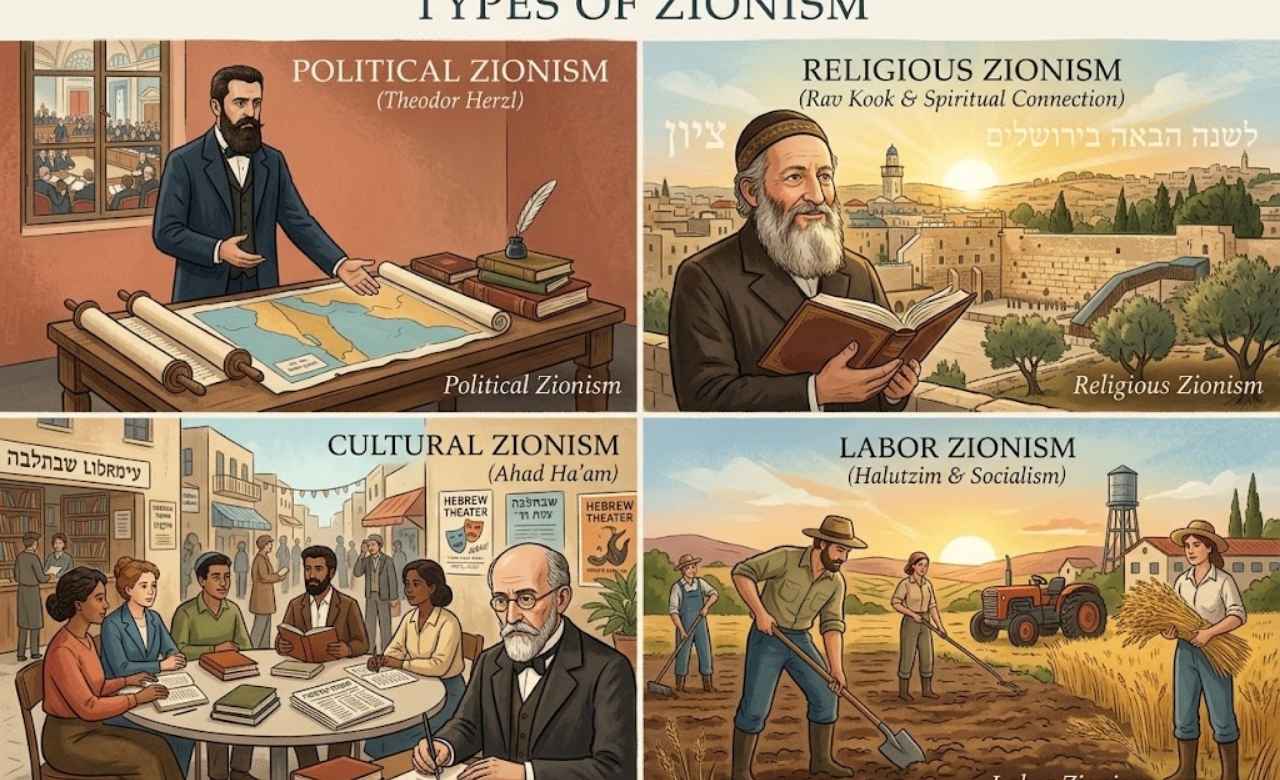
Zionism has never been a monolithic philosophy. From its earliest days, vigorous intellectual arguments split the movement into competing factions with divergent visions for what a Jewish state should be.
                             Major Branches of Zionism
    ┌────────────────────┬────────────────────┬────────────────────┐
    ▼                    ▼                    ▼                    ▼
Political Zionism    Labor Zionism        Cultural Zionism     Religious Zionism
(Herzl/Nordau)       (Gordon/Ben-Gurion)  (Ahad Ha'am)         (Kook/Reines)
Focus: Treaties,     Focus: Socialism,    Focus: Spiritual &   Focus: Messianic/
charters & state-    kibbutzim, working   Hebrew revival; a    biblical mandate to
hood diplomacy.      the land.            cultural beacon.     settle the land.
Political Zionism
Pioneered by Theodor Herzl and Max Nordau, this branch argued that securing international legal charters and diplomatic treaties from global superpowers was paramount. Political Zionists prioritized state-building, sovereignty, and rapid mass migration over internal cultural debates.
Labor Zionism (Socialist Zionism)
Championed by figures like A.D. Gordon, Ber Borochov, and David Ben-Gurion, Labor Zionism dominated the movement from the 1920s through the late 1970s. Influenced by Marxist and democratic-socialist ideals, they believed national redemption required transforming traditional Jewish socioeconomic structures through direct physical labor. They established the collective farming communes known as kibbutzim and moshavim, founded the national labor union (Histadrut), and established the political institutions that governed Israel throughout its first three decades.
Cultural (Spiritual) Zionism
Founded by Asher Ginsberg (better known by his pen name Ahad Ha’am), this camp clashed directly with Herzl. Ahad Ha’am argued that a small, vulnerable state could not solve the worldwide problem of antisemitism immediately. Instead, he envisioned Palestine as a dynamic spiritual and cultural center that would revitalize global Jewish identity, literature, philosophy, and moral values, radiating inspiration to Jewish communities remaining in the diaspora.
Religious Zionism
Historically initiated by Rabbi Yitzchak Yaakov Reines (founder of the Mizrachi movement) and expanded philosophically by Rabbi Abraham Isaac Kook, this branch bridged modern secular statecraft with traditional Orthodox theology. While classical ultra-Orthodoxy initially viewed secular Zionism with skepticism, Religious Zionists viewed political restoration and the return to the land not as human defiance of divine will, but as the initial dawn of divine redemption (Atchalta D’Geulah). Following the 1967 Six-Day War, a segment of this movement formed Gush Emunim, establishing communities and settlements across the West Bank (Judea and Samaria), viewing settling the land as a biblical obligation.
Revisionist Zionism
Founded by Ze’ev Jabotinsky in the 1920s in opposition to the socialist leadership, Revisionist Zionism advocated for an assertive, uncompromising nationalism, free-market economics, and military power (the concept of an “Iron Wall”). Jabotinsky argued that statecraft required establishing an unyielding defensive posture to secure Jewish rights on both sides of the Jordan River. This philosophy directly shaped the modern Likud Party, championed by figures such as Menachem Begin, Yitzhak Shamir, and Benjamin Netanyahu.
Is Zionism a Religion, a Political Movement or a Form of Nationalism?
Zionism is primarily classified by political scientists, sociologists, and historians as a modern national liberation movement and an ethno-cultural form of nationalism, rather than a theological religion.
To clarify this distinction, consider the following structural differences:
- Nationalism vs. Religion: Religions (such as Christianity, Islam, or Buddhism) focus on spiritual faith, theological dogma, rituals, metaphysics, and personal salvation. Nationalism, by contrast, is a political philosophy centered on identity, self-rule, territorial borders, and sovereign governance. Zionism arose among mostly secular, non-observant European Jewish intellectuals who viewed their people primarily as an ancient nation (ethnos) rather than simply a synagogue congregation.
- The Intertwining of Peoplehood and Faith: The confusion arises because Judaism differs from universalist religions. In Judaism, religion, ethnicity, and nationhood have been intertwined for millennia. Traditional texts treat the children of Israel as both a faith community and a distinct kinship tribe tied to a specific geographical homeland.
- Secular Roots: While Religious Zionism introduces theological interpretations to political events, the fundamental institutions of Zionism—the World Zionist Organization, the early agrarian settlements, the defense organizations, and the declaration of independence—were designed and led by secular, socialist, or liberal thinkers who operated using modern political frameworks.
What Is Christian Zionism and How Does It Differ From Jewish Zionism?
Christian Zionism refers to ideological and theological support for the return of the Jewish people to the Land of Israel and the modern State of Israel by non-Jewish Christians. While Jewish Zionism is grounded in national self-determination, historical survival, and ancestral ties, Christian Zionism is largely rooted in specific biblical interpretations and eschatological frameworks.
Historically, Christian Zionism predates Herzl’s political movement, with roots running back to 17th-century English Puritan theologians who argued that the biblical prophecies of the Old Testament foretold the physical restoration of the Jewish people to Palestine prior to the Second Coming of Jesus.
                              Zionist Perspectives
        ┌──────────────────────────────┴──────────────────────────────┐
        ▼                                                             ▼
Jewish Zionism                                                Christian Zionism
• Grounded in national self-determination.                   • Grounded in biblical prophecy & eschatology.
• Focus: Jewish survival, safety & culture.                   • Focus: Fulfillment of scripture & divine covenant.
• Centered on modern human rights & statehood.                • Associated with evangelical/restorationist theology.
The differences between the two traditions involve distinct foundations:
- Theological Foundation: Many Christian Zionists—prominently represented by American evangelical groups such as Christians United for Israel (CUFI)—base their political advocacy on Genesis 12:3 (“I will bless those who bless you, and whoever curses you I will curse”). They view modern Israel as the literal fulfillment of God’s unbreakable covenant with Abraham.
- Political Dynamics: In contemporary politics, Christian Zionists represent a influential, highly organized constituency, particularly within American foreign policy debates. They frequently lobby for unconditional financial and military aid to Israel, support conservative political candidates, and advocate for Jewish settlement expansion in the West Bank.
- Interfaith Tensions: While Israeli governments have welcomed Christian Zionist political, diplomatic, and charitable support, theological tensions persist. Many Jewish thinkers remain cautious regarding eschatological doctrines held by some Christian dispensationalists, who believe the gathering of Jews in Israel serves as a necessary prelude to the apocalypse and universal conversion to Christianity.
Zionism vs. Judaism: Why the Two Are Not the Same
One of the most consequential errors in modern geopolitical reporting and social discourse is the conflation of Zionism with Judaism. Conflating an ancient, diverse global religion with a modern political nationalist ideology distorts international understanding and can drive antisemitic prejudice.
                   JUDAISM                                    ZIONISM
       ┌──────────────────────────────┐           ┌──────────────────────────────┐
       │ • 3,000+ year-old world      │           │ • 19th-century political     │
       │   religion and civilization. │           │   nationalist ideology.      │
       │ • Centers on Torah, prayers, │           │ • Centers on modern self-    │
       │   mitzvot, and ethics.       │           │   determination and state-   │
       │ • Global faith community     │           │   hood in Israel.            │
       │   transcending borders.      │           │ • Independent of personal    │
       │                              │           │   religious observance.      │
       └──────────────┬───────────────┘           └──────────────┬───────────────┘
                      │                                          │
                      └─────────────────┬────────────────────────┘
                                        ▼
                            The Historic Overlap:
                 Both share an ancient spiritual connection
                      to Jerusalem and the Holy Land.
- Judaism is a venerable religious and cultural civilization spanning over three millennia. It is centered around sacred scripture (the Torah and Talmud), divine commandments (mitzvot), philosophical inquiry, and ritual life. Its adherents live across the globe as citizens of dozens of nations, holding wide-ranging political and philosophical beliefs.
- Zionism is a late 19th-century political movement that focuses on establishing, maintaining, and defending a sovereign nation-state. One can be an observant, devout Jew and hold critical or non-Zionist views, just as one can be an atheist or non-religious individual and identify as a Zionist.
Conflating the two creates significant harms: it falsely attributes the military and political policies of the State of Israel to Jewish communities worldwide who have no vote or voice in Israeli elections, while simultaneously obscuring the rich diversity of thought within Jewish intellectual life.
Are All Jewish People Zionists? Understanding Different Perspectives
No, not all Jewish people are Zionists. While demographic studies (such as those by the Pew Research Center) demonstrate that a substantial majority of global Jewry feels an emotional, cultural, or familial bond to Israel and supports its right to exist, the community includes varied opinions regarding the ideology:
Supportive Perspectives (The Majority Consensus)
For many mainstream Jews across Orthodox, Conservative, Reform, and secular traditions, Zionism is viewed as a vital success: an indigenous people returning to their ancestral home, rescuing millions of refugees from persecution, and establishing a thriving, innovative society. To them, supporting Israel’s basic security and right to self-determination is a natural expression of Jewish survival and solidarity.
Non-Zionist Approaches
Historically and in modern times, significant segments of Jewish society adopted a “non-Zionist” stance. Rather than actively opposing the state, these groups prioritize building Jewish religious, intellectual, and communal life in the diaspora, maintaining that the survival of Judaism does not depend exclusively on political sovereignty or territorial borders.
Anti-Zionist Religious Jewish Movements
Certain insular ultra-Orthodox (Haredi) groups, most visibly Neturei Karta and the Satmar Hasidic movement, vigorously oppose political Zionism on traditional theological grounds. They cite the Talmudic passage of the Three Oaths (Ketubot 111a), asserting that God commanded the Jewish people not to forcibly return en masse to the Holy Land or establish an independent state prior to the arrival of the divinely sent Messiah. They view secular political statehood as a premature human intrusion into divine redemption.
Left-Wing and Progressive Jewish Anti-Zionism
In contemporary Western nations, a visible minority of secular or progressive Jews—active in organizations such as Jewish Voice for Peace (JVP) or IfNotNow—oppose Zionism from a human rights perspective. They argue that Jewish nationalism, in its real-world implementation, has resulted in the systemic displacement and military occupation of Palestinians, maintaining that authentic Jewish ethical traditions command standing in solidarity with the oppressed.
Can Someone Be a Zionist Without Being Jewish?
Yes, an individual does not need to be Jewish to be a Zionist. Because Zionism is fundamentally an ideological position affirming the right of the Jewish nation to maintain a sovereign homeland, anyone who endorses that right can be described as a Zionist.
Notable manifestations of non-Jewish Zionism include:
- Christian Zionists: As examined above, millions of evangelical Christians worldwide actively support Israel based on their reading of biblical scripture and divine covenants.
- Secular and Geopolitical Allies: Numerous international political leaders, diplomats, and human rights figures have identified as Zionists on democratic or historical grounds. For example, prominent leaders such as U.S. President Joe Biden have publicly declared, “You don’t have to be a Jew to be a Zionist, and I am a Zionist,” signaling support for Israel’s legitimacy as a sovereign ally and democracy.
- Indigenous and Ethnic Minority Advocates: Various non-Jewish ethnic minorities in the Middle East, including segments of the Druze, Bedouin, and Maronite communities, have formed strategic, military, and civic alliances with Israel, viewing its sovereign presence as a bulwark for minority safety in a turbulent region.
Zionist vs. Israeli: What’s the Difference Between Identity and Ideology?
Mixing up the terms Israeli and Zionist confuses a person’s legal nationality with their political ideology.
       ISRAELI                                        ZIONIST
┌───────────────────────────────────┐  ┌───────────────────────────────────┐
│ • A legal nationality.            │  │ • A political ideology.           │
│ • Holds passport and citizenship. │  │ • Believes in the right of Israel │
│ • Can be Jewish, Arab, Druze,     │  │   to exist as a Jewish homeland.  │
│   Christian, or secular.          │  │ • Can hold any nationality or    │
│ • Defined by law, not ideology.   │  │   citizenship worldwide.          │
└───────────────────────────────────┘  └───────────────────────────────────┘
- Israeli is a legal nationality and citizenship designation. An Israeli is a citizen of the State of Israel who holds an Israeli passport, pays Israeli taxes, and is subject to Israeli civil law. Crucially, roughly 20% of Israeli citizens are ethnic Arab, Palestinian, Bedouin, or Druze individuals who hold full civic voting rights. An Israeli citizen may be passionately Zionist, politically indifferent, or openly anti-Zionist.
- Zionist is an ideological stance. A Zionist can be an American, Canadian, French, or Indian citizen who has never set foot in Israel but supports the country’s right to exist as a Jewish homeland. Conversely, an Israeli citizen living in Haifa might reject Zionism entirely, viewing it as exclusionary, while remaining an Israeli citizen by birth and law.
How Is Zionism Connected to Israel and Palestine?
The geographical territory that was historically designated as Canaan, the Kingdom of Israel, Judea, Syria-Palaestina, Ottoman Southern Syria, British Mandate Palestine, and modern Israel and the Palestinian territories forms the shared backdrop where these narratives collide.
                         The Geographic Nexus
                         Land of Many Names:
         Canaan ➔ Judea ➔ Syria-Palaestina ➔ British Mandate ➔ Israel & Palestine
                                  │
          ┌───────────────────────┴───────────────────────┐
          ▼                                               ▼
Jewish Historical Claim                          Palestinian Historical Claim
Continuous spiritual, linguistic,                Centuries of unbroken residency,
and archaeological ties spanning                 culture, familial roots, and
over three millennia.                            agricultural heritage.
For Jews, the land has represented their ancestral cradle for over 3,000 years—the place where their religious identity, language, prophets, and sovereign kingdoms emerged, verified by rich archaeological records and historical texts. Even during long centuries of global exile, small Jewish communities maintained a continuous presence in cities like Jerusalem, Hebron, Tiberias, and Safed.
For Palestinians, the very same land represents their generational home. For centuries, Arab Palestinian families lived, farmed, developed urban centers, and built cultural roots across the rolling hills of Judea and Samaria, the coastal plains of Jaffa, and the valleys of the Galilee.
Zionism’s mission to re-establish a sovereign Jewish state in this specific territory meant modern Jewish nationalism was realized on the same ground inhabited by another population with deep ties to the land. This mutual claim to the same geographical area forms the root of contemporary regional tensions.
Zionism and Palestinian Nationalism: Understanding Competing Historical Claims
The clash between Zionism and Palestinian nationalism is not an ancient tribal hatred; it is a modern collision between two distinct national movements claiming self-determination within the same territory.
                  COMPETING HISTORICAL CLAIMS
       ┌─────────────────────────────────────────────────┐
       │               The Shared Territory              │
       └────────┬───────────────────────────────┬────────┘
                │                               │
                ▼                               ▼
    The Zionist Narrative           The Palestinian Narrative
 • Indigenous return to ancestral    • Native population displaced by
   homeland after exile.               European colonial-style movement.
 • Historic continuity: language,    • Generational roots: towns, land,
   archaeology, and liturgy.           culture, and familial heritage.
 • Legal sanctuary from lethal       • The Nakba (1948): catastrophic
   global persecution.                 loss of home and sovereignty.
The Zionist Narrative
Zionists view the movement as an authentic, indigenous national liberation struggle. In this view, Jews were dispossessed by Roman and subsequent imperial conquerors, endured thousands of years of systemic discrimination, and finally returned home to rebuild their ancestral nation. They emphasize historical documentation, continuous physical presence, legal land purchases under Ottoman and British rules, and willingness to accept international partition compromises (such as the 1947 UN plan).
The Palestinian Narrative
Palestinians view Zionism as an external settler-colonial enterprise supported by European imperial powers (primarily the British Empire). From their perspective, indigenous Palestinian inhabitants were forced to pay the price for European antisemitism and the Holocaust, despite bearing no responsibility for those tragedies. They emphasize generational residency, the ownership of farms and olive groves, the destruction of hundreds of Palestinian villages in 1948, and the denial of their basic national right to self-determination in their homeland.
Both groups hold deeply rooted, historical attachments to this land, and peace initiatives depend on recognizing the authenticity and gravity of both narratives.
How Did Zionism Shape the Israeli–Palestinian Conflict?
The implementation of political Zionism shaped the modern Israeli-Palestinian conflict through several decisive historical turning points:
- Early Land and Labor Policies (Late 19th–Early 20th Century): Early Zionist organizations purchased agricultural land from absentee Ottoman landlords. When Jewish pioneers implemented policies of Ivrit (Hebrew labor) to build a self-sufficient working class, tenant Arab farmers who had worked those plots for generations were often displaced, generating early communal tensions.
- The 1948 War and the Nakba: The 1947 UN Partition Plan sparked localized fighting that escalated into full-scale war when Israel declared independence in May 1948 and surrounding Arab states intervened. The conflict concluded with Israel securing its statehood, but also resulted in the displacement of approximately 700,000 Palestinians, an event commemorated in Palestinian history as the Nakba (“Catastrophe”). The enduring issues of Palestinian refugees and their right of return remain central disputes in international diplomacy.
- The 1967 War and Military Administration: Following the Six-Day War, Israel took control of the West Bank, East Jerusalem, and the Gaza Strip. This development introduced a profound debate within Zionism: Should the land be retained for defense depth and religious-historical roots, or should it be exchanged for peaceful relations to protect Israel’s Jewish and democratic majority? The subsequent establishment of civilian settlements across the West Bank has grown into a major flashpoint.
Does Being a Zionist Mean Supporting Every Israeli Government Policy?
No. Being a Zionist does not require an individual to support, endorse, or defend every action of the Israeli government or military, any more than being an American patriot requires endorsing every decision of the White House or Congress.
In fact, modern Israel has one of the world’s most fiercely competitive multi-party political landscapes:
- Internal Political Disagreement: The Israeli public and diaspora Zionists are often divided over economic strategy, social legislation, judicial reform, and security choices. Tens of thousands of Zionist citizens regularly participate in public demonstrations against their own governing coalitions.
- The Distinction Between Country and Government: Zionism expresses commitment to the foundational existence and security of Israel as a sovereign homeland. An individual can identify as a committed Zionist while criticizing specific cabinet ministers, opposing military operations, demanding civil equality for minority citizens, or speaking out against settlement expansion in the West Bank.
Treating every Zionist as an unquestioning supporter of government policy ignores the vigorous debate that characterizes open democratic discourse.
Can Zionists Support Palestinian Rights and a Two-State Solution?
Yes. Millions of Zionists within Israel and across the global diaspora actively support the realization of Palestinian national rights and the implementation of a viable two-state solution.
                   Liberal & Progressive Zionist Framework
     ┌─────────────────────────────────────────────────────────────┐
     │  Goal: Long-term survival of Israel as Jewish & Democratic  │
     └──────────────────────────────┬──────────────────────────────┘
                                    │
           ┌────────────────────────┴────────────────────────┐
           ▼                                                 ▼
Preserve Jewish Democracy                         Recognize Palestinian Rights
Absorbing millions of Palestinians                A sovereign Palestinian state honors
erodes either democracy or Jewish majority;       universal human rights and ends the
a two-state separation preserves both.            cycle of military occupation.
This perspective—often called liberal, labor, or progressive Zionism—contends that:
- The Demographic Argument: For Israel to endure as both an authentic democracy and a Jewish-majority state, it cannot permanently rule over millions of disenfranchised Palestinians in the West Bank and Gaza Strip. Annexing those territories without granting full voting rights erodes democracy; granting full voting rights dilutes the Jewish-majority character. Therefore, establishing an independent Palestinian state alongside Israel is essential to secure the Zionist project.
- Moral and Universal Principles: Progressive Zionist movements (including organizations like Peace Now, Meretz, and J Street) emphasize that the universal right of national self-determination claimed by Jews applies to their Palestinian neighbors as well. They maintain that true security and ethical integrity can only be achieved when both peoples possess sovereign dignity, peace, and mutual recognition.
Why Is Zionism Controversial? Major Arguments and Criticisms Explained
Zionism is one of the most fiercely debated political ideologies in contemporary international politics. Its controversies involve competing philosophical viewpoints and geopolitical outcomes:
- Allegations of Settler-Colonialism: Critics argue that Zionism operated as a settler-colonial enterprise, utilizing European imperial protection to establish an ethnically preferential state at the direct expense of an indigenous population. Proponents strongly reject this categorization, countering that Jews were indigenous people returning to their historical cradle, fleeing lethal persecution rather than extending an empire’s power.
- The Question of Ethnic Nationalism: Critics challenge the concept of an ethno-national state, arguing that defining a country primarily as a “Jewish State” inherently creates tiers of belonging that disadvantage non-Jewish minorities. Supporters respond that nearly all European democracies—including Greece, Poland, Ireland, and Finland—practice forms of ethnic and cultural nationalism, offering expedited citizenship to their global diasporas while protecting internal minority civil rights.
- Military Occupation and Human Rights: Human rights groups (including Amnesty International, Human Rights Watch, and B’Tselem) argue that decades of military administration in the West Bank, expansion of civilian settlements, blockades, and unequal legal systems have created realities they characterize as apartheid. Defenders maintain that Israeli military actions are legitimate self-defense measures driven by persistent security threats, rocket fire, and terror networks, pointing out that Israel’s Arab citizens vote in elections, serve in the judiciary, and lead major hospital systems.
Zionism vs. Anti-Zionism: What Is the Difference?
The debate between Zionism and anti-Zionism centers on the basic legitimacy of the State of Israel’s existence as a sovereign Jewish homeland.
| Feature | Zionism | Anti-Zionism |
| Core Position | Affirms the inherent right of the Jewish people to sovereign statehood and self-determination in their ancestral homeland. | Rejects the legitimacy of Israel as a specifically Jewish state; opposes political Zionism as an ideology. |
| Proposed Geopolitical Vision | A sovereign State of Israel living in safety (either alongside a Palestinian state or with secured borders). | Ranges from a single secular bi-national state for all inhabitants to the complete replacement of Israel by a Palestinian state. |
| Historical Assessment | Views Israel’s creation as an indigenous return, a legal international act, and a necessary refuge from persecution. | Views Israel’s creation as an unjust act of displacement, dispossession, and colonial erasure of Palestinians. |
| View on the Law of Return | Essential legal guarantee protecting any Jew worldwide from experiencing persecution or exile. | Inherently discriminatory because it grants entry based on ethnic-religious identity while denying displaced Palestinians the right to return. |
| Internal Perspective | Ranges from progressive two-state advocates to conservative and religious nationalists. | Ranges from dedicated human rights activists to ideological state actors opposing Israel’s existence. |
Is Anti-Zionism the Same as Antisemitism? Understanding the Debate
The relationship between anti-Zionism (opposition to Jewish statehood) and antisemitism (hatred, prejudice, or discrimination against Jews) is one of the most intensely contested arguments in global political discourse. Disentangling the two requires examining nuanced perspectives.
       ANTISEMITISM                                 ANTI-ZIONISM
┌───────────────────────────────┐           ┌───────────────────────────────┐
│ Hatred, discrimination, or    │           │ Political opposition to the   │
│ conspiracy theories directed  │           │ concept, policies, or exis-   │
│ at Jewish individuals, faith, │           │ tence of a specifically       │
│ culture, or community life.   │           │ Jewish sovereign state.       │
└──────────────┬────────────────┘           └───────────────┬───────────────┘
               │                                            │
               └──────────────────┬─────────────────────────┘
                                  ▼
                         The Complex Nexus:
               • Can cross into antisemitism when using
                 ancient tropes, blood libels, or double standards.
               • Remains distinct when addressing human rights,
                 state policies, or general critiques of nationalism.
The Position That Anti-Zionism Is Inherently Antisemitic
Proponents of this view—including major advocacy organizations and the International Holocaust Remembrance Alliance (IHRA) working definition—argue that singling out the Jewish people for the denial of self-determination is discriminatory:
- The Double-Standard Argument: If every other ethnic group has a recognized right to self-determination, stripping that right solely from Jews applies a prejudicial standard.
- Classical Tropes in Modern Disguise: Often, anti-Zionist rhetoric recycles ancient antisemitic conspiracies (such as claims of global financial control, blood lust, or hidden media power), simply substituting the word “Zionist” for “Jew.”
- Physical Impacts: Hostility toward Zionism frequently spills over into real-world violence, harassment, and vandalism targeting synagogues, Jewish community centers, and individuals around the world who have no involvement in Israeli military actions.
The Position That Anti-Zionism Is Politically Distinct
Critics of this perspective—including scholars behind the Jerusalem Declaration on Antisemitism (JDA) and human rights organizations—maintain that conflating anti-Zionism with antisemitism restricts legitimate political speech:
- Legitimate Critique of State Policy: Principled opposition to nationalism, criticism of military occupations, or support for a single democratic bi-national state with equal voting rights for all inhabitants is a valid political viewpoint, not automatic racial or religious hatred.
- Non-Zionist Jewish Traditions: Conflating the two terms erases the long-standing tradition of Jewish non-Zionism and anti-Zionism, falsely labeling Jews who criticize the state’s founding philosophy as self-hating or antisemitic.
A clear guideline used by many analysts: Criticizing the policies, laws, and military actions of the Israeli government is standard political speech; denying Jews the right to security, using ancient dehumanizing tropes, or targeting Jewish people worldwide is antisemitism.
Zionist Meaning in 2026: How the Term Is Used in Politics and Social Media
The meaning and usage of the word “Zionist” has faced historic volatility in the wake of the October 7 attacks, the devastating regional wars, and the worldwide street and campus protests that followed.
                                Modern Semantic Usage (2026)
        ┌─────────────────────────────────────┴─────────────────────────────────────┐
        ▼                                                                           ▼
Mainstream & Communal Usage                                                 Social Media & Pejorative Tone
• Identity, resilience, and safety.                                         • Weaponized as a totalizing insult.
• Upholding the necessity of a sovereign haven.                              • Applied to silences, boycotts, and lists.
• Preserving continuity after crisis.                                       • Used as a thinly veiled substitute for "Jew."
In the current global lexicon, the term functions in sharply contrasting ways:
- Communal Resilience and Solidarity: Within mainstream Jewish communities, the term has seen a renewed embrace. In an era marked by rising global antisemitism, identifying as a Zionist represents solidarity with Israel’s ongoing survival, empathy for displaced citizens and hostages, and a conviction that the historical haven remains essential.
- Weaponization as a Pejorative on Social Media: Across platforms like TikTok, X, and Instagram, the word “Zionist” has increasingly been deployed as a pejorative term. It is often used to shut down debate, mark public figures for boycotts, or silence creators. In the most hostile environments, online commentators use “Zionist” as a thinly veiled substitute for “Jew,” attempting to evade automated content moderation against hate speech while deploying classical tropes against individuals.
- Campus and Progressive Polarizations: In university encampments and activist coalitions, the term is frequently treated as an absolute binary: either an endorsement of apartheid and military violence, or an ideology fundamentally incompatible with modern human rights. Conversely, institutional and moderate leaders emphasize that dismissing all Zionists marginalizes the overwhelming majority of the world’s Jewish population who feel an organic connection to their homeland.
Common Myths and Misconceptions About Zionism Explained
Given the heated rhetoric surrounding the topic, clearing up pervasive misconceptions is essential for grounded dialogue.
Myth 1: “Zionism is a European colonial movement with no historical connection to the land.”
Fact: While modern political Zionism was organized in Europe, Jews are an indigenous Middle Eastern people whose language (Hebrew), holy books, spiritual rituals, and collective identity formed in the ancient Levant. Archaeological digs continually reveal Hebrew inscriptions and structures dating back millennia. Furthermore, over half of Israel’s Jewish population today descends from Mizrahi and Sephardic families expelled from or forced to flee Middle Eastern and North African nations (like Iraq, Yemen, Egypt, Morocco, and Iran) in the mid-20th century.
Myth 2: “All Zionists are right-wing, anti-Palestinian extremists.”
Fact: Zionism contains a wide ideological spectrum, much like American or European political systems. While right-wing and nationalist factions exist, there are also long-standing traditions of labor, liberal, and environmental Zionists who advocate for Palestinian human rights, organize joint coexistence initiatives, and lead public campaigns for a two-state solution.
Myth 3: “Real Judaism is entirely opposed to Zionism.”
Fact: While small ultra-Orthodox groups like Neturei Karta reject secular statehood on specific messianic grounds, mainstream Judaism has maintained an unbroken spiritual and liturgical connection to Zion for millennia. The daily Jewish prayer service (Amidah), the grace after meals (Birkat Hamazon), the Passover Seder (“Next year in Jerusalem!”), and traditional weddings (breaking a glass to mourn the Temple’s destruction) all center around the longing to return to Jerusalem and the land of Israel.
Frequently Asked Questions
What is a Zionist in simple terms?
A Zionist is someone who supports Zionism, a movement advocating Jewish national self-determination in the historic Land of Israel. Zionists have different religious and political beliefs and do not necessarily support every Israeli government policy.
What is Zionism in Islam?
Islam does not have one universally accepted definition of Zionism, as Zionism is a modern political movement rather than an Islamic religious teaching. Many Muslim scholars and communities criticise Zionism because of its historical and political impact on Palestinians.
What is the main goal of Zionism?
The original goal of modern Zionism was to establish a Jewish national homeland in historic Palestine. Today, many Zionists focus on maintaining Israel as a Jewish state and supporting Jewish national self-determination.
What is Zionism according to Palestinians?
Many Palestinians view Zionism as a nationalist movement associated with the loss of Palestinian land, displacement, and the Nakba of 1948. Palestinian perspectives vary, but criticism often focuses on occupation, settlements, and Palestinian rights to self-determination.
Conclusion: Understanding the True Zionist Meaning
So, what is a Zionist, and what does the term really mean today? At its core, a Zionist is someone who supports Zionism, a movement historically rooted in Jewish nationalism and the pursuit of Jewish national self-determination in the Land of Israel. However, understanding the Zionist meaning involves much more than a simple definition.
From Theodor Herzl and the rise of political Zionism to the establishment of Israel in 1948, the movement has shaped modern Middle Eastern history. Yet Zionism is not the same as Judaism, and being a Zionist does not automatically mean supporting every Israeli government policy. Its history also remains deeply connected to Palestinian displacement, competing national aspirations, and the ongoing Israeli-Palestinian conflict.
Today, discussions about Zionism involve questions of national identity, historical rights, political sovereignty, and Palestinian self-determination. Understanding these different perspectives helps explain why the term continues to generate debate.
Ultimately, knowing what is a Zionist means recognising the difference between religious identity, political ideology, and individual beliefs. Rather than relying on stereotypes or social media claims, exploring credible historical sources and diverse perspectives provides a clearer, more balanced understanding of Zionism in 2026.Read other article 200+ Assassin Names: Dark, Deadly, Cool & Powerful Ideas

Welcome to NameInBible. I am Victoria, a Christian writer passionate about exploring biblical name meanings, Scripture-based insights, and powerful prayers. My goal is to help readers discover the spiritual significance of names and grow closer to God through faith-filled content.