
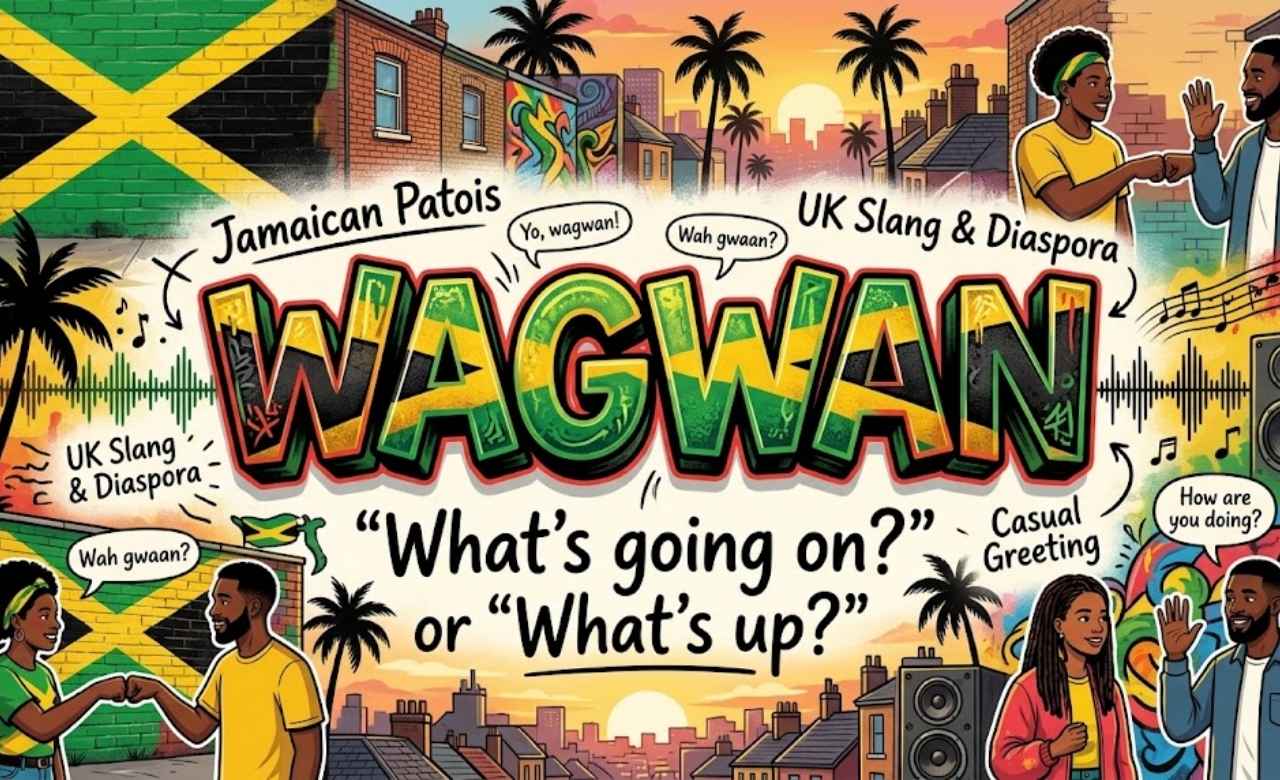
Ever heard someone say “Wagwan?” and wondered if they were greeting you or asking something? You’re not alone! This catchy expression has taken over social media, music, and everyday conversations. But what does Wagwan mean in Jamaica, and why is everyone using it? Rooted in Wagwan Jamaican Wagwan Meaning slang, the word simply means “What’s going on?” or “What’s up?” You might also have come across phrases like “Wagwan generals” and wondered about the Wagwan generals meaning.
Whether you’ve spotted it on TikTok, heard it in UK rap, or received it in a text, this guide breaks down its meaning, origins, pronunciation, and the best ways to reply without sounding awkward.
What Does Wagwan Mean? Simple Definition Explained
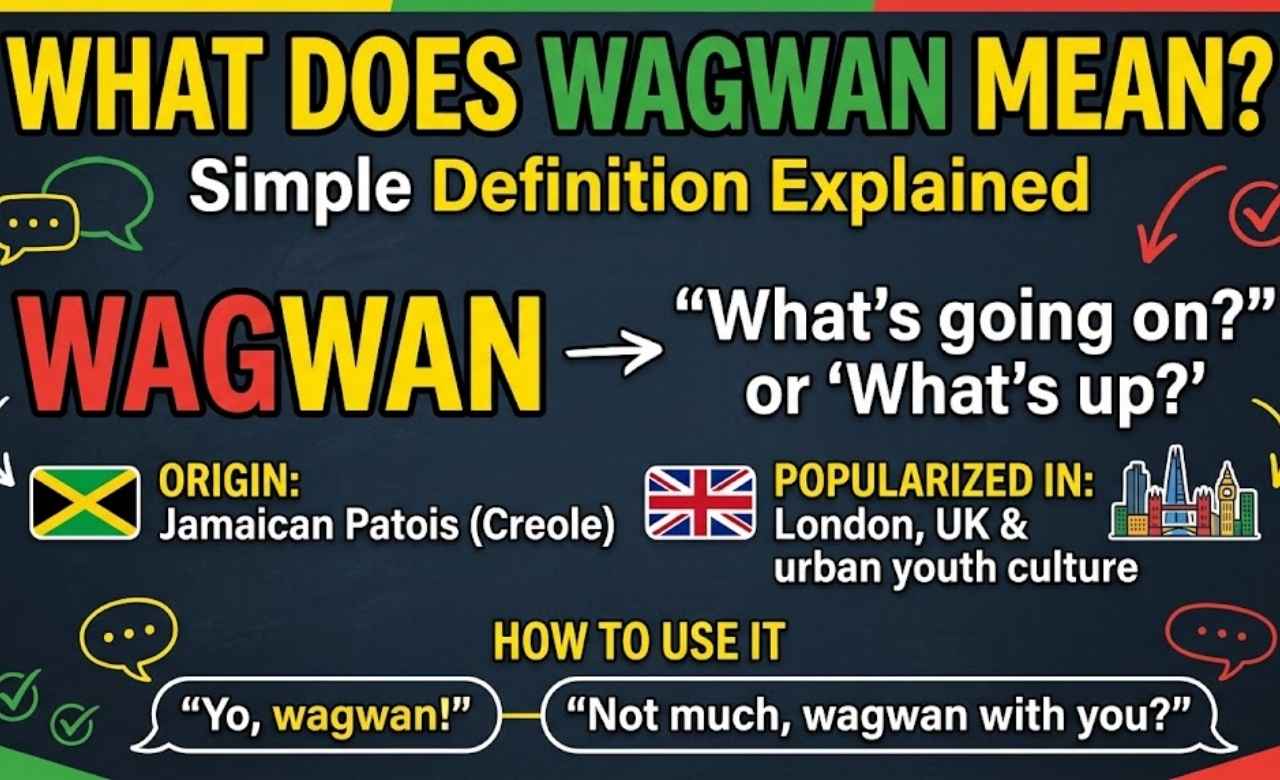
At its simplest and most fundamental level, the wagwan meaning is an informal greeting that translates directly to:
“What’s going on?” or “What’s happening?”
It is a phonetic, contracted rendering of the phrase “What is going on?” spoken in Jamaican Patois (an English-based creole language with West African influences). Just like standard English speakers turned “What is up?” into “What’s up?” and eventually “Sup?”, Caribbean speakers naturally Wagwan Meaning contracted “What a gwaan” (what is going on) into the phonetic word wagwan (often spelled wah gwaan or wha gwaan in traditional orthography).
Quick Semantic Breakdown
| Attribute | Details |
| Part of Speech | Interjection / Informal greeting / Conversational opener |
| Primary Meaning | “What’s going on?”, “What’s happening?”, “What’s up?”, “How are you doing?” |
| Language of Origin | Jamaican Patois (Patwa) |
| Adopted Dialects | Multicultural London English (MLE), British urban slang, international youth slang |
| Tone | Casual, warm, street-smart, relaxed, familiar |
| Formality Level | Strictly informal (never use in formal emails, corporate interviews, or academic papers) |
While the wagwan definition functions grammatically as a question asking about your current state or activities, it is frequently used as a phatic greeting—meaning it often acts simply as a friendly “hello” rather than an interrogation requiring a literal, detailed summary of your day.
Wagwan Meaning in English With Easy Examples
In standard conversational English, wagwan functions as a catch-all informal salutation. It serves the exact same conversational purpose as phrases like:
- “What’s up?”
- “How’s it going?”
- “What are you up to?”
- “How are things?”
- “Alright mate?”
The wagwan English translation does not imply an emergency, nor does it ask if something is wrong. When someone uses it, they are casually checking in, opening a dialogue, or Wagwan Meaning signaling friendly affiliation.
Practical Everyday Examples
- Catching up after work:
- Speaker A: “Wagwan! Haven’t seen you around the pitch this week.”
- Speaker B: “All good bro, just caught up with overtime. How are you doing?”
- Checking plans on a Friday afternoon:
- Speaker A: “Wagwan for tonight? We still linking up at eight?”
- Speaker B: “Yeah man, definitely. See you outside the station.”
- Acknowledging a friend passing by on the street:
- Speaker A: “Wagwan!” (Accompanied by an upward head nod)
- Speaker B: “Safe, my G.” (Continues walking)
In all three instances, the meaning of wagwan provides an effortless, warm bridge into conversation without the rigidity of formal greetings like “Good afternoon” or “Pleased to meet you.”
Wagwan Meaning in Urdu and Hindi
Because digital culture has flattened geographical boundaries, search intent for the wagwan meaning in Urdu and Hindi has surged across South Asia and the diaspora. Millions of internet users encounter the term on social video platforms, gaming lobbies, and transnational music releases.
Wagwan Meaning in Urdu (اردو ترجمہ)
In Urdu, the most direct and accurate semantic translations of wagwan are:
- کیا چل رہا ہے؟ (Kya chal raha hai?) — Literal: “What is going on / what is walking?”
- کیا ہو رہا ہے؟ (Kya ho raha hai?) — Literal: “What is happening?”
- کیا حال ہے؟ (Kya haal hai?) — Literal: “How is your state/condition?”
- سب ٹھیک ٹھاک؟ (Sab theek thaak?) — Meaning: “Is everything alright?”
When an Urdu speaker receives a message saying “Wagwan,” it carries the Wagwan Meaning exact vibe of an informal text from a close cousin or buddy asking: “اور سناؤ، کیا چل رہا ہے؟” (Aur sunao, kya chal raha hai? — “Tell me more, what’s going on?”).
Wagwan Meaning in Hindi (हिन्दी अनुवाद)
For Hindi speakers, the term matches identical everyday casual check-ins:
- क्या चल रहा है? (Kya chal raha hai?)
- क्या हाल-चाल हैं? (Kya haal-chaal hain?)
- सब कैसा है? (Sab kaisa hai?)
It mirrors the casual, colloquial greeting “और भाई, क्या हो रहा है?” (Aur bhai, kya ho raha hai?). Just like in English or Jamaican contexts, in Hindi and Urdu conversations, the listener is expected to reply that things are peaceful, normal, or good, rather than dumping unwanted life stress unless specifically prompted.
What Does Wagwan Mean in Texting and Online Chat?
In modern text message slang and online communication, wagwan functions as an instant digital conversational opener. Typing “Wagwan” into a messaging app serves as a low-friction “ping”—it notifies the recipient that you are online, thinking of them, and initiating contact, without carrying the coldness of a single “hey.”
+-----------------------------------------------------------+
|               ANATOMY OF A WAGWAN TEXT                    |
+-----------------------------------------------------------+
|  "Wagwan"  =  [Conversational Starter] + [Low-Stress Ping] |
|                                                           |
|  Function: Replaces "Hey" or "Hi" with street credibility  |
|  Tone:     Warm, relaxed, approachable, casual            |
|  Response: Requires only a short 1-to-3 word reply        |
+-----------------------------------------------------------+
When you analyze wagwan meaning in texting, remember that context dictates its weight:
- Stand-alone Text (“Wagwan.”): The sender wants to talk, hang out, or see if you are free.
- Prefacing a Request (“Wagwan bro, you got that file?”): Softens a direct inquiry so the sender doesn’t come across as demanding or purely transactional.
- Group Chat Broadcast (“Wagwan everyone”): Signals to an entire group that you have arrived in the lobby, joined the chat, or are seeking group plans.
Wagwan Meaning on WhatsApp, Instagram, and Snapchat
Each social media platform injects its own subtle contextual nuance into the term:
Wagwan on WhatsApp
WhatsApp is predominantly used for real-life peer networks, family, and direct personal messaging. On WhatsApp, wagwan typically signals an authentic, warm check-in. It is commonly followed by plans, questions about weekend arrangements, or shared memes. If a close friend drops “Wagwan” into a private WhatsApp chat, they are opening space for a casual, comfortable catch-up.
Wagwan on Instagram
On Instagram, you will encounter the term across three distinct surfaces:
- Direct Messages (DMs): Sent as an icebreaker or slide-in to someone whose story you liked. It sets a suave, confident, and nonchalant tone.
- Post Comments: Friends comment “Wagwan 🔥” or “Wagwan king” under outfit pictures (OOTD) or vacation snaps to hype up the creator.
- Reels Comments: Used reactively when a video depicts chaos, comedy, or confusion: “Wait, wagwan here?!” (translating to “Wait, what is actually happening in this clip?!”).
Wagwan on Snapchat
Snapchat communication is notoriously fast-paced and visual. When someone sends a blank screen snap or a quick selfie captioned with simply “Wagwan”, they are testing your availability. It means: “I am bored, hit me back, let’s chat.” It is also widely used on private Snapchat stories to announce a change of location or an open invitation to hang out: “In central today, wagwan?”
What Does Wagwan Mean on TikTok and Social Media?
TikTok has accelerated global slang adoption at an unprecedented rate. On TikTok and related algorithmic video feeds, wagwan has evolved into a broader meme and comedic catchphrase.
- The Trend Hook: Creators often kick off viral storytelling Wagwan Meaning videos or street interviews in cities like London, Toronto, or New York with an energetic “Wagwan guys, welcome back to another video!”
- Reaction Culture: In comment threads under viral videos featuring unexpected drama, unexpected plot twists, or bizarre public stunts, users spam the comments with: “Nah wagwan for real?” Here, the term shifts subtly from a greeting into an expression of disbelief, equivalent to: “What in the world is happening right now?”
- Online Gaming Communities: In multiplayer voice chats across titles like Call of Duty, Fortnite, Valorant, and FIFA / EA Sports FC, players dropping into public lobbies often announce their presence by saying “Wagwan team” or “Wagwan mic check.” It functions as an instantaneous vibe-check to weed out quiet players and discover who wants to communicate.
Where Did Wagwan Originate? Jamaican Slang History
To truly appreciate the term and avoid treating it as mere internet trivia, one must understand the rich, resilient history behind its linguistic roots. The wagwan origin lies squarely within the cultural soil of Jamaica and the evolution of Jamaican Patois.
[West African Linguistic Influences + English Lexifier]
                           │
                           ▼
                  [Jamaican Patois]
                 "Wah a gwaan?" (1900s)
                           │
                           ▼
              [Reggae & Dancehall Golden Age]
         Bob Marley, Yellowman, Shabba Ranks (1970s–1990s)
                           │
                           ▼
            [Windrush Generation & Diaspora Migration]
           London, Birmingham, Toronto, New York (1950s–1980s)
                           │
                           ▼
          [Multicultural London English (MLE)]
       Grime, Drill, UK Rap, Global Pop Culture (2000s–Present)
Jamaican Patois (also known as Patwa) formed as a contact language Wagwan Meaning during the transatlantic slave trade. Enslaved West Africans combined British English vocabulary with West African grammar, phonetics, and idioms. In Patois, grammatical verbs like “going” frequently elide and shift. The standard English interrogative phrase:
“What is going on?”
evolved phonetically into:
“Wah a gwaan?” or “Wah gwaan?”
In Jamaican culture, language is deeply expressive, rhythmic, and community-centered. Greetings are not throwaway formal gestures; they are relational checks on the collective health and peace of the community.
What Does Wagwan Mean in Jamaican Patois?
In authentic Jamaican Patois phrases, wah gwaan carries a deep sense of communal warmth and respect. It is far more than an English translation of “hello”—it is an inquiry into your life energy, your family, your state of mind, and your immediate reality.
When an elder or contemporary in Kingston or Montego Bay asks:
“Wah gwaan, bredren?” (What’s going on, brother?)
they are extending genuine fellowship. Depending on context, it can also be paired with deep philosophical reflections on societal struggles, economic conditions, or political events.
Patois is tonal and heavily dependent on inflection. Said with a rising pitch, wah gwaan is an enthusiastic welcome. Said with a low, drawn-out tone, it can express concern or sympathy: “Wah gwaan mon? You look troubled.” (What is wrong, my friend? You look troubled.).
How Wagwan Became Popular in British Slang
The transition of wah gwaan into the anglicized, one-word spelling wagwan is the story of migration, multiculturalism, and musical innovation across post-war Britain.
- The Windrush Generation: Beginning in 1948 with the arrival of HMT Empire Windrush, hundreds of thousands of Caribbean workers and families migrated to the United Kingdom to help rebuild post-WWII Britain. They settled heavily in urban centers like South London (Brixton, Peckham), West London (Ladbroke Grove, Notting Hill), North London (Tottenham, Harringay), Birmingham, and Manchester.
- Multicultural London English (MLE): In these dense, working-class urban neighborhoods, children of Jamaican immigrants shared classrooms, playgrounds, council estates, and community centers with peers of Nigerian, Ghanaian, Pakistani, Bangladeshi, Somali, and indigenous white working-class backgrounds. Over decades, this cross-pollination birthed a new dialect: Multicultural London English (MLE). Patois words like mandem, ting, dun know, bare, and wagwan became naturalized into the everyday speech of all British teenagers in these hubs, irrespective of their personal ethnic heritage.
- The Musical Pipeline (Reggae to Grime to Drill): Jamaican sound system culture birthed British sound systems, which evolved into UK Jungle, Drum & Bass, UK Garage, Grime (spearheaded by artists like Dizzee Rascal, Wiley, and Skepta), and modern UK Drill and Afrobeats. As these musical movements conquered national radio and global streaming platforms, MLE vocabulary—with wagwan at the forefront—became the de facto lingua franca of global youth culture.
How to Pronounce Wagwan Correctly Like a Native Speaker
Many people struggle with how to pronounce wagwan because the English spelling looks deceptively harsh or disjointed. It is not pronounced like “wag-one” or “wag-win.”
+-----------------------------------------------------------+
|               PHONETIC PRONUNCIATION GUIDE                |
+-----------------------------------------------------------+
|  Spelling:    W - A - G - W - A - N                       |
|  IPA:         /wɑːˈɡwɑːn/ or /wəˈɡwɑːn/                    |
|  Syllables:   Wah - GWAHN                                 |
|  Emphasis:    Heavy stress on the SECOND syllable (GWAHN) |
|  Rhyme:       First part rhymes with "Ma",                |
|               Second part rhymes with "Swan" or "Pawn"    |
+-----------------------------------------------------------+
Step-by-Step Pronunciation Breakdown
- The First Syllable (“Wag-“): Soften the “g”. Do not say “wag” like a dog wagging its tail. Pronounce the “a” as a broad “ah” sound: Wah.
- The Transition: The “g” transitions smoothly into the “w” sound—almost as if they are fused together: gw-.
- The Second Syllable (“-wan”): The vowel here is open, rounded, and prolonged: -ahn. It sounds identical to the “uan” in the Spanish name Juan, or the ending of the English word swan.
- Putting It Together: Say it fluidly without a harsh mechanical pause: Wah-GWAHN.
Common Pronunciation Mistakes to Avoid
- ❌ Don’t say: “Wag-wun” (rhyming the end with “sun”).
- ❌ Don’t say: “Wag-gawn” (sounding like “gone”).
- ❌ Don’t over-enunciate: Native speakers do not pronounce Wagwan Meaning each letter with rigid classical diction. The word flows smoothly, like a single connected breath.
Wagwan vs Wah Gwaan: Meaning and Spelling Differences
A frequent point of confusion among internet users is whether wagwan and wah gwaan are two different words with distinct definitions.
They mean the exact same thing. The difference lies entirely in orthography (spelling convention), cultural context, and geography.
| Feature | “Wah Gwaan” / “Wha Gwaan” | “Wagwan” |
| Origins | Traditional Jamaican Patois orthography | British English phonetic adaptation (MLE) |
| Geographic Hub | Jamaica, Caribbean diaspora, North America | United Kingdom, Europe, international internet spaces |
| Spelling Nature | Two distinct words preserving creole grammar | Fused single-word phonetic spelling |
| Cultural Association | Jamaican national identity, Reggae, Dancehall | UK Drill, Grime, London street style, texting slang |
| Formality in Patois | Standard written representation in Caribbean literature | Informal internet/texting shorthand |
If you are communicating with Caribbean elders or writing in a context celebrating authentic Jamaican literature and poetry, Wah Gwaan or Wha Gwaan is considered the respectful, culturally accurate written form. If you are texting a mate in London, messaging on Snapchat, or typing in a gaming lobby, Wagwan is the universally recognized spelling.
What Does Wagwan Mean in British and London Slang?
In British urban vernacular, wagwan has transcended its purely Caribbean immigrant context to become one of the cornerstone greetings of London street expressions and wider British urban slang.
In London, the term operates under a specific social code. It denotes camaraderie, belonging, and shared urban culture. It is used equally by people of Black, White, South Asian, Mediterranean, and Middle Eastern ancestry across the UK’s metropolitan hubs.
When used in British slang, it almost always pairs with terms of endearment or brotherhood. Understanding these compound phrases is essential for anyone wanting to grasp how British youth actually speak.
13. Wagwan Mandem Meaning: Popular UK Street Slang Explained
One of the most ubiquitous compound phrases in modern British slang is wagwan mandem. To understand what it means, we must analyze its components:
- Wagwan: “What’s going on?”
- Mandem: A classic Jamaican Patois loanword now universal in MLE. It refers to a collective group of men, boys, friends, or one’s entire squad/crew (originating from “men-them”).
Therefore, wagwan mandem translates directly to:
“What’s going on, boys?” or “What’s up, everyone / squad?”
                  WAGWAN MANDEM BREAKDOWN
 ┌──────────────────────┐         ┌──────────────────────┐
 │        WAGWAN        │    +    │        MANDEM        │
 │  ("What's going on") │         │   ("The boys/crew")  │
 └──────────┬───────────┘         └──────────┬───────────┘
            │                                │
            └───────────────┬────────────────┘
                            ▼
           "What's up, boys?" / "How's the crew doing?"
When Is It Used?
It is almost exclusively used as a group greeting. You would not say “wagwan mandem” to a single individual standing alone (to an individual, you would say wagwan my G or wagwan fam).
You say “wagwan mandem” when:
- Walking up to a group of friends sitting together at a café or park.
- Joining a multi-person voice call on Wagwan Meaning Discord or WhatsApp.
- Sending a message to a group chat with your circle of friends.
14. Wagwan Bruv and Wagwan Fam Meaning With Examples
British urban slang features an array of personalized variations depending on your degree of intimacy with the listener:
1. Wagwan Bruv Meaning
- Bruv: A British contraction of “brother,” conceptually identical to “bro” in American English or “mate” in traditional British English.
- Meaning: “What’s going on, brother?” or “What’s up, bro?”
- Context: Used when greeting a close male friend, colleague, or peer in an informal, familiar setting.
- Example: “Wagwan bruv, you watching the Arsenal match tonight?”
Wagwan Fam Meaning
- Fam: Short for “family.” Crucially, in UK street slang, “fam” rarely refers to biological family members. Instead, it denotes your closest inner circle—friends who are so loyal and reliable they feel like relatives.
- Meaning: “What’s up, my trusted friend / brother?”
- Context: Carries a higher degree of personal loyalty and affection than a casual greeting.
- Example: “Wagwan fam, let me know when you get home safe.”
Other Popular UK Slang Combinations
- Wagwan My G: (“G” stands for Gangster or Guy; means “What’s up, my guy / top friend”).
- Wagwan Bro: Universal, casual version heard across both sides of the Atlantic.
- Wagwan Boss: Often used informally in local shops, barbershops, or casual service encounters: “Wagwan boss, can I get a trim?”
How to Reply to Wagwan? Best Responses for Any Situation
The number one question people search when encountering this word is: how do you reply to wagwan?
Because wagwan functions both as a greeting (“hello”) and an open question (“what’s going on?”), beginners often freeze up. Do you answer with a greeting, or do you explain what you are doing?
The answer: Both are acceptable, but keeping it brief and relaxed is the golden rule. Here is your definitive blueprint for how to respond to wagwan across every social context.
Simple and Friendly Replies to Wagwan in Text
When someone texts you “Wagwan” on WhatsApp, Snapchat, or iMessage, they are looking for a casual vibe check. Any of the following standard, everyday responses will work seamlessly:
+-----------------------------------------------------------+
|          TOP 5 UNIVERSAL TEXT REPLIES TO WAGWAN           |
+-----------------------------------------------------------+
|  1. "All good, you?"           (Standard, safe, positive) |
|  2. "Not much, what's good?"   (Classic laid-back check)  |
|  3. "Just chilling, wagwan?"   (Mirrors their energy)     |
|  4. "Safe bro, you good?"      (Classic British style)    |
|  5. "Busy day, what are you    (Honest, keeps dialogue    |
|      up to?"                    moving forward)           |
+-----------------------------------------------------------+
Detailed Text Exchange Scenarios
- Scenario A: Casual Afternoon Text
- Friend: “Wagwan mate”
- You: “All good! Just having some lunch, you?”
- Scenario B: The Quick Ping-Back
- Friend: “Wagwan”
- You: “Yo! Wagwan, everything good?”
- Scenario C: Making Weekend Plans
- Friend: “Wagwan bro, free this weekend?”
- You: “Yeah man, nothing planned yet. What’s on?”
Funny and Clever Replies When Someone Says Wagwan
If you are texting close friends or someone you share banter with, playing into the slang with witty, humorous responses keeps the energy lively:
- “Nothing but the rent, unfortunately. You good?” (A humorous nod to adulthood and bills).
- “Same circus, different clowns. Wagwan with you?” (A playful way to describe a chaotic day at work or school).
- “Living the dream… or at least that’s what I tell myself! What’s happening?”
- “Still breathing, still surviving. Wagwan with your day?”
- “Just pretending to be productive until five o’clock. What’s good?”
- (For non-UK friends intentionally using the slang ironically): “Allow it fam, you grew up in Surrey!” (Playful British banter teasing someone who is using street slang outside their usual persona).
How to Respond to Wagwan in Jamaican Slang
If you want to know how do Jamaicans respond to wagwan, you need to understand the traditional cultural formulas. In Jamaican Patois, responding to wah gwaan has established, rhythmic rejoinders that emphasize peace, positivity, and resilience:
| Authentic Patois Response | Literal Meaning | Best Used When… |
| “Mi deh ya” (pronounced “mee deh-yah”) | “I am here / I am present” | You are doing alright; surviving and taking life day by day. This is the single most common, authentic Jamaican response. |
| “Nutten nah gwaan” | “Nothing is going on” | You have no drama, life is calm, and everything is steady and peaceful. |
| “Everything criss” | “Everything is crisp / perfect” | Things are going exceptionally well in your life right now. |
| “Everything cool” / “Cool mon” | “Everything is calm and alright” | Standard, relaxed reply signaling zero stress. |
| “Give thanks” | “Giving thanks to God / the universe” | Expressing gratitude for health, life, and blessings despite daily struggles. |
Pro Tip: If you are not Jamaican, deploying full Patois phrases like “Mi deh ya” in an exaggerated accent can easily sound unnatural or forced. Sticking to simple phrases like “All good man, how are you?” or “Everything’s cool” is always respected and keeps interactions genuine.
How to Use Wagwan in a Sentence With Real-Life Examples
Using wagwan in a sentence requires understanding that it is an opener or an interrogative clause. It cannot be used as a verb (e.g., you cannot say “I am wagwanning”), nor is it a noun describing an object.
                    GRAMMATICAL USAGE MATRIX
+─────────────────────────────────────────────────────────────+
|  CORRECT USAGE:                                             |
|  ✔ "Wagwan everyone, welcome to the stream!"                |
|  ✔ "I haven't heard from Sarah today, wagwan with her?"     |
|  ✔ "Wagwan for Friday night? You coming through?"           |
+─────────────────────────────────────────────────────────────+
|  INCORRECT USAGE:                                           |
|  ✘ "I am feeling very wagwan today." (Not an adjective)     |
|  ✘ "We did a lot of wagwan yesterday." (Not a noun)         |
|  ✘ "He wagwanned down the street." (Not a verb)              |
+─────────────────────────────────────────────────────────────+
Wagwan Examples in Daily Conversations and Text Messages
Here are realistic dialogues illustrating how the term is deployed naturally across modern life:
Example 1: Catching Up on Discord / Voice Chat
- Player 1: “Wagwan chat, anyone ready to queue for ranked?”
- Player 2: “Yo wagwan! Give me two minutes to finish this update and I’m in.”
Example 2: Checking on Someone Who Seems Down
- Friend A: “Hey, you’ve been really quiet in the group chat all morning. Wagwan? Everything alright at home?”
- Friend B: “Yeah, just had a massive headache earlier, but feeling much better now. Thanks for checking in.”
Example 3: Street Encounter Between Peers
- Jordan: “Wagwan Dave! Long time no see.”
- Dave: “Safe Jordan! Yeah man, been busy with the new job. How are the family?”
- Jordan: “All blessed, can’t complain.”
Example 4: Planning an Event on Social Media
- User Post: “Wagwan for bank holiday weekend? Drop the motives below 👇” (Translating to: “What is happening for the holiday weekend? Share the party/hangout plans in the comments.”)
What Does Wagwan Mean in UK Rap and Central Cee Songs?
Music has been the primary engine driving UK street slang into global ears. If you listen to British hip-hop, Grime, Afroswing, or UK Drill, you have heard artists weave wagwan into rhymes and hooks for years.
In recent years, West London rapper Central Cee became a global streaming phenomenon with tracks like Doja, Loading, and Sprinter (collaborating with Dave). In his lyrics and viral freestyle performances, Central Cee routinely incorporates London street vernacular:
In his track Loading, Central Cee spits lines exploring loyalty, street politics, and fame, deploying terms like mandem, ting, and wagwan to narrate his reality.
When international listeners search for Wagwan Central Cee, they are trying to decode how the rapper uses local dialect to project authenticity. In UK rap, saying wagwan accomplishes three critical artistic objectives:
- Authenticity (Street Credibility): It immediately roots the rapper in the concrete, working-class estates of London (such as Shepherd’s Bush, Ladbroke Grove, or Tottenham).
- Linguistic Rhythm: The sharp, percussive phonetic structure of Wah-GWAHN fits seamlessly into syncopated drill beats running at 140 beats per minute.
- Cultural Pride: It pays continuous homage to the British-Caribbean artists who built the UK sound from the days of Reggae sound systems to early 2000s Grime pioneers like Skepta, Wiley, Kano, and Jme.
Why Wagwan Is Common in British Music and Youth Culture
British youth culture is not monocultural; it is built on hybridity. The ubiquity of wagwan in British music reflects an organic cultural synthesis that began over half a century ago.
       WHY WAGWAN DOMINATES BRITISH MUSIC & YOUTH CULTURE

 ┌───────────────────────┐        ┌────────────────────────┐
 │   Radio 1Xtra & Club  │        │   Pirate Radio Legacy  │
 │      Airplay Dominance│        │  (Rinse FM, Deja Vu)   │
 └───────────┬───────────┘        └───────────┬────────────┘
             │                                │
             └───────────────┬────────────────┘
                             ▼
 ┌─────────────────────────────────────────────────────────┐
 │  CREATIVE EXPRESSION THROUGH SHARED WORKING-CLASS DIALECT│
 └───────────────────────────┬─────────────────────────────┘
                             │
             ┌───────────────┴────────────────┐
             ▼                                ▼
 ┌───────────────────────┐        ┌────────────────────────┐
 │ Global Streaming Hits │        │ Social Media Virality  │
 │ (Stormzy, Dave, Skepta│        │ (TikTok, IG Reels)     │
 └───────────────────────┘        └────────────────────────┘
When British artists make music, they do not mimic American hip-hop idioms like “What’s crackin'” or “What’s poppin'”; they write in their own authentic voices. By utilizing terms like wagwan, innit, safe, and fam, they celebrate their unique British-Caribbean heritage, transforming what was once localized inner-city slang into an internationally recognized brand of cool.
Wagwan vs What’s Up vs What’s Good: Key Differences
To understand where wagwan fits into the global lexicon of informal greetings, it helps to compare it directly against its closest American and traditional British counterparts.
| Expression | Primary Cultural Origin | Best Situation / Setting | Level of Intimacy | Geographic Epicenter |
| Wagwan | Jamaican Patois / UK (MLE) | Casual peer gatherings, texts, gaming, music culture | High (best with friends & peers) | UK, Jamaica, Canada (Toronto), Global youth |
| What’s Up | American English | Universal casual greeting, workplace peers, everyday life | Low to Medium (broadly accepted) | Worldwide |
| What’s Good | African American Vernacular English (AAVE) | Hip-hop spaces, street culture, casual check-ins | Medium to High (friendly, relaxed) | United States, global hip-hop spaces |
| Alright Mate | Traditional British English | Pub culture, casual workplace encounters, neighbors | Low to Medium (neutral & polite) | United Kingdom, Australia, New Zealand |
| Sup | American Internet / Slang | Fast messaging, quick head-nods, low-effort pings | High (very informal, minimalist) | Global digital spaces |
Nuance Comparison: Wagwan vs What’s Up
While both convey the same factual query (“What is happening?”), what’s up is culturally neutral and widely accepted even in semi-casual professional environments (e.g., chatting with a friendly co-worker at the water cooler). Wagwan, by contrast, carries deep cultural identity, street energy, and stylistic flair. Using it signals an affiliation with urban, youth, or Caribbean-influenced spaces.
Read more:Zionist Meaning
Is Wagwan a Greeting, Question or Slang Expression?
The short answer is: It is all three at once.
- It is an Informal Greeting: Functionally, when someone passes you on the street and says “Wagwan”, they are saying “Hello.” You do not need to deliver an essay about your day; you can simply nod and say “Safe” or “All good.”
- It is a Question: Grammatically, its root (wah a gwaan) is an explicit interrogative clause meaning “what is going on?” If someone sits down with you, looks you in the eyes, and asks “Wagwan with the family?”, they are asking a literal, sincere question that invites a real answer.
- It is a Slang Expression: Sociolinguistically, it serves as an in-group marker. It immediately places the conversation in an informal, familiar, and culturally specific register.
Is Wagwan Rude or Disrespectful? When to Use It
A common concern among people unfamiliar with street slang is whether wagwan is rude, disrespectful, or offensive.
No, wagwan is neither rude nor an insult. In fact, within its proper cultural setting, it is the exact opposite: it is an expression of friendship, warmth, and inclusion.
However, like all street vernacular, appropriateness is entirely dictated by context.
+─────────────────────────────────────────────────────────────+
|                APPROPRIATENESS SCORECARD                    |
+─────────────────────────────────────────────────────────────+
|  WHERE TO USE WAGWAN (SAFE & NATURAL):                      |
|  ✔ With friends, classmates, and teammates                  |
|  ✔ In direct messages (Snapchat, Instagram, WhatsApp)       |
|  ✔ In casual sports, gym, or gaming sessions                |
|  ✔ At parties, social outings, and music festivals          |
+─────────────────────────────────────────────────────────────+
|  WHERE TO AVOID WAGWAN (HIGH RISK OF BEING DISRESPECTFUL):  |
|  ✖ In job interviews or professional workplace emails        |
|  ✖ In courtrooms, legal, or medical appointments             |
|  ✖ In academic essays, dissertations, or exams              |
|  ✖ When addressing elders or authority figures who don't   |
|    use or appreciate street slang                           |
+─────────────────────────────────────────────────────────────+
Using wagwan in a corporate email to a client or during a serious job interview would be viewed as unprofessional, flippant, or disrespectful—not because the word itself is vulgar, but because the register is profoundly mismatched to the environment.
Can Anyone Say Wagwan? Cultural Context Explained
Because wagwan originated in Jamaica and was popularized globally by Black British communities, people frequently ask: can anyone say wagwan, or is it cultural appropriation?
To answer this honestly, one must examine how language operates in multicultural societies:
1. In the UK (Multicultural London English Context)
In cities like London, Manchester, and Birmingham, MLE is not segregated by race. Children of English, Turkish, Irish, African, Caribbean, and South Asian descent grow up on the same housing estates and attend the same comprehensive schools. For these communities, using words like wagwan, fam, and mandem is not an intentional costume—it is simply how they learned to speak. In this authentic environment, anyone from that background can naturally say wagwan without controversy.
2. The Danger of “Code-Switching” and Mockery
Where problems arise is when people who do not speak this way in their daily lives artificially adopt the word to appear “edgy,” “cool,” or to mock urban youth. If a middle-class speaker with an upper-crust accent suddenly puts on an exaggerated faux-Jamaican accent and shouts “Wagwan bredren!”, it immediately comes across as caricature, insensitive, and culturally tone-deaf.
3. Respecting the Roots
The key is authenticity and respect. If you are texting friends, greeting peers who use that language with you, or participating in casual internet spaces, using wagwan is completely harmless. Always remember its Jamaican heritage, pronounce it properly, and never use it to parody or ridicule Caribbean or urban working-class culture.
Why Is Wagwan So Popular in 2026?
As we navigate the linguistic landscape of 2026, wagwan has shown remarkable staying power. While ephemeral internet buzzwords like skibidi, gyatt, or short-lived micro-slang emerge and vanish within months, wagwan has endured for decades.
Why has it proven so resilient?
- Musical Hegemony: British rap, Drill, and Caribbean dancehall continue to dominate global streaming playlists on Spotify, Apple Music, and YouTube. As international audiences consume British media, the slang solidifies its status as a permanent fixture of global urban English.
- Algorithmic Globalization: Platforms like TikTok, Instagram Reels, and YouTube Shorts prioritize high-engagement content from urban centers. Viewers in Tokyo, Sydney, Lahore, and Dallas consume London- and Toronto-based content creators daily, absorbing their vocabulary through sheer immersion.
- Linguistic Efficiency: Like all enduring slang (such as cool, OK, or what’s up), wagwan is phonetically satisfying and extraordinarily communicative. It packs greeting, inquiry, warmth, and cadence into just two swift syllables. It is simply fun and effortless to say.
Frequently Asked Questions
What does Wagwan mean in slang?
Wagwan is a casual slang greeting that means “What’s going on?” or “What’s up?” It comes from Jamaican Patois and is commonly used in friendly, informal conversations.
How do I respond to Wagwan?
You can reply with “All good,” “Not much,” “Just chilling,” or “What’s up with you?” Keep your response friendly and relaxed, just like you would when someone asks how you’re doing.
What is Wagwan in Jamaican slang?
In Jamaican slang, Wagwan comes from “Wah gwaan,” meaning “What’s going on?” It’s a popular Jamaican Patois greeting used to ask how someone is doing or what’s happening.
Do British people say Wagwan?
Yes, Wagwan is widely recognised in British slang, especially in London and among younger speakers. It became popular through Jamaican cultural influence, UK music, and everyday street conversations.
Conclusion:
Now that you know the Wagwan meaning, you’ll never feel confused when someone drops this popular greeting into a conversation. Whether you’re wondering what does Wagwan mean in Jamaica or hearing it in British street slang, the message is simple: “What’s going on?” Rooted in Wagwan Jamaican slang, this friendly expression has become a familiar part of texting, social media, and everyday conversations.
Even phrases like Wagwan generals make more sense once you understand the Wagwan generals meaning—a casual way of greeting a group of people. So, next time someone says “Wagwan?” just smile and reply, “All good, what’s up with you?” It’s that easy!

Welcome to NameInBible. I am Victoria, a Christian writer passionate about exploring biblical name meanings, Scripture-based insights, and powerful prayers. My goal is to help readers discover the spiritual significance of names and grow closer to God through faith-filled content.