
What if the perfect name for your little girl carried a touch of mystery, midnight magic, or even the power of an ancient goddess? Not every beautiful name needs to mean sunshine or happiness. Some of the most unforgettable dark female names are inspired by moonlit skies, hidden shadows, powerful mythology, and the mysteries of life and death.
Whether you’re searching for names that mean darkness female, exploring girl names that mean death or darkness, or looking for rare female names meaning dark, there’s something fascinating about names with deeper stories. From Nyx, the Greek goddess of night, to Raven, a name associated with mystery Girl Names That Mean Darkness and dark beauty, these choices offer more than an unusual sound. They carry history, symbolism, and personality.
In this guide, you’ll discover 350+ girl names that mean darkness or death, along with names that mean night or darkness, gothic-inspired favorites, mythical names, and rare choices from different cultures. Each category will help you explore meaningful options, whether you’re naming a baby, creating a fantasy character, or simply drawn to the beauty of the unknown.
Girl Names That Mean Darkness or Death
Naming carries weight. For centuries, naming traditions favored the gentle and radiant words reflecting sunlight, blameless blossoms, or pure joy. Yet across world mythologies, ancient linguistic roots, and folklore, names tied to shadow, midnight, mortality, and the veil possess an enduring, magnetic allure.
Choosing dark girl names or female names that mean darkness or death does not mean invoking misfortune. In ancient cultures, night was the sacred cradle of creation, dreams, and rest. Mortality represented equilibrium, transformation, and ultimate feminine authority. Today, parents, authors, and worldbuilders look for names meaning darkness or death because they seek gravitas. They want an identity marked by quiet resilience, unshakeable poise, and gothic beauty—an alternative to overused floral monikers.
Whether you are searching for a hauntingly beautiful baby name, a name steeped in ancient mythology, or the perfect title for a dark fantasy protagonist, this definitive etymological Girl Names That Mean Darkness guide explores the history, pronunciation, literal translation, and cultural legacy of names that dwell gracefully in the shadows.
| Name | Origin | Literal or Mythological Meaning | Vibe & Best Use |
| Achlys | Ancient Greek | Mist of death; eternal gloom | Ethereal, ancient tragedy |
| Amaya | Japanese / Basque | Night rain (JP) or The end (EU) | Soft, modern, literary |
| Banshee | Irish Gaelic | Woman of the fairy mounds (harbinger of death) | Supernatural, gothic fantasy |
| Ciara | Irish | Dark-haired; little dark one | Classic, approachable, subtle |
| Desdemona | Greek | Ill-fated; misery | Shakespearean, dramatic, romantic |
| Esmeray | Turkish | Dark moon; black moon | Celestial, lyrical, rare |
| Hecate | Ancient Greek | Far-reaching; goddess of witchcraft & crossroads | Witchy, formidable, ancient |
| Hel / Hela | Old Norse | Hidden; ruler of the realm of the dead | Minimalist, mythic, authoritative |
| Kali | Sanskrit | The black one; time; death | Fierce, divine feminine energy |
| Keres | Ancient Greek | Violent doom; death-spirits | Edgy, sharp, mythological fantasy |
| Lilith | Akkadian / Hebrew | Night monster; belonging to the night | Rebellious, sensual, gothic |
| Mara | Hebrew / Slavic | Bitter (Hebrew); Nightmare/death spirit (Slavic) | Sleek, enigmatic, cross-cultural |
| Morrigan | Old Irish | Phantom Queen; great queen of war and death | Sovereign, warrior archetype |
| Nyx | Ancient Greek | Night; primordial goddess of darkness | Punchy, cosmic, timelessly cool |
| Persephone | Ancient Greek | Bringer of destruction; Queen of the Underworld | Regal, dualistic, transformative |
| Vespera | Latin | Evening star; dusk | Melodic, elegant, vintage gothic |
Best Girl Names That Mean Darkness or Death With Meanings
When balancing deep thematic substance with everyday wearability, the best dark names for girls draw from authentic linguistic roots rather than modern pastiche. They feel anchored, stately, and poetic.
- Achlys (AHK-liss) — Greek. Emerging from ancient Greek epic poetry, Achlys is the personification of misery, gloom, and specifically the pale mist that falls over human eyes at the instant of death. It carries a desolate, bone-deep elegance found in few other names.
- Amaya (uh-MY-uh) — Japanese. Written with the kanji 雨 (rain) and 夜 (night), Amaya literally translates to “night rain.” It balances dark natural imagery with a gentle, melodic cadence, making it an effortlessly wearable choice.
- Ciara / Kiera (KEER-uh) — Irish. Derived from the Old Irish male name Ciar, this moniker translates cleanly to “dark” or “little dark one.” Originally describing individuals with jet-black hair or dark complexions, it remains a timeless, accessible way to embrace shadow symbolism without overt morbidity.
- Esmeray (EZ-meh-rye) — Turkish. A compound name combining esmer (dark, brunette) and ay (moon). Esmeray translates directly to “dark moon” or “black moon,” evoking the silent grace of a moonless sky.
- Keres (KEH-reez) — Greek. In Greek myth, the Keres were the fierce, clawed spirits of violent death and doom who stalked battlefields. As a singular given name, it possesses a modern, sharp edge with ancient roots.
- Lilith (LIL-ith) — Hebrew / Akkadian. Originating from the Akkadian word līlītu (a female demon of the night) and cemented in Jewish folklore as Adam’s fiercely independent first wife, Lilith means “of the night” or “night monster.” It has evolved into a global symbol of dark feminine sovereignty.
- Mara (MAH-ruh) — Multi-origin. In Hebrew, Mara means “bitter” or “sorrowful” (taken by Naomi in the Book of Ruth to express grief). Across Slavic, Germanic, and Scandinavian folklore, Mara or Mora is the supernatural specter that sits on people’s chests at night, bringing nightmares and sleep paralysis.
- Morrigan (MOR-ih-gahn) — Old Irish. From Mór-Ríoghain, meaning “Phantom Queen” or “Great Queen.” The Morrígan was the shapeshifting Celtic triple goddess of war, fate, and death, frequently appearing as a raven circling the fallen.
- Nyx (NIKS) — Greek. The primordial goddess of the night, Nyx was a force so formidable that even Zeus stood in awe of her. It means simply and starkly “night,” packing immense mythological authority into a clean, one-syllable package.
- Persephone (per-SEF-uh-nee) — Greek. Derived from Greek components meaning “to destroy” and “murder/slaughter,” Persephone translates to “bringer of destruction.” Despite her spring associations, her eternal station is Queen of the Underworld, ruling the quiet dead alongside Hades.
Unique Girl Names That Mean Darkness
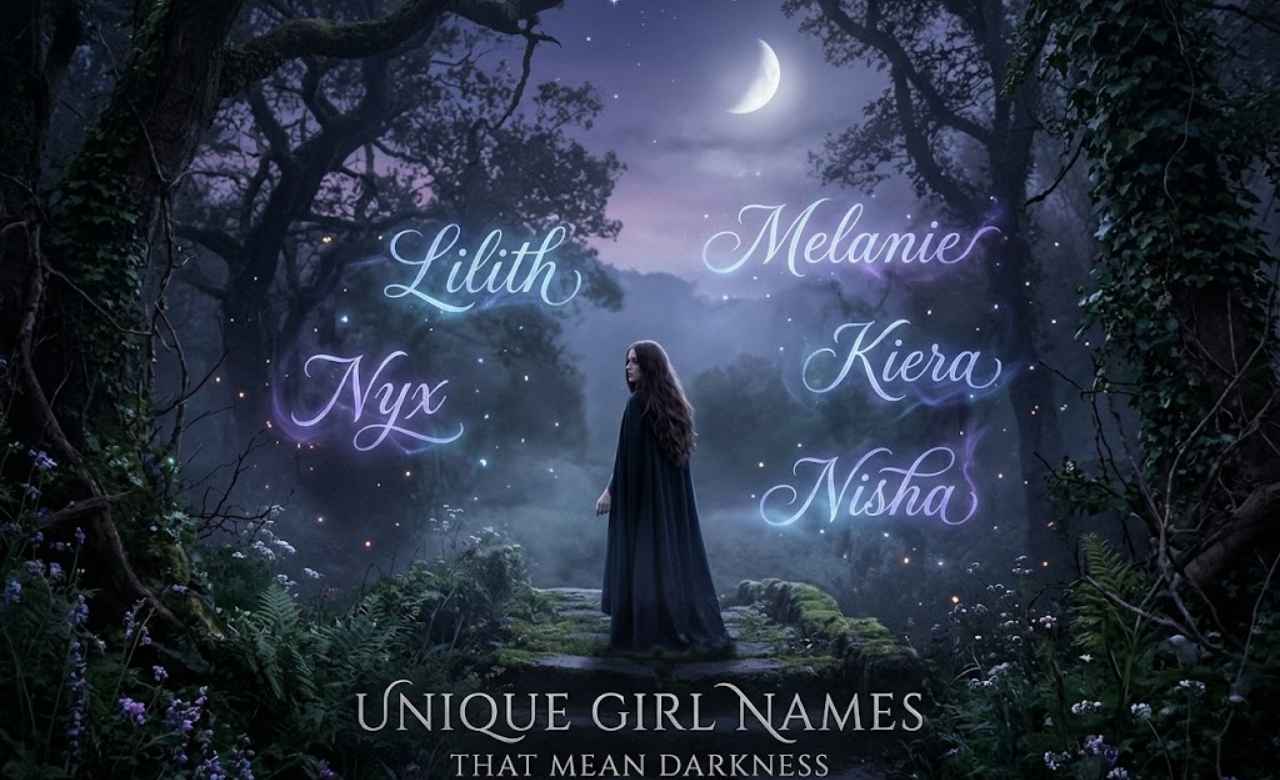
These rare girl names with dark meanings veer off the well-trodden path, relying on obscure dialects and historical terms to deliver deep obscurity.
- Blindheim (BLIND-hyme) — Old Norse. Derived from historical Scandinavian place-names meaning “the dark home” or “hidden dwelling,” perfect for a protagonist dwelling in secluded shadows.
- Carey (KAIR-ee) — Celtic. Originating from the Gaelic ciardha, this vintage gender-neutral moniker directly means “dark” or “black-featured.”
- Darthula (dar-THOO-luh) — Scottish Gaelic. Immortalized in James Macpherson’s Ossian poems, Darthula derives from Gaelic roots meaning “a woman with dark eyes” or “the silent one of the night.”
- Dusk (DUSK) — English. An underutilized nature word name describing the twilight boundary between sunset and midnight, capturing the exact moment light yields to dark.
- Kapuahela (kah-poo-uh-HEH-luh) — Hawaiian. A deeply atmospheric, compound Pacific name meaning “the dark, blooming twilight cloud.”
- Nox (NOKS) — Latin. The direct Roman equivalent of the Greek Nyx, Nox is the Latin word for night. It carries an austere, cinematic punch suited for speculative fiction or bold parents.
- Phaedra (FAY-druh) — Greek / Literary. While historically linked to “bright,” its classical tragic use in Euripides’ drama links the name forever to shadowed omens, consuming obsession, and lineage curses.
- Rajnish (rahj-NEESH) — Sanskrit. A traditional Indian name translating to “lord or ruler of the night,” occasionally used across progressive families for daughters.
- Sable (SAY-buhl) — Slavic / Old French. Referring to the luxurious small mammal with midnight fur, or used in heraldry to signify the absolute color black.
- Samon (SAH-mon) — Gaulish / Celtic. Related to Samhain, the ancient festival marking the onset of winter and the opening of the veil between the living and dead, translating to “the dark half of the year.”
- Tenebrae (TEN-eh-bray) — Latin. A direct translation of “shadows” or “darkness.” Historically, it refers to the Christian holy week service where candles are extinguished one by one until the room is plunged into complete obscurity.
- Zilla (ZIL-uh) — Hebrew. Meaning “shadow” or “shade,” Zilla offers a quirky, historical alternative to more common Hebrew names, carrying a crisp, mid-century retro charm.
Beautiful Girl Names That Mean Death
The concept of death does not have to evoke horror. Across many philosophies, death is a peaceful liberator, a dignified transition, or an elegant inevitability. These beautiful dark girl names honor mortality with striking lyricism.
- Ankou (AHN-koo) — Breton. Though traditionally a folkloric male figure who guides souls to the underworld, modern fantasy literature frequently uses this soft, melodious name for female reapers and spirit guides.
- Atropos (AT-roh-pohs) — Greek. The eldest of the Three Fates (Moirai), Atropos was known as “she who cannot be turned.” It was her golden shears that severed the thread of life, making her the ultimate arbiter of human death.
- Khalida (KHAH-lee-duh) — Arabic. Meaning “immortal” or “deathless.” By invoking the complete transcendence of bodily death, it frames mortality through its ultimate spiritual resolution.
- Libitina (lib-ih-TEE-nuh) — Latin. The ancient Roman goddess of funerals, death, and burial rites. Her name was synonymous with mortality itself; Roman undertakers were known colloquially as libitinarii.
- Macaria (muh-KAHR-ee-uh) — Greek. The daughter of Hades and Persephone, Macaria is the goddess of a “blessed death.” She represents a quiet, merciful end without agony or trauma, lending her name a deeply gentle, comforting beauty.
- Marzanna (mar-ZAHN-nah) — Slavic. The Polish and pan-Slavic goddess associated with winter’s death, agricultural renewal, and nightmares. Her springtime effigy is drowned or burned to clear away the dead cold and birth new crops.
- Morana (moh-RAH-nuh) — Czech / Slavic. A cognate of Marzanna, Morana literally derives from the Proto-Indo-European root *mor-, which gives rise to words like murder and mortality. She reigns as the queen of frost, winter, and death.
- Nirriti (neer-REE-tee) — Sanskrit. The Hindu goddess of death, decay, corruption, and the southwest direction. It translates conceptually to “destruction” or “the absence of order.”
- Omisha (oh-MEE-shuh) — Hindi. A lyrical feminine name meaning “goddess of life and death,” acknowledging the unified continuity of the two states.
- Shivani (shih-VAH-nee) — Sanskrit. The feminine form of Shiva, the supreme Hindu deity of transformation, dissolution, and cosmic destruction, representing the destruction of ego and physical forms to allow rebirth.
- Thanatia (thuh-NAY-shuh) — Invented / Neo-Latin. A modern feminine artistic invention derived directly from Thanatos, the ancient Greek personification of peaceful death.
- Vanth (VAHNTH) — Etruscan. A winged psychopomp demon in Etruscan underworld iconography who attended dying humans, gently opening the doorway to the afterlife with a torch and key.
Rare Girl Names That Mean Darkness or Death
If you want a name that will never be shared by a classmate or colleague, these rare baby names feature deep historical roots and vanishingly low popularity metrics.
- Charna (CHAR-nuh) — Yiddish. Directly translated from Slavic roots to mean “black” or “dark-complected.” A staple in pre-twentieth-century Eastern Europe that has faded from modern registries.
- Duskana (dus-KAH-nuh) — Literary Slavic. An evocative, forgotten name meaning “of the evening shadow” or “dimming twilight.”
- Erebusa (eh-reh-BOO-suh) — Invented / Classical Greek. A creative feminine adaptation of Erebus, the primordial Greek deity representing the deep darkness that filled the hollows of the underworld.
- Gethsemane (geth-SEM-uh-nee) — Aramaic. Translating to “oil press,” this biblical garden was the site of Christ’s Agony, betrayal, and impending death, cementing it as a name steeped in profound sacrifice and nocturnal sorrow.
- Kallikantzaros (kahl-ee-KANT-zuh-ros) — Greek Folklore. While historically referencing malevolent subterranean shadow creatures who surface during the winter solstice, its roots offer unique dark fantasy naming options.
- Melanthe (mel-AN-thee) — Greek. A gorgeous, neglected classical name formed from melas (dark, black) and anthos (flower), meaning “dark blossom” or “black flower.”
- Mictlancihuatl (meek-tlan-SEE-wahtl) — Nahuatl (Aztec). The Queen of Mictlan, the Aztec underworld. She watched over the bones of the dead and presided over the ancient festivals that evolved into the modern Día de los Muertos.
- Morriganne (mor-ee-GAN) — Archaic Celtic variant. A more formal, historicized spelling of the Phantom Queen of Irish battlefield lore.
- Perran (PEH-ruhn) — Cornish. Meaning “little dark one,” historically tied to Saint Piran, patron saint of tin miners who worked in subterranean darkness.
- Sciath (SKEE-uh) — Old Irish. Meaning “shadow,” “shield,” or “wing,” often used in ancient epics to describe warriors whose protective reach cast a deep shadow.
- Tamra (TAHM-ruh) — Hebrew. An alternative reading tied to “date palm,” but colloquially crossed in regional Semitic dialects with roots meaning “deep darkness” or “veiled.”
- Vesperina (ves-peh-REE-nuh) — Latin. An ultra-rare diminutive of Vespera, meaning “the gathering of dusk” or “the quiet shadows of the evening.”
Gothic Girl Names With Dark and Mysterious Meanings
The gothic aesthetic bridges Victorian romanticism, haunted architecture, graveyard poetry, and psychological mystery. Gothic baby girl names possess an undeniable architectural weight and melodramatic beauty.
- Bellatrix (BEL-uh-triks) — Latin. Translating to “female warrior,” this third-brightest star in the constellation Orion has become forever associated with dark, unhinged loyalty and gothic prestige through modern popular culture.
- Clarimonde (KLAIR-ee-mond) — Old French / Germanic. Meaning “shining protection,” it was immortalized in Théophile Gautier’s 19th-century gothic vampire story La Morte Amoureuse, linking the name forever to the elegant undead.
- Crimson (KRIM-zuhn) — English. A rich, blood-red color name that brings immediate gothic imagery of velvet cloaks, spilled wine, and vampiric folklore.
- Drusilla (droo-SIL-uh) — Ancient Roman / Latin. Derived from the Roman cognomen Drusus, meaning “strong” or “dew-eyed,” but culturally coded as dark, aristocratic, and gothic through historical scandals and Victorian vampire fiction.
- Elvira (el-VEER-uh) — Spanish / Germanic. Meaning “all true” or “white, fair,” the moniker was permanently redefined by the 1980s horror icon, turning it into the definitive name for campy, witty gothic elegance.
- Lenore (leh-NOR) — Greek / Literary. A variant of Eleanor (“bright”), this name was dragged into eternal gothic gloom by Edgar Allan Poe’s mournful masterpiece The Raven, representing a lost, saintly maiden mourned in the dead of winter.
- Morticia (mor-TISH-uh) — Literary. Coined by cartoonist Charles Addams from the word mortician (which traces to Latin mors, meaning death). Morticia has evolved into the gold standard of maternal gothic poise, sensuality, and domestic devotion to the macabre.
- Ophelia (oh-FEEL-ee-uh) — Greek. Meaning “help” or “succor,” Ophelia is eternally anchored to Shakespeare’s tragic heroine in Hamlet, who drowns wrapped in wild flowers—a quintessential symbol of Pre-Raphaelite melancholy and gothic romance.
- Raven (RAY-vuhn) — Old English. Directly referencing the intelligent, black-feathered corvid associated with carrion fields, prophecy, and nocturnal omens.
- Rowena (roh-EE-nuh) — Old German / Welsh. Meaning “fame and joy,” but popularized across gothic literature (notably Poe’s Ligeia) as an icy, aristocratic figure wrapped in psychological terror.
- Wednesday (WENZ-day) — Old English. Meaning “Woden’s Day” (named after Odin, god of war, wisdom, and death). The Addams Family child cemented it as the ultimate deadpan, darkly gifted aesthetic name.
Powerful Female Names That Mean Death or Destruction
When you need a name that projects authority and strength, these fierce feminine names evoke gods of war, bringers of doom, and unrelenting storms.
- Alecto (uh-LEK-toh) — Greek. One of the three Erinyes (Furies), her name means “unceasing,” “implacable,” or “the angry one.” Her role was to punish moral crimes committed against humanity with unrelenting mental torment.
- Bellona (buh-LOH-nuh) — Latin. The ancient Roman goddess of war, devastation, and bloodshed, preceding Mars in early cults. Her name derives directly from bellum (war).
- Bregenz (BREH-genz) — Celtic. An ancient regional name signifying a high, fortified position, associated with warrior women who defended mountain outposts to the bitter death.
- Deianira (day-uh-NY-ruh) — Greek. The wife of Heracles whose name translates literally to “man-destroyer” or “destroyer of her husband,” having inadvertently killed the demigod with the poisoned shirt of Nessus.
- Enyo (en-EYE-oh) — Greek. An ancient goddess of warfare and destruction, called the “waster of cities” and closely companioning Ares in classical battle accounts.
- Hulda (HOOL-duh) — Old Norse / Germanic. Meaning “hidden” or “secret.” In early Germanic folklore, Hulda leads the Wild Hunt, sweeping up the souls of the dead across the stormy winter sky.
- Kali (KAH-lee) — Sanskrit. The fierce Hindu mother goddess of ultimate time, change, destruction, and preservation. Her fierce depiction trampling ignorance with a garland of skulls makes this one of the most powerful female names on Earth.
- Maeve (MAYV) — Old Irish. Meaning “she who intoxicates.” The legendary warrior Queen of Connacht led catastrophic invasions and demanded the death of kings, embodying untamed destructive royalty.
- Medea (meh-DEE-uh) — Greek. Meaning “cunning” or “to ponder.” The tragic sorceress of Colchis used deadly poisons and ruthless vengeance to annihilate anyone who betrayed her oaths.
- Nemesis (NEM-eh-sis) — Greek. The winged goddess of divine retribution, justice, and unavoidable ruin. Her name means “distribution of what is due” or “righteous indignation.”
- Sekhmet (SEK-met) — Ancient Egyptian. The lioness-headed goddess of the scorching midday sun, plagues, war, and absolute destruction. Her name translates to “the powerful female one.”
- Tisiphone (tih-SIF-oh-nee) — Greek. Another of the Furies, Tisiphone translates specifically to “avenger of murder.” She guarded the iron gates of Tartarus, lashing the damned with serpents.
Girl Names That Mean Shadow or Darkness
Shadow names occupy a distinctive niche: they do not necessarily imply malice, but rather protection, coolness, subtlety, and quiet shelter from blinding light.
- Amaris (uh-MAH-ris) — Hebrew. Traditionally translated as “given by God,” modern naming registries frequently pair it with regional Arabic cognates meaning “moon’s shadow” or “child of the moon.”
- Chhaya (CHAH-yah) — Sanskrit. The Hindu personification of shadow and the consort of Surya, the sun god. She was created to protect her mistress from the sun’s unbearable heat, embodying comforting, protective shade.
- Darcie / Darcy (DAR-see) — Norman French. Derived from the French place-name d’Arcy, which traces back to linguistic roots meaning “dark” or “from the dark fortress.”
- Ereba (eh-REE-buh) — Greek. A modern feminine derivation of Erebus, designating the primordial subterranean shadow that sits beneath the surface of the world.
- Hamutal (hah-moo-TAHL) — Hebrew. Mentioned in the Old Testament, it translates poetically to “shadow of my father-in-law” or “protective dew against the heat.”
- Keara (KEER-ah) — Irish. A variant of Kiera, meaning “little shadow” or “dark-complected one.”
- Mohagany (muh-HOG-uh-nee) — Spanish / Caribbean. An earthy, rich English word name describing the dark, dense, shadowed wood favored in gothic architecture.
- Ombretta (om-BRET-tuh) — Italian. A rare, charming Italian diminutive derived directly from ombra, meaning “little shadow” or “cooling shade.”
- Sayeh (sah-YEH) — Persian. A graceful, minimalist Iranian name translating literally to “shadow” or “protective shade.”
- Senka (SEN-kuh) — Serbian / Slavic. A widely loved Balkan name meaning “shadow,” carrying an aura of quiet mystery and physical agility.
- Umbra (OOM-bruh) — Latin. The scientific and classical term for the darkest, innermost core of a shadow, especially during a complete solar eclipse.
- Zilpah (ZIL-pah) — Hebrew. An Old Testament name meaning “a dropping,” “frailty,” or in colloquial dialects, “a passing shadow.”
Girl Names That Mean Dark Moon or Night
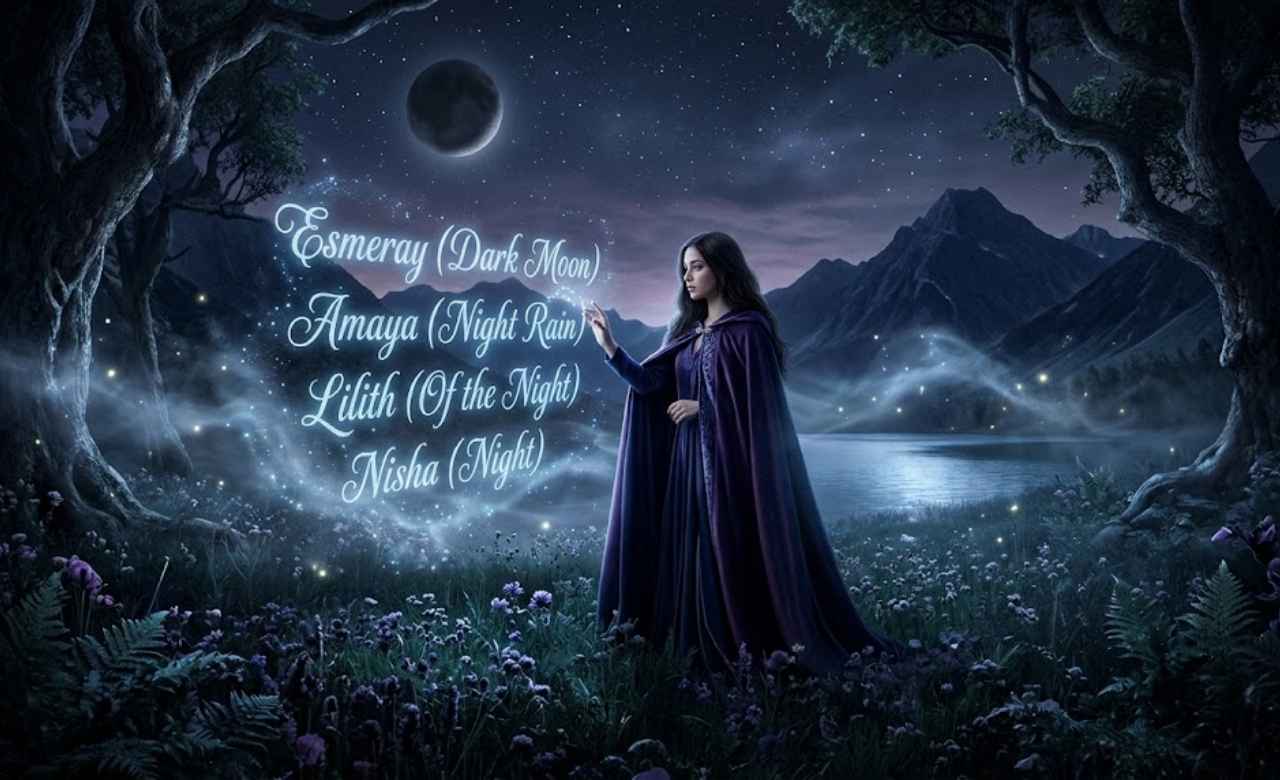
Night names hold a romantic, celestial magnetism. Rather than looking up at bright midday skies, these monikers celebrate the moonlit firmament, obsidian horizons, and nocturnal dreams.
- Ajambo (ah-JAHM-boh) — Luo (East Africa). A rhythmic, classic cultural name bestowed upon an infant girl born specifically during the late hours of the night.
- Altair (al-TY-er) — Arabic. While literally meaning “the flying bird,” this bright navigational star is tied historically to ancient nocturnal desert crossings under velvet black skies.
- Anumati (ah-noo-MAH-tee) — Sanskrit. The Hindu lunar deity representing the delicate crescent phase when the moon slips toward absolute darkness.
- Esmeray (EZ-meh-rye) — Turkish. Esmer (dark) + Ay (moon). Translates directly to “dark moon,” making it one of the most stunning celestial names in existence.
- Hesperia (hes-PEER-ee-uh) — Greek. Derived from hesperos, meaning “evening” or “of the setting sun,” referencing the mythical nymphs of the evening light.
- Ilta (EEL-tuh) — Finnish. A clean, modern Scandinavian name meaning “evening,” capturing the crystalline, silent nights of the far north.
- Layla / Leila (LAY-luh) — Arabic. Originating from the Semitic root L-Y-L, Layla means “night” or “dark beauty,” historically describing the intoxication of a deeply black desert evening.
- Nisha (NEE-shuh) — Sanskrit. A traditional, deeply popular Indian name meaning simply “night,” often associated with quiet wisdom and calm meditation.
- Noxolo (nok-SOH-loh) — Xhosa (South Africa). While incorporating the root for “peace,” the prefix rhythmically mirrors nocturnal lullabies sung under southern night skies.
- Nyx (NIKS) — Greek. The undisputed sovereign of the nocturnal cosmos, representing night before stars or earth were formed.
- Rhiannon (ree-AN-uhn) — Welsh. Translating to “Great Queen,” she is tied in the Mabinogi to otherworld birds that wake the dead and lull the living to night-sleep.
- Selena / Selene (suh-LEE-nuh) — Greek. The classical Titan goddess of the physical moon driving her chariot across dark celestial expanses.
Girl Names That Mean Dark Angel
The concept of a “dark angel” marries divine celestial elegance with shadow, rebellion, and subterranean grief. These names are suited for characters or babies meant to carry an aura of otherworldly fallen majesty.
- Abaddon (uh-BAD-on) — Hebrew. While historically a masculine entity or place meaning “ruin” or “destruction” (the angel of the abyss in Revelation), modern dark fantasy authors frequently repurpose it for imposing female angelic commanders.
- Azira (uh-ZEER-uh) — Invented / Semitic. A sleek feminine derivation of Azrael, the traditional Angel of Death across Abrahamic faiths whose duty is to sever the soul from the body.
- Dina (DEE-nuh) — Hebrew. In esoteric angelology, Dina is considered an angelic guardian of wisdom and learning who emerged from primordial obscurity.
- Lailah (LY-luh) — Hebrew / Arabic folklore. In Rabbinic traditions, Lailah is an angel in charge of the night, conception, and the unconscious mind, serving as the quiet celestial midwife of mortal souls.
- Muriel (MYOOR-ee-uhl) — Celtic / Greek. Meaning “sparkling sea,” but designated in occult angelology as the ruler of the deep, shadowed waters of the emotional unconscious.
- Raziel (RAH-zee-el) — Hebrew. Meaning “secret of God.” An archangel who stands close to the curtain separating light from ultimate shadow, keeping the primordial occult mysteries.
- Sariel (SAIR-ee-el) — Hebrew. An angel associated with lunar cycles, death, and straying souls, often numbered among the fallen watchers who loved mortality.
- Seraphina (sair-uh-FEE-nuh) — Hebrew. Meaning “burning ones.” While high-ranking celestial beings of pure fire, their terrifying six-winged biblical forms evoke cosmic dread rather than gentle sweetness.
Girl Names That Mean Darkness and Love
The intersection of darkness and love yields deep romance. These names reflect passion that flourishes in the dark, devotion that defies the grave, and beauty found in shadowed corners.
- Amethyst (AM-eh-thist) — Greek. The violet-black gemstone historically worn to ward against intoxication, dark passions, and emotional madness.
- Calypsa (kuh-LIP-suh) — Greek. A variant of Calypso, meaning “she who conceals” or “hides.” The nymph who loved Odysseus in her shadowed, hidden island grotto for seven years.
- Dionne (dee-ON) — Greek. The mother of Aphrodite in Homeric tradition, whose name links divine oceanic darkness with the origins of romantic passion.
- Erosia (eh-ROH-see-uh) — Greek. A creative feminine construction derived from Eros, the god of passionate, often destructive and blinding romantic love.
- Kerensa (keh-REN-zuh) — Cornish. A charming Celtic name meaning “love” or “affection,” traditionally given to children born during the dark, brooding winter months.
- Maitea (my-TAY-uh) — Basque. Meaning “beloved” or “darling,” carrying the ancient, shadowed weight of mountainous Basque linguistic heritage.
- Morrigan (MOR-ih-gahn) — Irish. While a war goddess, her myths are bound up with fierce sexual sovereignty, loving her chosen champions with an intensity that brings either victory or glorious death.
- Phaedra (FAY-druh) — Greek. A tragic figure whose doomed, dark romantic passion consumed kingdoms, making her an enduring symbol of love entangled with fatality.
- Vashti (VASH-tye) — Persian. Meaning “beautiful” or “best,” Queen Vashti chose exile and darkness over humiliating herself for her husband’s court, linking love of self to defiant solitude.
Girl Names That Mean Pain, Sorrow, or Suffering
These names carry an emotional gravity. Historically bestowed to commemorate a difficult childbirth, a period of national mourning, or to guard a child against arrogance, names meaning pain and sorrow offer dramatic weight.
- Brenna (BREN-uh) — Irish / Norse. Derived from Celtic roots for “raven” or “sorrow,” and Norse roots for “sword” or “burning fire.”
- Bronagh / Brónach (BROH-nuh) — Irish. Originating from the Gaelic brón, this ancient Irish name translates cleanly to “sorrowful” or “grief-stricken.” Saint Brónach was a 6th-century holy woman who tended to shipwrecked sailors.
- Claudia (KLAW-dee-uh) — Latin. Deriving from claudus, meaning “lame,” “crippled,” or “struggling with pain.” It remains a patrician Roman classic with an underlying bittersweet edge.
- Deirdre (DEER-dree) — Irish. The tragic heroine of Irish mythology whose breathtaking beauty was prophesied to bring war, slaughter, and exile. It translates etymologically to “sorrowful,” “broken-hearted,” or “raging.”
- Dolores (doh-LOR-es) — Spanish. Derived from Nuestra Señora de los Dolores (“Our Lady of Sorrows”), referring to the spiritual agony and pierced heart of the Virgin Mary.
- Kalonice (kal-oh-NY-see) — Greek. Translating to “beauty’s victory,” though associated in classical theater with the pain and sacrifice required to end widespread war.
- Lachrymosa (lak-rih-MOH-suh) — Latin. Directly meaning “weeping” or “tearful,” this word titles the section of the Catholic Requiem Mass describing the day of tears when the dead rise for judgment.
- Lorelei (LOR-uh-lye) — German. From the Rhine river rock where a heartbroken siren’s mournful songs lured fishermen to shipwreck and watery graves.
- Malou (mah-LOO) — French. A compound of Marie and Louise, carrying the Hebrew meaning of Mary (“bitter” / “sea of sorrow”) alongside the Germanic “famous warrior.”
- Tristesse (tree-STES) — French. The literal French word for “sadness” or “melancholy,” offering an ornate, poetic sound for an emotionally heavy concept.
Read more:What Does “ ” Mean in Text? Meaning, Hidden Messages & Examples Explained
Girl Names That Mean Rebirth, Death, or New Beginnings
Death is rarely a static finality; across spiritual systems, it serves as the necessary compost for new life. These names embody the ouroboros—the cyclical journey through death, transformation, and dawn.
- Anastasia (an-uh-STAY-zhuh) — Greek. Derived from anastasis, meaning “resurrection” or “she who will rise again,” inherently requiring the passage through physical death to achieve glory.
- Chrysalis (KRIS-uh-lis) — Greek. The pupal stage of a butterfly, where the caterpillar undergoes total cellular dissolution—a biological death—to reform into a winged creature.
- Eos (EE-os) — Greek. The Titan goddess of the dawn, who daily tears open the shroud of blackest night to rebirth the golden daylight.
- Fenix / Phoenix (FEE-niks) — Greek. The mythical firebird that lives for centuries, combusts into ash upon death, and is resurrected anew from its own charred remains.
- Kore (KOR-ee) — Greek. Meaning “maiden.” The original title of Persephone before she tasted the pomegranate seed in Hades’ realm and transformed into the iron-willed Queen of the Underworld.
- Rhea (REE-uh) — Greek. The mother of the Olympian gods, representing the flow of time and generational succession where old regimes die to let new eras breathe.
- Renata (reh-NAH-tuh) — Latin. A classic Italian, Spanish, and Slavic name meaning literally “reborn” or “born again.”
- Zora (ZOR-uh) — Slavic. Meaning “dawn” or “aurora,” marking the precise transformation where midnight is shattered by the return of light.
Girl Names That Mean Black, Raven, or Midnight
These visually descriptive names draw directly from the color black, the ink of midnight, and the obsidian feathers of the corvid family.
- Branwen (BRAN-wen) — Welsh. Formed from brân (raven) and gwen (fair, blessed), meaning “blessed raven.” A prominent, tragic figure in Welsh heroic myth.
- Colley (KOL-ee) — Old English. Meaning “dark-haired” or “black like coal,” tracing back to archaic terms for soot and charcoal.
- Corvina (kor-VEEN-uh) — Latin. The elegant feminine derivation of corvus, meaning “raven.” It evokes gothic grace and keen intelligence.
- Feather (FETH-er) — English. An artistic nature name evoking the glossy, iridescent down of black crows and nocturnal birds of prey.
- Jett (JET) — English. Referring to the velvety black gemstone formed from fossilized coal, historically used in Victorian mourning jewelry.
- Kalyani (kahl-YAH-nee) — Sanskrit. Meaning “auspicious” or “black,” often applied as a sacred epithet to Kali in her role as protector.
- Melanie (MEL-uh-nee) — Greek. Derived from melas, the ancient Greek word for “black” or “dark,” widely used across Europe for centuries.
- Merle (MURL) — French. Meaning “blackbird,” deriving from the Latin merula, capturing a quiet, rustic darkness.
- Midnight (MID-nyte) — English. A bold, modern word name designating the witching hour—the darkest threshold of the clock.
- Onyx (ON-iks) — Greek. Referring to the deep, banded black stone favored in amulets and talismans designed to absorb negative energy.
- Sable (SAY-buhl) — Slavic. Denoting the deep, lustrous black fur of the marten, used heraldically for the pitch-black tincture.
Mysterious Girl Names Inspired by the Underworld
The underworld across mythologies is not merely a place of punishment; it is a hidden subterranean court of precious metals, quiet rest, and primal judgment. These underworld names carry chthonic mystique.
- Avernus (uh-VUR-nus) — Latin. The crater lake near Naples believed by Romans to be the physical entrance to the Underworld, named for its dark vapors.
- Ereshkigal (air-ESH-kee-gahl) — Sumerian. The ancient Mesopotamian Queen of the Great Below (Irkalla). She ruled the subterranean land of the dead long before classical myths were recorded.
- Hadesa (huh-DEE-suh) — Invented / Neo-Classical. A feminine interpretation of Hades, god of the unseen realm and subterranean riches.
- Helia (HEE-lee-uh) — Norse / Greek hybrid. Borrowed as a feminine echo of Hel, the vast subterranean realm where those who die of illness or old age dwell.
- Inferna (in-FUR-nuh) — Latin. Meaning “that which lies below” or “subterranean realm,” carrying an imposing architectural weight.
- Proserpina (proh-SUR-pih-nuh) — Latin. The Roman equivalent of Persephone, derived from proserpere (“to emerge”), referencing the underworld seeds that force their way through dark soil.
- Tartara (TAHR-tuh-ruh) — Greek. A feminine literary construction inspired by Tartarus, the abyss beneath the underworld reserved for Titans and divine punishment.
Female Names Associated With Death Goddesses
Across every pantheon, death goddesses held supreme authority. They did not answer to mortal kings; they reaped champions, wove fate, and washed the bodies of the fallen.
- Cailleach (KY-lakh) — Scottish / Irish Gaelic. The ancient divine hag of winter, stone, and bitter cold. She reshapes the land with her staff and ushers in the annual death of plant life.
- Freyja (FRAY-uh) — Old Norse. Though widely celebrated for love and beauty, Freyja is fundamentally a death goddess: she receives the first half of all fallen warriors into her meadow, Fólkvangr, leaving the remainder to Odin.
- Hela (HEH-luh) — Old Norse. The daughter of Loki, half her face is living flesh and half is decayed bone. She rules the vast underworld realm of the quiet dead.
- Ixtab (eesh-TAHB) — Maya. The ancient Yucatec Maya goddess associated with the souls of those who met noble, self-inflicted, or sacrificial ends.
- Maman Brigitte (mah-MAHN bree-ZHEET) — Haitian Vodou. The Loa of death and graveyards, wife of Baron Samedi. She watches over gravestones and guards cemetery gates with fierce justice.
- Mania (MAY-nee-uh) — Etruscan / Roman. The ancient goddess of the dead, spirits, and nocturnal frights, ruler of the manes (souls of ancestors).
- Morana (moh-RAH-nuh) — Slavic. The sovereign ruler of winter, plague, and mortality across Eastern European pantheons.
- Oya (OH-yah) — Yoruba. The fierce Orisha of winds, lightning, violent storms, and rebirth, who stands as the guardian of the cemetery gates.
- Pele (PEH-lay) — Hawaiian. The volcanic goddess of fire, lightning, dance, and creative destruction, who annihilates forests with molten rock to create new land.
Greek Girl Names That Mean Darkness or Death
The Greeks treated the transition between life and death with unmatched philosophical and poetic nuance. Their language provides foundational terms for our vocabulary of shadow.
- Acantha (uh-KAN-thuh) — Greek. Meaning “thorn” or “prickle.” In myth, a nymph who scratched Apollo’s face when he tried to assault her, transforming into a sharp, shadowed thistle.
- Achlys (AHK-liss) — Greek. The mist of death and sorrow that falls upon the eyes of dying soldiers.
- Circe (SUR-see) — Greek. Meaning “bird of prey.” The legendary witch-goddess of Aeaea who turned men into beasts using shadowed herbal concoctions.
- Hecate (HEK-uh-tee) — Greek. Goddess of magic, crossroads, ghosts, and the moon, who roamed the night with howling hounds.
- Ker (KAIR) — Greek. The singular root of the Keres, embodying catastrophic battlefield death.
- Melinoe (mel-IN-oh-ee) — Greek. The nymph-goddess of ghosts, nightmares, and mental anguish, who rose nightly from the underworld with limbs half-black and half-white.
- Nyx (NIKS) — Greek. The primordial embodiment of night.
- Persephone (per-SEF-uh-nee) — Greek. Bringer of destruction and Queen of the Dead.
Japanese Girl Names Associated With Darkness or Death
In Japanese naming customs, the meanings of names depend heavily on the specific kanji chosen. The following names combine traditional aesthetic kanji with themes of darkness, night, and winter quietude.
- Chiyo (CHEE-yoh) — Japanese. While typically meaning “a thousand generations,” when paired with alternative historical kanji, it references the deep, shadowy lineage of an ancient house.
- Kuriko (koo-REE-koh) — Japanese. Composed of kuri (which can evoke dark chestnut tones) and ko (child), conveying a sense of earthy, shadowed subtlety.
- Miyako (mee-YAH-koh) — Japanese. By selecting kanji like 夜 (night) and 子 (child), it translates to “night child,” evoking calm evening grace.
- Saki (SAH-kee) — Japanese. Using kanji combinations that evoke the dark bloom of a winter flower opening in the cold.
- Sayuri (sah-YOO-ree) — Japanese. Often meaning “little lily,” but in gothic subcultures written with kanji signifying a flower blossoming in darkness.
- Yoriko (YOH-ree-koh) — Japanese. Written with 夜 (night) and 子 (child), this classic name literally translates to “child of the night.”
- Yoru (YOH-roo) — Japanese. The direct Japanese word for “night” or “darkness.” A striking, minimalist modern gender-neutral choice.
Latin Girl Names Associated With Death and Darkness
Latin remains the primary tongue of law, anatomy, and Catholic funeral liturgy. It possesses an austere, architectural balance that lends authority to dark names.
- Caligo (kuh-LEE-goh) — Latin. Meaning “fog,” “mist,” “gloom,” or “the darkness of the underworld.”
- Funerea (foo-NEH-ree-uh) — Latin. The direct root of funeral, describing mourning trees and solemn rites.
- Mortana (mor-TAH-nuh) — Neo-Latin. An artistic construction from mors (death), echoing ancient funerary poetry.
- Nox (NOKS) — Latin. The primordial night.
- Obscura (ob-SKYOOR-uh) — Latin. Meaning “dark,” “shrouded,” or “hidden from view.”
- Tenebris (TEN-eh-bris) — Latin. The direct dative/ablative form of tenebrae, meaning “in the shadows” or “from darkness.”
- Vespera (VES-peh-ruh) — Latin. The evening star and the descent of dusk.
Celtic and Irish Girl Names With Dark Meanings
Celtic traditions view winter and night as the starting points of the yearly cycle. Their languages are rich with words celebrating dark features, stormy skies, and phantom queens.
- Ciara / Kiera (KEER-uh) — Irish. “The dark one” or “black-haired.”
- Darcy (DAR-see) — Irish / Gaelic. From Ó Dorchaidhe, meaning “descendant of the dark one.”
- Deirdre (DEER-dree) — Irish. “Sorrowful” or “broken-hearted.”
- Doon (DOON) — Scottish Gaelic. Meaning “dark fortress” or “from the shadowy hill.”
- Kerry (KEHR-ee) — Irish. Derived from Ciarraí, meaning “people of the dark ancestor (Ciar).”
- Morrigan (MOR-ih-gahn) — Irish. The Great Phantom Queen of war and fate.
- Treasa (TRAH-suh) — Irish. Meaning “strength,” but historically linked in folklore with harsh winters and dark storms.
Norse and Viking Girl Names Inspired by Death and Mythology
Viking worldviews were clear-eyed regarding fate and mortality. Doom (Ragnarok) was inescapable, and valor was measured by standing unflinchingly in the face of death.
- Astrild (AS-trild) — Old Norse. A minor mythological figure linked with intense, battle-tested love.
- Brunhilde (BROON-hild) — Old Norse / Germanic. Meaning “armor of battle.” The leader of the Valkyries who selected which slain warriors earned a place in the halls of the afterlife.
- Gerd (GAIRD) — Old Norse. Meaning “enclosure.” A frost giantess connected to the cold, barren subterranean earth before spring.
- Hel / Hela (HEH-luh) — Old Norse. Sovereign ruler of the hidden realm of the dead.
- Rán (RAHN) — Old Norse. The sea goddess who cast a great net to drag drowning sailors down to her shadowed ocean floor.
- Skadi (SKAH-dee) — Old Norse. The jotun-goddess of winter, mountains, hunting, and shadow, whose name traces etymologically to “shade” or “damage.”
- Valkyrie (val-KEER-ee) — Old Norse. Meaning “chooser of the slain,” the supernatural maidens who escorted souls from the battlefield.
Biblical Girl Names Associated With Darkness or Death
While scripture celebrates light, its most profound literary moments unfold in desert shadows, nocturnal revelations, and valleys of grief.
- Damaris (DAM-uh-ris) — Greek / Hebrew. Mentioned in Acts, her name traces to “calf” or “to tame,” often linked in regional folklore with silent mourning.
- Delilah (deh-LY-luh) — Hebrew. Meaning “delicate” or “night,” the Philistine woman whose cunning dismantled Samson’s strength in the shadowed chambers of Sorek.
- Jezebel (JEZ-uh-bel) — Phoenician / Hebrew. Meaning “unexalted” or “where is the prince?” A queen whose tragic, violent death cemented her name as a symbol of defiance.
- Lilith (LIL-ith) — Hebrew. The nocturnal screecher of Isaiah 34:14, later understood as the original rebel of Eden.
- Mara (MAH-ruh) — Hebrew. Naomi’s self-chosen moniker: “Call me Mara, for the Almighty has dealt very bitterly with me.”
- Orpah (OR-puh) — Hebrew. Meaning “back of the neck,” representing the daughter-in-law who turned back into the shadowed lands of Moab.
- Salome (suh-LOH-may) — Hebrew. Though derived from shalom (peace), the New Testament Salome is permanently tied to the macabre execution of John the Baptist.
Arabic Girl Names That Mean Night or Darkness
Arabic poetry possesses an unparalleled, reverent vocabulary for the desert night, which brought cool relief, privacy, star-guided travel, and spiritual peace.
- Asma (AZ-mah) — Arabic. Meaning “sublime” or “dark-hued,” celebrating the rich complexion of beauty.
- Duha (DOO-huh) — Arabic. Mentioned in the Quran to describe morning light, often paired with the blackness of night (Layl) to express spiritual duality.
- Ghadir (gah-DEER) — Arabic. Meaning “dark, still pool of water.”
- Laila / Layla (LAY-luh) — Arabic. “Night” or “nocturnal intoxication.”
- Layal (ly-AHL) — Arabic. The plural form of Layla, meaning “nights.”
- Nayla (NAY-luh) — Arabic. A name signifying attainment, traditionally paired with quiet, midnight efforts.
- Reem (REEM) — Arabic. A pure white gazelle, frequently celebrated by classical poets for its contrast against the black sands of the desert night.
Mythological Girl Names Connected to Death and the Afterlife
These mythical female names belong to figures who held court where light ended and eternity began.
- Amenti (uh-MEN-tee) — Ancient Egyptian. The hidden western horizon where the sun set, serving as the dwelling place of the deceased.
- Carna (KAR-nuh) — Roman. The goddess who protected physical human organs, particularly the heart and intestines, against night-demons that drained life.
- Ereshkigal (air-ESH-kee-gahl) — Sumerian. Supreme Queen of the underworld.
- Macaria (muh-KAHR-ee-uh) — Greek. The blessed daughter of Hades granting merciful death.
- Mictlancihuatl (meek-tlan-SEE-wahtl) — Aztec. The skeletal lady of the dead.
- Nephthys (NEF-this) — Ancient Egyptian. Goddess of mourning, the night, and embalming, who stood vigil at the heads of caskets.
- Sedna (SED-nuh) — Inuit. Goddess of the icy sea floor and mistress of the underworld (Adlivun), born from sacrifice.
Fantasy Girl Names With Dark and Magical Meanings
For authors, dungeon masters, and game developers, dark fantasy female names must sound organic within speculative worlds while carrying authentic linguistic roots.
- Aethelgard (ATH-uhl-gard) — Old English. “Noble shadow-fortress.”
- Belladonna (bel-uh-DON-uh) — Italian. Meaning “beautiful lady,” the botanical name for deadly nightshade.
- Cimmeria (sih-MEER-ee-uh) — Greek / Literary. The mythical land of perpetual mist and darkness described by Homer.
- Drakoria (druh-KOR-ee-uh) — Invented. An imposing fantasy title evoking dragons, black scales, and volcanic stone.
- Maleficent (muh-LEF-ih-sent) — Latin. Meaning “doing evil” or “working harm,” immortalized as dark fairy royalty.
- Morgath (MOR-gath) — Invented / Sindarin inspired. Echoing Tolkien’s roots for darkness, blackness, and iron.
- Necra (NEK-ruh) — Greek derivative. A direct feminine offshoot of nekros, the Greek word for corpse.
- Shadowind (SHAD-oh-wind) — Invented. A swift, untraceable assassin moniker for stealth characters.
- Vespereth (VES-per-eth) — Invented. Combining the Latin vesper (evening) with an archaic fantasy suffix.
Witchy and Gothic Girl Names for Dark Fantasy Characters
Witchy girl names evoke herbalism, midnight rituals, bone charms, and moon magic. These selections are tuned for dark fantasy literature.
- Agatha (AG-uh-thuh) — Greek. “Good,” though stamped with witchy associations through historical folklore and literature.
- Circe (SUR-see) — Greek. The arch-sorceress of Greek myth.
- Endora (en-DOR-uh) — Hebrew. Inspired by the biblical Witch of Endor who summoned the spirit of the prophet Samuel.
- Grimalkin (grim-AL-kin) — Old English. A historical name for a witch’s cat familiar, evoking grey mists and subtle cunning.
- Hecate (HEK-uh-tee) — Greek. The patron goddess of all witches.
- Lamia (LAY-mee-uh) — Greek. A child-devouring monster and night-specter in Greek folklore.
- Prudence (PROO-dens) — Latin. “Caution,” a puritanical virtue name adopted by gothic literature for stern young spellcasters.
- Sabrina (suh-BREE-nuh) — Celtic. A water nymph name permanently linked to modern occult fiction.
- Tabitha (TAB-ih-thuh) — Aramaic. Meaning “gazelle,” an enduring mid-century and historical witch name.
Short Girl Names With Dark and Powerful Meanings
Sometimes a single syllable packs more force than a four-syllable classical moniker. These short girl names with dark meanings are punchy, memorable, and sharp.
- Ash (ASH) — English. The grey residue left behind after total destruction by fire.
- Blake (BLAYK) — Old English. An paradoxical name that historically meant both “pale” and “pitch black” (blæc).
- Cole (KOHL) — Old English. Meaning “charcoal” or “swarthy.”
- Crow (KROH) — English. A sharp, direct corvid name tied to omens and intelligence.
- Gloom (GLOOM) — Middle English. Meaning deep darkness or melancholic atmosphere.
- Jett (JET) — English. Polished black coal.
- Kear (KEER) — Irish. Short form of Kiera (“dark”).
- Mab (MAB) — Celtic. Queen of the nocturnal trickster fairies who brings dreams.
- Nox (NOKS) — Latin. Night.
- Nyx (NIKS) — Greek. Primordial night.
- Shade (SHAYD) — English. Dimness produced by the shelter of shadow, or a wandering ghost.
- Vail / Vale (VAYL) — English. A valley, evoking the “valley of the shadow of death.”
Cute Girl Names With Mysterious or Dark Meanings
Not every dark name needs to sound severe. These monikers sound approachable, playful, and sweet, yet conceal surprisingly dark etymologies.
- Darcy (DAR-see) — French. A bouncy, vintage name that literally translates to “from the dark fortress.”
- Kiki (KEE-kee) — Japanese / Multi-origin. Cute and bright to the ear, but can incorporate Japanese kanji for “crisis” or “danger.”
- Lola (LOH-luh) — Spanish. A sweet, mid-century diminutive of Dolores (“sorrows and pain”).
- Mallory (MAL-uh-ree) — Norman French. Meaning “unfortunate,” “unlucky,” or “ill-fated.”
- Mara (MAH-ruh) — Hebrew. Soft and friendly, yet translating directly to “bitter” or “nightmare.”
- Melanie (MEL-uh-nee) — Greek. A cheerful playground staple that literally means “pitch black.”
- Perrin (PEH-rin) — Cornish. A jaunty, approachable name meaning “little dark one.”
- Sasha (SAH-shuh) — Russian. Meaning “defender of mankind,” linked to bloody wartime defense.
- Zilla (ZIL-uh) — Hebrew. Upbeat and spirited, meaning “shadow.”
Old-Fashioned and Victorian Gothic Girl Names
Victorian Britain embraced a unique culture of mourning: jet jewelry, black crinoline dresses, memento mori hair lockets, and overgrown garden cemeteries. These vintage names reflect that melancholy.
- Agnes (AG-nis) — Greek. Meaning “pure,” popular during the Victorian era and linked with gothic ghost stories.
- Beatrice (BEE-uh-tris) — Latin. “She who brings happiness,” immortalized in Dante’s Inferno as his guide through the afterlife.
- Cordelia (kor-DEEL-ee-uh) — Celtic / Latin. The tragic, loyal daughter of King Lear whose unjustified death anchors Shakespearean sorrow.
- Edith (EE-dith) — Old English. Meaning “blessed in war,” a staple of drafty, haunted Victorian country estates.
- Evangeline (ee-VAN-juh-leen) — Greek. Meaning “bearer of good news,” popularized by Longfellow’s tragic poem of lifelong separation.
- Genevieve (JEN-eh-veev) — Celtic / Germanic. Meaning “tribe woman,” carrying a pale, shadowed, stained-glass presence.
- Hester (HES-ter) — Persian / Greek. A variant of Esther (“star”), stamped with gothic puritanical defiance in Nathaniel Hawthorne’s The Scarlet Letter.
- Maude (MAWD) — Old German. Meaning “battle-mighty,” carrying an unapologetic, velvet-curtained Victorian gravitas.
- Mildred (MIL-dred) — Old English. Meaning “gentle strength,” associated with austere institutional Gothic architecture.
- Victoria (vik-TOR-ee-uh) — Latin. Meaning “victory,” defined forever by Queen Victoria’s forty years of unrelenting black mourning dress.
How to Choose a Girl Name With a Dark Meaning
Selecting a name tied to darkness, mortality, or night requires deliberate thought. Whether naming a newborn child or an original fictional character, use this strategic framework to guide your decision:
1. Balance the Literal Meaning with Phonetic Softness
If a name carries a heavy meaning (like “sorrow,” “death,” or “destruction”), pairing it with soft phonetic elements (such as liquid consonants like l, m, r, and open vowels) keeps it wearable. Names like Amaya (“night rain”) or Macaria (“merciful death”) sound gentle while retaining their thematic depth.
2. Verify Etymological Accuracy
The internet is full of invented baby name meanings. Many sites claim names mean “dark angel” or “death princess” when they are fabricated fantasy inventions. Always cross-reference a name against reliable historical resources, Greek lexicons, Gaelic dictionaries, or Latin roots.
Tip: If you invent a fantasy name for a book, build it from real roots (such as the Latin
mort-or the Greekmelan-) to ensure it sounds linguistically plausible.
3. Consider Daily Wearability and Nickname Potential
If you choose a bold, historical, or mythological name for a baby, evaluate how it functions in real life:
- Can a young child pronounce it?
- Does it provide conventional nicknames for school, sports, and professional careers?
- Example: Bellatrix can be shortened to Bella or Trixie; Persephone can be shortened to Percy or Effie; Morrigan softens to Mora.
4. Understand Cultural Context and Sacred Boundaries
Certain death goddesses and underworld figures (such as Kali, Oya, or Maman Brigitte) remain deeply sacred deities within living religious traditions (Hinduism, West African Yoruba religion, Haitian Vodou). Respect the difference between an ancient pan-European mythic figure from an inactive cult (like Nyx or Atropos) and a living, venerated spiritual entity.
FAQS
What is a gothic name for a girl?
Popular gothic girl names include Lilith, Raven, Morticia, Nyx, and Belladonna, known for their mysterious, elegant, and dark aesthetic. These names are perfect for anyone drawn to gothic beauty, supernatural themes, and unusual names.
What is a dark fairy name?
Dark fairy names include Nyxara, Umbrelle, Morwen, Vespera, and Shadowelle, blending magical beauty with mysterious fantasy themes. Some are invented fantasy names inspired by shadows, moonlight, enchanted forests, and mystical creatures.
What is a devilish name for a girl?
Lilith, Lamia, Jezebel, and Hecate are popular choices for devilish girl names because of their associations with dark folklore, mythology, or supernatural themes. However, these names do not literally mean devil, and their cultural origins and meanings differ.
What is a mythical name for darkness?
Nyx is one of the most recognizable mythical names associated with darkness, representing the primordial goddess of night in Greek mythology. Other mythology-inspired choices include Erebus, associated with darkness, and Hecate, linked to magic, crossroads, and the night.
Conclusion
A beautiful name doesn’t always have to represent light, joy, or happiness. Sometimes, the most unforgettable names are inspired by shadows, midnight skies, ancient legends, and life’s greatest mysteries. From the mysterious Nyx and powerful Morrigan to the elegant Raven and enchanting Lilith, girl names that mean darkness or death offer a fascinating blend of beauty, strength, and symbolism.
Whether you’re exploring dark female names, searching for names that mean darkness female, or discovering rare female names meaning dark, there’s a wide variety of choices to match your style. Some names have direct meanings connected to night or shadows, while others are associated with death, transformation, and mythology.
The best name is one that feels meaningful to you. Take time to explore its origin, pronunciation, and cultural significance before making your choice. Whether you love gothic elegance, mythical inspiration, or names that mean night or darkness, choose something that tells a story worth remembering.
Which dark and mysterious girl name is your favorite? Share your pick in the comments. We’d love to know!

Welcome to NameInBible. I am Victoria, a Christian writer passionate about exploring biblical name meanings, Scripture-based insights, and powerful prayers. My goal is to help readers discover the spiritual significance of names and grow closer to God through faith-filled content.