
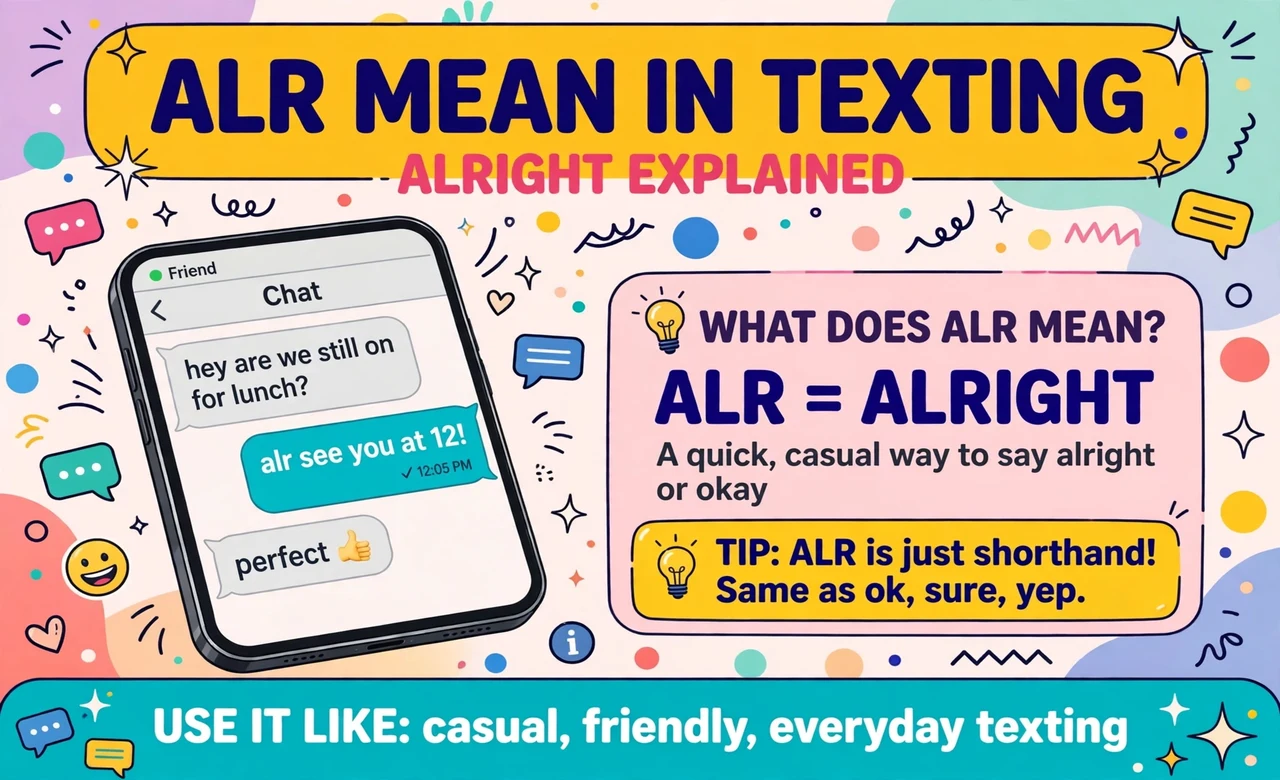
You receive a text saying “alr,” and suddenly you are wondering what the person really means. Are they agreeing with you, saying yes, or showing that they are annoyed? If you’ve been searching for the alr meaning, you’re not alone. This three-letter abbreviation is becoming increasingly popular in everyday texting, Snapchat conversations, and social media chats.
So, what does alr mean in text? In most cases, ALR is a shortened version of “alright.” People use it to express agreement, acknowledge a message, or confirm plans without typing the full word. However, understanding the alr meaning in text can sometimes depend on the conversation and context. Some people also use ALR as an already short form, although this meaning is less common.
In this guide, we’ll explain what does alr mean when texting, how people use it on different social media platforms, and whether it sounds friendly, rude, or dismissive. You’ll also discover real texting examples and the best ways to respond when someone sends you “alr.”
What Does ALR Mean in Texting?
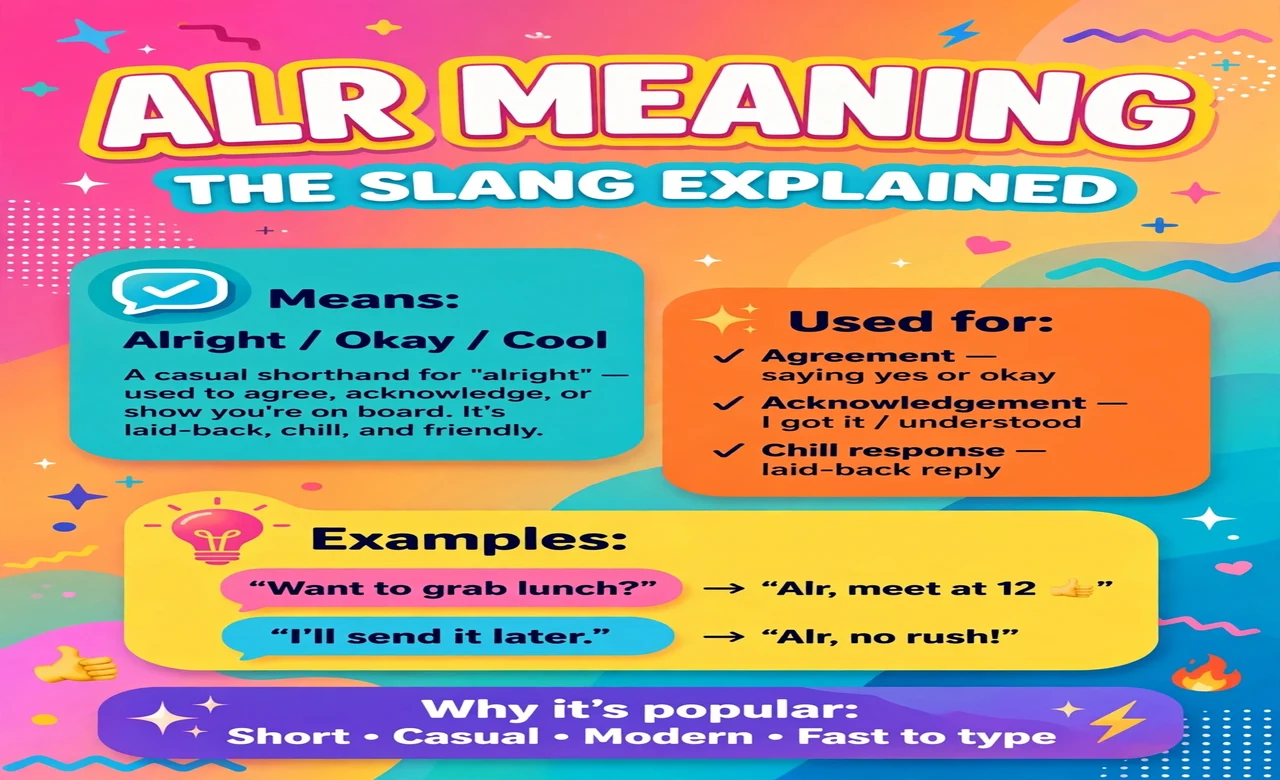
At its core, the ALR meaning in texting comes down to speed and convenience. It functions primarily as a phonetic, highly compressed abbreviation for the word “alright” (or the two-word phrase “all right”).
In today’s fast-paced digital messaging environment, full words are frequently stripped of their vowels and redundant consonants. Just as talk to you later turned into TTYL and by the way became BTW, alright was streamlined down to its dominant phonetic anchors: the initial A, the liquid consonant L, and the hard stop R.
A - L - R ===> AL - R - IGHT ===> "Alright"
When you see ALR pop up on your phone screen, the sender is almost always signaling acknowledgement, assent, or compliance. It is the conversational equivalent of giving a brisk head nod across a room.
ALR Meaning in Simple English
If you want the ALR meaning stripped of all technical jargon, it simply translates to:
- “Okay.”
- “Sounds good.”
- “Understood.”
- “Sure thing.”
- “I hear you.”
It is used as a functional bridge in everyday casual texting. Someone provides a piece of information, poses an update about their arrival time, or suggests a change in weekend plans, and the recipient shoots back ALR to confirm receipt of the message without stopping to compose a full, grammatical sentence.
Because modern smartphone keyboards come equipped with aggressive predictive text and swipe typing, single-syllable acknowledgments might seem unnecessary to abbreviate. Yet, within modern internet slang, three-letter acronyms like ALR are not just about typing speed—they represent a relaxed, low-effort social aesthetic. Sending an abbreviated reply tells the other person that the interaction is casual, ongoing, and requires zero formal ceremony.
What Does ALR Stand For in Text Messages?
In the vast majority of online conversations, ALR stands for “Alright”.
However, language is rarely static. Depending on sentence structure and conversational placement, ALR short form can occasionally substitute for “Already”.
| Full Word | Primary Text Shortcut | Secondary Shortcut | Typical Sentence Position |
| Alright / All right | ALR | Aight / Ight | Standalone reply or beginning of a clause |
| Already | ALR | Alrdy | Embedded mid-sentence or before a past-tense verb |
When ALR is dropped as a standalone, one-word reply, it almost universally stands for alright. When it is woven into the middle of an active sentence preceding an action, such as “I ALR did that,” its grammatical role shifts to already.
Recognizing which word the sender intends requires analyzing where the abbreviation sits within the flow of the dialogue, a distinction explored in depth later in this guide.
What Does ALR Mean on Snapchat, TikTok and Instagram?
While the baseline definition remains consistent, social media platforms cultivate their own micro-cultures. The unspoken etiquette of a private WhatsApp exchange with a family member is worlds apart from the comment section of a viral TikTok video or the ephemeral feed of Snapchat.
Understanding the nuance of ALR slang across platforms helps you avoid tone-deaf blunders in public feeds and private direct messages.
ALR Meaning on Snapchat
Snapchat is the native breeding ground for rapid-fire, visual-first communication. Between maintaining Snapstreaks, swapping casual self-erasing snaps, and coordinating immediate, real-world meetups, speed is the currency of the platform.
On Snapchat, the ALR meaning on Snapchat is driven by rapid transactional acknowledgement. Conversations on Snap are meant to be light, disposable, and continuous. Users do not sign off with formal farewells; they simply stop replying or drop a quick acknowledgment to let the other person know their snap was viewed.
Common scenarios where ALR appears on Snapchat include:
- Streak Maintenance: Responding to a daily snap when there is nothing substantive to say, but the streak must be preserved.
- Location & ETA Updates: A friend snaps their live location showing they are outside your house; you send back “alr coming down” to confirm you are on your way.
- Quick Plan Pivots: An invitation changes from meeting at 7:00 PM to 7:30 PM; a quick snap with text reading “alr bet” closes the loop instantly.
Because Snapchat users prioritize rapid-fire messaging, seeing ALR here carries minimal emotional weight. It is rarely analyzed for passive-aggression; it is simply accepted as a standard piece of shorthand efficiency.
ALR Meaning on TikTok
TikTok operates on an entirely different conversational plane. Here, communication happens primarily in public comment sections, creator video responses, and stitched reactions.
The ALR meaning on TikTok frequently takes on an ironic, exhausted, or humorous tone. Comment sections move fast, and TikTok users lean heavily into deadpan humor, dry reactions, and collective slang trends.
On TikTok, ALR is regularly deployed in situations such as:
- Reacting to Absurd Content: When a creator posts an unhinged cooking tutorial, a wild conspiracy theory, or an overly dramatic storytime, top comments will often read simply: “alr bro…” or “alr that’s enough internet for today.” In this context, ALR acts as an exasperated sigh, signaling that the viewer has seen enough.
- Yielding in Comment Arguments: When two users debate in the comments and one realizes the discussion is going nowhere, they may end the thread with “alr whatever you say.” It serves as a digital white flag—a way to disengage without formally admitting defeat.
- Validating Relatable Trends: When a POV (Point of View) video perfectly nails an awkward social interaction, viewers chime in with “alr this is way too accurate,” using the term to build community consensus around an observation.
How People Use ALR on Instagram and WhatsApp
On Instagram and WhatsApp, the context shifts from public performance back to interpersonal relationships, but each app brings its own distinct flavor.
Instagram (DMs and Stories)
Instagram Direct Messages (DMs) blend casual chatting with media sharing. Most conversations revolve around sharing reels, memes, and reacting to Instagram Stories.
When someone sends you a funny reel and you reply with “alr that actually got me,” ALR functions as an entry point to a shared laugh. Alternatively, when coordinating plans via Instagram DM, dropping an “alr sounds like a plan” keeps the conversation breezy without demanding deep emotional investment.
WhatsApp (Group Chats and Direct Messaging)
WhatsApp serves as the central communication hub across generations, bridging personal friends, family group chats, and semi-professional project teams. Because WhatsApp hosts older users alongside younger ones, ALR in WhatsApp can occasionally cause minor friction.
Among younger circles, WhatsApp group chats see ALR used constantly to confirm meeting locations, acknowledge shared media files, and validate announcements:
Participant A: "Meeting at the library at 4, don't be late."
Participant B: "Alr"
Participant C: "Alr see you there"
However, when texting parents or older colleagues on WhatsApp, deploying a standalone “alr” can read as cold or overly dismissive. Older demographics, accustomed to complete punctuation and traditional phrasing, may interpret three lowercase letters without an emoji as a sign that you are annoyed, irritated, or trying to shut down the conversation.
How to Use ALR in Everyday Text Conversations
Knowing what a slang term means is only half the battle; knowing how to integrate it naturally into your daily vernacular without sounding awkward is what matters. Modern texting language is delicate, and mastering how to wield ALR in text messages requires paying attention to context, sentence placement, and pacing.
ALR Meaning in Different Chat Situations
Because ALR is fundamentally an adaptable agreement term, its practical meaning flexes depending on the scenario in which it is used.
                  ┌── Affirmation: "Alr, sounds great!"
                  │
                  ├── Yielding: "Alr, fine, we'll do your idea."
ALR Contexts ─────┼── Pivot: "Alr, so what are we doing next?"
                  │
                  ├── Resignation: "Alr... guess I'm staying home."
                  │
                  └── Standalone: "Alr." (Neutral or Dry)
1. The Low-Stakes Confirmation
This is the most common use case. Someone shares administrative or logistical information that requires no debate.
- Example: “The movie starts at 8:15, so get your ticket online.”
- Response: “Alr, buying it now.”
- Intent: Direct, frictionless confirmation.
2. The Reluctant Agreement (Yielding)
When you do not necessarily agree with a decision, but you do not care enough to keep arguing, ALR acts as a soft concession.
- Example: “We really shouldn’t spend money on takeout tonight; we have food in the fridge.”
- Response: “Alr fine, let’s just cook.”
- Intent: Yielding ground to maintain peace.
3. The Conversational Pivot
ALR can serve as a verbal clearing of the throat, closing one subject and opening another.
- Example: “Alr, enough about work. Did you see the game last night?”
- Intent: Drawing a clean line under a completed topic to shift focus.
4. The Melodramatic Resignation
When paired with an ellipsis or a disappointed tone, ALR signals quiet discontent.
- Example: “Sorry, my mom said I can’t borrow the car tonight so I can’t pick you up.”
- Response: “Alr… guess we’re rescheduling then.”
- Intent: Voicing subtle frustration without launching a direct confrontation.
Real-Life Examples of ALR in Text Messages
To see how ALR functions across realistic messaging interfaces, examine these representative chat transcripts between friends, roommates, and romantic partners.
Scenario A: Casual Plan Coordination (Casual & Smooth)
Jordan: Yo, basketball courts are packed right now. Want to head to the park instead?
Sam: Alr, works for me. Give me 10 mins to grab my shoes.
Jordan: Bet. See you there.
Analysis: Here, Sam uses ALR at the very beginning of the sentence to quickly greenlight Jordan’s proposed change in venue. The tone is easygoing, cooperative, and engaged.
Scenario B: The Shared Living Room Check-in (Logistical Utility)
Maya: Hey, I’m stopping by the grocery store on my way home from the gym. Do we need milk?
Chris: Yeah, grab oat milk if they have it. Also some paper towels.
Maya: Alr, on it.
Analysis: Maya’s reply is short, direct, and completely free of fluff. In utilitarian roommate interactions, ALR functions as an efficient confirmation that instructions were received and are being executed.
Scenario C: Responding to a Change of Mind (Slight Disappointment)
Taylor: Hey, I’m honestly exhausted from work today. Mind if we skip dinner tonight and do this weekend instead?
Alex: alr.
Analysis: Notice the lack of capitalization and the presence of a hard period. Alex’s one-word response here will almost certainly be interpreted by Taylor as cold or hurt, even if Alex didn’t consciously mean to trigger an argument.
When Someone Replies ALR, What Should You Say?
Receiving a flat ALR as a response can sometimes bring a conversation to a screeching halt. How you choose to respond depends entirely on whether you need more information or if the exchange has naturally reached its conclusion.
When You Receive "ALR":
│
├── Was it confirming logistics? ─────> No reply needed (Conversation concluded)
│
├── Was it a standalone "alr."? ──────> Soft check-in: "Everything good?"
│
├── Did it open a new direction? ─────> Continue plan: "Sweet, meet you outside."
│
└── Do you need definitive input? ────> Ask directly: "Does that time actually work for you?"
If it was a purely logistical confirmation:
Do nothing. If you texted “I left the keys under the mat” and they responded “Alr,” the interaction is complete. There is no need to send an OK, a thumbs-up emoji, or an additional pleasantry. Let the conversation rest.
If the tone feels off or passive-aggressive:
If you delivered disappointing news and received an abrupt “alr” or “alr.”, you can test the waters with a low-pressure clarification:
- “You good with that, or would you rather pick another day?”
- “Just making sure you aren’t annoyed—we can totally stick to the original plan if you want.”
If they used it to confirm a collaborative plan:
Lock in the final details with a brief, warm closing:
- “Perfect, see you at 6.”
- “Sounds good, ping me when you’re close.”
Does ALR Mean Alright or Already?
One of the most frequent points of confusion regarding this abbreviation is the overlap between two very common English words: alright and already.
Because both words start with “al-” and feature an “r” sound early on, people frequently ask: Does ALR mean alright or already?
The short answer is that it can mean both, but context will virtually always tell you which one is intended.
                     ┌── Standalone: "Alr" ───────────────────────> "Alright"
                     │
                     ├── Preceding Verb: "I alr finished that" ───> "Already"
ALR Dual-Meaning ────┤
                     ├── Answering Question: "Alr, let's do it" ──> "Alright"
                     │
                     └── Time-Sensitive: "Are you alr there?" ────> "Already"
ALR as a Short Form of Alright
In roughly 85% to 90% of texting instances, ALR means alright.
It functions syntactically as an interjection or an adjective expressing approval, acceptance, or confirmation.
Look for these dead giveaways that ALR means alright:
- It stands completely on its own: If the text message contains only the word “ALR”, it is 100% substituting for alright. No one answers a question with the standalone word already.
- It starts a sentence followed by a comma: “Alr, let me think about it.”
- It replaces “OK” directly: If you can swap the letters ALR with the word “OK” and the sentence makes complete grammatical sense, it means alright.
| Sentence Example | Swap Test (Replace with “OK”) | Meaning |
| “ALR, see you soon.” | “OK, see you soon.” (Makes sense) | Alright |
| “Is everything ALR with you?” | “Is everything OK with you?” (Makes sense) | Alright |
| “ALR then, have fun.” | “OK then, have fun.” (Makes sense) | Alright |
Can ALR Also Stand for Already?
Yes, ALR can certainly stand for already, particularly among speed-texters who drop middle vowels across all adverbs.
However, when ALR stands for already, it functions as an adverb modifying an action, an adjective, or a point in time. It almost never appears as an isolated reply.
Look for these structural markers that indicate ALR means already:
- It is sandwiched between a pronoun and a past-tense verb:“I alr ate dinner, so don’t order for me.” (I already ate dinner).
- It modifies a completed state or status:“Are you alr in line for tickets?” (Are you already in line).
- It describes an ongoing condition:“He’s alr complaining about the movie and it just started.” (He is already complaining).
Context Test:
"I alr told him no."
  └─ Can you replace "alr" with "alright"?  ==> "I alright told him no." (Nonsense)
  └─ Can you replace "alr" with "already"?  ==> "I already told him no." (Correct)
If you ever encounter an ambiguous sentence where both words could theoretically fit, the surrounding conversation will immediately clarify the intent. But as a rule of thumb: replies = alright; sentences describing completed actions = already.
ALR Meaning in Different Contexts and Situations
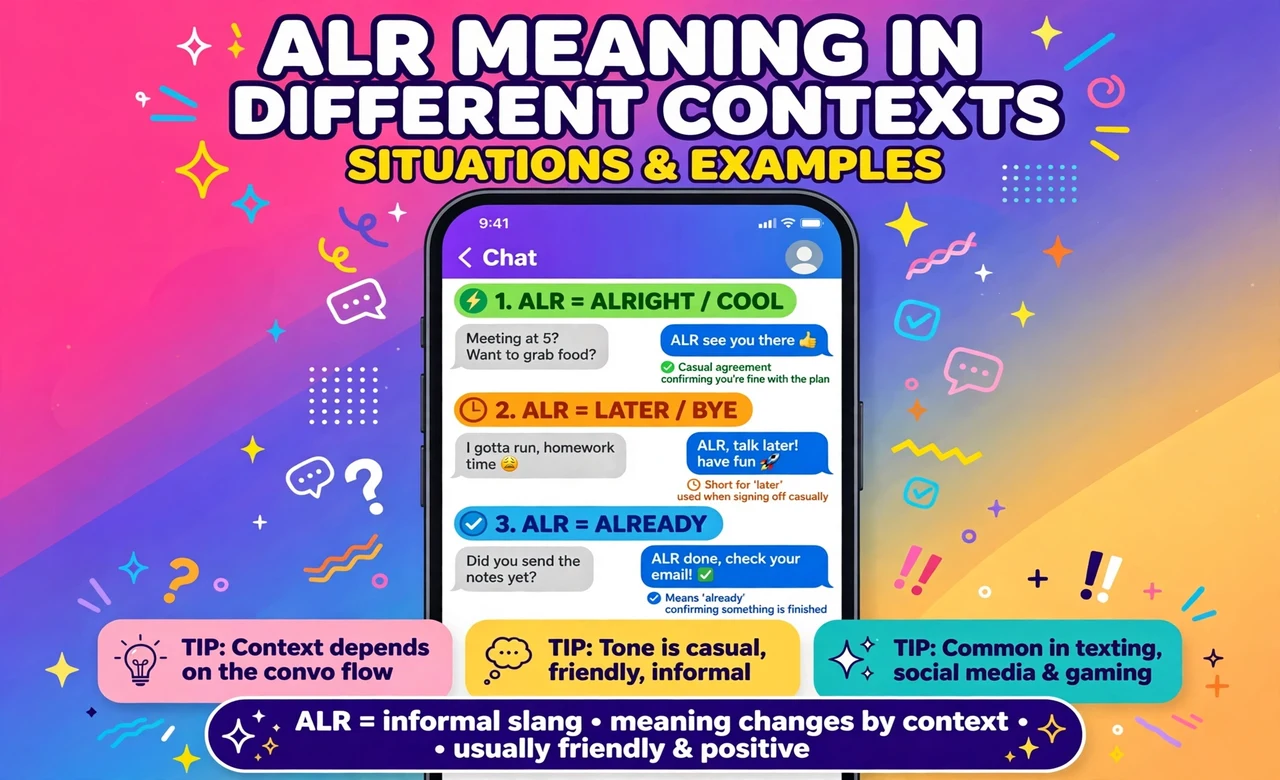
No slang term lives in an emotional vacuum. The social fabric between the people texting fundamentally defines how words are processed. What feels warm and familiar between childhood friends can feel jarring, dismissive, or downright rude when exchanged with an employer or a romantic interest.
ALR Meaning Between Friends
Between close friends, ALR is comfortable, frictionless shorthand. It signals that there is enough built-in trust and familiarity that you don’t need to put on a performance of politeness.
When your close friend texts:
“Hey, bringing my brother along to the gym with us.”
“Alr cool”
There is zero anxiety attached to that exchange. Both parties understand that the relationship is secure. The brief response is simply a rapid, low-friction acknowledgement that allows both of you to keep moving through your day.
In casual peer groups, brevity is often a sign of closeness rather than distance. You don’t write structured paragraphs to your best friends for simple confirmations; you use abbreviations because you communicate constantly.
ALR Meaning in Casual and Online Conversations
In online communities, gaming servers, and general social feeds, ALR is a universal social lubricant.
Gaming Chats (Discord, Steam, Console Parties)
During fast-paced multiplayer gaming sessions (like Call of Duty, Valorant, or Fortnite), players cannot afford to take their fingers off controls to type out lengthy responses. In team text channels, ALR is constantly used to acknowledge callouts:
- “Drop weapons at B” $\rightarrow$ “alr”
- “Pushing right flank in 5 seconds” $\rightarrow$ “alr bet”
In this environment, ALR indicates focus and shared tactical understanding.
Dating Apps (Tinder, Hinge, Bumble)
On dating apps, conversational investment is the metric by which people evaluate interest. Because of this dynamic, using ALR on a dating app can be risky.
If someone you matched with asks you what you like to do on weekends, and you respond with bare, abbreviated fragments, it signals low effort. However, if you are simply confirming the date’s logistical details:
- “I reserved a table for 7:30 under my name.”
- “Alr perfect, see you tonight!”
Here, pairing ALR with an exclamation mark and an enthusiastic word like “perfect” keeps the interaction positive and forward-moving.
ALR Meaning in Professional Communication
Here is the golden rule of workplace communication: Never use ALR in professional correspondence.
Whether you are communicating over company email, Slack, Microsoft Teams, or direct SMS with a client or manager, abbreviations like ALR look careless, overly casual, and unprofessional.
Workplace Communication Matrix:
┌─────────────────────────┬──────────────────────────────────────────────┐
│ What You Might Text     │ What You Should Say in Slack / Professional  │
├─────────────────────────┼──────────────────────────────────────────────┤
│ "alr"                   │ "Understood, will do."                       │
│ "alr got it"            │ "Received, thank you for the update."        │
│ "alr sounds good"       │ "Sounds good, I'll review this shortly."     │
│ "alr fine"              │ "Understood. We will proceed with that plan."│
└─────────────────────────┴──────────────────────────────────────────────┘
In a corporate or professional setting, brevity without standard punctuation often reads as incompetence or disrespect. Even in relaxed startup environments where emojis and GIFs are welcome, core workflow acknowledgments should remain clear, complete, and polished. Stick to standard business English: “Understood,” “Will do,” or “Sounds good.”
Is ALR Rude, Dry or Disrespectful in Texting?
The short answer: It can be, but it depends entirely on how it is styled.
Text messaging lacks the vocal inflections, facial expressions, and body language that human beings rely on to decode emotional intent. Consequently, short text replies suffer from a psychological phenomenon known as the negative bias of digital text—recipients naturally assume a flat, unembellished response is more negative than the sender intended.
Tone Spectrum of "ALR":
[ Warm & Energetic ] ───────────────────────────────> [ Cold & Dismissive ]
"alr!! sounds great"    "alr cool 😊"    "alr"    "alr..."    "alr."
Does ALR Sound Like Someone Is Annoyed?
When delivered as a solitary, unadorned response, ALR frequently reads as “dry” or passive-aggressive.
Consider the difference between these two interactions:
Person A: “I just found out I have to stay late at the office tonight, so I’m not going to make it to your dinner party. I’m really sorry!”
Person B: “No worries at all! Thanks for letting me know, we’ll hang out this weekend instead.”
Now, swap Person B’s response with a single word:
Person B: “alr”
In the second scenario, the recipient will instantly wonder:
- Are they mad at me?
- Are they giving me the silent treatment?
- Did I ruin their evening?
A standalone ALR shuts down conversation. It offers no conversational hook for the other person to respond to, signaling either emotional exhaustion, irritation, or an active desire to end the dialogue.
If someone repeatedly answers your thoughtful, multi-sentence messages with just “alr”, they are sending a clear behavioral signal: they either lack the time to talk to you right now, or they are mentally checking out of the interaction.
How Punctuation and Emojis Change ALR’s Tone
Punctuation and emojis act as the digital stand-ins for facial expressions and tone of voice. Modifying ALR with small visual cues can flip its meaning from hostile to warm in an instant.
         ┌── "alr."    ──> Finality, annoyance, cold boundary
         │
         ├── "alr..."  ──> Reluctance, skepticism, trailing off
ALR Tone ┼── "alr!"    ──> Cheerful, cooperative agreement
         │
         ├── "alr 😂"  ──> Amused, playful concession
         │
         └── "alr 👍"  ──> Efficient, neutral-positive sign-off
1. The Period: “alr.”
Adding a period to a one-word slang response is the ultimate digital cold shoulder. In informal texting culture, periods at the end of single-word messages are rarely used for grammar; they are used for emphasis. A period transforms ALR into a hard boundary, signaling anger, resentment, or abrupt dismissal.
2. The Ellipsis: “alr…”
An ellipsis suggests words left unsaid. It implies hesitance, suspicion, or doubt. If you tell a friend a wild excuse for why you didn’t call them, and they reply with “alr…”, it translates directly to: “I don’t believe you, but I’m not going to waste energy arguing about it.”
3. The Exclamation Mark: “alr!”
An exclamation mark injects genuine enthusiasm. It strips away all possible ambiguity and tells the reader that you are happy to agree or help out.
4. Paired with Emojis: “alr 👍” or “alr sounds good 🙌”
Emojis provide instant emotional context. Adding a simple thumbs-up, a laughing crying face, or a peace sign immediately clarifies your mindset and protects against accidental misunderstandings.
ALR vs. Other Popular Texting Abbreviations
The internet is packed with interchangeable ways to express agreement and acknowledgement. To truly understand where ALR fits within the modern vernacular, it helps to compare it directly against its closest linguistic cousins.
                  Casual / Friendly
                         │
        "aight"          │          "alr"
                         │
Slang ───────────────────┼─────────────────── Traditional
                         │
         "bet"           │       "alright" / "OK"
                         │
                  Harsh / Direct
                         │
                        "K"
ALR vs. Alright
- ALR: Highly casual, fast, informal, and vowel-stripped. Best reserved for casual texting, social media comments, and peers.
- Alright: Standard English, universally accepted, polite, and neutral. Appropriate for all audiences, including parents, managers, and formal correspondence.
The takeaway: Use “alright” whenever you want to be completely certain your tone isn’t misinterpreted. Use “ALR” when speed and casual rapport are already established.
ALR vs. Aight (or Ight)
- Aight / Ight: A phonetic spelling of African American Vernacular English (AAVE) that became widely adopted across global internet culture decades ago. It carries a distinctly relaxed, rhythmic tone. It conveys not just acknowledgement, but a certain level of coolness or contentment.
- ALR: A mechanical, consonant-focused acronym created purely for keyboard efficiency. It feels more utilitarian and less distinctly vocalized than aight.
The takeaway: Aight sounds more conversational and spoken; ALR looks and feels like pure text shorthand.
ALR vs. Bet
- Bet: An enthusiastic slang term meaning “yes,” “deal,” or “challenge accepted.” Saying bet indicates active investment, agreement, and excitement about a plan.
- ALR: A neutral acknowledgment. It merely confirms you heard what was said.
Comparison:
Friend: "I got us VIP passes for the concert tonight!"
Response A: "Alr"  ==> Underwhelming, flat, almost rude given the exciting news.
Response B: "Bet!" ==> Perfectly matched excitement and shared enthusiasm.
The takeaway: Use bet when you want to show excitement or seal an agreement with energy; use ALR when the topic is mundane and strictly operational.
ALR vs. K and OK
- OK: The timeless, gold-standard acknowledgment. While occasionally perceived as slightly dry by younger Gen Z texters when spelled in all-caps without an emoji, it remains largely neutral.
- K: The undisputed heavyweight champion of dismissive text responses. Sending a standalone single letter K is widely recognized across every generation as an intentional brush-off or an indicator of anger.
- ALR: Falls comfortably between OK and K. It is more casual than OK, but significantly less aggressive and hostile than the dreaded single-letter K.
Why Is ALR So Popular Among Gen Z?
Every generation develops its own distinct slang ecosystem. Baby Boomers had their workplace jargon, Gen X perfected cynical sarcasm, Millennials popularized early web acronyms like ROFL, FTW, and BRB, and Gen Z slang has reshaped modern text communication into a minimalist, hyper-efficient dialect.
Why did ALR specifically rise to such widespread prominence among Gen Z users?
1. The Drive Toward Extreme Linguistic Efficiency
Gen Z does not remember a world without smartphones. Growing up with constant, ubiquitous digital connectivity means that texting is not a dedicated activity—it is a continuous background thread running throughout their entire day.
When you send hundreds of messages daily across multiple platforms, saving micro-seconds on repetitive keystrokes matters. Stripping the word alright down to three keystrokes on a phone keyboard aligns perfectly with this high-frequency messaging lifestyle.
2. Aesthetic Minimalism and “Lowercase Texting”
A noticeable trend in Gen Z digital culture is the deliberate abandonment of standard capitalization and aggressive punctuation. Autocorrect and capitalized first letters can sometimes feel too rigid, performative, or overly formal.
Abbreviating words into clean, aesthetic lowercase clusters (like idk, rn, tbh, and alr) reflects an easygoing, unbothered posture. It signals that the sender is calm, relaxed, and not overthinking the interaction.
3. The Influence of High-Speed Social Algorithms
The explosion of platforms like TikTok and Twitch created fast-scrolling live streams and viral feeds where hundreds of comments flash past screen displays every second. In a live Twitch chat or a TikTok stream, brevity is the only way to get your thoughts seen before the scroll takes them away. Short forms like ALR flourished in these high-velocity digital arenas before migrating seamlessly into private SMS and messaging apps.
Other Meanings of ALR Outside Texting
While alright dominates text messages and social apps, ALR is an established acronym across several specialized professional industries. If you encounter ALR in an academic journal, a hospital chart, a financial report, or a home theater specification guide, it carries an entirely different definition.
                               ┌── Medical: Aldose Reductase
                               │
                               ├── Law: American Law Reports
Other Meanings of "ALR" ───────┼── Banking: Accounting & Regulatory Reporting
                               │
                               └── Technology: Ambient Light Rejecting (Screens)
ALR Meaning in Medical Terminology
In medicine, biosciences, and clinical research, ALR most commonly stands for Aldose Reductase.
- Aldose Reductase (ALR): An enzyme that plays a critical role in the polyol pathway of glucose metabolism. It catalyzes the reduction of glucose to sorbitol. In diabetic patients, hyper-activation of aldose reductase is heavily studied because the accumulation of sorbitol is directly linked to chronic complications such as diabetic neuropathy, retinopathy (eye damage), and cataracts.
- Autosomal Recessive / Acute Locomotor Reflex: In genetics and neurology, ALR may occasionally be used in specialized chart notes to describe specific inheritance patterns or rapid motor responses.
ALR Meaning in Banking and Finance
Within corporate finance, commercial banking, and institutional investment, ALR typically refers to regulatory frameworks and credit evaluation.
- Accounting and Legislative Reporting / Asset-Liability Reporting: Financial institutions must maintain rigorous balance-sheet equilibrium to protect against liquidity shortfalls. ALR often designates reporting systems that track assets versus liabilities across different maturity dates.
- Application Loss Ratio: In insurance underwriting and consumer credit evaluation, ALR can refer to the metric tracking projected claim or default losses against incoming applicant volume.
ALR Meaning in Law
In the legal profession, ALR holds a prestigious and historically significant meaning: American Law Reports.
- American Law Reports (A.L.R.): A leading legal reference publication series widely utilized by attorneys, judges, and legal scholars across the United States. Published by Thomson Reuters, ALR provides exhaustive, in-depth annotations and analytical essays on specific points of federal and state law.
- Rather than simply printing case decisions, an ALR annotation collects, analyzes, and synthesizes all judicial opinions across every jurisdiction related to a narrow legal question, serving as a fundamental research tool for legal briefs and court arguments.
Read more:DSL Meaning in Text: What It Stands For on Social Media in 2027
ALR Meaning in Projectors and Technology
If you are researching home theaters, audiovisual equipment, or consumer electronics, ALR stands for Ambient Light Rejecting.
- Ambient Light Rejecting (ALR) Screens: A specialized optical projection screen designed specifically to prevent overhead lighting and daylight from washing out a projected image. ALR screens use micro-grooves, multi-layered reflective coatings, and optical filters to reflect light originating from the projector directly toward the viewer, while absorbing or redirecting ambient light coming from windows or ceiling lamps. This allows vibrant, high-contrast viewing even in bright living rooms without blackout curtains.
10. Common Mistakes to Avoid When Using ALR
Because text abbreviations seem simple on the surface, people often deploy them without considering how subtle execution errors alter their meaning. Avoiding these four common pitfalls will keep your messaging clear and socially calibrated.
Common ALR Mistakes:
1. Capitalizing as "ALR" in casual chats  ──> Looks angry or like a technical system code
2. Using it with authority figures        ──> Reads as lazy, unprofessional, or disrespectful
3. Dropping a standalone "alr."           ──> Signals irritation and passive aggression
4. Forgetting context clues for "already" ──> Creates confusing, disjointed sentences
Mistake 1: Typing it in All-Caps (“ALR”)
In digital culture, capital letters equal shouting. While typing alr in lowercase reads as relaxed and informal, writing “ALR” in all-caps makes you look startled, frustrated, or aggressive. Unless you are intentionally exaggerating a reaction (“ALR CALM DOWN”), stick to lowercase.
Mistake 2: Using it with Bosses, Clients, or Professors
Sending a text containing alr to your boss when they ask you to work an extra shift or cover an account does not make you look relaxed—it makes you look indifferent and careless. Always gauge the hierarchical dynamic of the relationship. When in doubt, write out complete words in professional contexts.
Mistake 3: The Standalone Period Trap
As discussed, pairing alr with a hard period creates an icy, dismissive tone. Unless you are actively trying to tell the recipient that you are upset and do not want to speak to them further, leave the period off single-word acknowledgements.
Mistake 4: Overusing it as a Conversational Crutch
If your half of a conversation consists exclusively of alr, cool, ok, and lol, you become exhausting to talk to. Good conversations require reciprocal effort. Use ALR to handle rapid logistics, but contribute substantive thoughts when someone is trying to build a genuine personal connection.
11. When Should You Use ALR and When Should You Avoid It?
To help you make the right choice across every text, DM, and email, use this operational decision framework before typing out ALR.
Clear Situations Where You SHOULD Use ALR
✅ Quick confirmations between established friends
✅ High-velocity multiplayer video game text chats
✅ Fast-moving direct messages on Snapchat, Instagram, or TikTok
✅ Acknowledging non-critical updates (e.g., "be there in 5")
✅ Casual social media comments and humorous reaction threads
✅ Embedded as shorthand for "already" in rapid personal texts
Critical Situations Where You Should AVOID ALR
❌ Formal emails, work Slack workspaces, and professional Teams chats
❌ Serious emotional conversations or resolving relationship conflicts
❌ Communicating with older relatives unfamiliar with internet slang
❌ Expressing condolences, apologies, or serious personal reflections
❌ High-stakes client, customer, or academic interactions
❌ Anytime a single-word reply could be misinterpreted as passive-aggressive
Frequently Asked Questions About ALR
What does ALR mean from a girl?
When a girl texts you ALR, its meaning depends entirely on the surrounding context and punctuation. If she sends “alr sounds fun!” or “alr see you at 8 😊”, she is expressing cheerful, genuine agreement. However, if she sends a standalone, lowercase “alr” or an icy “alr.” after an argument, a late reply, or a canceled plan, it is a textbook sign of annoyance, disappointment, or emotional withdrawal.
What does ALR mean from a guy?
When a guy texts ALR, it is usually literal, straightforward, and pragmatic. Guys frequently use abbreviations simply to confirm information with minimal effort. In most instances, a guy sending “alr” simply means “understood” or “sounds good,” with no hidden subtext or hidden passive-aggression intended, especially when coordinating plans or sports.
Is ALR rude or disrespectful?
ALR is not inherently rude, but it easily becomes disrespectful if used in the wrong setting. Sending it to an employer, a teacher, or someone opening up about an important personal matter reads as uncaring and dismissive. In casual texting between friends, it is completely acceptable, provided it isn’t punctuated to look cold.
How do you respond to ALR?
If ALR was sent to confirm a plan (like “alr see you there”), no response is necessary. If someone sent a cold, standalone “alr” after you delivered disappointing news, you can reply with a gentle check-in, such as: “Are you good with that, or would you prefer a different plan?”
Does ALR mean already or alright?
It means both, but alright is far more common (making up roughly 90% of usage). If it appears as an isolated answer to a question, it always means alright. If it sits before a past-tense action verb (e.g., “I alr finished my homework”), it means already.
What is the difference between ALR and OK?
OK is a universally understood, century-old standard term accepted in both casual and professional environments. ALR is modern, vowel-stripped internet slang predominantly used by younger generations in casual digital channels. While OK is emotionally neutral, an unembellished ALR can carry more casual warmth between peers or sharper perceived dryness if mismanaged.
The Bottom Line on ALR
Digital shorthand exists to make communication faster, but language is never just about letters on a screen—it is about tone, empathy, and social calibration.
At its simplest, ALR means “alright.” It is a fast, efficient tool that keeps modern chats moving without slowing down your day. Used thoughtfully among friends, in gaming lobbies, and across social apps like Snapchat and TikTok, it is a natural part of contemporary texting culture.
Keep it casual, keep it in lowercase, watch your punctuation when things get sensitive, and keep it far away from your professional life. Master those simple rules, and you will never have to second-guess three simple letters in your inbox again.
Frequently Asked Questions
1. What does ALR mean in texting?
ALR usually stands for “alright” in text messages and online conversations. People use it to show agreement, confirm plans, or acknowledge something quickly.
2. Does ALR also mean “already”?
Yes, some people use ALR as a shortened form of “already,” but this usage is less common. The surrounding sentence usually makes the intended meaning clear.
3. How do you abbreviate “already”?
“Already” is commonly shortened to “alrdy” in informal texting. Some people also use “alr,” but it can be confused with “alright.”
4. Is ALR alright?
Yes, ALR is a common informal abbreviation for “alright.” It works well in casual chats with friends but is best avoided in professional emails and formal communication.
Final Thoughts on ALR Meaning in Text
Understanding the alr meaning makes modern texting a little easier. In most conversations, ALR simply means “alright.” People use it as a quick way to agree, acknowledge messages, confirm plans, or keep conversations moving. Whether you see it on Snapchat, TikTok, WhatsApp, or Instagram, its meaning usually stays the same.
Now you know what does alr mean in text and how to understand it in different situations. Remember that tone, punctuation, and context can change how a short reply feels. Although ALR can sometimes be used as an already short form, “alright” remains its most common meaning.
The next time someone texts you “alr,” you won’t have to guess. Just read the conversation, understand the context, and reply naturally.

Welcome to NameInBible. I am Victoria, a Christian writer passionate about exploring biblical name meanings, Scripture-based insights, and powerful prayers. My goal is to help readers discover the spiritual significance of names and grow closer to God through faith-filled content.
1 thought on “What Does ALR Mean in Text? Slang Meaning, Context & Real Examples (2027)”