
Have you ever wondered if your image of God comes from the Bible or from tradition, movies, and popular culture? Many people believe they know God, yet their understanding is often shaped by human ideas rather than Scripture. The biblically accurate God is far greater than any picture the human mind can create. He is the eternal Creator, the Holy One, and the loving Savior who reveals Himself through His Word, not through imagination. If you truly want to know who God is, you must begin where He has chosen to reveal Himself the Bible.
In this comprehensive guide, we’ll uncover the truth about the biblically accurate, Bible accurate God, and biblical accurate God by examining what Scripture says about God’s nature, appearance, attributes, glory, and relationship with humanity. You’ll learn how Jesus Christ perfectly reveals the invisible God, why God’s holiness, justice, mercy, and love work together in perfect harmony, and how understanding the God biblically accurate according to Scripture can transform your faith, worship, and daily walk with Him. Whether you’re a lifelong Christian or simply searching for biblical truth, this article will help you see God as He truly is not as the world imagines Him to be.
What Does “Biblically Accurate God” Really Mean?

To speak of a biblically accurate God is to anchor our understanding of the Creator strictly in how He has chosen to reveal Himself through the Old and New Testaments. Rather than Biblically Accurate God relying on human philosophy, ancient mythology, or visual representations, biblical theology lets Scripture interpret Scripture.
                         [ SPECIAL REVELATION ]
                                   │
               ┌───────────────────┴───────────────────┐
               ▼                                       ▼
       Old Testament Visions                  The Person of Jesus
   (Ezekiel, Isaiah, Daniel, John)            (Colossians 1:15, Hebrews 1:3)
               │                                       │
               ▼                                       ▼
    Symbolic, Apocalyptic Glory               The Image of the Invisible God
The biblical view of God emphasizes that God is not a creation of human thought; He is the self-existent, eternal Creator of heaven and earth. When we search for who is God according to the Bible, we find a living, active Deity who transcends human comprehension yet makes Himself intimately known to humanity through progressive revelation.
Does the Bible Describe What God Looks Like?
A primary source of fascination for many believers and seekers is whether the Scriptures contain a physical biblical description of God.
The short answer is both yes and no. The Scriptures state clearly that God in His primary essence is Spirit (John 4:24) and therefore invisible to mortal eyes (1 Timothy 1:17). However, throughout biblical history, prophets, patriarchs, and apostles were granted dramatic apocalyptic visions and theophanies (visible manifestations of God).
When the Bible describes God’s appearance in the Bible, it rarely offers human features like skin color, hair type, or physical dimensions. Instead, it uses sensory language—brilliant light, roaring fire, gleaming jewels, thunderous voices, and overwhelming glory to communicate His unapproachable majesty.
God’s Appearance in the Old Testament: Visions of Divine Glory
When Old Testament writers attempt to convey what does God look like according to the Bible, they rely on metaphor and apocalyptic symbolism because human language breaks down before the divine presence.
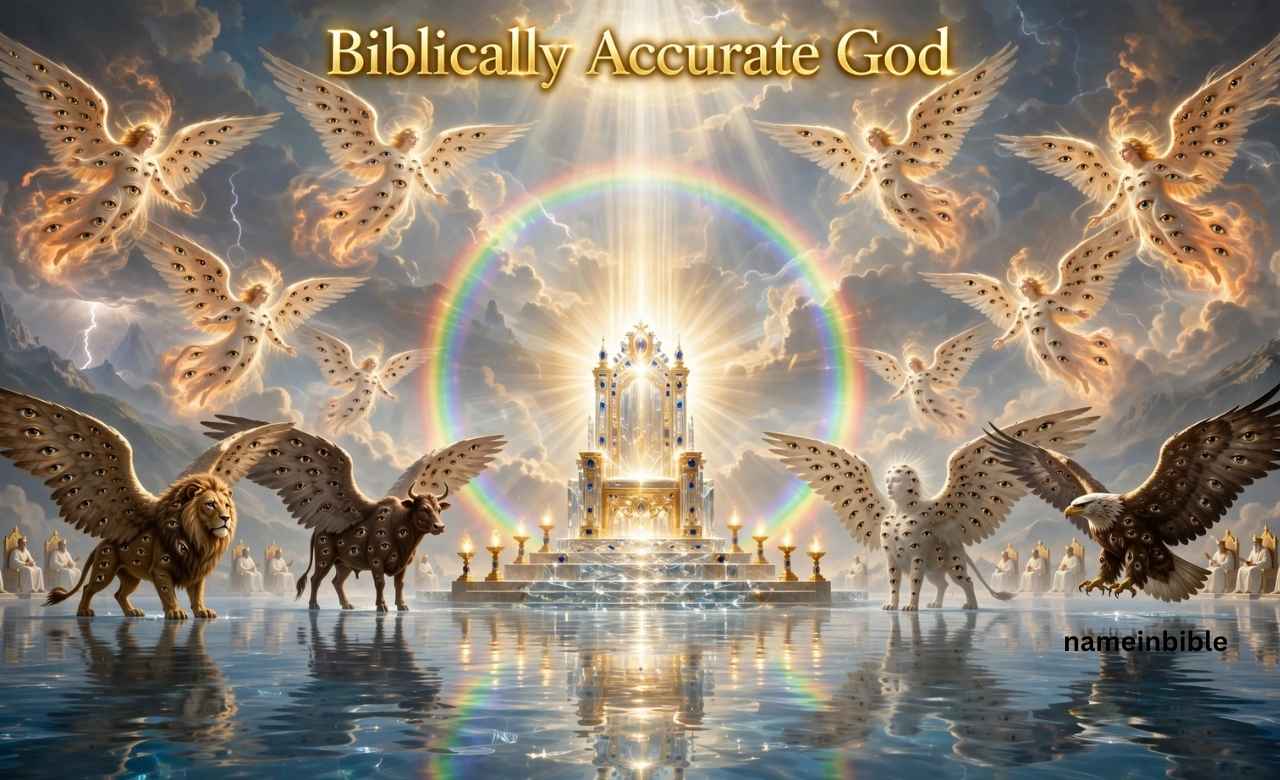
The Throne Room Visions
                          ┌────────────────────────┐
                          │   THE THRONE OF GOD    │
                          │ (Lapís Lazuli / Sapphire) │
                          └───────────┬────────────┘
                                      │
            ┌─────────────────────────┼─────────────────────────┐
            ▼                         ▼                         ▼
      [ EZEKIEL 1 ]              [ ISAIAH 6 ]            [ DANIEL 7 ]
  Wheels within wheels,      Seraphim crying:        Ancient of Days,
  eyes, fiery chrysolite,    "Holy, Holy, Holy,"     snow-white clothing,
  glory like rainbow.        temple filled with      pure wool hair,
                             smoke.                  throne of fire.
- Ezekiel’s Vision (Ezekiel 1): Ezekiel saw what he described as “the likeness of the glory of the Lord.” He observed glowing metal, brilliant fire surrounding a throne of lapis lazuli, wheel-like angelic beings (cherubim) covered in eyes, and a rainbow-like brightness shining around a throne above the expanse.
- Isaiah’s Calling (Isaiah 6): Isaiah beheld the Lord seated on a high and exalted throne, with the train of His robe filling the heavenly temple. Six-winged seraphim flew above Him, covering their faces and feet while crying out: “Holy, holy, holy is the Lord of hosts; the whole earth is full of His glory!”
- Daniel’s Prophetic Dream (Daniel 7:9-10): Daniel describes the “Ancient of Days” taking His seat. His clothing was white as snow, the hair of His head like pure wool, His throne was ablaze with flames, and its wheels were burning fire.
These descriptions demonstrate that Old Testament visions focus on the glory of the Lord His majesty, brightness, and purity rather than a localized human form.
How Jesus Reveals the Invisible God Perfectly
The central climax of God revealed in Scripture occurs not in apocalyptic visions, but in the historic person of Jesus Christ.
                           THE INVISIBLE GOD
                                   │
                                   ▼
                         [ THE INCARNATION ]
                         (John 1:14 / Col 1:15)
                                   │
                    ┌──────────────┴──────────────┐
                    ▼                             ▼
          Perfect Representation        Fullness of Deity
             (Hebrews 1:3)               (Colossians 2:9)
The Apostle John writes: “No one has ever seen God; the only God, who is at the Father’s side, He has made Him known” (John 1:18). Furthermore, the Apostle Paul declares in Colossians 1:15 that Jesus is the image of the invisible God.
| Scripture Reference | Biblical Truth Revealed |
| Hebrews 1:3 | Jesus is the radiance of God’s glory and the exact representation of His being. |
| Colossians 2:9 | For in Christ all the fullness of Deity lives in bodily form. |
| John 14:9 | Jesus said to Philip: “Anyone who has seen Me has seen the Father.” |
To know God’s true nature, we look to Christ. In His compassion, teaching, miracles, sacrificial death, and bodily resurrection, Jesus shows us the heart, character, and love of God the Father in human context.

The Most Important Attributes of the Biblically Accurate God
To comprehend the nature of God in the Bible, theologians categorize His attributes into incommunicable attributes (qualities unique to God alone) and communicable attributes (qualities He shares with human beings in limited measure).
Incommunicable Attributes (Unique to God)
- Omnipotence (Almighty God): God possesses all power over creation, history, and physical laws (Genesis 17:1, Jeremiah 32:17).
- Omniscience: God possesses infinite knowledge of all things past, present, future, and potential (Psalm 139:1-4, 1 John 3:20).
- Omnipresence: God is fully present in all places simultaneously; He is not confined by space or time (Psalm 139:7-10).
- Immutability: God’s character, promises, and essential nature never change (Malachi 3:6, James 1:17).
- Eternal Nature: God exists outside of time, having no beginning and no end (Psalm 90:2, Revelation 1:8).
God’s Holiness, Love, Mercy, Justice, and Wrath Explained
A truly biblically accurate God cannot be reduced to a single character trait. Scripture reveals a complete, perfectly balanced portrait of His moral attributes.
                      ┌────────────────────────────┐
                      │    GOD'S MORAL NATURE      │
                      └─────────────┬──────────────┘
                                    │
            ┌───────────────────────┴───────────────────────┐
            ▼                                               ▼
     DIVINE PURITY                                   DIVINE LOVE
  (Holiness & Justice)                            (Mercy & Grace)
            │                                               │
            └───────────────────────┬───────────────────────┘
                                    │
                                    ▼
                          [ THE CROSS OF CHRIST ]
               Where Mercy and Justice Perfectly Meet
1. God’s Holiness
The holiness of God is His central attribute in Scripture. To be holy (Kadosh in Hebrew) means to be completely set apart, morally pure, and utterly unique from creation (Exodus 15:11). God’s absolute purity means He cannot tolerate or fellowship with unatoned sin.
2. God’s Love and Mercy
Scripture declares that “God is love” (1 John 4:8). This is not a passive sentiment, but an active, covenantal love (Hesed) that leads Him to seek and redeem fallen humanity. His mercy withholding the punishment we deserve, and His grace granting unmerited favor, are most clearly seen in John 3:16.
3. God’s Justice and Wrath
Many modern readers bypass the topic of divine judgment, yet a biblically accurate God is fiercely just. God’s righteousness demands that evil, oppression, and sin be punished (Psalm 11:7). God’s wrath is not an erratic temper, but His holy, settled opposition to sin and injustice. At the cross of Christ, God’s perfect justice and infinite love met: Jesus bore the penalty for human sin so that believers could receive divine mercy (Romans 3:25-26).
Is God Visible? Understanding God’s Spiritual Nature
The Scriptures present what seems at first glance to be a tension regarding whether humans can see God:
- “No one can see Me and live” (Exodus 33:20).
- “God is spirit, and His worshipers must worship in the Spirit and in truth” (John 4:24).
- “Moses and Aaron, Nadab and Abihu, and the seventy elders of Israel went up and saw the God of Israel” (Exodus 24:9-10).
The resolution lies in understanding theophanies and the spiritual nature of God.
God in His unveiled, infinite deity (God the Father) cannot be directly seen by mortal humans without consuming them in His holiness. When individuals in the Old Testament “saw God,” they were beholding a veiled manifestation, a symbolic vision, or a pre-incarnate appearance of the Son of God (often referred to as the Angel of the Lord).
The Trinity Explained: Father, Son, and Holy Spirit
Central to Christian doctrine and biblical theology is the reality of the Holy Trinity. While the word “Trinity” does not appear explicitly in the Bible, the truth of the Triune God is woven across Old and New Testament passages.
                           GOD IS ONE
                        (Deuteronomy 6:4)
                               │
            ┌──────────────────┼──────────────────┐
            │                  │                  │
            ▼                  ▼                  ▼
     GOD THE FATHER       GOD THE SON      GOD THE HOLY SPIRIT
       (Creator)          (Redeemer)           (Comforter)
The Three Statements of Trinitarian Truth
- There is only one God. (Deuteronomy 6:4, Isaiah 45:5).
- The Father, the Son, and the Holy Spirit are three distinct Persons.
- Each Person is fully, eternally God.
At the baptism of Jesus (Matthew 3:16-17), all three Persons of the Trinity are manifested simultaneously: the Son is baptized in the water, the Holy Spirit descends like a dove, and the voice of God the Father speaks from heaven.
How God Reveals Himself Throughout the Bible
God does not uncover His full character all at once; He utilizes progressive revelation. Throughout redemptive history, God discloses His character, covenants, and ultimate plan step-by-step.
  GENESIS 3          EXODUS 3          PROPHETS         GOSPELS         REVELATION
      │                  │                 │               │                │
  Promise of         "I AM THAT        Messianic       Word Made       Full Manifestation
  Seed               I AM"             Prophecies      Flesh           of Glory
- In Creation: General revelation in nature shows His power, majesty, and design (Psalm 19:1, Romans 1:20).
- Through the Patriarchs: Revealing His covenant faithfulness to Abraham, Isaac, and Jacob.
- To Moses at the Burning Bush: Revealing His sacred covenant name I AM WHO I AM (Yahweh / Jehovah) (Exodus 3:14).
- Through the Law and Prophets: Establishing His ethical holiness, righteousness, and promises of a coming Redeemer.
- In the Person of Jesus Christ: The climax of special revelation, bringing salvation, grace, and eternal life.
Common Misconceptions About God’s Nature
Over time, secular culture and popular spirituality have introduced several major distortions regarding God’s character:
- Misconception 1: “The God of the Old Testament is harsh, while Jesus in the New Testament is purely loving.”
- Biblical Reality: God exhibits profound mercy, patience, and love throughout the Old Testament (Exodus 34:6-7), while Jesus speaks frequently about judgment, sin, and holiness in the New Testament (Matthew 10:28). God is consistent across both testaments.
- Misconception 2: “God is an old man with a beard sitting on a cloud.”
- Biblical Reality: God is an uncreated, infinite Spirit who transcends physical human limitations (1 Timothy 6:16).
- Misconception 3: “All spiritual paths lead to the same God.”
- Biblical Reality: Jesus asserted His singular role in revealing God: “I am the way and the truth and the life. No one comes to the Father except through Me” (John 14:6).
Biblically Accurate God vs. Human Ideas About God
┌───────────────────────────────────────┬───────────────────────────────────────┐
│     POPULAR HUMAN CONCEPTS            │       BIBLICALLY ACCURATE GOD         │
├───────────────────────────────────────┼───────────────────────────────────────┤
│ Created in man's moral image          │ Transcendent, infinitely holy Creator │
│ Indifferent to sin and holiness       │ Righteous Judge who punishes evil     │
│ Distant, passive, or uninvolved       │ Sovereign, active Lord of history     │
│ Vague cosmic force or energy          │ Personal God who loves and speaks     │
└───────────────────────────────────────┴───────────────────────────────────────┘
When human beings craft a god of their own imagination, they usually create a deity that demands little repentance, matches their personal cultural preferences, and requires no life transformation. The living God of Scripture challenges our assumptions, calls us out of sin, and invites us into genuine transformation.
What Does God Look Like According to the Bible?
To summarize what the Bible indicates regarding God’s manifestation:
- In His Divine Nature: God is invisible Spirit (John 4:24, 1 Timothy 1:17).
- In Prophetic Vision: God appears surrounded by unapproachable light, consuming fire, radiant glory, and heavenly retinues (Revelation 4, Ezekiel 1).
- In Physical Incarnation: God took on human flesh in Jesus Christ (John 1:14), making the invisible God tangible and visible to humanity.
- In His Heavenly Realm: The glorified Christ is portrayed in Revelation 1:13-16 with eyes like flaming fire, feet like glowing bronze, a voice like rushing waters, and a face shining like the sun at full strength.
Bible Verses About God’s Glory, Presence, and Character
Key passages for Bible study on God’s true nature:
“The Lord, the Lord, a God merciful and gracious, slow to anger, and abounding in steadfast love and faithfulness…”
— Exodus 34:6
“In the beginning was the Word, and the Word was with God, and the Word was God… And the Word became flesh and dwelt among us, and we have seen His glory…”
— John 1:1, 14
“He is the image of the invisible God, the firstborn of all creation. For by Him all things were created, in heaven and on earth, visible and invisible…”
— Colossians 1:15-16
“To the King of the ages, immortal, invisible, the only God, be honor and glory forever and ever. Amen.”
— 1 Timothy 1:17
Why Knowing God’s True Nature Changes Your Faith
Understanding the biblically accurate God is not merely an academic exercise it transforms how you live every day:
                          TRUE KNOWLEDGE OF GOD
                                    │
       ┌────────────────────────────┼────────────────────────────┐
       ▼                            ▼                            ▼
  DEEPER WORSHIP               SOLID TRUST                 GENUINE HUMILITY
  Reverence replacing         Peace in His                Surrender replacing
  flippant views              sovereignty                 self-reliance
- It Elevates Worship: Recognizing God’s immense holiness restores genuine reverence, awe, and the fear of the Lord to our worship.
- It Anchor Faith: When life brings hardship, knowing that God is both sovereign and loving provides unshakable peace.
- It Clarifies Salvation: Realizing God’s absolute purity reveals why we cannot save ourselves through good works, driving us to rely entirely on the gospel of Jesus Christ for forgiveness and redemption.
What the Early Church Taught About God’s Nature
The earliest Christian leaders and Church Fathers (such as Irenaeus, Athanasius, and Augustine) defended the biblical view of God against ancient heresies.
- Anti-Gnosticism: The early church affirmed that the God of the Old Testament and New Testament are the same God—the Creator of the physical world, which He declared good.
- The Nicene Creed (325 AD): Formulated to defend the full deity of Jesus Christ against Arianism, affirming that Jesus is “of one substance with the Father.”
- The Athanasian Creed: Clearly outlined the orthodox doctrine of the Trinity, affirming one God in three distinct Persons, equal in power and eternal majesty.
Practical Ways to Know God Through Scripture and Prayer
Building a deep, authentic relationship with God requires moving from knowing about God to personally knowing Him.
1.Engage in Daily Scripture Reading:
Read the Bible systematically, asking: “What does this passage reveal about God’s character, priorities, and will?” Start in the Gospels (John) or Psalms.
2.Pray with Biblical Truth:
Praise God for His specific attributes during prayer—His faithfulness, righteousness, mercy, and wisdom.
3.Practice Holy Obedience:
Jesus noted that those who love Him keep His commandments (John 14:15). Walking in obedience deepens your experiential knowledge of His presence.
4.Gather in Faithful Community:
Join a gospel-centered local church to study Scripture, celebrate the sacraments, and worship the Lord alongside fellow believers.
How to Build a Personal Relationship with the Biblically Accurate God
The ultimate purpose of biblical revelation is not simply to satisfy human curiosity about what God looks like, but to bring us into a covenantal relationship with our Creator.
                           THE PATHWAY TO GOD
                                   │
              ┌────────────────────┴────────────────────┐
              ▼                                         ▼
         REPENTANCE                                   FAITH
  (Turning from sin & self)                  (Trusting Christ's work)
              │                                         │
              └────────────────────┬────────────────────┘
                                   │
                                   ▼
                         RECONCILIATION WITH GOD
                         (Eternal Life & Peace)
Through the atonement of Jesus Christ on the cross, the barrier of sin that separates humanity from a holy God is removed. When we repent of our sins and put our faith in Jesus as Lord and Savior, we are adopted into God’s family, indwelt by the Holy Spirit, and granted direct access to the throne of God.
Knowing the biblically accurate God means discovering a Creator who is infinitely majestic yet intimately near a God who calls you to know Him, love Him, and walk with Him throughout eternity.
Faqs
What is a biblically accurate God?
A biblically accurate God is God as revealed in the Bible, not as imagined by culture or tradition. Scripture describes Him as holy, loving, just, merciful, all-powerful, all-knowing, and eternal.
Is Allah a true God?
Christians and Muslims both believe in one God, but Christianity and Islam describe God’s nature differently. This article explains the Christian understanding of God based on the Bible, where God is fully revealed through Jesus Christ.
What generation will not pass away?
This question refers to Jesus’ words in Matthew 24:34. Christians have interpreted this passage in different ways, with many understanding it in the context of the events Jesus was describing and God’s unfolding plan.
Is there 100% proof that God is real?
The existence of God cannot be proven in the same way as a scientific experiment. Christians believe that Scripture, the life and resurrection of Jesus Christ, creation, and personal experience together provide compelling reasons for faith.
Conclusion
The biblically accurate God is not a product of human imagination, religious tradition, or cultural opinion. He is the Bible accurate God who has faithfully revealed Himself through Scripture from Genesis to Revelation. His holiness, love, mercy, justice, sovereignty, and eternal nature work together in perfect harmony, revealing a God who is both infinitely powerful and deeply personal. As you study the biblical accurate God, you begin to see that every page of the Bible points to His glorious character and His plan of redemption through Jesus Christ.
Knowing the God biblically accurate according to the Bible changes more than your theology it transforms your heart, strengthens your faith, deepens your worship, and gives you confidence in every season of life. Instead of relying on assumptions or popular ideas, let God’s Word shape your understanding of who He truly is. As you continue reading Scripture, praying with humility, and following Jesus Christ, you’ll grow in a genuine relationship with the living God and experience the peace, hope, and purpose that come from knowing Him as He has revealed Himself.Read other article 300+ Bible Verses for Instagram Bio: Short, Powerful Scriptures to Inspire Your Profile

Welcome to NameInBible. I am Victoria, a Christian writer passionate about exploring biblical name meanings, Scripture-based insights, and powerful prayers. My goal is to help readers discover the spiritual significance of names and grow closer to God through faith-filled content.