
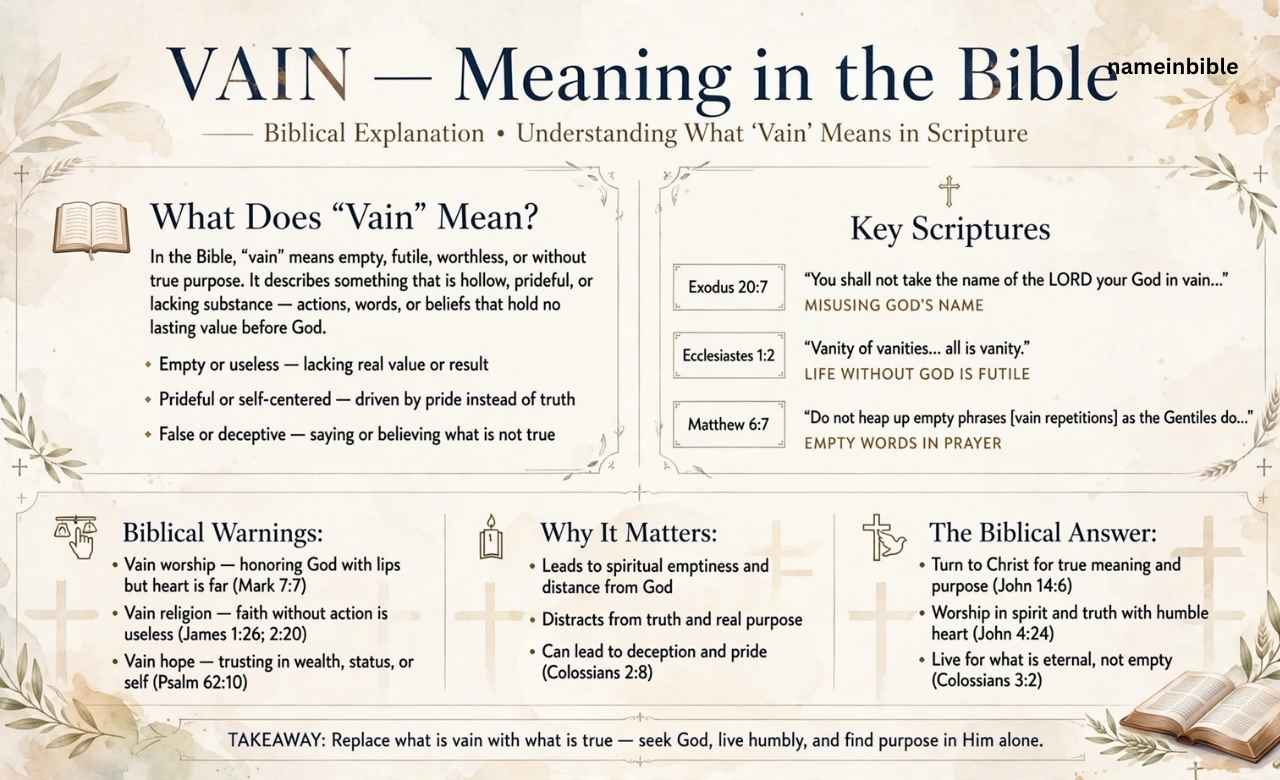
ave you ever wondered what the meaning of vain in the Bible truly is? Many people associate the word vain with pride or appearance, but Scripture reveals a much deeper spiritual truth. The definition of vain in the Bible goes beyond arrogance it describes anything that is empty, meaningless, false, or done without God’s purpose.
From the wisdom of Ecclesiastes to the teachings of Jesus and the apostles, the Bible repeatedly warns believers Vain Meaning in the Bible against living a life that is spiritually empty and Vain Meaning in the Bible disconnected from God’s will. Understanding the vain Bible definition can help you recognize attitudes and actions that lead away from a meaningful relationship with the Lord.In this comprehensive guide, we’ll define vain in the Bible by exploring its original Hebrew and Greek meanings, comparing major Bible translations, and examining key Scriptures that explain its significance.
What Does Vain Mean in the Bible?
To understand the vain Bible definition KJV or modern translations present, we have to look past outward looks and look at structural realities.
Simple Biblical Definition of Vain
At its absolute core, the vain Bible definition means empty, hollow, worthless, or utterly fruitless. When scripture calls an action, a thought, or an idol “vain,” it means that it looks substantial from the outside but lacks any true internal weight. It is a shell.
Think of it like a beautiful piece of fruit that Vain Meaning in the Bible has completely rotted away into dust on the inside it looks like food, but it can never satisfy your hunger. The futile meaning in the Bible directly mirrors this idea: it describes an immense amount of human labor, worry, and effort that ultimately yields a grand total of zero eternal results.
Why the Word “Vain” Appears So Often in Scripture
The Holy Spirit repeats this word across both testaments Vain Meaning in the Bible because human beings are incredibly prone to investing their life savings, emotional energy, and spiritual devotion into things that cannot save them.
The Bible uses the word “vain” as a loving but urgent warning system. It acts like a guardrail on a dangerous cliffside road. God Vain Meaning in the Bible points out what is “vain” so that we do not waste our short, earthly lives chasing illusions, practicing empty worship, or building houses on shifting sands.
Vain Meaning in Hebrew and Greek
To unpack the deep linguistic layers behind this concept, we have to travel back to the original languages of the text. The biblical writers chose their terms with masterful, inspired precision.
Hebrew Word for Vain in the Old Testament
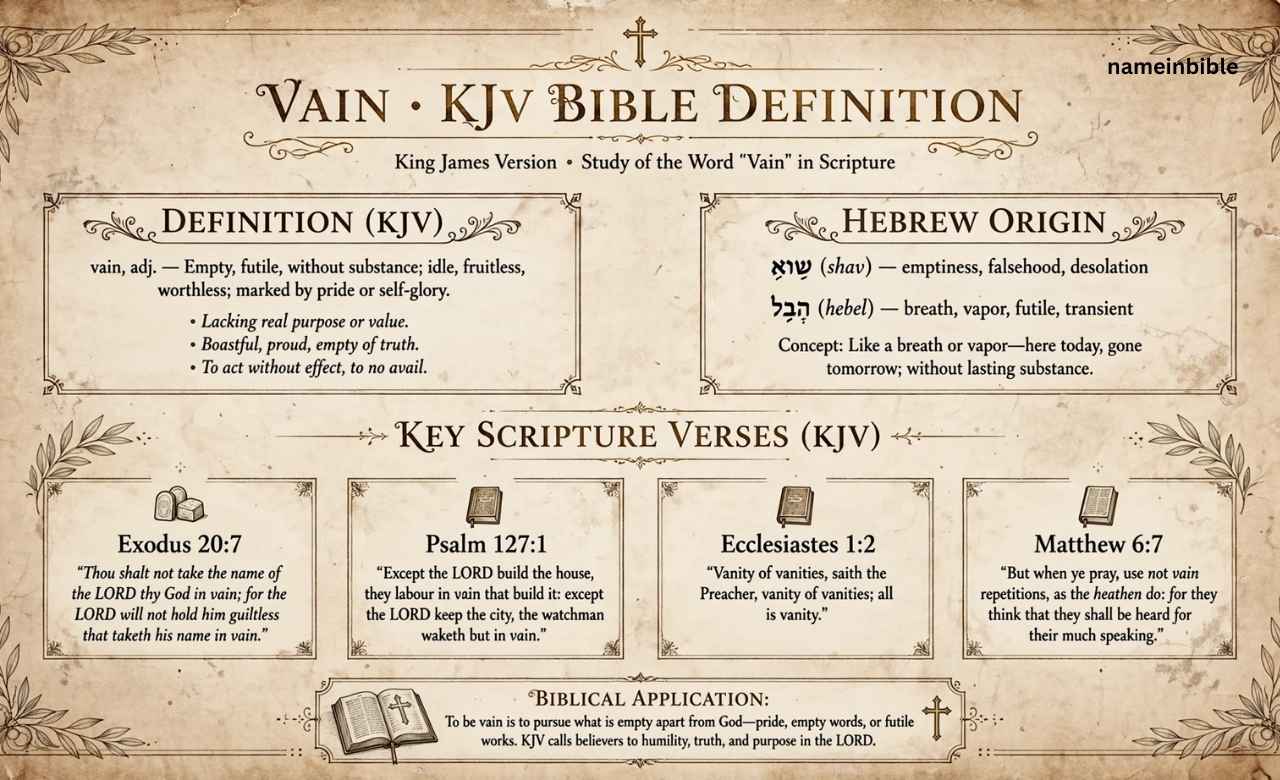
In the Old Testament, the primary Hebrew word for vain shifts depending on the specific theological context, but two heavyweight terms dominate the landscape:
- Hevel (הֶבֶל): This is the foundational word used throughout the wisdom literature. It literally translates to “breath,” “vapor,” or “a puff of smoke.” When you step outside on a freezing winter morning and exhale, you see a plume of vapor. It looks solid for a split second, but when you reach out to grab it, your hand closes on thin air, and it vanishes within moments. This is the meaning of vanity in Ecclesiastes. It is not that life is evil; it is that life apart from God is fleeting, ungraspable, and temporary.
- Shav (שָׁוְא): This word carries a stronger connotation of deception, falsehood, and nothingness. It is used when describing deceptive idols or lying words. When something is shav, it promises security but delivers absolute ruin. This is the word explicitly used in the Commandment regarding the Lord’s name.
Greek Word for Vain in the New Testament
When we transition into the New Testament, the apostolic writers use specific Greek vocabulary to diagnose the state of the human soul under the New Covenant.
- Mataios (μάταιος): This Greek word for vain means devoid of force, success, or result. It points directly to things that fail to reach their intended goal. If an anchor line snaps before it hits Vain Meaning in the Bible the ocean floor, that anchor is mataios—it fails to hold the ship. Paul uses this word to warn that if Jesus did not rise from the dead, our Christian faith is completely mataios (1 Corinthians 15:17).
- Kenos (κενός): This literally means “empty.” It refers to a container that has absolutely nothing inside of it. When Paul writes about his labor not being “in vain,” he is praying that his intense missionary work won’t end up like an empty box.
Vain Bible Definition (KJV, NIV & Other Translations)
Depending on the translation sitting on your desk or phone app, you will see the word “vain” pop up in very different places. This is because modern English has largely lost the older, broader definition of the word.
| Translation | Common Renderings of Hevel / Mataios | Theological Nuance |
| King James Version (KJV) | Vain, Vanity, Vanity of Vanities | Retains the poetic, classical English sense of emptiness and transience. |
| New International Version (NIV) | Meaningless, Futile, Worthless | Focuses on the psychological and practical outcome—the lack of permanent value. |
| English Standard Version (ESV) | Vanity, In Vain, Empty | Balances the classic literary metaphor with clear, modern syntax. |
| New Living Translation (NLT) | Useless, Meaningless, Foolish | Emphasizes the relational and practical foolishness of ignoring God’s design. |
What Is the Difference Between Vain and Vanity in the Bible?
While these two words sound nearly identical and share the same linguistic root, Scripture applies them to two distinctly different dimensions of human life.
“In Vain” is an adverbial phrase that describes the outcome or quality of an action. It tells you that an effort has failed to produce its intended effect. For example, if you spend all night building a massive Vain Meaning in the Bible sandcastle right at the low-tide mark, your hard work is done “in vain” because the incoming tide will completely erase it by morning. It deals with fruitlessness.
“Vanity” is a noun that describes a state of being or an attitude. In the Old Testament, it describes the radical fragility and brevity of human life under the sun. In a psychological sense, it is tied directly to biblical pride—the delusion that a human being can be completely self-sufficient, self-satisfied, and independent of their Creator.
Powerful Bible Verses About Vain and Their Meaning
To see how these concepts function in real-time, let us analyze several anchor passages where the Holy Spirit unpacks the reality of a life lived apart from living for God’s glory.
1. Psalm 127:1 — The Futility of Human Effort Apart from God
“Except the Lord build the house, they labour in vain that build it: except the Lord keep the city, the watchman waketh but in vain.”
This verse brilliantly cuts through our culture’s obsession with hustle and self-reliance. You can work eighty hours a week, build an impressive financial empire, and secure your home with the most advanced security systems money can buy. But if God is not the foundational Vain Meaning in the Bible architect and protector of your family, your future, and your soul, your stress and labor are utterly hollow.
2. Galatians 2:21 — The Sufficiency of the Cross
“I do not frustrate the grace of God: for if righteousness come by the law, then Christ is dead in vain.”
Here, Paul uses the word kenos to present a staggering theological reality. If human beings could save themselves by being good enough, keeping the rules, or checking off religious boxes, then the brutal crucifixion of the Son of God was a completely pointless waste of life. Legalism turns the cross of Christ into something empty.
3. Proverbs 31:30 — The Deception of Surface Beauty
“Favor is deceitful, and beauty is vain: but a woman that feareth the Lord, she shall be praised.”
This is one of the rare places where the biblical definition intersects slightly with our modern one. Scripture does not say physical beauty is evil; it says it is hevel—a vapor. It wrinkles, it ages, and it fades away. Putting your ultimate identity into your physical body is a losing game Vain Meaning in the Bible because time wins every single time. True, enduring weight is found in the fear of the Lord.
What Does “Taking the Lord’s Name in Vain” Really Mean?
This brings us directly to one of the most famously misunderstood passages in the entire global lexicon: the Third Commandment.
“Thou shalt not take the name of the Lord thy God in vain; for the Lord will not hold him guiltless that taketh his name in vain.” (Exodus 20:7, KJV)
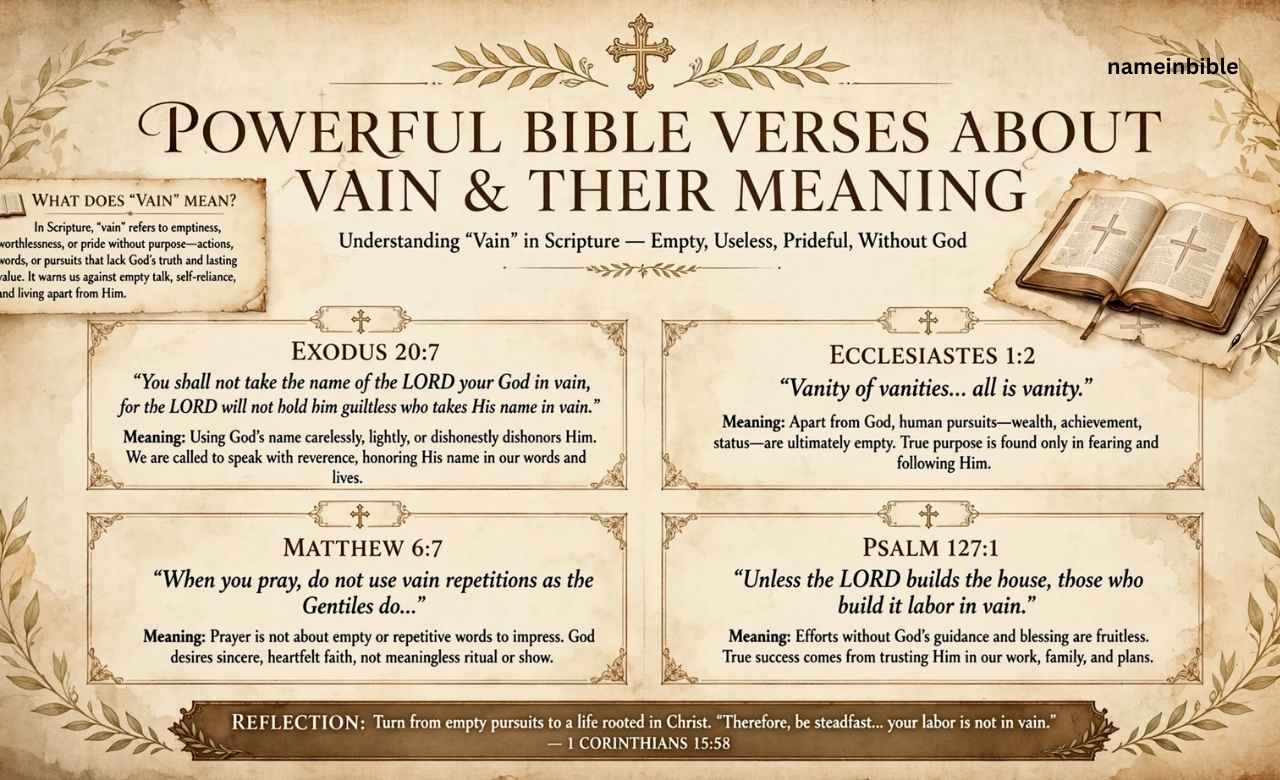
For generations, well-meaning Christians have taught that take the Lord’s name in vain simply means using “God” or “Jesus” as a casual curse word when you stub your toe on a coffee table. While treating the holy name of Christ as a cheap expletive is absolutely dishonoring, the text goes vastly deeper than that.
In the ancient Near East, a person’s name wasn’t just a random label it represented their character, their Vain Meaning in the Bible presence, and their sovereign authority. The literal Hebrew phrasing for “take” is nasa, which means “to carry” or “to bear.”
Therefore, a more precise translation is: “You shall not bear or carry the name of the Lord your God in a hollow, false, or empty way.”
[Bearing the Name of God]
   ├── Casual/Profane Speech (Stubbing your toe)
   └── Structural/Hypocritical Actions (Claiming His name while living in rebellion)
If you claim to be a follower of Yahweh if you wear His name as a Christian but your private life is defined by greed, malice, and unrepentant sin, you are actively carrying His holy name in vain. You are using Vain Meaning in the Bible His identity as a cosmetic mask to hide your own corruption. It is the ultimate form of empty worship.
What Is Vain Repetition According to the Bible?
In the Sermon on the Mount, Jesus targets another area where emptiness loves to hide: our personal prayer lives.
“But when ye pray, use not vain repetitions, as the heathen do: for they think that they shall be heard for their much speaking.” (Matthew 6:7, KJV)
The phrase vain repetition meaning in the Bible comes from the Greek word battalogeo, which means to babble, stammer, or drone on with mindless, mechanical chatter.
Mindless Babble (Battalogeo) ──► Just saying words to hit a time goal ──► Vain Repetition
Relational Devotion         ──► Speaking from a place of open honesty ──► True Prayer
Jesus is explicitly exposing ancient pagan prayer strategies. In the Roman and Greek worlds, people believed that gods were easily distracted or indifferent. To get their attention, you had to chant their names over and over again, using precise magic formulas, trying to essentially wear the deity down through sheer verbal volume.
Our Heavenly Father is not a distant, moody bureaucrat who needs to be nagged into helping you. He is a loving Dad who already knows exactly what you need before you even open your mouth. True prayer is not about hitting a specific word count or mindlessly reciting Vain Meaning in the Bible formal scripts; it is about authentic, heart-level communication with a living God.
What Does “In Vain” Mean in the Bible?
When the text notes that something was done “in vain,” it means that the human actors involved sowed an immense amount of seed but reaped absolutely nothing of value. It indicates an ultimate bankruptcy of return.
Consider Isaiah 49:4, where the prophet cries Vain Meaning in the Bible out in a moment of deep human exhaustion: “I have labored in vain; I have spent my strength for nothing and in emptiness.” Have you ever felt that exact way in your life?
- You poured your heart into a relationship, only for it to blow up in your face.
- You spent decades climbing a corporate ladder, only to realize it was leaning against the completely wrong wall.
- You tried to fix a broken situation in your own strength, only to make it worse.
When we operate entirely within our own human cleverness, talent, and stamina, our ultimate spiritual output is in vain. It is only when our efforts are surrendered to the power of the Holy Spirit that our labor takes on eternal, unshakeable weight.
Why Does God Warn Against Living in Vain?
God does not warn us against vanity because He is a cosmic killjoy who wants to ruin our fun. He warns us because He loves us too much to watch us destroy our souls on things that cannot sustain us.
The Relational Heart of God
The warning against vanity is intensely relational. God knows that the human heart is a non-stop idol factory. If we do not Vain Meaning in the Bible anchor our lives in Him, we will naturally drift toward chasing money, career status, toxic relationships, or physical perfection.
The Law of Spiritual Anatomy
Scripture reveals a fundamental law of spiritual anatomy: you become exactly like whatever you worship.
“They walked after vanity, and became vain.” (Jeremiah 2:5)
If you worship a vapor, your character becomes vaporous. If you anchor your soul to things that have no internal weight, your life loses its spiritual substance. God warns us because He wants us to be firmly rooted, solid, and filled with the heavyweight glory of His presence.
Biblical Examples of Vanity and Pride
To move this concept from abstract theology into concrete reality, let us examine three profound historical case studies recorded across the pages of Scripture.
King Solomon and Vanity
If anyone on earth had the resources to test whether a life lived for personal pleasure could satisfy the human soul, it was King Solomon. He possessed unlimited wealth, supreme political Vain Meaning in the Bible power, unmatched intellectual brilliance, and access to every luxury imaginable.
In the book of Ecclesiastes, Solomon conducts a massive psychological experiment. He chases architecture, vineyards, gardens, wealth, music, and relationships. Yet, after sampling everything the world could offer, he looks over his vast empire and writes this famous summary:
“Vanity of vanities, saith the Preacher, vanity of vanities; all is vanity.” (Ecclesiastes 1:2)
The meaning of vanity in Ecclesiastes is a brilliant warning for the modern world. Solomon uses the word hevel nearly forty times. He discovered that trying to find ultimate joy in worldly achievements is like trying to catch a shadow with a butterfly net. It leaves you entirely empty-handed.
The Pharisees and Empty Religion
The Pharisees are the ultimate biblical warning that you can be incredibly religious and still be completely vain. On the outside, they looked immaculate. They wore long robes, prayed long prayers on busy street corners, and fastidiously tithed down to the spices in their kitchen cabinets.
But Jesus completely exposed their system:
“This people honoreth me with their lips, but their heart is far from me. Howbeit in vain do they worship me, teaching for doctrines the commandments of men.” (Mark 7:6-7)
Their religious devotion was a hollow performance. They loved the praise of men more than the approval of God. They were trapped in a loop of empty worship, proving that it is entirely possible to go Vain Meaning in the Bible to church every week, memorize scripture, and still live a life that is completely empty in the eyes of God.
Lucifer’s Pride as a Warning
Long before human history began, the cosmic origin of vanity took root in the heart of Lucifer. Isaiah 14 and Ezekiel 28 give us a vivid window into this tragedy. Lucifer was created as an incredibly beautiful, high-ranking angel. But instead of reflecting that beauty back to his Creator, he turned his focus inward.
He looked at his own perfection and allowed biblical pride to rot his character. He declared, “I will ascend above the heights of the clouds; I will be like the most High” (Isaiah 14:14).
Self-Focus (Lucifer looks at his own beauty) ──► Spiritual Vanity ──► Cosmic Fall
This choice transformed a holy archangel into the Father of Lies. It stands as an eternal warning: spiritual vanity always precedes a catastrophic fall.
Spiritual Lessons Christians Can Learn from the Word “Vain”
When we allow the Holy Spirit to re-educate us on the true meaning of this word, it changes how we approach our daily walk of faith.
1. Recognizing the Illusion of Self-Sufficiency
The first major milestone of Christian spiritual growth is realizing that you cannot save, fix, or sustain yourself. The word “vain” shatters our illusions of control. It forces us to stop trying to build our own empires and brings us to our knees in total dependence on the grace of God.
2. Embracing Biblical Humility
Knowing that worldly accolades and physical looks are just temporary vapors creates deep biblical humility within us. We stop wasting our time trying to impress people or building a false persona. We find Vain Meaning in the Bible our peace in knowing that God opposes the proud but gives immense grace to the humble (James 4:6).
How to Avoid a Vain Life According to the Bible
If the problem is that our hearts naturally drift toward emptiness, what is the ultimate practical solution? Scripture provides a clear blueprint for building an unshakeable, meaningful life.
1.Shift Your Foundational Target:Daily Focus.
Stop working for things that rust, rot, and fade away. Intentionally re-orient your daily career, your parenting, and your private thoughts around living for God’s glory rather than building your own name.
2.Root Your Devotion in the Word:Consistent Discipline.
Protect your mind against the deceptive noise of the world by anchoring yourself in Scripture. True prayer avoids vain repetition meaning in the Bible by talking to God transparently about your real struggles, fears, and joys.
3.Walk in Active Accountability:Community Connection.
Do not isolate yourself. Surround yourself with a local body of believers who will love you enough to call out spiritual vanity or creeping pride when they see it creeping into your life.
4.Anchor Your Identity in the Resurrection:Eternal Security.
Remind your soul every single morning that Jesus Christ is physically risen from the dead. Because the tomb is empty, your labor in the Lord is never kenos—it is weighted with eternal value that can never be lost.
Common Misunderstandings About the Word “Vain”
To close our deep dive, let us quickly clear up three common misconceptions that frequently cause confusion in modern small groups and Bible studies.
Misconception 1: “If everything is vanity, then nothing matters.”
This is a dark, cynical reading that completely misunderstands Ecclesiastes. Solomon is not arguing for nihilism. He is arguing that everything apart from God is vanity. When you put God back at the Vain Meaning in the Bible center of the equation, your ordinary life—eating food, loving your family, working your job instantly fills with beautiful, eternal significance.
Misconception 2: “Enjoying beautiful things means you are practicing vanity.”
God is the master artist who created oceans, sunsets, and rich flavors for our enjoyment. The vanity meaning in the Bible is triggered when we take a good creation and try to turn it into an ultimate savior. Enjoy the gift, but worship the Giver.
Misconception 3: “Repeating a prayer is always a sin.”
In the Garden of Gethsemane, Jesus prayed the exact same prayer three separate times within a few hours. The issue is never repetition itself; it is the heart behind the repetition. If your prayers are coming from an authentic heart of deep relational dependence, you can cry out the same words a thousand times, and God will hear every single one.
“Therefore, my beloved brethren, be ye stedfast, unmoveable, always abounding in the work of the Lord, forasmuch as ye know that your labour is not in vain in the Lord.” — 1 Corinthians 15:58
Frequently Asked Questions (FAQs)
What is a vain person in the Bible?
A vain person in the Bible is someone who is consumed by pride, self-importance, or empty pursuits instead of seeking God’s will. Scripture encourages believers to replace biblical pride with biblical humility and to live for God’s glory.
What does the Bible say about being vain?
The Bible warns that being vain leads to spiritual emptiness, deception, and separation from God’s purpose. It teaches that God values humble hearts and reminds us that God opposes the proud but gives grace to the humble.
What does it mean to be vain?
To be vain means placing excessive value on yourself, your achievements, appearance, or worldly success while neglecting your relationship with God. The meaning of vain in the Bible also includes actions that are empty, futile, or lacking eternal purpose.
What is believing in vain?
Believing in vain refers to having a faith that is empty, insincere, or without genuine commitment to Christ. In 1 Corinthians 15:2, Paul explains that faith is “in vain” if it is not rooted in the true gospel and steadfast belief in Jesus.
Conclusion
Understanding the meaning of vain in the Bible is about far more than learning a definition it is about examining the condition of our hearts before God. The definition of vain in the Bible reveals that anything empty, meaningless, prideful, or disconnected from God’s truth ultimately leads to spiritual loss. Throughout Scripture, we are encouraged to reject spiritual vanity, embrace biblical humility, and pursue a life that honors the Lord in both our words and actions. May you like other article Josiah Meaning in the Bible: Biblical Meaning, Hebrew Origin, and Spiritual Significance

Welcome to NameInBible. I am Victoria, a Christian writer passionate about exploring biblical name meanings, Scripture-based insights, and powerful prayers. My goal is to help readers discover the spiritual significance of names and grow closer to God through faith-filled content.