
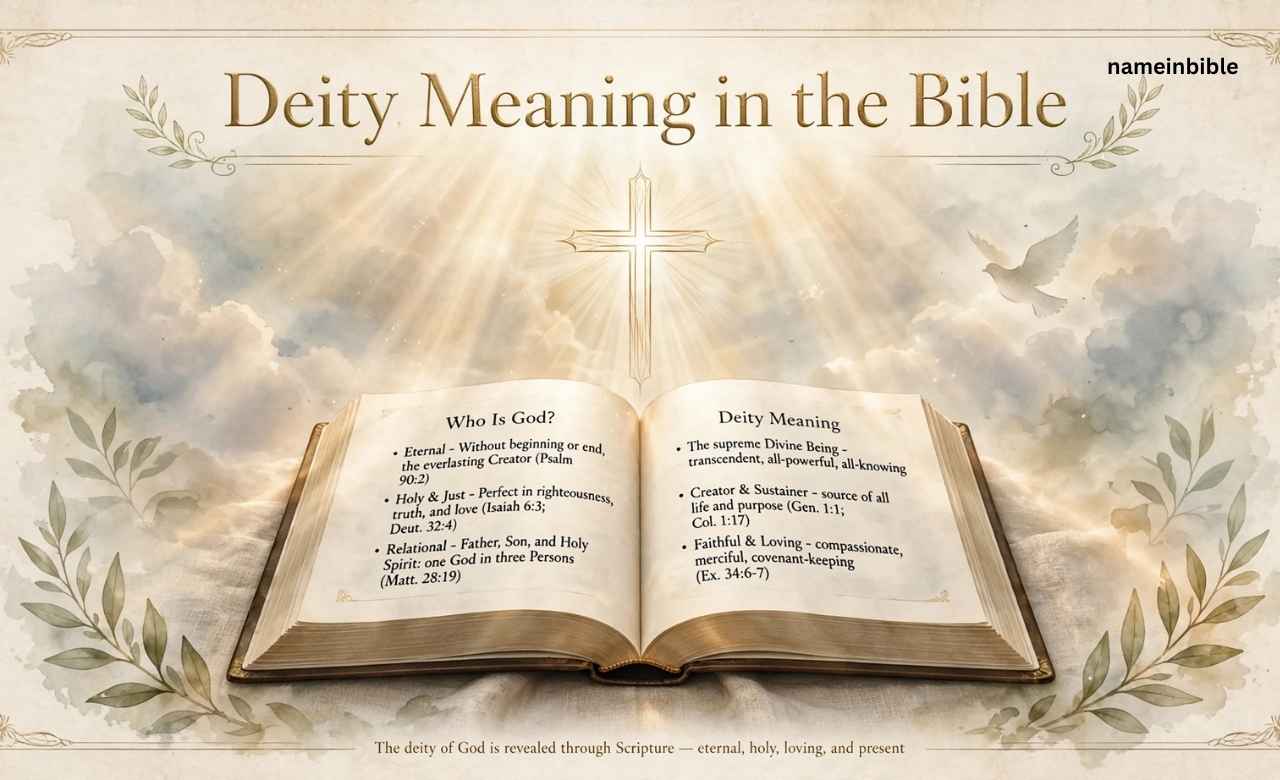
Have you ever come across the word deity while reading the Bible and wondered what it truly means? Perhaps you’ve asked yourself, what does deity mean in the Bible, or searched for the definition of deity in the Bible after reading a verse about God’s divine nature. The term may sound complex, but its biblical meaning reveals one of the most important truths in all of Scripture the identity of the one true God and His relationship with humanity.
The deity meaning in the Bible goes far beyond simply referring to a god or powerful being. It speaks of God’s divine nature, eternal existence, supreme authority, perfect holiness, and unlimited power. Throughout both the Old and New Testaments, the Bible consistently reveals that God alone possesses true deity. It also teaches that Jesus Christ shares the same divine nature, making the doctrine of Christ’s deity a cornerstone of the Christian faith.
What Does Deity Mean in the Bible?
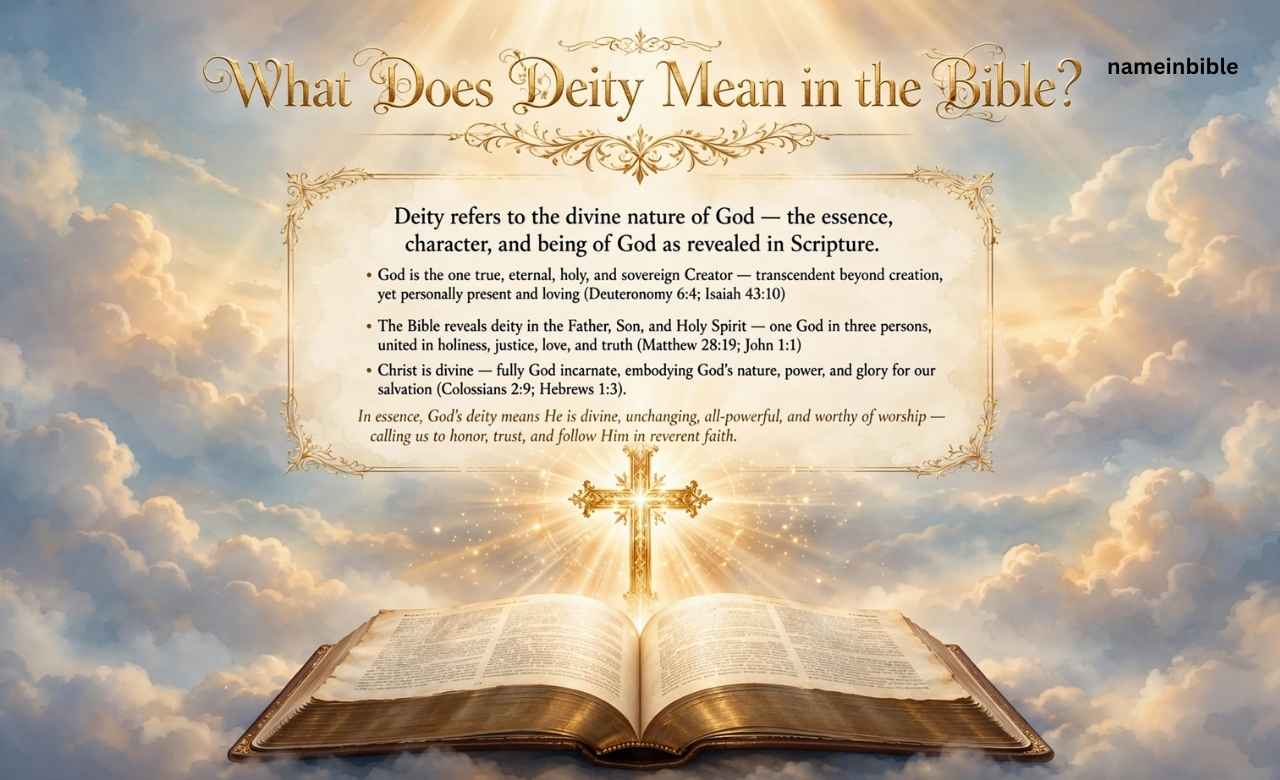
To understand what is deity meaning in a biblical framework, we must first look past modern, secular definitions. In common English, “deity” can refer to any god, goddess, or supernatural being worshipped in various world religions. However, the deity meaning in the Bible points to a completely different reality: the unique, self-existent, and supreme Creator of Heaven and Earth.
The word “deity” comes from the Latin deitas, which translates directly to “godhead” or “divine nature.” When we talk about the biblical meaning of deity, we are referring to the essential Deity Meaning in the Bible essence and character of being God. It is not a title given to someone who has achieved a high level of spiritual power; rather, it is the state of absolute, uncreated Godhood.
In the biblical narrative, God’s divine nature is characterized by:
- Self-Existence (Aseity): God does not depend on anyone or anything else for His existence. He is the eternal God, the uncaused cause of all things.
- Supreme Authority: As the Creator, He possesses absolute sovereign control and divine power over all creation.
- Infinite Perfection: Every attribute of His character such as love, justice, holiness, and truth—is perfect and infinite.
In short, the biblical doctrine of deity establishes that God is not just a stronger or smarter version of humanity. He is entirely other transcendent, holy, and uniquely worthy of our ultimate worship and obedience.
Biblical Definition of Deity with Key Bible Verses
What is deity according to the Bible? To build a robust biblical definition of deity, we must look at how Scripture itself articulates God’s divine essence.
Throughout the Old and New Testaments, God’s divine presence is revealed as singular and supreme. Here are Deity Meaning in the Bible three crucial passages that serve as anchors for understanding God’s divine nature, compared across three classic translations: the King James Version (KJV), the New International Version (NIV), and the English Standard Version (ESV).
Genesis 1:1 — The Power of Creation
Genesis 1:1 establishes God as the sovereign Creator who exists before and outside of the material universe.
- KJV: “In the beginning God created the heaven and the earth.”
- NIV: “In the beginning God created the heavens and the earth.”
- ESV: “In the beginning, God created the heavens and the earth.”
Isaiah 45:5 — The Declaration of Monotheism
This verse highlights God’s absolute supremacy. There is no other divine being; He is the one true God.
- KJV: “I am the Lord, and there is none else, there is no God beside me: I girded thee, though thou hast not known me.”
- NIV: “I am the Lord, and there is no other; apart from me there is no God. I will strengthen you, though you have not acknowledged me.”
- ESV: “I am the Lord, and there is no other, besides me there is no God; I equip you, though you do not know me.”
Colossians 2:9 — The Fullness of Deity
This is one of the most explicit New Testament teachings on deity, pointing directly to the incarnation of Christ.
- KJV: “For in him dwelleth all the fulness of the Godhead bodily.”
- NIV: “For in Christ all the fullness of the Deity lives in bodily form.”
- ESV: “For in him the whole fullness of deity dwells bodily.”
Deity Meaning in Hebrew and Greek
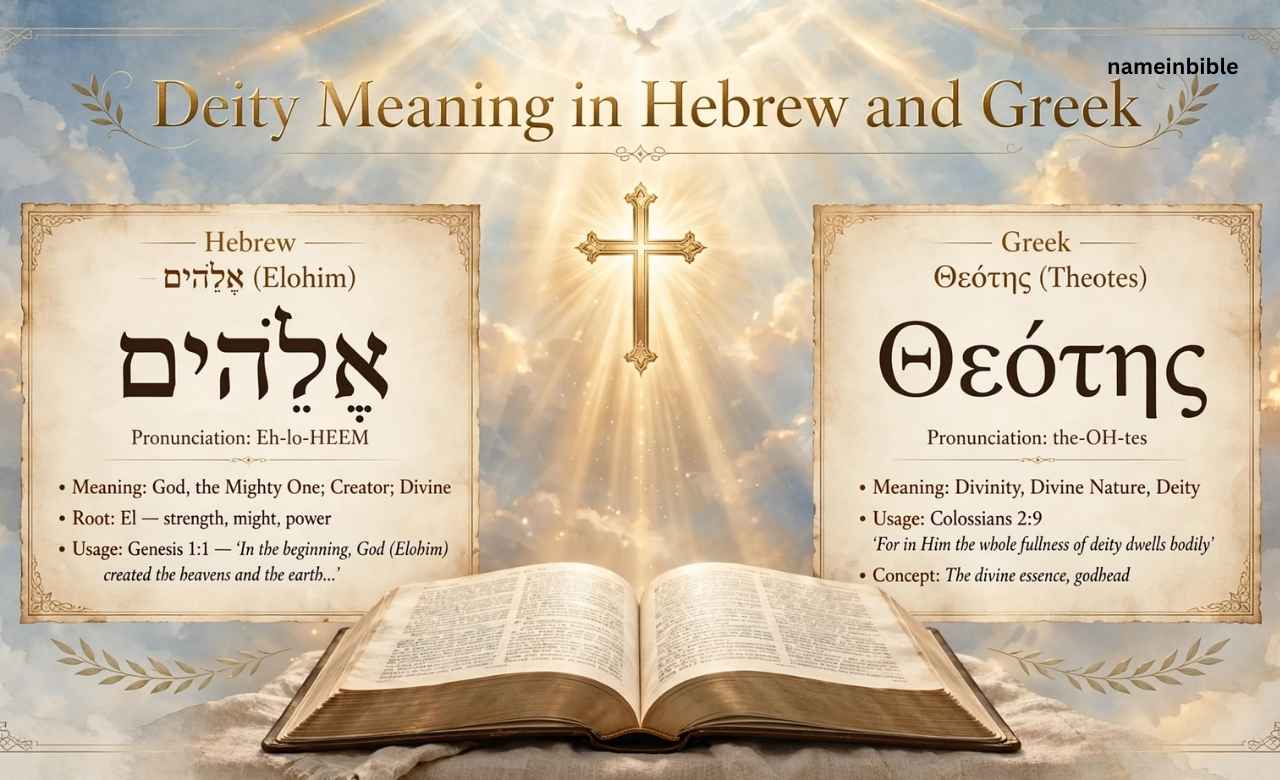
To truly grasp the depths of deity meaning in Hebrew and Greek, we have to look closely at the original languages of the Holy Bible. The biblical writers used specific terms to express God’s character, identity, and authority.
| Original Word | Language | Transliteration | Core Meaning & Usage |
| אֱלֹהִים | Hebrew | Elohim | Plural of majesty; indicates supreme power, creator, and judge. |
| אֵל | Hebrew | El | Strong, mighty, prominent; often combined with other descriptors (e.g., El Shaddai). |
| יהוה | Hebrew | Yahweh | The covenant name of God; “I AM WHO I AM”; self-existent and eternal. |
| אֲדֹנָי | Hebrew | Adonai | Lord, Master; emphasizes God’s sovereign ownership and rule. |
| Θεός | Greek | Theos | God; used for the one true God, and specifically of Jesus Christ in the New Testament. |
| Κύριος | Greek | Kyrios | Lord, Master; used to translate Yahweh in the Septuagint and applied directly to Jesus. |
The Hebrew Terms
1. Elohim (אֱלֹהִים)
Elohim is the very first name used for God in Genesis 1:1. Linguistically, it is a plural noun, yet when it refers to the one true God, it is grammatically paired with singular verbs. This “plural of majesty” or “plural of fullness” highlights the infinite greatness, divine majesty, and supreme Deity Meaning in the Bible authority of God. It hints at the rich mystery of the Trinity, which would be fully revealed in the New Testament.
2. El (אֵל)
El is the singular root word meaning “mighty, strong, or prominent.” In biblical theology, it is frequently paired with other attributes to show God’s character, such as El Elyon (Most High God) or El Shaddai (God Almighty).
3. Yahweh (יהוה) and Adonai (אֲדֹנָי)
Though often translated as “Lord” or “God,” Yahweh (often rendered as Jehovah in older translations) is the personal, covenant-keeping name of God revealed to Moses at the burning bush. It signifies His eternal, self-existent nature (“I AM”). Out of deep reverence, the Jewish people would substitute Yahweh with Adonai (Lord/Master) when reading Scripture aloud.
The Greek Terms
1. Theos (Θεός)
In the Greco-Roman world, theos was used for many pagan gods. However, New Testament writers hijacked the term to refer to the supreme Creator. Most importantly, New Testament theology uses Theos to declare the absolute deity of Jesus Christ (e.g., John 1:1, John 20:28).
2. Kyrios (Κύριος)
Meaning “Lord” or “Sovereign Ruler,” Kyrios is the Greek translation of the Hebrew Adonai and Yahweh in the Septuagint (the Greek Old Testament). When the early Christians proclaimed, “Jesus is Lord” (Kyrios Iesous), they were not just calling Him their leader; they were boldly declaring His absolute deity and equality with Yahweh.
Does Deity Mean God? Understanding the Biblical Difference
A common point of confusion for many readers is the question: does deity mean god? Is there a difference between saying “a deity” and “God”?
The answer depends entirely on capitalization and biblical context.
  Deity (Lowercase)               Deity / Godhead (Capitalized)
  -----------------               -----------------------------
  - Pagan gods or idols           - The unique divine essence
  - Created, finite spirits       - Uncreated, eternal Creator
  - Lacks true divine attributes   - All-powerful, holy, and sovereign
In the ancient Near East and the Greco-Roman world of the New Testament, people believed in many deities. These “gods” were finite, flawed, and often restricted by geography or specific roles (like a god of the sea or a goddess of fertility). In contrast, the biblical revelation of God is radically different.
When the Bible speaks of the Deity or the Godhead, it is referring to the unique, infinite, and uncreated divine nature of the one true God. There is a vast, impassable gulf between created spiritual beings (such as angels or demons, who are sometimes called “gods” in a highly qualified, lowercase sense) and the Sovereign Creator.
To say that Jesus possesses the “fullness of deity” means He is not simply a divine-like figure or a demi-god. It means He shares fully and completely in the single, uncreated divine essence of the Father.
The Deity of God the Father in Scripture
The foundational truth of biblical theology is the supreme deity of God the Father. From the opening chapters of Genesis to the Deity Meaning in the Bible closing visions of Revelation, the Father is presented as the ultimate source, the eternal Creator, and the sovereign ruler of all that exists.
- In Genesis: We see the Father speaking the universe into existence by His divine power (Genesis 1:1). He establishes covenants with humanity, guiding our ancestors on their spiritual journey.
- In Deuteronomy: Moses writes, “Hear, O Israel: The Lord our God, the Lord is one” (Deuteronomy 6:4). This confession, known as the Shema, is the cornerstone of biblical monotheism, declaring that the God of Abraham is the sole ruler of the cosmos.
- In Isaiah: The Father repeatedly asserts His exclusive divinity: “I am the first and I am the last; besides me there is no god” (Isaiah 44:6).
The Father’s deity is marked by His absolute holiness, supreme authority, and eternal power. He is the one who initiates the plan of salvation, sending His Son to redeem humanity and offering us a restored relationship with God.
The Deity of Jesus Christ: Proof from the Bible
Among all Christian doctrines, the deity of Christ meaning is arguably the most fiercely debated and yet the most essential. Is Jesus merely a great moral teacher, a prophet, or a highly elevated created being? The New Testament answers with a resounding no. Jesus is fully and eternally God.
This theological reality is known as the incarnation of Christ—the moment the eternal, uncreated Son of God took on human flesh. In theology, we call this perfect union of Jesus’ divine and human natures the hypostatic union: He is 100% God and 100% man.
The Written Proof: Three Pillar Passages
John 1:1 — The Eternal Word
“In the beginning was the Word, and the Word was with God, and the Word was God.”
John leaves no room for ambiguity. The “Word” (Logos) is Jesus Christ (as confirmed in John 1:14). John establishes that before creation existed, Christ was already present (pre-existence), He existed in perfect, face-to-face relationship with the Father, and He was, in His very nature, God.
Colossians 2:9 — The Fullness of Godhood
“For in him dwelleth all the fulness of the Godhead bodily.” (KJV)
The Greek word used here for “Godhead” is Theotes, which refers to the state of being God—deity in its absolute sense. Paul is declaring that Jesus does not merely reflect God or act with God’s permission; He embodies the entire, undiluted divine essence in human form.
Hebrews 1:3 & 8 — The Express Image of God
“He is the radiance of the glory of God and the exact imprint of his nature, and he upholds the universe by the word of his power.” (Hebrews 1:3, ESV)
“But of the Son he says, ‘Your throne, O God, is forever and ever…'” (Hebrews 1:8, ESV)
In Hebrews 1, the author makes a stunning presentation of Jesus’ deity. Not only does Jesus sustain the entire universe with His divine power, but the Father Himself addresses the Son as “God” (Theos), confirming His sovereign throne and eternal authority.
The Holy Spirit and the Doctrine of Deity
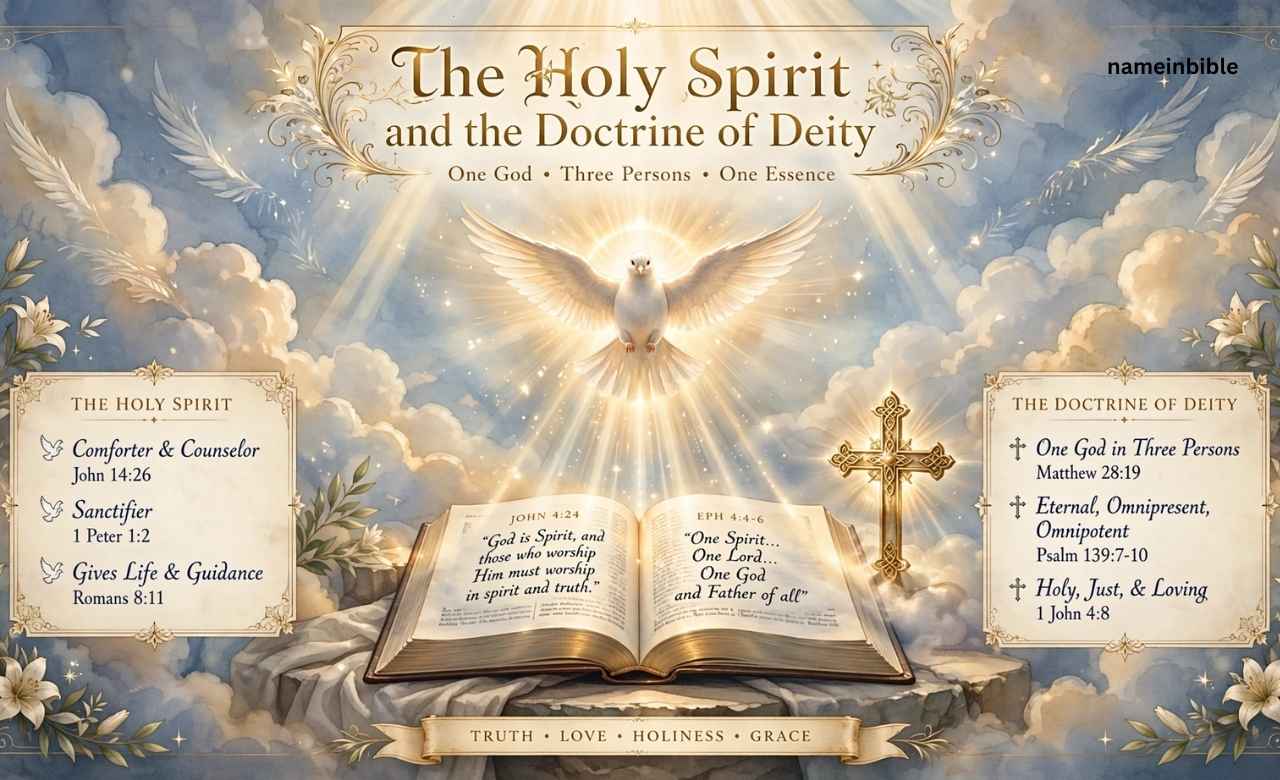
Just as the Father and the Son are fully God, the Holy Spirit is not an impersonal force or an energy wave emanated by God. The Holy Spirit is a divine person who possesses the full essence of deity.
To illustrate how these three distinct persons share the same, undivided divine nature, Christians have long Deity Meaning in the Bible used visual aids. One of the most famous and pedagogically sound diagrams is the medieval Shield of the Trinity (or Scutum Fidei), which captures the essence of early creeds like the Nicene Creed.
As shown in this historical diagram, the Christian doctrine of the Trinity teaches that:
- The Father is God, The Son is God, and The Holy Spirit is God.
- The Father is not the Son, the Son is not the Holy Spirit, and the Holy Spirit is not the Father.
- Yet, there are not three Gods, but one true God.
Biblical Proof of the Holy Spirit’s Deity
- He has the Attributes of God: The Holy Spirit is eternal (Hebrews 9:14), omnipresent (Psalm 139:7-10), and possesses infinite wisdom (1 Corinthians 2:10-11).
- He is Called God: In Acts 5:3-4, Peter confronts Ananias for lying to the Holy Spirit, telling him, “You have not lied to just men but to God.”
- He is Grouped Equitably with the Father and Son: In the Great Commission (Matthew 28:19), Jesus commands believers to baptize in the singular “name” (not names) of the Father, and of the Son, and of the Holy Spirit.
Deity in the Bible KJV: Important Verses and Their Meaning
For centuries, the King James Version (KJV) has been a beloved translation of the Holy Bible. When searching for the deity meaning in the Bible KJV, readers will notice that the translators frequently used the term “Godhead” to translate the Greek words for deity (Theiotes, Theotes, and Theion).
Let’s examine the three times “Godhead” appears in the KJV, exploring how they illuminate God’s divine nature.
1. Acts 17:29 — Godhead as Uncreated Creator
“Forasmuch then as we are the offspring of God, we ought not to think that the Godhead is like unto gold, or silver, or stone, graven by art and man’s device.”
The Meaning: Speaking to pagan philosophers at the Areopagus in Athens, the Apostle Paul argues that because humans are created in the image of God, the supreme divine nature cannot be represented by cold, lifeless idols made of metal or stone. The Godhead is living, personal, and infinitely superior to human art.
2. Romans 1:20 — Godhead Revealed in Creation
“For the invisible things of him from the creation of the world are clearly seen, being understood by the things that are made, even his eternal power and Godhead; so that they are without excuse.”
The Meaning: Paul asserts that God’s existence, eternal power, and divine character are clearly visible through the physical universe. By observing the complex beauty, order, and scale of creation, any human being can understand that a powerful, sovereign God exists.
3. Colossians 2:9 — The Fullness of Godhead in Christ
“For in him dwelleth all the fulness of the Godhead bodily.”
The Meaning: As discussed earlier, this is the ultimate defense of Jesus’ deity in the KJV. It warns believers against worldly philosophies that try to separate Jesus from His true, eternal identity as the Creator.
God’s Divine Nature According to the Bible
When we talk about the divine nature of God, we are diving into what theologians call the attributes of God. These are the inherent characteristics that define who God is. We can divide these into two categories:
- Incommunicable Attributes: Characteristics that belong only to God (e.g., His infinite, eternal nature).
- Communicable Attributes: Characteristics that humans can reflect, though in a finite and imperfect way (e.g., love, justice, mercy).
Key Elements of God’s Divine Nature
Holiness
To say God is holy means He is completely set apart from creation and entirely free from any moral Deity Meaning in the Bible stain or imperfection. Isaiah 6:3 records the angels crying out, “Holy, holy, holy is the Lord of hosts; the whole earth is full of his glory!” His holiness demands our deepest worship and reverence.
Omnipotence (All-Powerful)
There is no limit to God’s divine power. He speaks universes into existence, commands the weather, and orchestrates history. As Jeremiah 32:17 exclaims, “Ah, Lord God! It is you who have made the heavens and the earth by your great power… Nothing is too hard for you.”
Omniscience (All-Knowing)
God’s wisdom is absolute. He knows the past, present, and future simultaneously, down to the very thoughts of our hearts. Psalm 147:5 declares, “Great is our Lord, and abundant in power; his understanding is beyond measure.”
Eternal Nature
God has no beginning and no end. He exists outside of the constraints of time. He is the “Alpha and the Omega, the first and the last, the beginning and the end” (Revelation 22:13).
Spiritual Meaning of Deity in Everyday Christian Life
The biblical doctrine of deity is not just a dry topic for academic debate. It is a vibrant, living truth that has practical, daily implications for your personal spiritual journey, relationship with God, and Christian discipleship.
It Inspires True Worship in Spirit and Truth
When you understand that God is not just a “benevolent force” but the supreme, holy, and sovereign Creator, your worship shifts. It transitions from casual songs to deep, heartfelt adoration. Knowing Deity Meaning in the Bible His divine majesty compels us to bow before Him, offering our obedience and lives as living sacrifices.
It Secures Our Salvation
The deity of Christ is the very foundation of biblical salvation. If Jesus were only a man, His death on the cross would have been insufficient to pay the infinite penalty of humanity’s sin. Because Jesus is fully God, His sacrifice has infinite value and power, offering eternal life and a guaranteed relationship with God to all who place their trust in Him.
It Fuels Radical Faith and Prayer
Knowing that the Sovereign Lord of the universe hears your prayers changes how you pray. You can step into your spiritual life with absolute trust, knowing that the one who holds your future is both all-powerful (omnipotent) and deeply loving. In times of trial, we can rest in God’s promises because He has the supreme authority to fulfill them.
Common Misunderstandings About Deity in Christianity
Throughout the history of Christian theology, several myths and heresies have emerged regarding the concept of deity, the Trinity, and the nature of Jesus Christ. Correcting these misunderstandings is vital for maintaining a healthy biblical faith.
Myth 1: “The Trinity Means Christians Worship Three Gods”
This is the error of Tritheism. The Bible is strictly monotheistic (Deuteronomy 6:4). Christians do not worship three separate deities. We worship one God who eternally exists as three distinct, co-equal persons: the Father, the Son, and the Holy Spirit. They are one in essence, yet distinct in relationship.
Myth 2: “Jesus Became God at His Baptism or Resurrection”
This ancient heresy, known as Adoptionism, claims that Jesus was born a mere human and was “adopted” into deity by God because of His sinless life. The Bible refutes this by showing that the Word was God in the beginning (John 1:1) and that He is the eternal Creator of all things.
Myth 3: “The Holy Spirit is Just God’s ‘Force’ or ‘Energy'”
Many people struggle to view the Holy Spirit as a person. However, Scripture consistently shows the Spirit engaging in personal actions: He speaks (Acts 13:2), He can be grieved (Ephesians 4:30), He teaches (John 14:26), and He distributes spiritual gifts according to His own will (1 Corinthians 12:11). The Holy Spirit is fully God and fully personal.
12. Bible Verses About Deity Everyone Should Know
To build a strong foundation in biblical truth, here are 12 essential Bible verses highlighting the deity of God, Christ, and the Holy Spirit, accompanied by brief commentary.
1. John 1:1
“In the beginning was the Word, and the Word was with God, and the Word was God.”
- Significance: Proves the pre-existence and absolute deity of Jesus Christ, the eternal Word.
2. Colossians 2:9
“For in him the whole fullness of deity dwells bodily.”
- Significance: Confirms that Jesus is not just a messenger of God; He is fully God in physical form.
3. Titus 2:13
“…waiting for our blessed hope, the appearing of the glory of our great God and Savior Jesus Christ.”
- Significance: A direct New Testament declaration calling Jesus both “our great God” and “Savior.”
4. Hebrews 1:8
“But of the Son he says, ‘Your throne, O God, is forever and ever…'”
- Significance: The Father Himself addresses the Son as “God,” establishing His eternal sovereign rule.
5. Isaiah 9:6
“For to us a child is born, to us a son is given… and his name shall be called Wonderful Counselor, Mighty God, Everlasting Father, Prince of Peace.”
- Significance: An Old Testament messianic prophecy predicting that the coming Messiah would be the “Mighty God.”
6. John 8:58
“Jesus said to them, ‘Truly, truly, I say to you, before Abraham was, I am.'”
- Significance: Jesus claims the divine name of Yahweh (I AM) for Himself, which is why the religious leaders tried to stone Him for blasphemy.
7. Acts 5:3-4
“…Ananias, why has Satan filled your heart to lie to the Holy Spirit… You have not lied to man but to God.”
- Significance: Equates lying to the Holy Spirit with lying directly to God, proving the Spirit’s deity.
8. Deuteronomy 6:4
“Hear, O Israel: The Lord our God, the Lord is one.”
- Significance: The foundational confession of Jewish and Christian monotheism.
9. Revelation 1:8
“‘I am the Alpha and the Omega,’ says the Lord God, ‘who is and who was and who is to come, the Almighty.'”
- Significance: Establishes the eternal power and supreme, timeless authority of God.
10. John 10:30
“I and the Father are one.”
- Significance: Jesus asserts His absolute unity in essence and nature with God the Father.
11. Philippians 2:5-6
“…Christ Jesus, who, though he was in the form of God, did not count equality with God a thing to be grasped…”
- Significance: Affirms that Jesus possessed the very nature of God before emptying Himself to become a servant.
12. 1 Timothy 3:16
“And without controversy great is the mystery of godliness: God was manifest in the flesh, justified in the Spirit, seen of angels…” (KJV)
- Significance: A beautiful summary of the incarnation, celebrating the mystery of God revealing Himself in human form.
Deity Synonyms and Biblical Words with Similar Meanings
To enrich your study of Scripture, it is helpful to look at biblical synonyms and related terms that carry the same Deity Meaning in the Bible weight as “deity” or “divine nature.”
- God (Elohim / Theos): The most common term pointing to the supreme, eternal Creator.
- Lord (Yahweh / Kyrios / Adonai): Highlights His supreme authority, sovereign ownership, and covenant relationship with His people.
- Almighty (El Shaddai / Pantokrator): Emphasizes His limitless power and sovereign strength over all creation.
- Creator (Boreh): Points to His role as the uncreated author and architect of the universe.
- Sovereign (Sovereign Lord): Reflects His absolute right to rule, govern, and guide history according to His perfect will.
By understanding these terms, we see that the deity meaning in the Bible is not a cold, abstract philosophical concept. It is the vivid reality of a personal, loving, holy, and infinite God who stepped into history, revealed Himself in human flesh, and invites us into an eternal relationship with Him.
Understanding Deity: The Ultimate Biblical and Theological Guide
When we open the pages of the Holy Bible, we are not merely reading historical accounts or moral guidelines; we are stepping into a profound encounter with the divine nature. One of the most critical concepts in all of Christian theology is understanding the deity meaning in the Bible.
Whether you are a seasoned scholar, a curious believer on a spiritual journey, or someone exploring the Christian Deity Meaning in the Bible faith for the first time, getting to the heart of what a “divine being” is changes how you read Scripture. This guide explores the historical, linguistic, and theological facets of deity in the Bible, unpacking the eternal nature, supreme authority, and glorious presence of the one true God.
Frequently Asked Questions
What is the biblical meaning of deity?
The biblical meaning of deity refers to God’s divine nature, eternal existence, supreme authority, and perfect holiness. In the Bible, deity describes the one true God and affirms that Jesus Christ and the Holy Spirit fully share in this same divine nature.
What is the deity of Jesus?
The deity of Jesus means that Jesus Christ is fully God as well as fully man. Scriptures such as John 1:1, Colossians 2:9, and Hebrews 1:3 reveal that Jesus possesses the fullness of God’s divine nature and is worthy of worship.
Is a deity a spirit?
God is Spirit (John 4:24), but the word deity refers to God’s divine essence rather than simply being a spirit. In the Bible, deity emphasizes God’s eternal Deity Meaning in the Bible nature, power, holiness, and unique identity as the one true God.
What is an example of deity?
The greatest example of deity in the Bible is the one true God revealed as the Father, the Son, and the Holy Spirit. Jesus Christ is also a perfect example of deity because He is fully divine while living among humanity, as declared in Colossians 2:9.
Conclusion
Understanding the deity meaning in the Bible is essential for knowing who God truly is and why He alone deserves our worship. The Bible reveals that deity is far more than a title it describes God’s eternal divine nature, absolute holiness, limitless power, and sovereign authority over all creation. From Genesis to Revelation, Scripture consistently proclaims that there is one true God, and that Jesus Christ and the Holy Spirit fully share in that same divine nature.
As we’ve explored the definition of deity in the Bible, the original Hebrew and Greek words, and the deity meaning in the Bible KJV, one truth becomes unmistakably clear: God is eternal, unchanging, and worthy of complete trust. The biblical doctrine of deity forms the foundation of Christian faith, helping believers understand God’s character, His plan of salvation, and His everlasting presence in our lives. May you like other article Eloise Meaning in the Bible: Biblical Meaning, Origin & Spiritual Significance

Welcome to NameInBible. I am Victoria, a Christian writer passionate about exploring biblical name meanings, Scripture-based insights, and powerful prayers. My goal is to help readers discover the spiritual significance of names and grow closer to God through faith-filled content.