
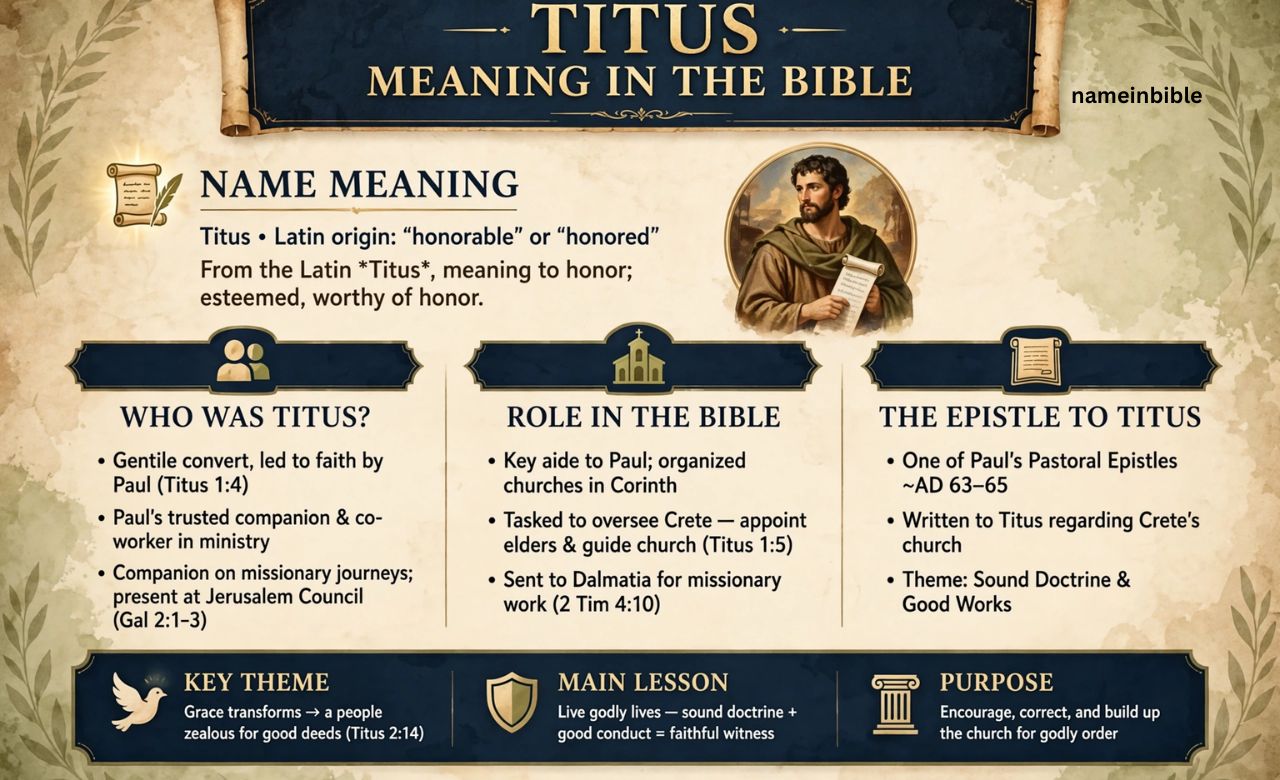
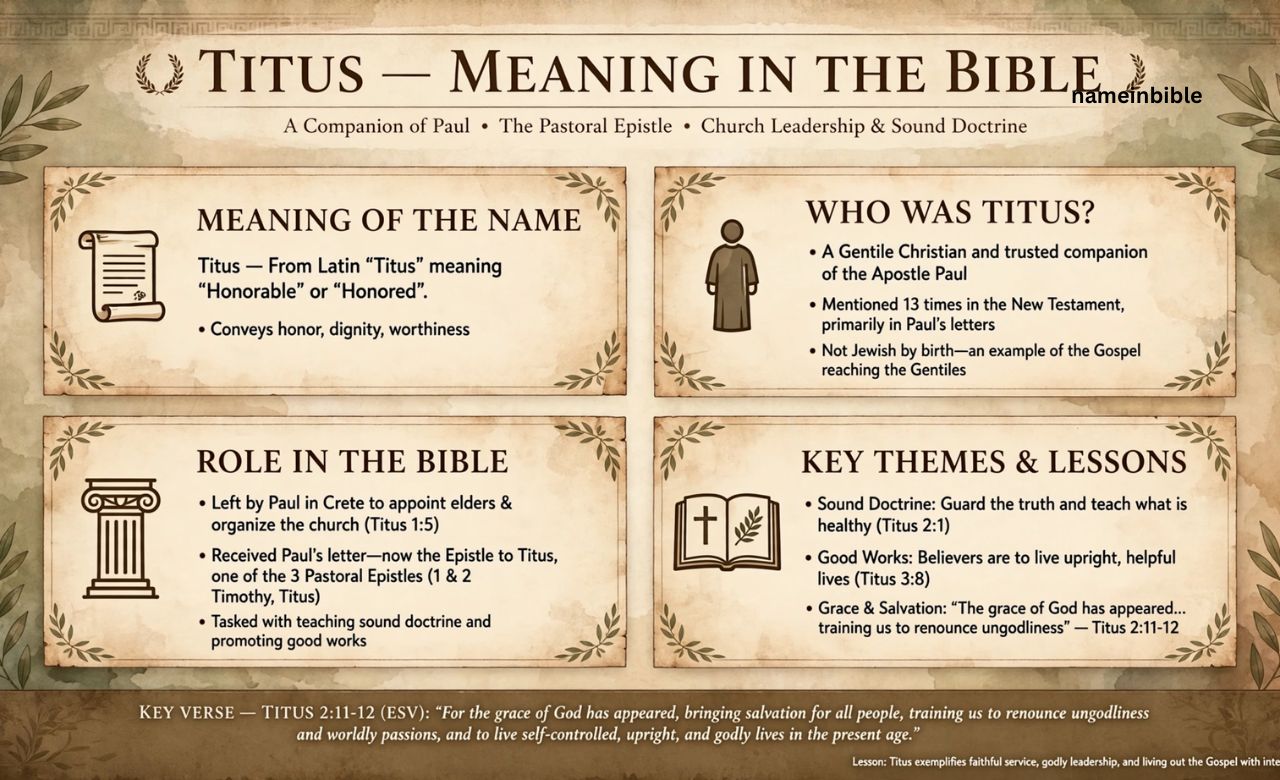
Every name in the Bible carries a story, but some names leave a lasting spiritual legacy. The Titus meaning in Bible is one of faithfulness, courage, and unwavering commitment to God’s truth. If you’ve ever wondered what does the name Titus mean in the Bible, what does Titus mean, or searched for the true meaning of Titus in the Bible, you’ll discover that Titus was far more than a trusted companion of the Apostle Paul. His life Titus Meaning in the Bible reflects the qualities of a servant leader integrity, wisdom, humility, and steadfast faith that continue to inspire Christians across generations.
The Titus meaning goes beyond its linguistic origin; it points to a life devoted to Christian leadership and spiritual maturity. Throughout the New Testament, Titus played a crucial role in strengthening the early church, encouraging believers, and defending sound doctrine in challenging times. Whether you’re studying Scripture, exploring Titus Meaning in the Bible biblical names, choosing a meaningful Christian baby name, or seeking deeper spiritual insight, this guide will uncover the Titus meaning in Bible, explain what does the name Titus mean in the Bible, and reveal why his remarkable example remains a powerful model of faithful living today.
What Does Titus Mean in the Bible?
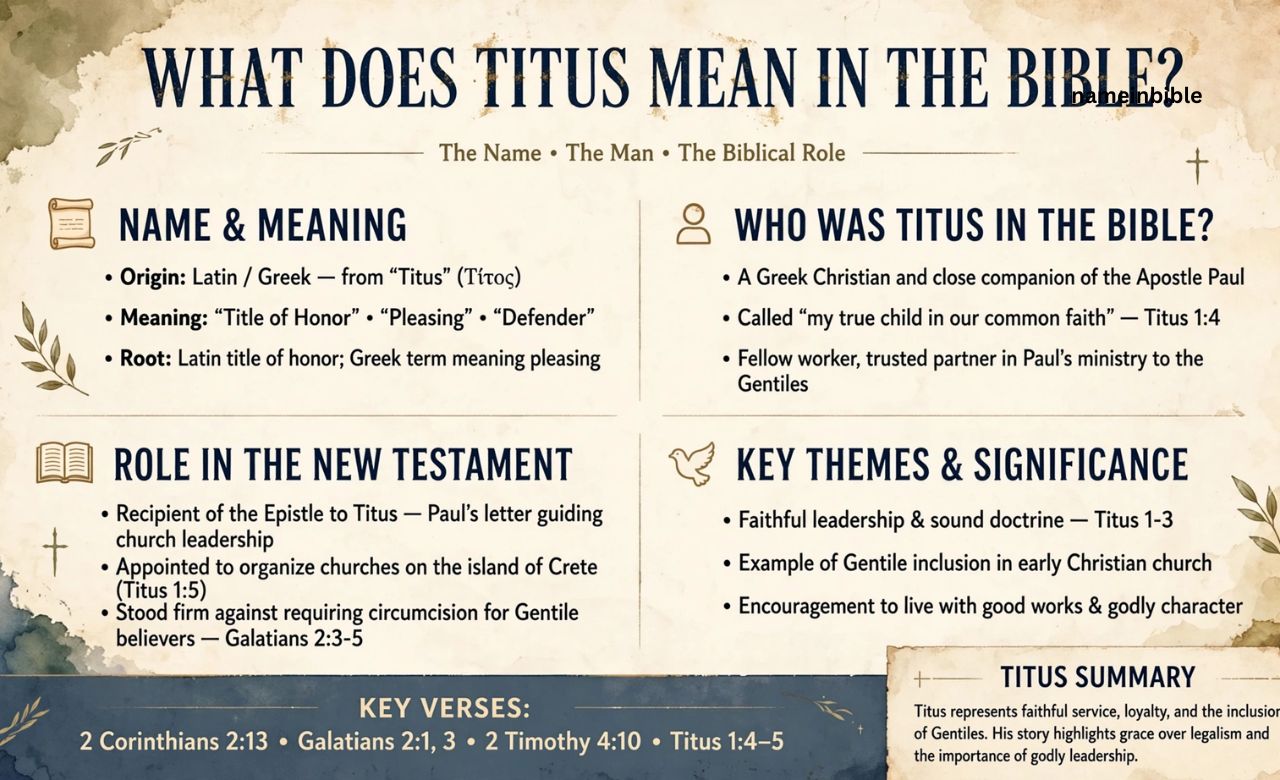
When exploring Titus Meaning in the Bible, we encounter more than just an ancient name; we uncover an identity deeply linked to structural integrity, resilience, and early Christian development. In the context of the New Testament, Titus serves as a vital Titus Meaning in the Bible anchor point for early believers navigating cultural transitions and institutional growth.
The Biblical Definition of the Name Titus
In Holy Scripture, the biblical meaning of Titus cannot be understood in isolation from the historical figures who bore it. While the name itself carries secular roots, its theological and structural definition within the text emerges from the functional execution of Christian ministry.
Titus is defined not by mystical visions, but by practical execution:
- The Blueprint Builder: He was a fixer sent to chaotic environments to build orderly, lasting leadership frameworks.
- The Cultural Bridge: As an uncircumcised Gentile who was fully accepted into leadership, his presence legally and structurally defined the universal scope of the early Christian faith.
- The Trusted Representative: The name stands as a synonym for structural reliability, representing someone who protects administrative and theological purity under extreme pressure.
Why the Name Titus Still Matters to Christians Today
The modern relevance of Titus lies in his role as an archetype for everyday Christian living and structured Christian leadership. In a contemporary culture that often prioritizes rapid, shallow expansion over internal stability, the biblical role of Titus serves as a direct counter-weight.
For believers today, Titus represents the necessity of balancing deep theological convictions with pragmatic, everyday execution. His legacy proves that spiritual maturity is not merely an internal feeling, but a measurable state characterized by self-control, moral character, and structural integrity. Whenever modern believers confront Titus Meaning in the Bible institutional chaos, ethical compromises, or internal divisions within a local assembly, the legacy of Titus provides a proven blueprint for restoration.
Titus Name Meaning in Greek and Biblical Origin
To fully grasp the meaning of Titus in the Bible, we must examine the linguistic, historical, and geopolitical landscape of the first-century Greco-Roman world. The etymological roots of the name reveal the exact cultural expectations placed upon individuals who bore it.
Greek Meaning of Titus
The Titus name meaning originates outside of ancient Israel. It is derived from the Latin praenomen Titus, which was Titus Meaning in the Bible widely integrated into the Greek-speaking regions of the eastern Roman Empire as Τίτος (Titos). Etymologically, the name is linked to the Latin verb tueor, which translates directly to:
- “To protect”
- “To defend”
- “To guard”
Consequently, the widely accepted Titus meaning in Greek and Roman contexts is “defender,” “guardian,” or “honored.”
In classical antiquity, this name carried connotations of physical strength, civil responsibility, and legal protection. When the Apostle Paul chose Titus as his administrative representative, this linguistic identity perfectly matched his functional assignments: guarding the purity of sound doctrine against subversion and defending vulnerable congregations from predatory teachers.
Is Titus a Hebrew or Greek Name?
When researching Titus meaning in Hebrew, modern readers frequently look for an Old Testament equivalent or a Semitic root. However, historical and linguistic evidence confirms that Titus is strictly a Roman name of Latin origin, transliterated into Greek, with no native Hebrew origin.
Unlike other early Christian figures who possessed dual names (such as Saul, who also went by Paul, or John Mark), Titus is referred to exclusively by his Gentile name throughout the entire text of the New Testament. This linguistic distinction carries immense theological weight.
By retaining an explicitly non-Hebrew, non-Jewish name while operating at the highest levels of apostolic administration, Titus stood as a living testament to a core reality: salvation through the gospel of Jesus Christ was fully accessible to Gentiles apart from ethnic or ceremonial Jewish identities.
| Linguistic Layer | Original Form | Literal Translation | Functional Context in Scripture |
| Latin Root | Titus / Tueor | To guard, protect, shield | Guarding the deposit of faith from corruption |
| Greek Form | Τίτος (Titos) | Honored, esteemed defender | Appointing elders and defending sound doctrine |
| Hebrew Status | None | N/A (Gentile origin) | Proving the inclusion of the nations without legalism |
Who Was Titus in the Bible?
When asking who was Titus in the Bible, we must look beyond the short letter that bears his name. He was a foundational administrative operative within the first-century missionary movement, tasked with managing some of the most volatile and fractured environments in the early Church.
Titus as a Trusted Companion of Apostle Paul
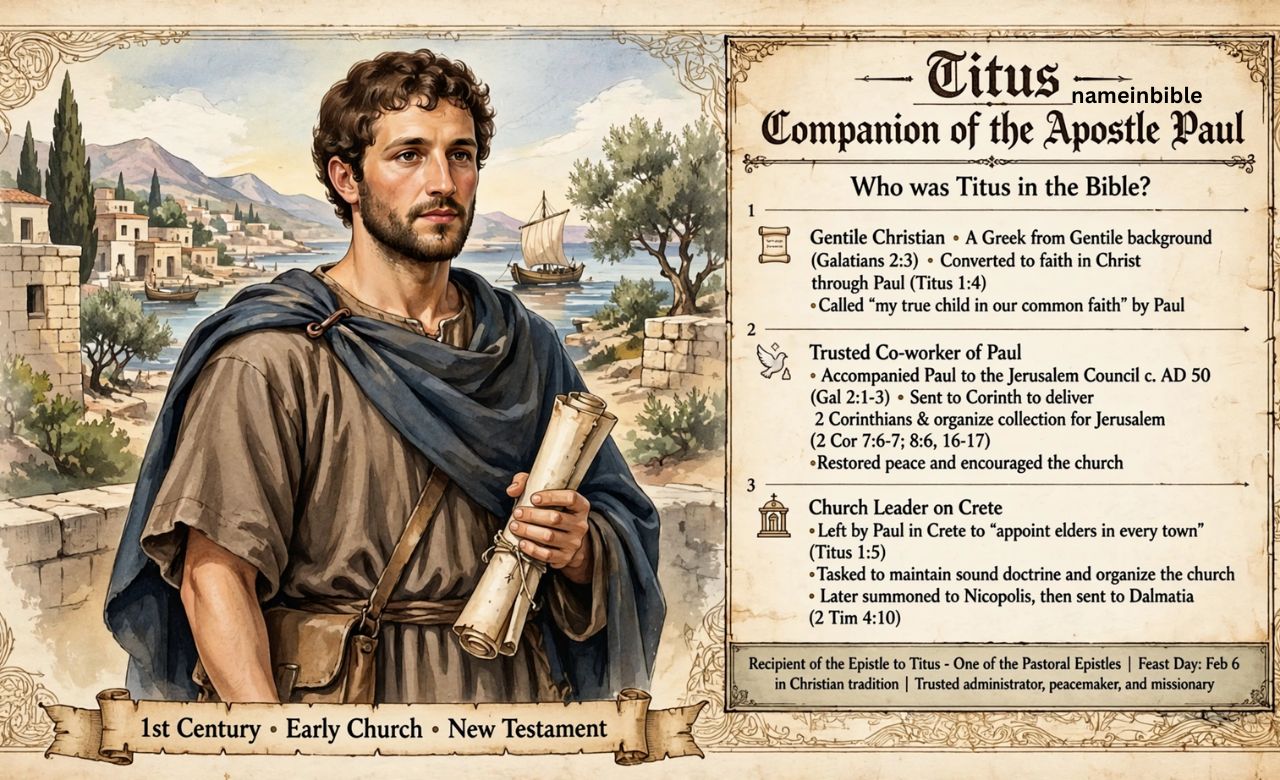
The historical relationship between the Apostle Paul and Titus was forged through decades of shared crises. Paul refers to Titus using deeply affectionate yet intensely professional terms, calling him “my true Titus Meaning in the Bible child in a common faith” (Titus 1:4) and “my partner and fellow worker” (2 Corinthians 8:23).
Unlike Timothy, who is frequently portrayed as possessing a more sensitive disposition requiring regular Titus Meaning in the Bible personal encouragement, Titus emerges in the text as a resilient, highly capable operative. When a specific church suffered from deep internal dysfunction, financial mismanagement, or ethical rebellion, Paul consistently dispatched Titus to resolve the issue. The Paul and Titus relationship was built on an unshakeable foundation of mutual trust and shared strategic execution.
Titus’ Mission in the Early Church
The historical record indicates that the biblical role of Titus was defined by high-stakes diplomacy and organizational restructuring across three major geographical hubs:
- The Jerusalem Council: Titus accompanied Paul and Barnabas to Jerusalem as a critical test case for the gospel itself. As an uncircumcised Greek believer, his presence forced the apostolic leadership to explicitly decide whether Gentile converts had to adopt Jewish ceremonial laws. The council’s refusal to force circumcision upon Titus was a historic victory for Christian liberty.
- The Crisis in Corinth: The church at Corinth was notoriously fractured, facing moral scandals and open rebellion against Paul’s authority. After previous visits by other emissaries Titus Meaning in the Bible failed to restore order, Paul sent Titus with a severe letter of correction. Titus successfully navigated the emotional hostility, collected the relief fund for poor believers, and guided the Corinthian church back to structural health.
- The Church in Crete: Following his release from his first Roman imprisonment, Paul traveled to the island of Crete with Titus. Finding the local house churches in complete disarray, Paul left Titus behind to establish permanent structural order.
What Is the Book of Titus About?
The Epistle to Titus is one of the three Pastoral Epistles found in the New Testament, alongside 1 and 2 Timothy. Written by Paul around the mid-60s AD, this compact letter serves as a dense, hyper-practical field guide for church administration and community transformation.
[Paul's Epistle to Titus]
       │
       ├──► 1. Structural Order (Appointing qualified Elders)
       │
       ├──► 2. Sound Doctrine (Refuting Cretan cultural vices)
       │
       └──► 3. Public Good Works (Living out faith in civil society)
Key Themes of the Epistle to Titus
A comprehensive Book of Titus summary reveals three core themes that form the framework of the entire letter:
- The Qualification of Godly Leaders: Paul explicitly outlines the absolute prerequisites for church elders. Leadership is never awarded based on raw talent, personal charisma, or secular wealth. Instead, a leader must display verifiable, long-term stability in their family life, personal ethics, and emotional self-control.
- The Enforcement of Sound Doctrine: The text places an urgent emphasis on matching theological clarity with practical living. Titus is commanded to silence false teachers who use religion for financial exploitation. True doctrine must directly produce a visible transformation in how older men, older women, young women, young men, and servants behave within their daily spheres of influence.
- The Motivation for Good Works: Paul repeatedly emphasizes that good works do not earn salvation. Instead, beautiful, public actions are the mandatory, inevitable byproduct of experiencing saving grace. Believers are instructed to be model citizens, avoid Titus Meaning in the Bible foolish arguments, and actively dedicate their lives to solving practical problems within human society.
Important Bible Verses from Titus
To truly understand what is the Book of Titus about, one must memorize and study its key structural hinges. The text moves seamlessly from administrative commands to profound theological declarations that ground those commands:
Titus 1:5: “This is why I left you in Crete, so that you might amend what was defective, and appoint elders in every town as I directed you.”
This verse establishes the primary administrative objective of the letter: transforming an unorganized, chaotic movement into a structured, self-sustaining network of mature local assemblies.
Titus 2:11-12: “For the grace of God has appeared, bringing salvation for all people, training us to renounce ungodliness and worldly passions, and to live self-controlled, upright, and godly lives in the present age.”
Here, Paul reveals the true engine behind Christian ethics. Grace is not an excuse for moral laziness; it is an active training instructor that shapes human desires, equipping believers to model profound self-control in an unstable world.
Titus 3:5: “He saved us, not because of works done by us in righteousness, but according to his own mercy, by the washing of regeneration and renewal of the Holy Spirit.”
This text serves as the theological core of the letter, anchoring all practical duties in the unmerited mercy of God. Good works are positioned properly as the fruit of salvation, never the root.
Spiritual Meaning of Titus in Christianity
Looking at the spiritual meaning of Titus, his life serves as a clear blueprint for how internal spiritual transformation must express itself through external structural order.
Titus as a Symbol of Faithful Leadership
In historical Christian theology, Titus is recognized as a living symbol of faithful leadership and unshakeable loyalty. While other figures in the New Testament are remembered for their grand public orations or dramatic martyrdoms, Titus is celebrated for his quiet, unflagging consistency in the background of early church history.
He symbolizes the corporate structural health of the Church. His life proves that true spiritual responsibility is found in doing the difficult work of organizing communities, managing financial collections transparently, and confronting false teachings directly. He stands as a reminder that the Titus Meaning in the Bible health of any ministry depends entirely on the moral character and integrity of those operating within its infrastructure.
Spiritual Lessons for Everyday Christian Living
The narrative of Titus provides vital Titus spiritual lessons designed for ordinary believers navigating daily life:
- Character Trumps Environment: The island of Crete was infamous in antiquity for its cultural dishonesty and unchecked moral decline. Yet, Titus proved that a believer can maintain absolute purity and distinctiveness even when fully immersed in a toxic, hostile culture.
- True Faith Produces Tangible Order: Internal spiritual growth should naturally manifest as orderly conduct, structured personal habits, and reliable relationships. A chaotic, deceitful life is fundamentally incompatible with the indwelling power of the Holy Spirit.
- The Vital Importance of Christian Mentorship: Titus did not develop his exceptional character in isolation. His life highlights the immense value of spiritual mentorship. By walking closely alongside Paul, absorbing his wisdom, and accepting his corrections, Titus grew into an expert leader capable of carrying the mission forward independently.
Character Study of Titus in the Bible
An analytical character study of Titus reveals a mature executive who excelled under pressure. He was a strategic leader who possessed a rare combination of theological precision, emotional intelligence, and administrative grit.
Qualities That Made Titus an Effective Leader
When we dissect the biblical text, we can isolate the exact biblical leadership qualities that made Titus so exceptionally effective:
- High Emotional Intelligence and Mediation Skills: Managing the Corinthian church required immense diplomacy. Titus could deliver hard truths without causing unnecessary alienation, successfully transforming their toxic defensive posture into deep godly grief and organizational repentance.
- Absolute Financial Integrity: In 2 Corinthians, Paul highlights that when Titus managed the massive, multi-regional financial collection for the impoverished saints in Jerusalem, he did so with flawless transparency. No one could accuse him of financial manipulation or taking personal advantage of church resources.
- An Unshakable Identity as a Faithful Servant of God: Titus never showed anxiety about operating in the shadow of the Apostle Paul. He possessed the rare security of a true leader who did not require constant public adulation; he simply focused on executing his Titus Meaning in the Bible assigned mission with total focus.
What Christians Can Learn from His Character
For contemporary believers seeking long-term spiritual maturity, Titus’ character provides three indispensable principles:
- Develop a Resilient Spirit: Never run away from complex, messy ministry situations. When assigned to Crete a highly challenging territory Titus did not complain about the cultural difficulty. He simply rolled up his sleeves and systematically built stable foundations.
- Ensure Your Life Matches Your Doctrine: A Christian’s personal lifestyle must never contradict their public theology. If a person teaches truth but lives a chaotic, undisciplined life, they completely undermine the message of the gospel.
- Lead Exclusively Through Loving Humility: Titus did not rule over the churches like an authoritarian dictator. He led by providing a clear Christian example, working directly alongside people, and earning their deep respect through visible integrity and genuine care.
Bible Verses That Mention Titus
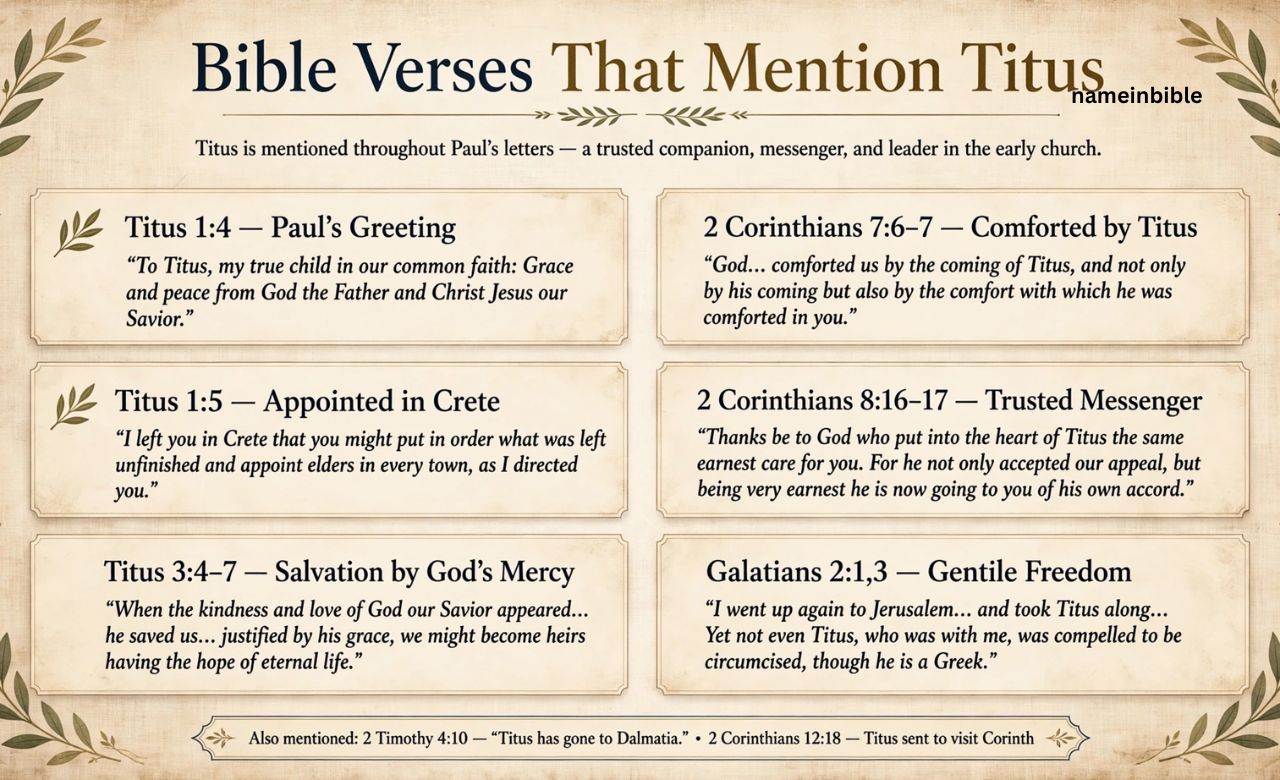
Because Titus is completely absent from the narrative of the Book of Acts (likely due to Luke’s specific focus or personal connections), our entire understanding of his life must be pieced together from explicit mentions Titus Meaning in the Bible across Paul’s personal correspondence.
Titus in 2 Corinthians
The Book of 2 Corinthians contains the densest concentration of biographical data regarding Titus. Here, Paul pulled back the curtain to reveal how deeply he relied on Titus’ operational skill during the lowest points of his apostolic ministry.
- 2 Corinthians 2:13: “My spirit was not at rest because I did not find my brother Titus there. So I took leave of them and went on to Macedonia.”
- 2 Corinthians 7:6: “But God, who comforts the downcast, comforted us by the coming of Titus.”
- 2 Corinthians 7:13: “And besides our own comfort, we rejoiced still more at the joy of Titus, because his spirit has been refreshed by you all.”
- 2 Corinthians 8:16: “But thanks be to God, who put into the heart of Titus the same earnest care I have for you.”
- 2 Corinthians 8:23: “As for Titus, he is my partner and fellow worker for your benefit.”
These Bible verses about Titus demonstrate that he was not an interchangeable administrative assistant. He was an invaluable source of personal encouragement and emotional strength to Paul.
Titus in Galatians and 2 Timothy
Outside of the Corinthian correspondence and the specific letter addressed to him, Titus appears at two critical historical goalposts that define the beginning and the absolute end of Paul’s ministry.
- Galatians 2:1: “Then after fourteen years I went up again to Jerusalem with Barnabas, taking Titus along with me.”
- Galatians 2:3: “But even Titus, who was with me, was not forced to be circumcised, though he was a Greek.”
These verses establish Titus’ historical presence at the very core of the theological battle for the purity of the gospel, serving as a historic shield for Gentile Christian freedom.
- 2 Timothy 4:10: “For Demas, in love with this present world, has deserted me and gone to Thessalonica. Crescens has gone to Galatia, Titus to Dalmatia.”
Written from a cold Roman dungeon just moments before Paul’s execution, this final verse reveals that while others abandoned the mission out of fear, Titus remained fully engaged, traveling north to the rugged frontier of Dalmatia (modern-day Croatia) to continue expanding the early Church.
Facts About Titus in the Bible You Should Know
To build an accurate profile of this vital New Testament figure, we must separate popular cultural assumptions from concrete biblical data.
Lesser-Known Biblical Facts About Titus
- He is never mentioned a single time in the Book of Acts: Despite his monumental role in the early Church, the author Luke never lists him by name. Scholars theorize this omission may have been a deliberate strategy to protect Titus’ legal safety during a time of intense Roman scrutiny, or that Titus may have been a close relative of Luke himself.
- He was the ultimate financial administrator of the early Church: Titus was personally responsible for organizing, collecting, and securing the famous “Jerusalem Collection”—the highly sensitive international relief fund gathered from Gentile churches to save poor Jewish believers from famine.
- He was specifically chosen for his toughness: Paul did not send Titus to easy, comfortable locations. He intentionally dispatched him to Corinth to handle open rebellion, and left him in Titus Meaning in the Bible Crete to confront deeply entrenched cultural corruption.
Why Titus Was Important in the Early Church
Without Titus’ exceptional organizational interventions, the early Christian movement could have easily fractured into isolated, competing factions. He successfully prevented a permanent theological split between Jewish and Gentile believers during the Jerusalem Council.
Furthermore, his administrative work in Crete and Corinth established the operational template for how autonomous local churches should be structured and governed for centuries to come. He translated abstract theology into functional, everyday reality.
Was Titus Married and Did He Have a Family?
When exploring the personal lives of historical biblical figures, modern readers often look for clues regarding their marital status and family dynamics.
What the Bible Actually Says
The canonical text of the New Testament provides absolutely zero details regarding Titus’ marital status, family background, or domestic life. Scripture focuses exclusively on his public apostolic ministry, his travels, and his moral character.
However, in the text of the letter written to him, Paul provides exhaustive criteria for the selection of church elders, noting that they should be “the husband of one wife” and have “faithful children” (Titus 1:6). While some historical commentators suggest that Titus must have modeled these exact parameters in his own life to preach them effectively, this remains an inference rather than an explicit biblical fact.
Common Misconceptions About Titus
A frequent misconception is that because Titus was a prominent leader, he must have traveled with a wife, similar to the Apostle Peter (Cephas), whose missionary travels with his wife are explicitly mentioned in 1 Corinthians 9:5.
However, given the highly volatile, unpredictable, and dangerous nature of Titus’ specific troubleshooting assignments, most church historians believe he likely remained unmarried during his active missionary years, adopting an ascetic lifestyle similar to Paul to maximize his operational flexibility.
How Did Titus in the Bible Die?
The New Testament ends its narrative of Titus while he is still actively engaged in ministry, leaving a historical gap regarding his final days.
Historical Traditions About His Death
Because the Bible does not record his final moments, we must look to early church history and patristic tradition to answer how did Titus in the Bible die. According to the widely Titus Meaning in the Bible accepted accounts recorded by the ancient church historian Eusebius of Caesarea and early liturgical traditions:
- Titus returned from Dalmatia to the island of Crete after the martyrdom of the Apostle Paul.
- He spent his remaining decades serving as the revered Archbishop of Gortyn, systematically building up the Cretan church network.
- Unlike many of his apostolic contemporaries who suffered violent execution, tradition states that Titus died peacefully of old age at 94 around the year 107 AD.
To this day, Saint Titus is venerated as the patron saint of Crete, and the ruins of the ancient Basilica of Agios Titos in Gortyn stand as a historical monument to his enduring legacy.
What Scripture Reveals and What It Doesn’t
We must maintain a clear distinction between historical tradition and inspired scripture:
| Category | Scriptural Record | Patristic Tradition |
| Last Known Location | Dispatched to Dalmatia (2 Tim 4:10) | Returned to Crete as Archbishop |
| Manner of Death | Unrecorded in the Bible | Peaceful passing of natural causes |
| Age at Death | Unrecorded in the Bible | Died at 94 years old (~107 AD) |
Is Titus a Good Biblical Name for a Baby?
For modern parents exploring biblical names and meanings, Titus has experienced a significant modern revival. It balances a strong, historic phonetic sound with profound spiritual weight.
Christian Meaning for Modern Parents
When choosing among Christian baby names, Titus offers an exceptional option for families seeking a name that implies strength, protection, and deep integrity.
It carries none of the tragic narrative baggage associated with names like Samson or Jonah. Instead, choosing the name Titus Titus Meaning in the Bible connects a child directly to a legacy of trustworthiness, intellectual depth, and faithful service to the truth.
Personality Traits Associated with Titus
Based on the explicit record of his life in the New Testament, the name Titus is historically associated with several distinct Titus personality traits:
- Reliability: Someone who can be completely trusted with sensitive tasks and valuable resources.
- Emotional Resilience: The ability to remain calm, balanced, and composed when placed in highly chaotic or stressful environments.
- Diplomatic Wisdom: A natural capacity to build bridges, resolve complex conflicts, and guide divided people toward peace.
- Uncompromising Integrity: A steadfast dedication to living out one’s core convictions with transparency and honor.
Titus Meaning in Dreams and Biblical Symbolism
From a metaphorical perspective, names in scripture often carry symbolic value that extends into the realm of Christian Titus Meaning in the Bible reflection and spiritual discernment.
Seeing the Name Titus in a Dream
In the context of modern Christian discussions regarding dream interpretation, hearing or seeing the name Titus is often understood as a symbolic message regarding order and spiritual alignment.
Because of his functional role in the New Testament, dreaming of Titus is frequently interpreted as a call to:
- Bring order to areas of personal or professional chaos (“amend what is defective”).
- Step boldly into a season of leadership or spiritual mentorship.
- Guard one’s heart and mind against deceitful or toxic cultural influences.
- Prepare for a challenging task that requires emotional resilience and administrative focus.
Biblical Perspective on Dream Interpretation
While dreams occur throughout scripture, mature biblical wisdom demands extreme caution. The New Testament establishes that the primary, authoritative guide for daily Christian life is the written Word of God, illuminated by the Holy Spirit.
Any personal insight derived from a dream must be rigorously tested against the clear, objective standard Titus Meaning in the Bible of sound biblical teaching. Dreams should never be used to fabricate new doctrines or justify unscriptural actions. If a dream encourages order, integrity, and faithful service, it simply aligns with what the Epistle to Titus has already commanded.
Life Lessons from Titus for Christians Today
The corporate legacy of Titus leaves modern believers with a clear blueprint for navigating the complexities of faith in a changing world. His life proves that true spirituality is measured by its structural durability and ethical clarity.
Living with Integrity and Faith
The primary life lesson from Titus is that living with integrity is non-negotiable for a follower of Christ. In an era where public personas can easily mask internal corruption, Titus reminds us that God prioritizes hidden, consistent character over shallow, superficial success.
To live with true biblical integrity means ensuring that your private actions match your public declarations, and that your faith directly produces tangible, good works that benefit human society.
Leading Others Through Humility and Truth
Finally, Titus redefines our understanding of success. True leadership does not require demanding authority or standing under a constant public spotlight.
Instead, it means leading others by providing a clear, visible example of self-control, remaining firmly anchored in biblical truth, and serving those around you with deep humility. By committing to these Titus Meaning in the Bible timeless values, every modern believer can fulfill their personal calling and leave an enduring spiritual legacy.
Frequently Asked Questions
What is the full meaning of Titus?
The name Titus is commonly understood to mean “honorable,” “strong,” or “defender.” In the Bible, it symbolizes faithful service, spiritual maturity, integrity, and unwavering commitment to God’s truth.
What is Titus in the Bible known for?
Titus is best known as a trusted companion of the Apostle Paul and a faithful leader in the early church. He helped strengthen churches, appoint godly elders, and teach sound doctrine, especially Titus Meaning in the Bible on the island of Crete.
Is Titus a religious name?
Yes, Titus is a well-known biblical and Christian name found in the New Testament. Because of its strong connection to faith, leadership, and Christian character, it remains a popular choice among Christian families.
What is the spiritual meaning of Titus?
The spiritual meaning of Titus represents faithful leadership, obedience, integrity, and spiritual growth. His life reminds believers Titus Meaning in the Bible to stand firm in biblical truth, lead by example, and serve God with humility and courage.
Conclusion
The Titus meaning in Bible reveals far more than the origin of a name it tells the story of a faithful servant who lived with integrity, courage, and unwavering devotion to God. As a trusted companion of the Apostle Paul, Titus became a powerful example of Christian leadership, sound doctrine, and spiritual maturity. His life demonstrates that God often uses humble, dependable people to strengthen His church and Titus Meaning in the Bible encourage believers to remain faithful in every season.
Whether you were searching for what does the name Titus mean in the Bible, exploring the meaning of Titus in the Bible, or considering Titus as a meaningful Christian baby name, his story offers timeless lessons for every generation. The spiritual meaning of Titus encourages us to live with truth, lead with humility, and reflect Christ through our words and actions. Like Titus, may we remain steadfast in faith, Titus Meaning in the Bible committed to God’s calling, and willing to be faithful servants who make a lasting impact for His kingdom.May you like other article Marie Meaning in Bible: Biblical Meaning, Hebrew Origin & Spiritual Significance (2026)

Welcome to NameInBible. I am Victoria, a Christian writer passionate about exploring biblical name meanings, Scripture-based insights, and powerful prayers. My goal is to help readers discover the spiritual significance of names and grow closer to God through faith-filled content.