

The Emily name meaning in the Bible is a topic many Christian parents and Bible readers search when looking for a meaningful baby name rooted in faith. Although Emily is not directly mentioned in Scripture, its values, symbolism, and historical background closely align with many biblical principles. This is why the name has remained one of the most beloved Christian girl names for generations.
If you’ve ever wondered what does the name Emily mean in the Bible, the answer goes beyond finding the name in a Bible verse. Instead, understanding the Emily biblical meaning requires looking at its origin, spiritual symbolism, and the biblical qualities it represents. Many biblical names Emily Name Meaning carry significance because of the virtues they reflect rather than their exact appearance in Scripture, and Emily fits this pattern beautifully.
What Does the Name Emily Mean in the Bible?
When searching for the Emily name meaning Bible enthusiasts often want a direct, verse-by-verse definition. To understand what does the name Emily mean in the Bible, we have to look closely at both linguistic history and theological themes.
Strictly speaking, the word “Emily” itself is not an ancient Middle Eastern name born out of the dusty roads of Galilee or Jerusalem. Instead, its biblical value comes from its deeply Emily Name Meaning resonant translation and the powerful character traits it represents when filtered through Christian theology.

The core linguistic meaning of Emily translates to “industrious,” “striving,” “eager,” or “rival.” When we translate these concepts into a scriptural framework, the Emily name meaning biblical perspective shifts from a secular competitive edge to a holy, passionate devotion. In a Christian context, being “industrious” or “striving” is not about beating others in a worldly race; it is about striving after the heart of God, working diligently for the Kingdom, and remaining fervent in prayer.
Is Emily Mentioned in the Bible?
A common question many parents ask is: Is Emily in the Bible?
The direct answer is no. If you open a Concordance or search from Genesis to Revelation, you will not find a character named Emily. There is no Prophetess Emily or Queen Emily in ancient Israel.
However, asking is Emily a biblical name requires looking past the surface text. While the literal name is absent from the pages of Scripture, the spiritual DNA of the name is Emily Name Meaning woven into the very fabric of the biblical narrative. The virtues of industriousness, perseverance, and holy ambition are explicitly commanded and praised throughout both the Old and New Testaments.
Biblical Interpretation of the Name Emily
Because the name implies a sense of earnest effort and diligence, the biblical interpretation of the name Emily revolves around the concept of spiritual labor and unwavering faith.
In Christian theology, life is often described as a race or a labor of love. An “industrious” soul is one that does not grow weary in doing good. Therefore, interpreting Emily through the Bible means looking at a woman who is:
- Diligently seeking God’s will (Hebrews 11:6)
- Working heartily as unto the Lord (Colossians 3:23)
- Striving to enter God’s rest through faith (Hebrews 4:11)
Instead of viewing the definition of “rival” or “striver” as a negative, competitive trait, Christian scholars view it as a holy counter-cultural stance. An Emily is someone who strives against sin, fights the good fight of faith, and stands firm against spiritual apathy.
Emily Name Meaning in Hebrew and Biblical Context
To fully grasp the Emily name meaning in the Bible, it helps to examine how the name interacts with the Hebrew language—the original language of the Old Testament.
Does Emily Have a Hebrew Origin?
Linguistically, Emily does not have a native Hebrew origin. It belongs firmly to the Indo-European language family, specifically emerging from classical Latin.
However, language is fluid, and names Emily Name Meaning often cross-pollinate across cultures. When etymologists look for a meaning in Hebrew that mirrors the phonetic sound or the thematic essence of Emily, they bridge the gap between Latin diligence and Hebrew devotion.
If one were to translate the concept of Emily—the industrious, hardworking, and steadfast woman into Hebrew terms, you land directly upon the concept of “Eshet Chayil” (the Virtuous Woman or Woman of Valor) described in Proverbs 31. The Hebrew mindset heavily values the exact traits that Emily embodies: action, dedication, and fruitful labor.
Hebrew Names Similar to Emily
If you love the sound or the spiritual weight of Emily but want a name with direct, undeniable Hebrew roots in the Bible, there are several wonderful linguistic cousins and thematic alternatives:
- Amalia (אָמַלְיָה): A gorgeous Hebrew name that means “Work of the Lord” or “Industrious of God.” It shares almost identical phonetic roots and meanings with Emily, making it the perfect Hebrew counterpart.
- Amilia: Often considered a variant, meaning “hardworking” or “striving in the Lord’s strength.”
- Emunah (אֱמוּנָה): A powerful biblical Hebrew word meaning “Faith,” “Faithfulness,” or “Steadfastness.” It matches the spiritual trait of an industrious, unyielding spirit.
- Alma (עַלְמָה): Meaning a “young woman” or “maiden,” carrying a sense of purity and grace often associated with the classic nature of Emily.
Emily Name Origin, History, and Etymology
To truly appreciate the Emily name meaning Bible context, we must trace its journey through secular history into the arms of the Christian Church.
[Aemilius] (Ancient Roman Clan Name)
     │
     ▼
[Aemilia] (Latin: "Industrious", "Striving", "Eager")
     │
     ▼
[Émilie] (Old French Adaptation)
     │
     ▼
[Emily] (English & Modern Christian Classic)

Latin and Roman Roots
The story of Emily begins in the heart of the ancient Roman Empire. It is derived from the Roman family name Aemilius, which was one of the most influential patrician clans in ancient Rome. The name stems from the Latin word aemulus, which means “to strive,” “to excel,” “industrious,” or “rival.”
In Roman society, to be an Aemilius meant you were part of a lineage known for its statesmen, generals, and builders people who shaped civilization Emily Name Meaning through hard work, intellect, and sheer determination. When the Roman Empire gradually adopted Christianity, many of these classic names were baptized into new, spiritual meanings.
How Emily Became a Popular Christian Name
As the centuries rolled on, the name transitioned into Western Europe, taking the form of Émilie in French and eventually Emily in English.
Its transformation into a beloved Christian meaning of Emily was solidified during the Protestant Reformation and the subsequent centuries. Christian parents moved away from naming their children strictly after obscure saints and began choosing names that reflected strong, godly character traits.
Emily became an enduring favorite because it perfectly balanced a soft, elegant sound with a strong, resilient meaning. It painted a picture of a woman who was gentle in demeanor but fierce, industrious, and dedicated in her faith and household management.
What Does the Name Emily Mean Spiritually?
Moving past the history books, let us explore the Emily spiritual meaning. If you are named Emily, or if you are bestowing this name upon your daughter, what is the spiritual mantle that comes with it?
┌─────────────────────────────────────────────────────────────┐
│                 THE SPIRITUAL TRITYCH OF EMILY              │
├──────────────────────────────┬──────────────────────────────┤
│       HOLY AMBITION          │       STEADFAST FAITH        │
│ Striving after God's heart,  │ Remaining industrious and    │
│ refusing to settle for a     │ unshakeable when facing life's│
│ mediocre spiritual life.     │ unexpected trials.           │
├──────────────────────────────┴──────────────────────────────┤
│                        KINGDOM LABOR                        │
│          Building up communities, serving the broken,       │
│          and using talents to glorify God's vineyard.        │
└─────────────────────────────────────────────────────────────┘
Spiritual Traits Linked to Emily
The spiritual meaning of Emily centers on holy ambition. In a world where people strive for wealth, fame, or social media validation, a spiritual Emily directs that intense drive toward the things of God.
An Emily is spiritually characterized by:
- Fervency in Prayer: She does not just pray casually; she wrestles in prayer, striving for the spiritual well-being of her family and community.
- Spiritual Resiliency: Because her name implies “striving,” she views obstacles not as stop signs, but as invitations to trust God deeper and push through in faith.
- A Servant’s Heart: An industrious soul is naturally drawn to action. She is the first to volunteer, the first to bake a meal for a grieving family, and the first to step into the gap where help is needed.
God’s Purpose Behind the Name Emily
Every child is born with a divine destiny, and names can act as a prophetic blueprint. The purpose God has laid out for an Emily is often centered around restoration and building.
In the Kingdom of God, an industrious worker is invaluable. God’s purpose for an Emily is to be a builder of faith, an encourager of the weary, and a living testimony of what happens Emily Name Meaning when human energy is completely surrendered to the Holy Spirit. She is designed to show the world that true satisfaction comes from pouring oneself out out of love for Christ.
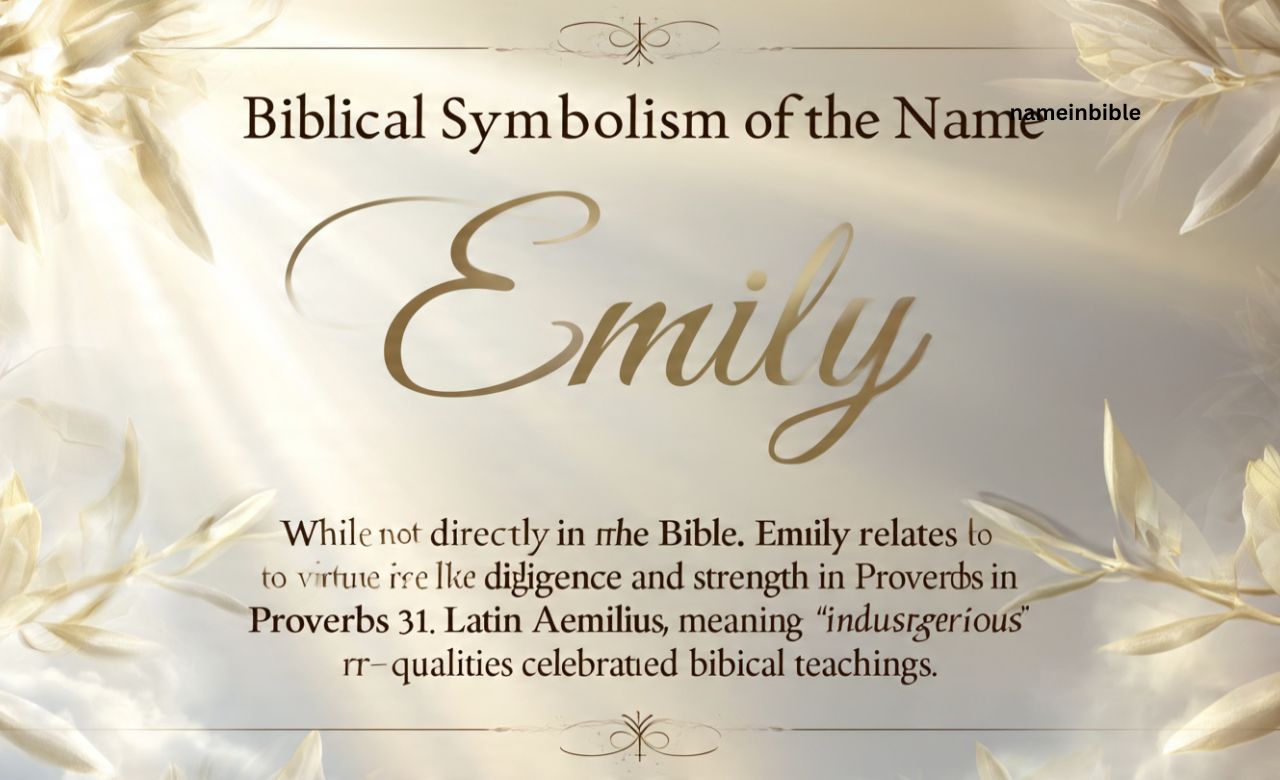
Biblical Symbolism of the Name Emily

Symbols help us conceptualize deep spiritual truths. When we look at the core definitions of Emily diligence, striving, and earnestness .we find powerful biblical symbols that echo across the ancient texts.
Faith and Devotion
The first major symbol is the unshakeable anchor of faith. The Bible teaches that faith without works is dead (James 2:17). Because Emily symbolizes purposeful action and industriousness, she serves as a vibrant symbol of living, active faith. She represents the dynamic Christian life one Emily Name Meaning that is moving, growing, producing fruit, and deeply devoted to the teachings of Jesus.
Humility and Grace
While “striving” might sound aggressive at first glance, the biblical lens tempers it with humility and grace. True Christian diligence is born out of an understanding that our own strength is insufficient, and we must rely entirely on God’s grace.
Emily symbolizes the quiet strength of a woman who works tirelessly behind the scenes without needing the spotlight. Her reward is not human applause, but the quiet approval of her Heavenly Father.
Strength Through God
Finally, Emily symbolizes supernatural endurance. In the Old Testament, the imagery of an ox tilling the soil or a watchman standing guard over a city wall represents strength and alertness. Emily symbolizes that very spiritual stamina—the inner strength given by the Holy Spirit to keep moving forward when the path is steep and the night is long.
Bible Verses That Reflect the Meaning of Emily
Since the name Emily is not written word-for-word in the text, the best way to anchor the Emily Bible verse connection is to look at scriptures that explicitly define, praise, and command the unique spiritual attributes of an Emily: industriousness, holy striving, and faithful labor.
Here are six powerful Bible verses that beautifully capture the essence of the name Emily:
1. Colossians 3:23
“And whatsoever ye do, do it heartily, as to the Lord, and not unto men;”
- Explanation: This verse perfectly encapsulates the Emily name meaning in the Bible KJV perspective of being industrious. An Emily does not half-heartedly glide through life. Whatever her hands find to do whether raising children, running a business, or serving in a ministry she does it “heartily” with her whole soul, keeping her eyes fixed on glorifying God rather than earning human praise.
2. Proverbs 31:27
“She looketh well to the ways of her household, and eateth not the bread of idleness.”
- Explanation: This is the ultimate description of an industrious woman of faith. The phrase “eateth not the bread of idleness” is practically a literal translation of the spiritual disposition of Emily. She is active, observant, deeply organized, and fiercely protective of her home and family’s spiritual atmosphere.
3. Philippians 3:14
“I press toward the mark for the prize of the high calling of God in Christ Jesus.”
- Explanation: The Greek word for “press toward” carries an intense connotation of striving, chasing, and pursuing with passion. For an Emily, this verse serves as a life anthem. It is a reminder to use her natural drive and focus to pursue spiritual growth, intimacy with God, and the eternal prize awaiting her in heaven.
4. Galatians 6:9
“And let us not be weary in well doing: for in due season we shall reap, if we faint not.”
- Explanation: Because striving can sometimes lead to exhaustion, this verse provides comfort and a beautiful promise tailored for Emily. It reassures her that her industrious efforts in loving others and serving God are never in vain. A glorious harvest of peace and joy is guaranteed as long as she rests her spirit in Christ.
5. Romans 12:11
“Not slothful in business; fervent in spirit; serving the Lord;”
- Explanation: This New Testament command is a pristine summary of the name Emily. It pairs the avoidance of slothfulness (being industrious) with an on-fire, fervent spirit that is actively engaged in serving the living God.
6. Hebrews 11:6
“But without faith it is impossible to please him: for he that cometh to God must believe that he is, and that he is a rewarder of them that diligently seek him.”
- Explanation: God loves diligence. He doesn’t just want us to seek Him casually; He rewards those who chase after Him with intentionality. This verse honors the intrinsic, focused nature of Emily, promising that her diligent pursuit of God will always yield divine rewards.
Is Emily a Biblical or Christian Name?
When selecting a name for baptism or birth registration, it’s important to clarify the distinct nuances of religious naming conventions.
Biblical vs Christian Perspective
Is there a difference between a biblical name and a Christian name? Yes, absolutely:
- Biblical Names: These are names found explicitly within the pages of the Bible (e.g., Sarah, Rachel, Rebecca, Miriam).
- Christian Names: These are names that historically emerged within the Christian Church, were borne by Saints, or possess meanings that align cleanly with Christian virtues, theology, and values.
Therefore, while Emily is not strictly a biblical name due to its absence from the direct text, it is unequivocally an authentic, historic, and powerful Christian name. Its roots are deeply Emily Name Meaning tangled with Christian history, saintly traditions, and godly character.
Can Christians Name Their Child Emily?
Without a doubt, yes! Christian parents can proudly choose the name Emily for their child. It carries no negative spiritual baggage, pagan associations, or ungodly meanings. On the contrary, it acts as a beautiful prayer over a young girl’s life, declaring that she will grow up to be a woman of substance, focus, high capability, and tireless devotion to her faith and family.
Emily Name Meaning in the Bible (KJV Perspective)
For readers who cherish the classic, majestic prose of the King James Version (KJV), looking at the Emily name meaning in the Bible KJV context means studying the specific words the King James translators used to describe industriousness.
In the KJV, the word “diligent” or “diligently” appears over one hundred times. The KJV heavily emphasizes the spiritual reward of hard work and alertness. For example, Proverbs 12:27 (KJV) states: “The substance of a diligent man is precious.”
From a KJV perspective, the name Emily represents someone who possesses this “precious substance”—a person of integrity whose work ethic and spiritual Emily Name Meaning commitment are solid, dependable, and highly valued by God. It brings to mind an old-school, rock-solid faith that stands the test of time through steady, unmovely devotion.
Emily Name Meaning in the Bible (Catholic Perspective)
In Catholic tradition, names carry a sacramental weight, often linking a child directly to a heavenly patron who can intercede for them throughout their earthly life. The Emily name meaning in the Bible Catholic perspective is incredibly rich, thanks to several extraordinary Catholic saints who bore the name and illustrated its meaning beautifully.
┌─────────────────────────────────────────────────────────────────┐
│                    PROMINENT CATHOLIC SAINTS                    │
├─────────────────────────────────────────────────────────────────┤
│ • Saint Emily de Vialar (1797–1856)                             │
│   Foundress of the Sisters of St. Joseph of the Apparition.     │
│   An incredibly industrious woman who established medical centers│
│   and schools across Europe, Africa, and Asia.                  │
│                                                                 │
│ • Saint Emily de Rodat (1787–1852)                              │
│   Foundress of the Congregation of the Holy Family.             │
│   Dedicated her entire life to providing free education for poor│
│   young girls, completely embodying the spirit of holy labor.   │
│                                                                 │
│ • Saint Emmelia of Caesarea (4th Century)                       │
│   The revered mother of multiple major saints, including        │
│   St. Basil the Great and St. Gregory of Nyssa. Known as the    │
│   ultimate model of a holy, industrious Christian mother.       │
└─────────────────────────────────────────────────────────────────┘
For a Catholic, naming a child Emily provides them with a vibrant lineage of holy women who took the secular concept of “striving” and used it to build religious orders, care for orphans, heal the sick, and raise icons of the early Church.
Personality Traits Associated with the Name Emily
Beyond the theological structures, names often carry a distinct psychological and social energy. Over decades of observation, certain personality profiles have naturally clustered around women who answer to the name Emily.
Positive Characteristics
- Highly Organized and Capable: True to the meaning “industrious,” Emilys often possess a spectacular ability to organize chaos, manage timelines, and execute complex tasks with minimal fuss.
- Deeply Empathetic: Their inner strength is rarely cold; instead, it manifests as a warm, protective empathy for the vulnerable and brokenhearted.
- Perseverant: When life gets incredibly messy or difficult, an Emily rarely quits. She possesses an innate, quiet stubbornness that helps her weather long storms.
- Artistic and Expressive: Many Emilys channel their intense inner focus into creative outlets, becoming gifted writers, musicians, artists, or teachers.
Possible Challenges
Every natural strength can present a unique vulnerability if it is not balanced by spiritual maturity. For an Emily, her primary challenges often stem from her greatest asset—her drive:
- A Tendency Toward Perfectionism: Because she desires to do things well (“heartily”), she can easily fall into the trap of demanding perfection from herself and those around her.
- Difficulty Resting: An industrious spirit can find it incredibly hard to simply sit still and rest, occasionally leading to emotional or physical burnout.
- Internalizing Stress: She may carry the weight of her family or community on her own shoulders, forgetting to consistently cast her burdens upon the Lord.
Biblical Women Who Reflect Emily’s Character
While you won’t find the exact name Emily in scripture, you will find legendary women who perfectly lived out the essence of the name. By studying these figures, we can get a vivid, living picture of the Emily biblical meaning in full action.
Ruth: The Symbol of Diligent Loyalty
Ruth is the quintessential embodiment of an industrious, faithful spirit. When she lost her husband, she didn’t collapse into despair or self-pity. Instead, she traveled to a foreign land with her mother-in-law, Naomi, and immediately went to work gleaning in the grain fields from dawn until dusk.
Her relentless work ethic and deep loyalty caught the eye of Boaz, eventually Emily Name Meaning placing her directly into the lineage of Jesus Christ. Ruth shows how an Emily uses quiet, daily labor to step into an extraordinary divine destiny.
Esther: Striving with Strategic Courage
Queen Esther represents the “striving” and “excel” aspects of the name. Placed in a high-stakes, hostile political environment, she had to use her intellect, self-discipline, and deep spiritual resolve to save her nation from total annihilation.
Through fasting, prayer, and calculated courage, she strove against evil forces and completely turned the tables on her enemies. She reminds us that an Emily can be incredibly elegant while harboring an unbreakable spine of steel.
Mary: The Grace of Holy Surrender
Mary, the mother of Jesus, reflects the profound humility that guides a Christian Emily. When the Angel Gabriel brought her the world-changing news of her miraculous pregnancy, her response was pure, focused submission: “Behold the handmaid of the Lord; be it unto me according to your word.”
Mary worked tirelessly behind the scenes to raise, protect, and support the Savior of the world, never demanding center stage but completely fulfilling her monumental Kingdom assignment.
Deborah: Leadership and Visionary Strength
Deborah was a Judge, a Prophetess, and a bold leader of ancient Israel. When the nation was paralyzed by fear, Deborah rose up like a mother over Israel, organizing armies and driving out oppressors through divine strategy. She perfectly mirrors the intense capability, leadership qualities, and spiritual fire that an Emily possesses when called to lead communities into victory.
Emily Name Numerology and Spiritual Insights
For those who enjoy exploring the symbolic meaning of numbers through a biblical worldview (often called gematria or biblical numerology), the name Emily yields fascinating insights.
In standard expression numerology, the name Emily reduces to the Number 7.
E (5) + M (4) + I (9) + L (3) + Y (7) = 28 ──► 2 + 8 = 10 ──► 1 + 0 = 1
(Note: Depending on the exact linguistic derivation or calculation method used, Emily commonly vibrates to the spiritual frequencies of 7 or 1).
Let’s look at what these numbers symbolize across the Bible:
| Number | Biblical Symbolism | Connection to Emily |
| 7 | Divine Perfection, Completeness, and Holy Rest. God rested on the 7th day after completing His creation. | Reminds Emily that the ultimate goal of her industrious labor is to find perfect rest and completion in Jesus Christ. |
| 1 | Unity, New Beginnings, and Primacy. Represents the One True God. | Highlights Emily’s natural leadership abilities and her call to put God first above all else. |
Famous People Named Emily and Their Influence
Throughout modern history, women named Emily have consistently left deep, permanent footprints across literature, science, and social reform, proving that the name’s heritage of industriousness is very real.
- Emily Dickinson (1830–1886): One of America’s most brilliant and enduring poets. She lived a quiet, highly introspective life, yet her fierce internal focus produced thousands of profound poems exploring faith, mortality, nature, and the soul.
- Emily Brontë (1818–1848): The English novelist and poet who penned the classic Wuthering Heights. Her intense creative drive allowed her to craft masterpieces that are still studied globally centuries later.
- Emily G. Johns / Christian Reformers: Numerous women named Emily served on the frontlines of the global missionary movements of the 19th and 20th centuries, translating bibles, building clinics, and founding orphanages across developing nations.
Is Emily a Good Biblical Baby Name?
If you are a parent sitting at a kitchen table, flipping through name books, and weighing your options, let’s simplify the final verdict: Is Emily a good option for a baby name?
Why Christian Parents Love the Name Emily
Christian parents are continuously drawn to Emily because it feels completely timeless. It avoids the traps of passing, modern naming trends while staying soft, accessible, and deeply sophisticated. It is incredibly easy to pronounce across multiple languages, making it a wonderful asset in our interconnected world. More importantly, its underlying spiritual meaning—being diligent for the Lord—provides a beautiful foundational truth that a young girl can proudly grow into as she develops her personal faith.
Who Should Choose the Name Emily?
You should choose the name Emily if:
- You want a name that sounds gentle but possesses an incredibly strong, resilient meaning.
- You desire to honor a heritage of hard work, continuous personal growth, and active Christian service.
- You love classic, historical names backed by an array of inspiring real-world saints and literary icons.
- You want your daughter’s identity to be explicitly tied to the beautiful biblical promises of diligence, holy focus, and spiritual fruitfulness.
Frequently Asked Questions
What does the name Emily mean spiritually?
Spiritually, Emily signifies holy ambition, steadfast faith, and a dedicated heart. It describes a woman who channels her natural energy, intellect, and drive away from worldly achievements and directly toward serving God, building up her community, and pursuing deep spiritual intimacy.
Is Emily mentioned in the Bible?
No, the literal name Emily does not appear within the texts of the Old or New Testaments. However, its core meaning of industriousness, earnest striving, and spiritual diligence is a major theme praised in dozens of verses throughout Scripture.
What does Emily mean in Hebrew?
Emily does not have a native Hebrew linguistic origin, as it comes from Latin. However, when translating its core meaning of an industrious and virtuous worker into Hebrew concepts, it matches the famous concept of the Eshet Chayil (the Woman of Valor) featured in Proverbs 31, as well as the Hebrew name Amalia, which means “Work of the Lord.”
Is Emily a Catholic name?
Yes, Emily is a highly respected name within Catholic tradition. Several canonized Catholic saints bear the name, including Saint Emily de Vialar and Saint Emily de Rodat, both of whom founded influential religious communities dedicated to education, medical care, and helping the poor.
What Bible verse relates to Emily?
A pristine verse that reflects the soul of Emily is Colossians 3:23: “And whatsoever ye do, do it heartily, as to the Lord, and not unto men.” Other incredibly relevant verses include Proverbs 31:27 and Philippians 3:14, which praise diligence and pressing forward in faith.
Why is Emily such a popular Christian name?
Emily remains popular because it perfectly bridges the gap between elegance and strength. Christian parents appreciate that it carries a rich history free of negative associations, offers a soft, beautiful sound, and serves as a prophetic blessing for a life defined by meaningful labor and profound faithfulness.
Final Thoughts
The name Emily is far more than just a sweet, melodic combination of letters. It is a lifelong calling to a beautiful, active faith. While she may not have her own specific book in the Bible, the spirit of the Emily her industriousness, her unyielding resilience, her sharp capability, and her fierce devotion shines brightly through every single page of scripture.
If you choose this name for your daughter, you are breathing a historic blessing over her life: a prayer that she will never grow weary in doing good, that Emily Name Meaning she will press toward the mark of her high calling, and that she will use her brilliant gifts to build beautiful things for the Kingdom of God.May you like other article Evelyn Name Meaning in the Bible: Spiritual Symbolism, Origin & Biblical Insights

Welcome to NameInBible. I am Victoria, a Christian writer passionate about exploring biblical name meanings, Scripture-based insights, and powerful prayers. My goal is to help readers discover the spiritual significance of names and grow closer to God through faith-filled content.