
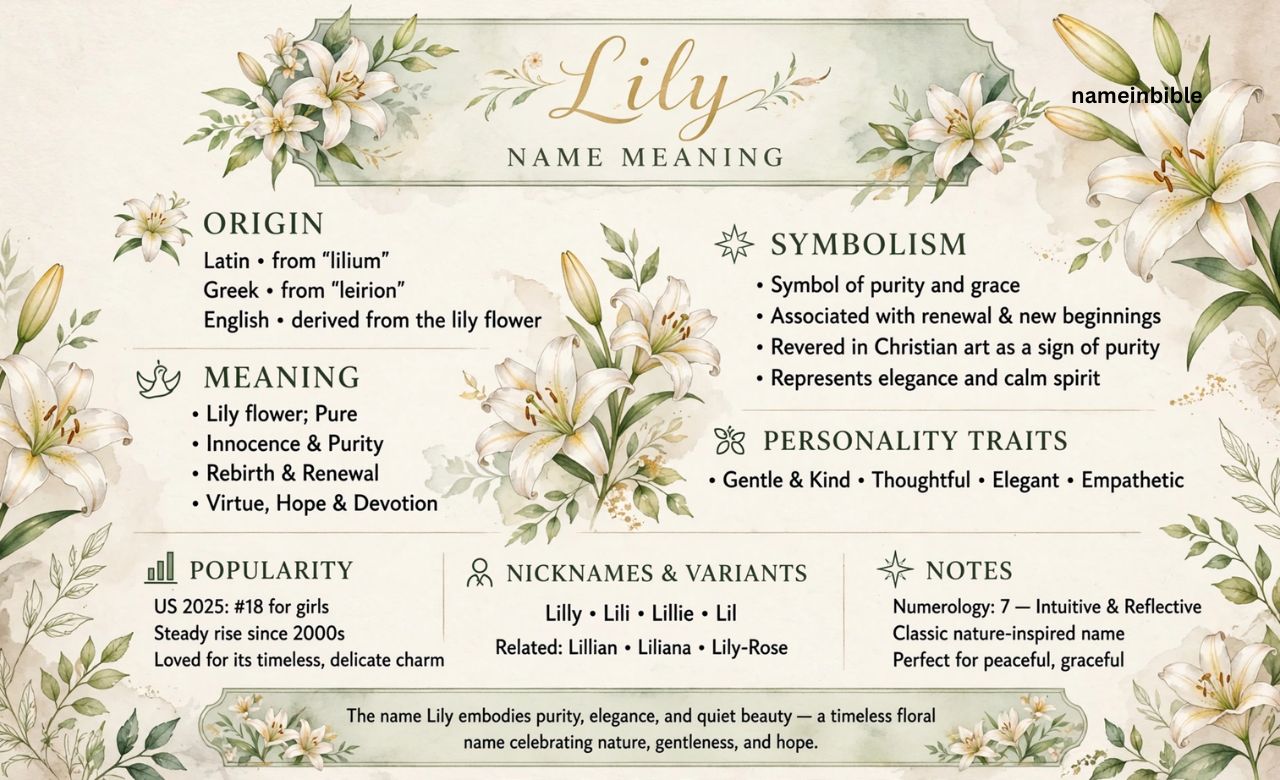
The lily name meaning Bible is one of the most searched topics among people who love biblical names, Christian symbolism, and the deeper messages found in Scripture. Delicate yet remarkably strong, the lily appears throughout the Bible as a beautiful reminder of God’s love, purity, and faithful provision. If you have ever wondered about the lily meaning in Bible, or asked yourself, is Lily a biblical name, you are not alone. Many believers Lily Name Meaning are drawn to this graceful name because it reflects timeless spiritual values and points the heart toward God’s presence and care.
As you explore the lily biblical meaning, you will discover that the Bible uses the lily to teach powerful lessons about faith, humility, peace, and trust in God. From the words of Jesus Christ in the Gospels to the poetic beauty of the Song of Solomon, the lily carries rich spiritual symbolism that Lily Name Meaning continues to inspire Christians today. Whether you are choosing a baby name, studying biblical flowers, or asking what do lilies represent in the Bible, this guide will help you uncover the biblical, Hebrew, and Christian significance of the name Lily through Scripture, historical context, and practical faith lessons.
What Does the Name Lily Mean in the Bible?
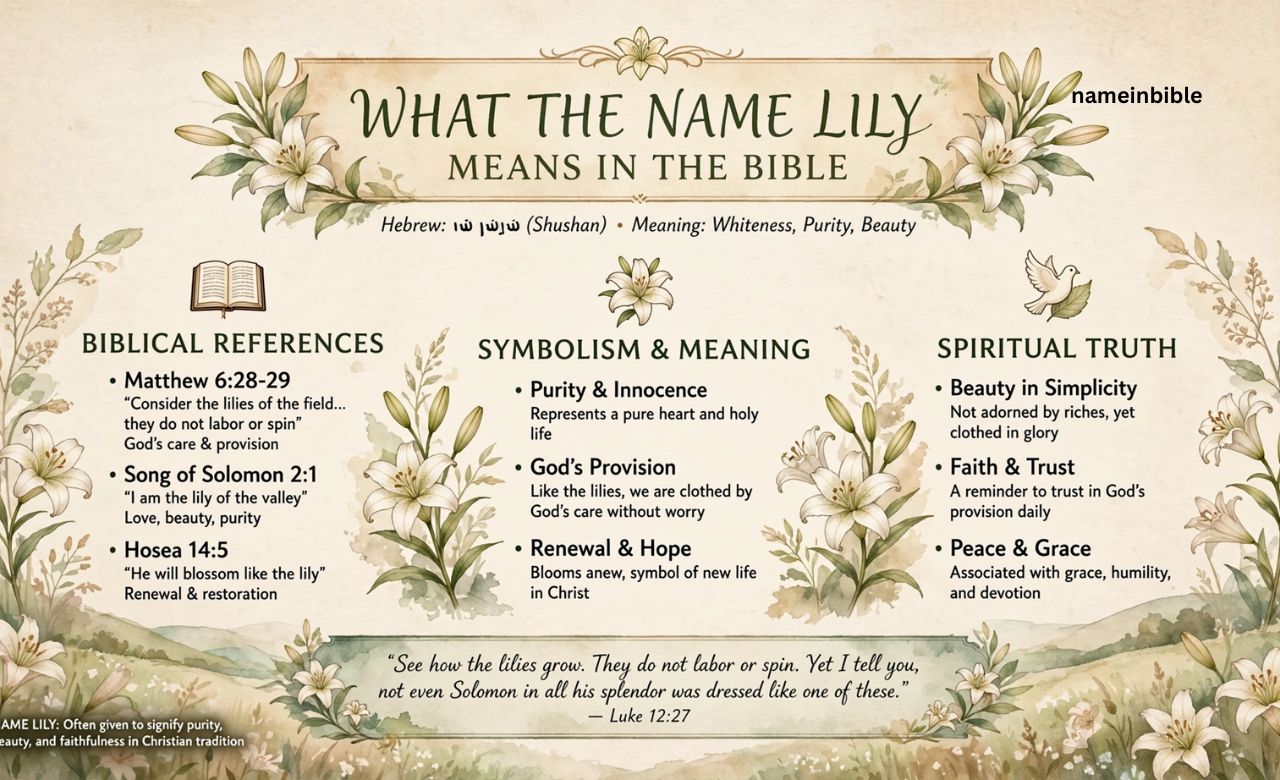
To understand the Lily name meaning in the Bible, we have to look at how the lily flower in the Bible is used across different contexts. In sacred Scripture, names and objects are rarely accidental; they carry prophetic weight and spiritual assignments. The Lily meaning in the Bible centers primarily Lily Name Meaning on three major themes: divine provision, unblemished purity, and spiritual renewal.
When the Bible references a lily, it uses it to illustrate how God interacts with His creation. The lily biblical meaning represents a state of being completely sustained by God’s grace rather than human striving. When a child is given the Christian meaning of Lily, it serves as a lifelong reminder of God’s love and His absolute trustworthiness.
 Lily Biblical Meaning Core Themes:
 ├── Divine Provision ── Resting completely in God's daily care
 ├── Absolute Purity   ── Spiritual innocence washed clean by God's grace
 └── Sovereign Beauty  ── Inner glory given by the Creator, not earned by work
The name signifies an individual who reflects God’s presence through their character. It points to a deep, unshakeable inner peace that comes from knowing you are valued by the Creator. In short, the biblical meaning of the name Lily is “a beautiful creation that thrives under the direct care and grace of God.”
Is Lily a Biblical Name? Understanding Its Biblical Connection
A common question that arises for parents exploring Christian baby names and biblical girl names is: Is Lily explicitly mentioned as a person’s name in the text of the Holy Bible?
The technical answer is no; you will not find a matriarch, prophetess, or disciple named Lily walking through the pages of the Old Testament or New Testament. However, this does not mean Lily Name Meaning it lacks a biblical connection. In fact, its connection is arguably deeper because it originates directly from Scripture as a sacred metaphor.
The name Lily belongs to a special class of biblical names derived from the natural world much like Sharon, Rose, or Hadassah (the Hebrew name for Queen Esther, which means “myrtle”). The lily in the Bible is a prominent, repeated image used by prophets, poets, and Jesus Christ Himself to convey deep biblical truth.
Therefore, while Lily is not a historical biographical name from antiquity, it is an profoundly biblical name because its identity, roots, and spiritual definitions are pulled straight out of the pages of the Holy Bible. Choosing it means anchoring your child’s identity in the poetic and instructional imagery used by God to teach humanity about faith.
Lily Meaning in Hebrew and Its Biblical Origin
To truly uncover the lily name meaning in the bible hebrew, we have to look at the linguistic roots of the ancient Hebrew language.
In the original Hebrew text of the Old Testament, the word translated as lily is Shoshannah (שׁוֹשַׁנָּה), which is derived from the root word shush, meaning “to rejoice,” “to be bright,” or “to vivid.” The literal Hebrew meaning of Lily translates directly to “whiteness,” “brilliance,” or “flower of choosing.”
[Hebrew Root: Shush] (To rejoice / Be bright)
       │
       ▼
[Hebrew Word: Shoshannah] (שׁוֹשַׁנָּה)
       │
       ▼
[Literal Meanings]: Whiteness • Brilliance • Flower of Choosing
The Evolution from Shoshannah to Lily
Over centuries of translation, the Hebrew name Shoshannah evolved into the Greek name Sousanna in the New Testament era, which later transitioned into the Latin Susanna, and eventually blossomed into the English names Susannah, Susan, and ultimately, Lily.
When you study the Lily Hebrew origin, you find that the flower symbolized top-tier excellence. Because lilies grew vibrantly in valleys and fields without human cultivation, ancient Hebrews saw the Shoshannah as a direct manifestation of God’s blessings and divine provision. It was a visual reminder that Lily Name Meaning true beauty and joy (shush) are gifts dropped straight from heaven into the valleys of human life.
Bible Verses About Lilies and Their Deeper Meaning
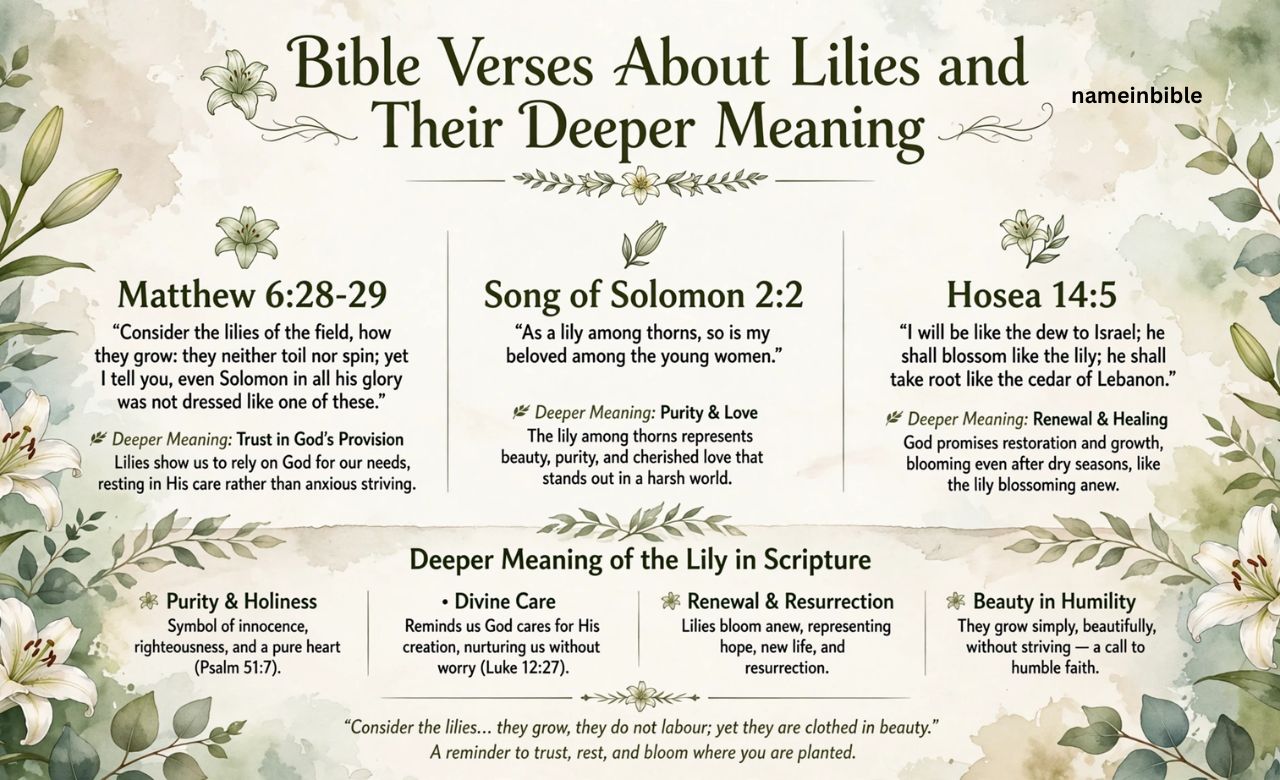
The spiritual weight of the lily is best understood by looking directly at the Bible verses where it appears. Let’s examine three critical passages that define the biblical symbolism of the lily.
1. The Lesson of Absolute Trust: Matthew 6:28-29
In the New Testament, during the iconic Sermon on the Mount, Jesus Christ used the lilies of the field to deliver a timeless sermon on shifting from anxiety to a faithful heart.
“And why take ye thought for raiment? Consider the lilies of the field, how they grow; they toil not, neither do they spin: And yet I say unto you, That even Solomon in all his glory was not arrayed like one of these.” — Matthew 6:28-29 (KJV)
Here, Jesus contrasts the frantic, stressful striving of human beings with the effortless growth of the lily. The lily doesn’t stress about its clothes or struggle for survival; it simply rests in God’s daily provision. Jesus teaches that if God clothes a temporary biblical flower with glory that outshines King Solomon, He will undeniably Lily Name Meaning take care of His children. The deeper meaning here is faith over fear and resting in God.
2. Divine Distinction: Song of Solomon 2:1-2
In the Old Testament, the lily is used as an expression of love, beauty, and chosen status within sacred covenant relationships.
“I am the rose of Sharon, and the lily of the valleys. As the lily among thorns, so is my love among the daughters.” — Song of Solomon 2:1-2
In this beautiful poetic dialogue, the lily represents distinct, immaculate beauty thriving in a harsh environment (“among thorns”). It speaks to the believer’s call to remain pure, gentle, and full of inner peace, even when surrounded by the sharp, difficult trials of a broken world. It underscores the theme of being uniquely chosen and protected by divine love.
3. Freedom from Anxiety: Luke 12:27
Mirroring the account in Matthew, Luke records Jesus reinforcing this vital piece of biblical wisdom:
“Consider the lilies how they grow: they toil not, they spin not; and yet I say unto you, that Solomon in all his glory was not arrayed like one of these.” — Luke 12:27
By repeating this illustration, Christ elevates the lily to a masterclass symbol of spiritual reassurance. It reminds us that our worth is not tied to our frantic work, production, or worldly achievements, but to our status as children under the divine care of a loving heavenly Father.
What Does the Lily Symbolize in Christianity?
Within Christendom, the lily has transitioned from a simple agricultural reference to an essential piece of holy symbolism. When asking what does the lily represent in Christianity, the answer spans across multiple dimensions of the Christian faith.
             ┌────────────────────────────────────────┐
             │     Lily Symbolism in Christianity     │
             └───────────────────┬────────────────────┘
       ┌─────────────────────────┼─────────────────────────┐
       ▼                         ▼                         ▼
 [Resurrection]               [Purity]                [The Trinity]
Life breaking through    Innocence restored      Three petals joined
    the dark tomb           by God's grace          at a single stem
The Symbol of Resurrection and New Beginnings
The lily is universally recognized as the ultimate symbol of Easter and the Resurrection of Jesus Christ. Lilies grow from bulbs that sit buried in the cold, dark earth during winter, looking completely dead. Yet, when spring arrives, they break through the soil, bursting into beautiful, brilliant white blooms.
This lifecycle perfectly mirrors the death, burial, and triumphant Lily Name Meaning resurrection of Jesus. It serves as a visual sermon on new beginnings in the Bible and the ultimate victory of life over death.
The Standard of Purity and Grace
In Christian symbolism, the lily represents a soul that has been washed clean and restored by God’s grace. It depicts an untainted, faithful heart that strives for spiritual purity and humility before God. It stands as a reminder that regardless of a person’s past, entry into the Christian life brings total spiritual renewal.
A Reflection of the Holy Trinity
Early Christian scholars also noticed the unique structure of many lily varieties—specifically how three distinct petals often join together at a single, central stem. This physical attribute was used as a natural illustration to teach the concept of the Holy Trinity: God the Father, God the Son, and the Holy Spirit existing as three co-equal persons in one divine essence.
The Spiritual Meaning of the Name Lily
Beyond the historical data, the spiritual meaning of the name Lily carries a distinct, impactful energetic resonance for anyone who carries it today. If you are named Lily, or are considering it for a child, your name is tied to specific spiritual declarations.
- Living by Grace, Not Striving: Carrying this name is a spiritual reminder to step off the treadmill of performance and self-reliance. It calls the individual to trust in God’s promises and lean on God’s protection.
- A Vessel of Peace: The name Lily carries an atmosphere of inner peace and calm reassurance. It is a calling to be a peacemaker in chaotic environments, bringing the fragrance of hope and faith wherever you go.
- Walking in Spiritual Growth: Just as the lily naturally extends its roots deep into the earth to draw nutrients, the spiritual symbolism of Lily points to a life marked by continuous spiritual growth and deep rooting in biblical truth.
Choosing this name acts as an active blessing, declaring that the bearer will Lily Name Meaning grow in grace, display uncompromised integrity, and live a life illuminated by the light of God’s love.
White Lily Meaning in the Bible and Christian Faith
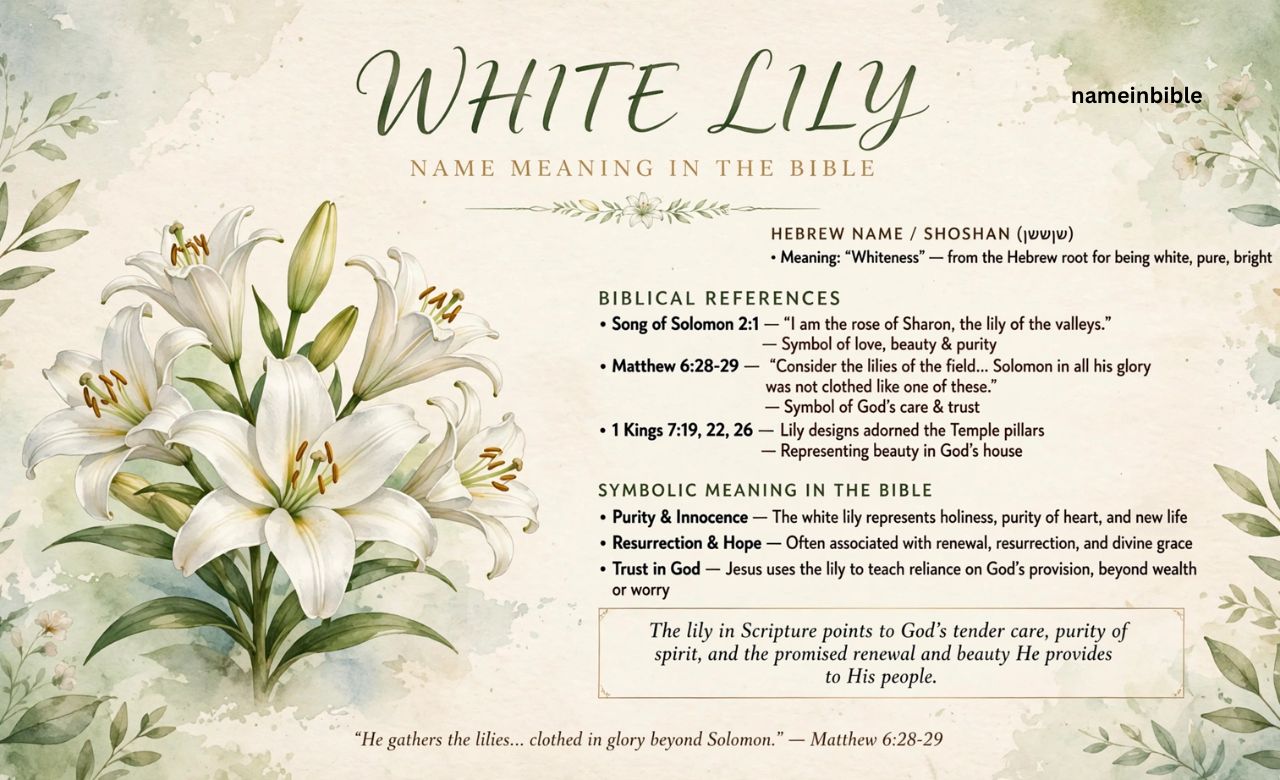
While lilies come in many vibrant hues, it is the pristine white lily that holds the most revered position in scriptural study and theological history. The white lily name meaning in the bible focuses tightly on the complete eradication of sin and the restoration of perfect innocence.
In the ancient ancient near east, white was the color of victory, righteousness, and celestial purity. When the scriptures mention being washed “whiter than snow” (Psalm 51:7), the white lily stands as the botanical embodiment of that promise.
   White Lily Symbolism:
   [Pristine Color] ──► Absolute Sinlessness / Washed Clean
   [Sweet Fragrance] ──► Prayers of the Saints / Sweet Aromas to God
   [Golden Anthers]  ──► The Radiance of Divine Light & Majesty
The white lily symbolism also extends to the concept of divine light. The bright, radiant petals catch light easily, standing out clearly even in the dim twilight of a valley. In the same way, a believer walking in purity in the Bible is called to be a light in a dark world, reflecting the holiness of Jesus Christ through a lifestyle of humility and Christian devotion.
Lily in the KJV Bible: References and Biblical Significance
For readers who prefer classic textual analysis, looking at the lily name meaning in the bible kjv (King James Version) provides excellent insight into how early English scholars understood this floral icon. The word “lily” or “lilies” appears over 15 times in the Old and New Testaments of the KJV translation.
Architectural Majesty: 1 Kings 7:19-22
In the King James Version, we discover that the lily wasn’t just a wild flower; it was integrated into the highest forms of holy architecture. When King Solomon constructed the Temple of God, he commissioned Lily Name Meaning master craftsmen to carve “lily work” onto the very tops of the massive pillars (Jachin and Boaz) that framed the entrance to the Holy Place.
“And the chapiters that were upon the top of the pillars were of lily work in the porch, four cubits… And upon the top of the pillars was lily work: so was the work of the pillars finished.” — 1 Kings 7:19, 22 (KJV)
This highlights that in the lily in the Bible KJV context, the flower represents the ultimate intersection of strength and beauty. The pillars held up massive structural weight, yet their crowning glory was the delicate, elegant design of the lily. It shows us that in God’s economy, true spiritual strength is always crowned with gentleness, purity, and grace.
Lily in the Catholic Tradition and Biblical Symbolism
In the rich history of the Catholic tradition, the lily holds a uniquely prominent place, often appearing across centuries of religious paintings, stained glass windows, and historical liturgies. The lily name meaning in the bible catholic focus heavily on the concepts of immaculate virtue and the lives of the saints.
                  ┌────────────────────────────────────────┐
                  │       Lily in Catholic Tradition       │
                  └───────────────────┬────────────────────┘
             ┌────────────────────────┴────────────────────────┐
             ▼                                                 ▼
     [The Madonna Lily]                                [The Lily of Joseph]
  Symbol of the Virgin Mary;                        Symbol of St. Joseph's purity;
Represents immaculate conception                   Depicted as a staff blooming
     and total devotion.                                with white lilies.
The Madonna Lily and the Virgin Mary
In Catholic art, the white lily is frequently called the “Madonna Lily” and serves as the personal emblem of Mary, the mother of Jesus. In paintings depicting the Annunciation the moment the Angel Gabriel announces to Mary that she will give birth to the Savior—Gabriel is very often shown Lily Name Meaning holding a white lily, or a vase of lilies is placed between them. Here, it symbolizes Mary’s immaculate purity, her complete surrender to God’s plan, and her role as a vessel of divine grace.
St. Joseph’s Staff
The lily is also deeply connected to Saint Joseph, the earthly foster-father of Jesus. Catholic iconographic history depicts Joseph holding a walking staff that has miraculously blossomed with pure white lilies at the top. This imagery stems from early traditions symbolizing that Joseph was chosen by God out of all men to be the protector of Mary’s purity, exemplifying humility before God and a perfectly faithful heart.
Is There a Woman Named Lily in the Bible?
A point of frequent confusion among casual readers of scripture is whether there is a specific woman Lily in the Bible. People often wonder: Who is this historical character?
To clear up any historical misconceptions: There is no woman named Lily mentioned in the text of the Holy Bible.
When people recall a “Lily” in scripture, they are typically misremembering the poetic phrases found in the Old Testament, such as the famous line from the Song of Solomon: “I am the rose of Sharon, and the lily of the valleys.” In this allegorical book, these words are spoken by the Shulamite woman to describe her own beauty and her devotion to her beloved, but her name is not Lily.
Additionally, because the Hebrew name Shoshannah translates to Lily, some link it to historical figures like Susanna, a faithful woman mentioned in Luke 8:3 who traveled with and financially supported Jesus’ ministry out of her own means. So, while you won’t find a chapter detailing the life of a woman explicitly named Lily, the virtues, history, and linguistic essence of the name are woven tightly into the lives of the Bible’s most devoted women.
Lily Name Personality Traits and Spiritual Characteristics
Names have a powerful way of shaping how we see ourselves and how we interact with the world around us. In semantic and psychological study, names carry structural expectations. When we align these with biblical interpretation, we can map out the key personality traits and spiritual markers commonly associated with the name Lily:
| Personality Trait | Spiritual Manifestation | Biblical Anchor |
| Serene & Unanxious | Operates with a calm, resting trust in God’s daily provision; unaffected by panic. | Matthew 6:28 |
| Uncompromising Integrity | Walks in spiritual purity and transparent honesty, even when under pressure. | Song of Solomon 2:2 |
| Quiet Strength | Combines deep inner resilience with an approachable, gentle exterior. | 1 Kings 7:22 |
| Generous & Nurturing | Radiates God’s love naturally, offering comfort and spiritual encouragement to others. | Luke 12:27 |
The Heart of a Lily
An individual carrying the spiritual signature of a lily is rarely loud, boastful, or aggressive. Instead, they command respect through their quiet consistency, deep inner peace, and unshakeable anchor in Scripture. They are individuals who don’t just talk about Christian spirituality—they live it out quietly, standing tall as an example of God’s blessings in action.
Seeing Lilies in Dreams: Biblical Meaning and Spiritual Messages
Dreams have always served as an intriguing canvas for spiritual communication throughout biblical history from Joseph in the Old Testament to Joseph Lily Name Meaning in the New Testament. When analyzing seeing lilies in dreams, a solid framework of biblical dream interpretation reveals several powerful spiritual messages.
               ┌────────────────────────────────────────┐
               │         Lilies in Dreams Matrix        │
               └───────────────────┬────────────────────┘
       ┌───────────────────────────┼───────────────────────────┐
       ▼                           ▼                           ▼
 [Bloomed Lily]              [Withered Lily]             [Wild Field]
Anxiety is ending;          A gentle warning to        A call to expand your
A season of rest is        re-align and root your       faith and trust in
   now arriving.          identity back in God.         divine provision.
1. A Call to Release Anxiety and Fear
If you dream of vibrant, thriving lilies, it is often a profound message of spiritual reassurance. It is as if the Holy Spirit is echoing Jesus’ command to “consider the lilies.” The dream may be telling you to lay down your worries regarding finances, career, or family, reminding you that you are under active, divine care. It signals a transition from panic into a season of resting in God.
2. A Season of Spiritual Renewal and New Beginnings
Because of its unbreakable association with Easter and resurrection, dreaming of lilies breaking through the soil can point directly to spiritual transformation and new beginnings in the Bible. If you have walked through a painful, dry, or “dead” winter season of life, the dream serves as a beautiful prophetic marker that God’s grace is bringing life out of the dust once again.
3. A Reminder to Walk in Purity and Integrity
If the dream highlights the striking, unblemished whiteness of a lily, it can act as a gentle spiritual course-correction. It calls the dreamer to check their current path, encouraging them to pursue purity in the Bible, walk away from compromised positions, and cultivate a clean, faithful heart before the Lord.
Life Lessons We Can Learn from the Lily in the Bible
The inclusion of nature illustrations in ancient scripture wasn’t just to add poetic flair it was meant to provide practical blueprints for daily living. Here are three transformative life lessons from the Bible that we can extract directly from the humble lily:
Lesson 1: Grow Wherever God Plants You
Lilies do not carefully select pristine, curated garden beds to grow; they are frequently found thriving deep inside rugged, rocky valleys, or pushing up directly through thickets of thorns.
The lesson for us is clear: Your current environment does not dictate your ultimate spiritual beauty. Even if you find yourself in a harsh workplace, a challenging family dynamic, or a season Lily Name Meaning surrounded by cultural “thorns,” you can still bloom brilliantly by drawing your nutrients from God’s word and resting under His protection.
Lesson 2: Yield to the Process of Hidden Growth
Before a lily can stun the world with its white petals, it must spend months hidden completely in the dark, silent earth as an unsightly, dormant bulb. To the human eye, nothing is happening.
This teaches us the value of the hidden seasons of the Christian life. True spiritual growth requires times of obscurity where God works on our roots, deep underground, far away from public applause. Trust the dark seasons; they are simply preparing you for your spring revelation.
 The Lifecycle of Spiritual Blooming:
 Phase 1: The Bulb   ── Hidden obscurity, deep root development (Trusting the dark)
 Phase 2: The Sprout ── Breaking through heavy soil, defying obstacles (Perseverance)
 Phase 3: The Bloom  ── Radiating God's glory, effortless beauty by grace (Manifestation)
Lesson 3: Abandon the Myth of Self-Manufactured Worth
The core of Christ’s message regarding the lily is that its unparalleled glory doesn’t come from spinning, working, or striving—it comes simply from being what God designed it to be, in total dependence on the Creator.
We must learn to break our addiction to frantic, human-centered striving. When we shift our focus from working to earn our worth to resting in our identity as children of God, our lives naturally become beautifully ordered, peaceful, and profoundly impactful.
Is Lily a Good Christian Name for a Baby Girl?
When welcoming a new daughter into the world, choosing a name is one of the first, most lasting gifts you will give her. If you are weighing options within the world of biblical girl names, Lily stands out as an exceptional, time-tested Christian name.
It strikes a flawless balance: it is effortless to pronounce, carries an elegant simplicity, and avoids looking dated, while remaining fundamentally anchored in ancient, holy soil.
  Why Lily is an Ideal Christian Baby Name:
  ├── Scriptural Anchor ── Pulled directly from Christ's core teachings
  ├── Timeless Elegance ── Universally recognized, simple, and clean
  └── Prophetic Identity── Continually speaks peace & grace over her life
By naming your daughter Lily, you are actively speaking a prophetic identity over her life every single day. You are declaring that she is a chosen creation, that she will walk through this world with uncompromised purity, and that her life will stand as a living testament to God’s daily provision and divine grace. It is a name that doesn’t just sound beautiful to the ear—it rings with deep, spiritual truth that will guide her heart throughout her entire life.
FAQs About Lily Name Meaning in the Bible
Who is Lily in Christianity?
There is no woman named Lily mentioned in the Bible. In Christianity, the lily is a powerful symbol of purity, holiness, God’s grace, and the beauty of a faithful life centered on Jesus Christ.
Is Lily a religious name?
Yes, Lily is widely considered a religious and Christian-inspired name because of its strong biblical symbolism. Although it is not the name of a biblical person, it represents purity, faith, peace, and God’s loving care throughout Scripture.
Is God’s favorite flower a lily?
The Bible never says that the lily is God’s favorite flower. However, Jesus used the lilies of the field in Matthew 6:28–29 to teach about God’s provision, making the lily one of the most meaningful flowers in the Holy Bible.
What does the girl’s name Lily mean?
The girl’s name Lily symbolizes purity, innocence, beauty, hope, and spiritual renewal. In the Bible, it also reflects trust in God, humility, and the reminder that God faithfully cares for His children.
Conclusion
The lily name meaning in the Bible goes far beyond the beauty of a flower. Throughout Scripture, the lily stands as a timeless symbol of purity, faith, humility, hope, and God’s faithful care. From the teachings of Jesus Christ to the poetic imagery in the Song of Solomon, the lily meaning in the Bible reminds believers to trust God’s provision, embrace spiritual growth, and find peace in His promises.
Whether you are researching the biblical meaning of Lily, choosing a meaningful Christian baby name, or simply wondering what do lilies represent in the Bible, this graceful flower offers a powerful message of God’s love and presence. While Lily is not the name of a biblical woman, its rich biblical symbolism and enduring connection to the Christian faith make it a beautiful and inspiring name that continues to encourage believers to walk in faith, purity, and unwavering trust in God.May you like other article Titus Meaning in the Bible: Biblical Origin, Spiritual Meaning & Christian Significance (2026)

Welcome to NameInBible. I am Victoria, a Christian writer passionate about exploring biblical name meanings, Scripture-based insights, and powerful prayers. My goal is to help readers discover the spiritual significance of names and grow closer to God through faith-filled content.