
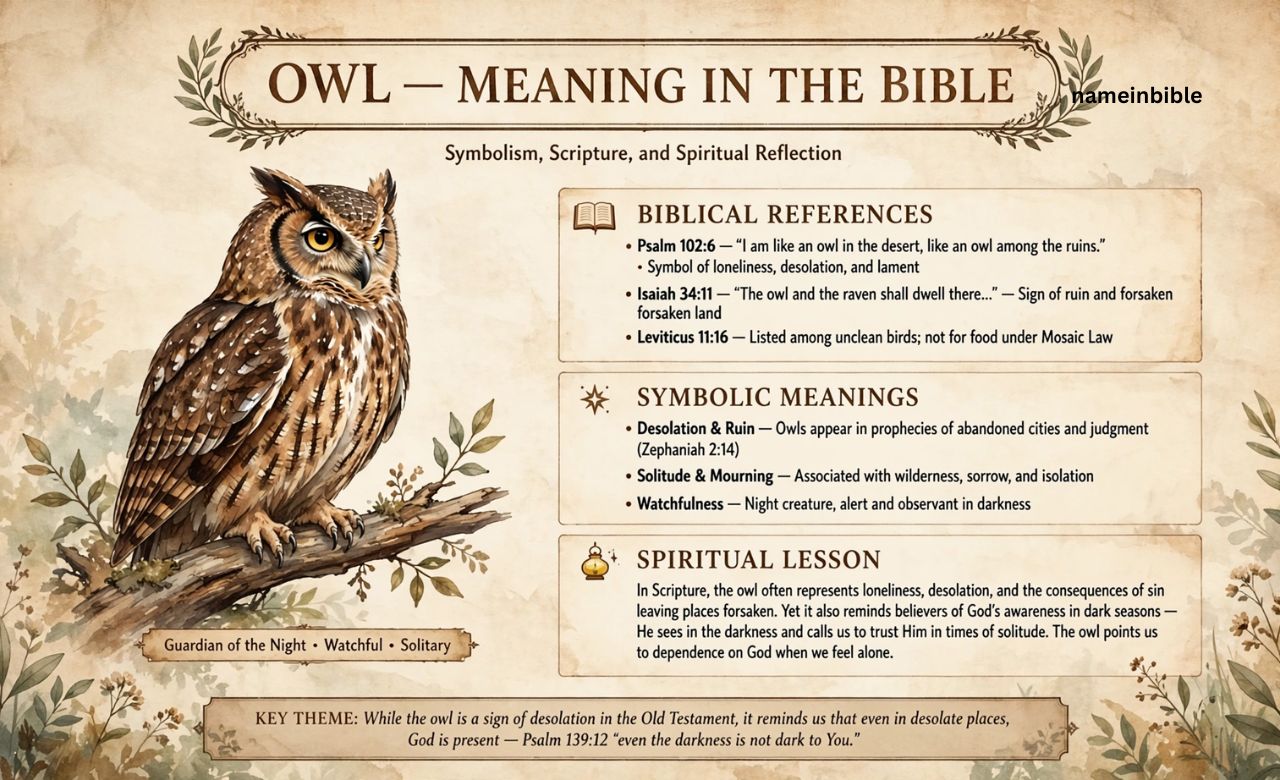
The owl meaning in the Bible has fascinated Christians and Bible readers for generations. Some believe owls represent wisdom, while others see them as signs of judgment or spiritual warning. But what do owls symbolize in the Bible according to Scripture? The answer is more meaningful than many popular beliefs and traditions suggest.
In this guide, you’ll discover the biblical meaning of an owl, explore the true meaning of owls in the Bible, and learn whether there is any biblical basis for the biblical meaning of owl at your house at night. By examining key Bible verses in their proper context, you’ll uncover the spiritual lessons God reveals and separate biblical truth from myths and superstitions
What Does the Bible Say About Owls? (Key Bible Verses Explained)
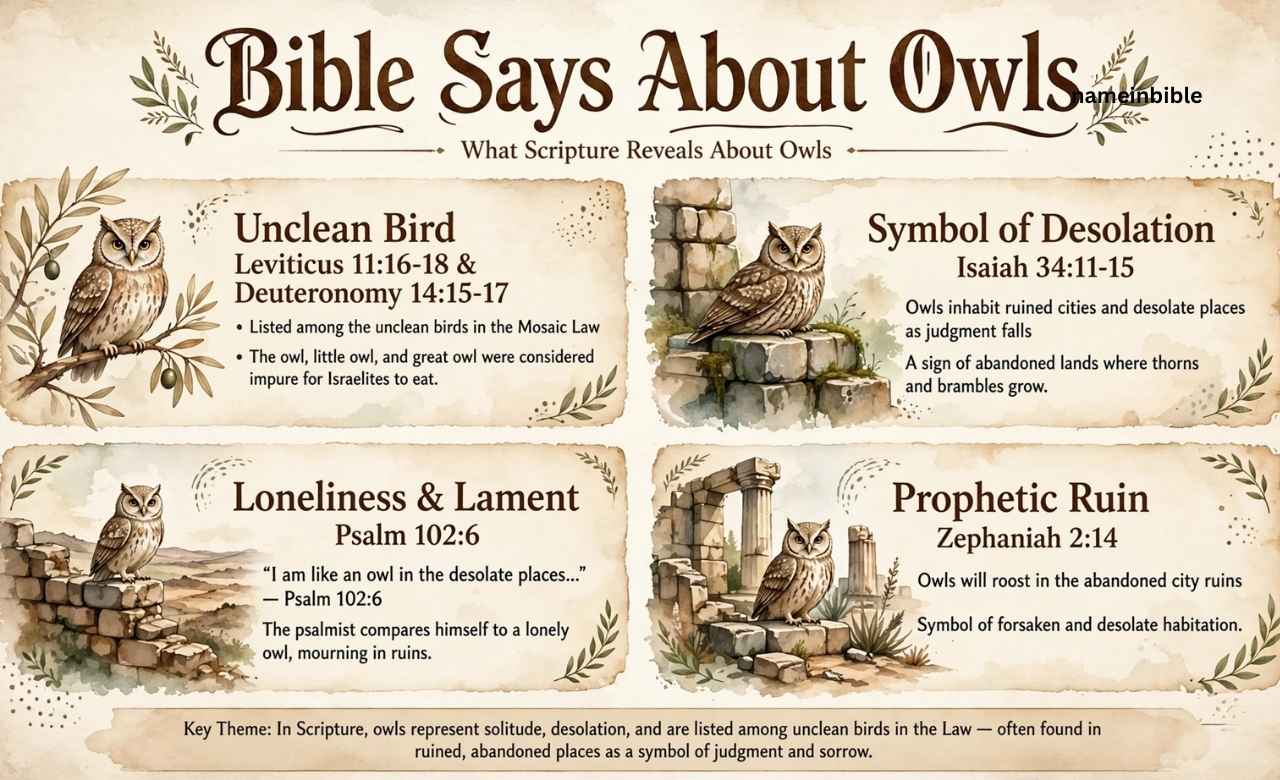
The quiet hoot of an owl echoing through a still night is a sound that has captivated humanity for centuries. In modern western culture, we tend to view the owl through a highly specific lens as a charming, spectacles-wearing symbol of wisdom, academic achievement, and Owl Meaning in the Bible quiet intelligence. But if you open the pages of the Holy Bible, you will find a strikingly different portrayal.
To the ancient Israelites, the owl was not a cute mascot of scholarly success. Instead, it was a creature of the wilderness, a quiet resident of broken and shattered places, and a bird wrapped in the imagery of mourning, desolation, and spiritual darkness.
To understand the owl meaning in the Bible, we have to peel back our modern, 21st-century cultural assumptions and step into the dry, rocky deserts of the ancient Near East. Let’s dig deep into Scripture, uncover the raw biblical symbolism, and discover the profound spiritual lessons these mysterious creatures of the night can teach us about our walk of faith, the reality of repentance, and the enduring light of Jesus Christ.
Owl Meaning in the Bible: The True Biblical Symbolism
To understand the true biblical meaning of owl life, we must look at how biblical writers used the animal kingdom to convey deep spiritual realities. In ancient Israel, animals were frequently Owl Meaning in the Bible associated with specific physical environments, spiritual states, or theological truths.
When we analyze the owl symbolism in the Bible, we see that these birds serve as physical illustrations of internal spiritual conditions. They are not merely biological specimens in the text; they are living parables.
Owls as a Symbol of Desolation and Abandoned Places
The most prominent biblical owl symbolism revolves around desolation, loneliness, isolation, and ruined places. In the geographic landscape of the Old Testament, when a great city or kingdom was judged by God and laid waste, it became a barren wasteland. In these dry, uninhabited ruins, normal human life ceased, and wild desert animals moved in.
The owl, with its solitary nature and preference for nesting in crumbling stone walls, hollow trees, and abandoned buildings, became the ultimate visual marker of a place that had been completely deserted by humans. When a prophet wanted to describe a once-proud kingdom reduced to rubble, they would declare that it had become a “dwelling place for owls.”
In this context, the owl represents desolation and loneliness. It serves as a stark visual reminder of what happens when a society or an individual turns away from the source of life, leaving behind an empty, decaying shell of what once was.
Why Owls Were Listed Among Unclean Birds
In Leviticus 11:16 and Deuteronomy 14:15, the Israelites were given strict dietary laws regarding clean and unclean animals. Among the avian species, owls were explicitly labeled as unclean (tamei in Hebrew) and were strictly forbidden for consumption. But why?
The reason lies in the spiritual connection between physical holiness and the natural habits of these biblical animals. Owls are apex nocturnal predators. They hunt in the dark, and they feed on small mammals, insects, and sometimes other birds often consuming Owl Meaning in the Bible their prey whole, including the blood and bones.
Under the Mosaic Covenant, blood was sacred and reserved exclusively for atonement. Because owls were birds of prey that consumed blood, lived in close proximity to decaying ruins, and were active during the hours of spiritual darkness, they were ritually unclean. They represented a lifestyle that was incompatible with the ritual purity required of God’s covenant people.
Do Owls Represent Judgment or God’s Warning?
Yes, the presence of an owl in prophetic scripture is almost always linked to the judgment of God and serves as a powerful spiritual warning. When the prophets under the inspiration of the Holy Spirit warned nations of impending doom, the owl was used as a dramatic literary device.
For instance, when God’s judgment falls upon a rebellious nation, their fertile fields and bustling markets are transformed into dry deserts where only nocturnal birds can survive. In this sense, the owl is a visual call to repentance. It warns the reader that persistent rebellion Owl Meaning in the Bible against God’s loving boundaries leads inevitably to a state of spiritual isolation and brokenness. It is a sign of what remains when God’s protective and preserving presence is withdrawn due to unrepentant sin.
Can Owls Symbolize Spiritual Wisdom in the Bible?
Here is one of the most common points of confusion: Is an owl a symbol of wisdom in the Bible?
While Greek mythology strongly associated the owl with Athena (the goddess of wisdom), this concept is completely absent from the Holy Bible. In Scripture, true wisdom from God is never represented by a nocturnal bird of prey that dwells in ruins. Instead, biblical wisdom is associated with light, life, fruitfulness, and the fear of the Lord.
In fact, rather than representing wisdom, the owl’s preference for darkness over light is used by some Christian commentators to illustrate spiritual blindness. Just as an owl has eyes designed to see in the dark but is easily blinded by the midday sun, a person suffering from spiritual blindness can navigate the sinful ways of the world but is utterly blind to the brilliant light of Jesus Christ and God’s grace.
Every Owl Mentioned in the Bible (Complete Scripture References)

To build a healthy, grounded understanding of owl in the Bible studies, we must look directly at the biblical text. In the Owl Meaning in the Bible Hebrew Scriptures, several different Hebrew words are translated as “owl,” depending on the English translation you are reading (such as the KJV, ESV, or NASB).
Let’s look at the primary Hebrew terms used for owls and the specific scriptures where they appear:
| Hebrew Term | Likely Meaning / Translation | Key Bible Verses | Biblical Context & Significance |
| Kos (כּוֹס) | Little Owl / Cup Owl | Leviticus 11:17, Deuteronomy 14:16, Psalm 102:6 | Associated with grief, personal isolation, and ruin. |
| Yanshuph (יַנְשׁוּף) | Great Owl / Screech Owl | Leviticus 11:17, Deuteronomy 14:16, Isaiah 34:11 | Used to describe the complete desolation of judged lands like Edom. |
| Qippoz (קִפּוֹז) | Arrow Snake / Screech Owl | Isaiah 34:15 | Represents nesting, breeding, and multiplying in abandoned places. |
| Lilith (לִילִית) | Night Monster / Screech Owl | Isaiah 34:14 | Symbolic of the wild, untamable creatures that inhabit desolate ruins. |
Let’s examine these key scriptures in detail to understand their profound theological context:
1. Leviticus 11:16-17 & Deuteronomy 14:15-16
“And the owl, and the night hawk, and the cuckow, and the hawk after his kind, And the little owl, and the cormorant, and the great owl…” (KJV)
In these passages, God establishes the dietary boundaries for Israel. The inclusion of the “little owl” (kos) and the “great owl” (yanshuph) among the forbidden birds emphasizes the concept of holiness through separation. God’s people were called to be distinct from the surrounding pagan nations, not just in their worship, but in their daily habits, reminding Owl Meaning in the Bible them to choose life-giving practices over those associated with death and darkness.
2. Psalm 102:6
“I am like a pelican of the wilderness: I am like an owl of the desert.” (KJV)
“I am like a desert owl of the wilderness, like a tiny owl of the ruined places.” (AMP)
This is one of the most beautiful and raw expressions of human emotion in all of Scripture. The psalmist is going through an incredibly painful, dark season of life, feeling completely abandoned, lonely, and physically exhausted.
By comparing himself to an “owl of the ruined places,” the writer perfectly captures the feeling of isolation and loneliness. If you have ever felt like you are sitting alone in the ruins of a broken relationship, a failed career, or a season of heavy grief, this verse validates your pain. Even in the depths of our quietest struggles, God’s Word understands our sorrow and provides a vocabulary for our grief.
3. Isaiah 34:11-15
“But the cormorant and the bittern shall possess it; the owl also and the raven shall dwell in it: and he shall stretch out upon it the line of confusion, and the stones of emptiness… There shall the great owl make her nest, and lay, and hatch, and gather under her shadow…”
This highly prophetic passage describes God’s judgment upon Edom, a nation known for its pride and hostility toward Israel. The sudden appearance of the great owl nesting and hatching its Owl Meaning in the Bible young in the ruins of Edom’s palaces is a powerful physical picture of permanent desolation. It shows that what was once a highly secure, wealthy stronghold has been completely reclaimed by the wild wilderness.
Prophetic Meaning of Seeing an Owl: Biblical Truth vs Common Beliefs
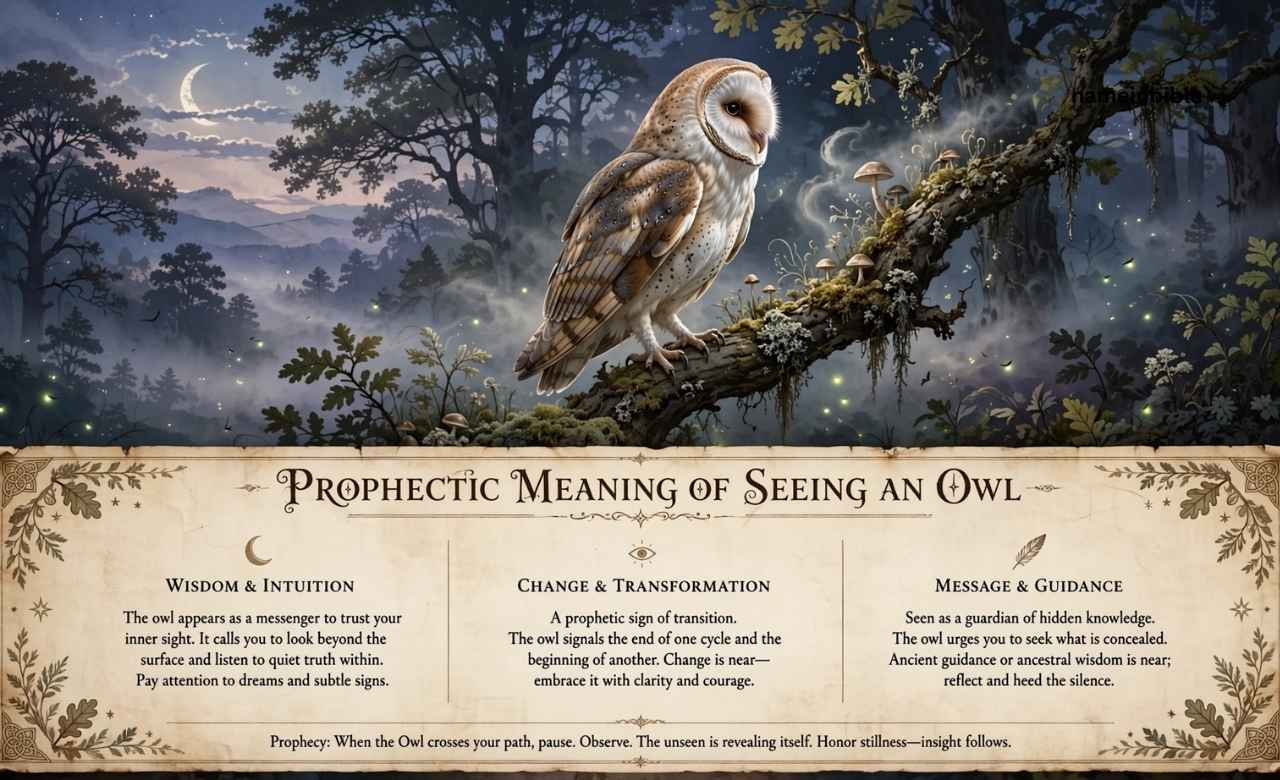
Many believers wonder: is an owl a sign from God, or does God use owls as signs today?
In many ancient and modern folk traditions, seeing an owl is viewed as a highly negative omen a harbinger of impending death, bad luck, or physical illness. Conversely, in New Age spirituality, seeing an owl is often celebrated as a sign of psychic intuition or hidden knowledge.
But when we search the scriptures, we find a much more grounded perspective. The Bible does not support the idea that seeing a physical owl is an automatic omen of bad luck or physical death. God is the sovereign Creator of the universe; animals do not possess independent magical powers to bring about good or bad fortune.
If you happen to see an owl perched on a branch Owl Meaning in the Bible at dusk, there is no need to fear a curse. The biblical interpretation of owl sightings is focused on self-reflection. Instead of looking at the owl as a superstition, we can view it as a prompt for spiritual reflection:
- A Call to Examine the Heart: Seeing a creature of the dark can remind us to step out of any lingering spiritual darkness and walk fully in God’s light (John 8:12).
- A Reminder of a Quiet Season: It may symbolize that you are currently in a quiet, hidden season of preparation, where God is calling you to deep prayer and study rather than public activity.
- A Prompt to Watch and Pray: Just as the owl sits silently, watchful and alert, it reminds us of Christ’s command to “watch and pray” so that we do not fall into temptation (Mark 14:38).
Biblical Meaning of an Owl Hooting at Night
The sound of an owl hooting in the dead of night can feel incredibly eerie, especially when you are alone. Culturally, many Owl Meaning in the Bible people search for the biblical meaning of hearing an owl or ask: what does hearing an owl at night mean spiritually?
In Scripture, the nighttime is often symbolic of seasons of trial, testing, and spiritual warfare. When we hear the distant cry of an owl in the dark, it can serve as a spiritual metaphor for a cry in the wilderness.
                  THE HOOT OF THE OWL IN THE NIGHT
                               │
            ┌──────────────────┴──────────────────┐
            ▼                                     ▼
     A Reminder of the                     An Invitation to
      Broken Wilderness                     Watch and Pray
(Grief, Isolation, Ruined Places)     (Spiritual Alertness, Faith)
Instead of interpreting the hooting as an ominous warning of doom, a mature Christian can see it as an invitation to spiritual awareness:
- A Cry in the Dark: It represents the cry of those who are currently experiencing loneliness and suffering. It should prompt us to pray for those in our communities who are carrying silent, heavy burdens.
- Maintaining Spiritual Vigilance: The owl’s voice reminds us that even when the world around us is spiritually asleep, we must remain alert, keeping our lamps filled with oil, ready for the return of our Lord.
- An Assurance of God’s Presence: No matter how dark the night gets, the owl’s ability to navigate the darkness reminds us that God’s eyes see perfectly in the dark. As the Psalmist wrote, “Even the darkness is not dark to You, and the night is as bright as the day” (Psalm 139:12).
White Owl Meaning in the Bible: Does Scripture Support It?
The white owl, most notably the Barn Owl (Tyto alba), is one of the most stunning creatures in the natural world. With its heart-shaped white face and ghostly, silent flight, it is a breathtaking sight. This leads many to ask: what is the white owl meaning in the Bible?
Strictly speaking, the Bible does not make a specific distinction between brown owls and white owls; they are all grouped Owl Meaning in the Bible under the general categories of unclean birds in Leviticus and Deuteronomy. However, if we look at the natural traits of a white owl through the lens of broader Christian symbolism, we can draw some beautiful connections:
- Beauty in the Ruins: The barn owl is famous for nesting in abandoned barns, church belfries, and historical ruins. The sight of a pure white bird living inside a dusty, broken place is a stunning physical picture of God’s grace entering into our brokenness to bring beauty out of ashes.
- Purity and Holiness: White is the biblical color of righteousness, purification, and the redeeming work of Jesus. A white owl navigating the dark night can symbolize a believer who, by the power of the Holy Spirit, walks in purity and holiness despite living in a morally dark world.
- The Transition from Night to Dawn: White reflects light. Seeing a white owl can be a gentle reminder of the promise found in Psalm 30:5: “Weeping may endure for a night, but joy cometh in the morning.” It points forward to the ultimate victory of light over darkness.
Are Owls Evil in the Bible? Separating Myths from Biblical Facts
Because owls are listed as unclean, inhabit ruined places, and are active at night, some people mistakenly conclude that owls are inherently evil, demonic, or satanic in the eyes of Scripture.
Let’s set the record straight: Owls are not evil.
To understand this clearly, we must separate ancient superstitions from actual biblical theology. Here is a direct comparison of common myths versus the actual truths of Scripture:
- Myth: Owls are demonic spirits or bad omens that carry curses.
- Biblical Fact: Owls are physical, biological creatures created by God on the fifth day of creation (Genesis 1:20-23). God looked at everything He had made, including the birds of the air, and declared it “very good.”
- Myth: Being “unclean” means the animal is morally corrupt or wicked.
- Biblical Fact: The Old Testament clean and unclean laws were about ritual purity and food safety, not moral status. An animal cannot commit sin. An owl is simply living out its God-given design as a nocturnal predator.
- Myth: The owl is a symbol of Satan.
- Biblical Fact: While 1 Peter 5:8 compares the devil to a roaring lion looking for someone to devour, Scripture never equates the owl with Satan. The owl’s association with ruined places is a consequence of human sin and judgment, not a sign of the bird itself being evil.
By understanding these facts, we can appreciate the owl as a beautiful, intricate part of God’s diverse creation while still respecting the symbolic lessons its lifestyle teaches us.
Owls and Jesus: Is There Any Biblical Connection?
While Jesus Christ never explicitly mentions owls during His earthly ministry recorded in the Gospels, there is a powerful Owl Meaning in the Bible thematic connection between the symbolic role of the owl and the redemptive mission of Jesus.
Consider the places where the owl dwells: desolation, isolation, and ruined places. Now, consider where Jesus went to rescue us: He entered directly into our spiritual desolation.
In John 8:12, Jesus declared:
“I am the light of the world: he that followeth me shall not walk in darkness, but shall have the light of life.”
The owl’s natural environment is the dark, but Jesus came to shatter that darkness. On the cross, Jesus took upon Himself the ultimate “desolation” and separation from God that our sins deserved, so that we would never have to live in spiritual isolation.
Furthermore, the Psalmist’s cry in Psalm 102:6 (“I am like an owl of the desert”) points prophetically to the intense loneliness Jesus experienced in the Garden of Gethsemane and on the cross, where His closest friends abandoned Him, and He cried out in deep agony. Because Jesus became the ultimate “lonely bird on the roof” for us, we are promised that He will never leave us nor forsake us (Hebrews 13:5).
Owl Meaning in Dreams According to the Bible
Dreaming of animals is a frequent occurrence, and many believers look to biblical dream interpretation to understand if God is speaking to them through their night parables. Throughout the Bible, God frequently used dreams to communicate Owl Meaning in the Bible warnings, instructions, and prophetic insights to His people.
If you are trying to understand the owl dream biblical meaning or looking for an owl dream interpretation biblical framework, it is helpful to look at the specific action or context of the owl in your dream.
Dreaming of a White Owl
A white owl in a dream is generally a highly encouraging symbol. Because white represents purity, righteousness, and the presence of the Holy Spirit, dreaming of a white owl often points to divine guidance and wisdom from God in the midst of a difficult, confusing, or dark situation. It indicates that God is giving you the spiritual eyes to navigate a complex trial with grace, integrity, and peace.
Dreaming of an Owl Watching You
If you dream of an owl silently watching you with its large, unblinking eyes, it can be a symbolic representation of your own spiritual awareness or a prompt from the Holy Spirit to examine your heart. It may suggest that there are hidden things in your life fears, unconfessed sins, or difficult Owl Meaning in the Bible decisions that you need to bring into the light of God’s presence for healing and resolution. It is a call to live with absolute transparency before God.
Dreaming of an Owl Attacking You
A dream where an owl attacks you can feel terrifying, but biblically, it often represents a struggle with hidden fears, anxiety, or spiritual warfare. It may indicate that you are feeling overwhelmed by a sudden trial, or that the enemy is trying to exploit your vulnerabilities during a dark season of your life. This dream is a strong prompt to put on the full armor of God, stand firm in your faith, and seek spiritual protection through passionate prayer and scripture study.
Hearing an Owl in a Dream
Hearing the hoot of an owl in a dream, even if you cannot see the bird, often represents a quiet spiritual warning or a call to pay closer attention to your spiritual surroundings. It is a whisper to “watch and pray,” encouraging you to tune out the loud, distracting noises Owl Meaning in the Bible of the world so that you can clearly hear the still, small voice of God guiding your steps.
Owl Meaning in the Bible (Catholic, Protestant, and Jewish Perspectives)
Because the Bible has been studied and translated across various traditions for thousands of years, different branches of faith have developed unique nuances when interpreting owl symbolism:
The Jewish Perspective (Tanakh & Talmud)
In classical Jewish thought, the owl is deeply tied to the Hebrew concept of Churba (ruin). The Talmud discusses the unclean birds of Leviticus, focusing heavily on their dietary habits and nesting locations. For Jewish scholars, the owl is a literal and symbolic representation of exile (Galut). Just as the owl lives away from human communities in barren lands, the Jewish people experienced long seasons of wandering and exile, longing for the restoration of Jerusalem and the Temple.
The Catholic Perspective
In historic Catholic art and Christian iconography, the owl has a fascinating, dualistic history. During the Middle Ages, Catholic artists sometimes used the owl to represent the devil or those who actively reject the light of Christ, choosing instead to dwell in the darkness of sin.
However, in other monastic traditions, the quiet, solitary, and night-vigilant nature of the owl was reinterpreted positively. Monks who spent their entire nights in silent prayer, contemplation, and copying scripture saw the owl as a symbol of the contemplative life, quiet study, and the devotion of those who seek God in solitude.
The Protestant Perspective
Protestant commentators generally take a highly expository, text-focused approach to owl symbolism. Rather than relying on historical art or external allegories, Protestant theology emphasizes the literal context of the verses in Isaiah, Psalms, and Leviticus. The owl is viewed primarily as a symbol of the devastating consequences of sin and the reality of God’s holy judgment, pointing believers back to the absolute necessity of salvation, repentance, and finding our ultimate comfort and community in the local body of Christ rather than remaining in isolated wildernesses.
Common Misunderstandings About Owl Symbolism in Christianity
Because of the overlap between secular culture, ancient mythology, and Christian tradition, several major misunderstandings have crept into modern churches regarding owls. Let’s address and clear up these misconceptions:
- “Owls bring bad luck to a home.”This is a pagan superstition, not a biblical truth. As Christians, our lives are held securely in the hands of God. A bird nesting near your house has no power to alter God’s plans for your life, your family, or your home.
- “If I dream of an owl, someone I know is going to die.”In scripture, dreams about birds are symbolic of spiritual states, messages, or environments they are almost never literal predictions of physical death. Do not let fear rob you of God’s peace.
- “Using owl decor in my house is spiritually dangerous.”Some over-cautious believers worry that having an owl figurine or painting in their home invites demonic influence. An owl is simply a beautiful part of God’s creation. Unless an Owl Meaning in the Bible object is actively being used for pagan worship or occult practices, a decorative owl is completely harmless. We can enjoy the aesthetic beauty of God’s wildlife without fear.
Spiritual Lessons Christians Can Learn from Owls
Even though the Bible primarily uses the owl to illustrate desolation and isolation, God’s incredible design of this bird still offers powerful spiritual lessons for our daily Christian life:
- 1. Navigating Our Quiet Seasons: Just as the owl is designed to survive and thrive in the quietest, darkest hours of the night, we must learn to trust God when we are placed in a quiet season of life. When you feel hidden, unseen, or isolated, remember that God is still forming, shaping, and preparing you for what lies ahead.
- 2. Silent Action: Owls are famous for their silent flight; their feathers are specially designed to muffle the sound of their wings so they can glide completely undetected. This teaches us the value of quiet obedience. We don’t always need to make a loud noise or seek human applause for our good deeds; we can serve God silently, faithfully, and effectively.
- 3. Developing Spiritual Eyes: An owl’s eyes are incredibly sensitive, allowing it to see clearly in conditions where humans are completely blind. As believers, we need to ask God for spiritual eyes. We must look past the physical surface of our trials and see the spiritual opportunities for growth, ministry, and faith that lie underneath.
- 4. Finding Comfort in the Wilderness: If you currently feel like the “owl of the desert” in Psalm 102 struggling with deep loneliness or living in the ruins of a difficult situation take heart. God is the expert at rebuilding ruined places. He does not abandon us in our deserts; He meets us there, offering His supernatural comfort, His redeeming grace, and the hope of a brand new dawn.
Frequently Asked Questions
What does an owl symbolize biblically?
In the Bible, an owl most often symbolizes desolation, isolation, spiritual darkness, and God’s judgment rather than wisdom. The owl meaning in the Bible is closely connected to abandoned places and serves as a reminder to seek God’s light through faith, prayer, and repentance.
What sin do owls represent?
The Bible does not teach that owls represent one specific sin. Instead, they are often associated with the consequences of spiritual blindness, rebellion against God, and the need for repentance, especially in prophetic passages describing judgment.
Are owls messengers of God?
Scripture never identifies owls as direct messengers of God like angels or prophets. While God can use any part of His creation to draw people toward spiritual reflection, Christians should rely on the Holy Bible rather than viewing owls as supernatural messengers.
Final Thoughts:
Ultimately, the story of the owl in Scripture is a journey from the shadows into the light. While these beautiful, mysterious birds serve as solemn reminders of the reality of spiritual desolation, isolation, and the consequences of turning away from God, they also point us forward to our desperate need for a Savior.
We do not have to live as creatures of the night, hiding our hearts in the shadows of shame or fear. Through the finished work of Jesus Christ on the cross, we have been fully redeemed, rescued from the desert ruins of our past, and called to walk as children of the day.
The next time you hear the quiet hoot of an owl under a starry sky, let it be a reminder to thank God for His incredible creation, to step fully into His life-giving light, and to rest securely in the promise that His love is bright enough to shatter even the darkest night.May you like other article 111 Meaning in the Bible: Biblical Meaning, Spiritual Symbolism & God’s Message

Welcome to NameInBible. I am Victoria, a Christian writer passionate about exploring biblical name meanings, Scripture-based insights, and powerful prayers. My goal is to help readers discover the spiritual significance of names and grow closer to God through faith-filled content.